AI Video Holi IPL Campaign Automation India 2026: The Enterprise Guide to Real-Time Engagement
Estimated reading time: ~14 minutes
Key Takeaways
- Move from manual production to a modular, automated Video-as-Code model to deliver at Holi and IPL speed.
- Use real-time triggers (toss, wickets, milestones) to ship relevant videos within a <120s SLA.
- Win with Indic-first, hyper-local personalization across languages, dialects, and regional offers.
- Enforce enterprise governance (ISO/SOC2, consent, watermarking) and multi-layered brand safety filters.
- Launch fast via a 14-day playbook and measure ROI on efficiency, engagement, and conversions.
The marketing landscape in India is undergoing a seismic shift as we approach the dual-peak season of 2026. With AI video Holi IPL campaign automation India 2026, brands are no longer just competing for eyeballs; they are competing for milliseconds of relevance in a hyper-fragmented digital ecosystem. As Holi falls on March 4, 2026, and the IPL season kicks off shortly after, the window for consumer attention is narrower—and more valuable—than ever before.
The urgency is backed by data. India’s AI market is projected to reach nearly ₹1.4 lakh crore by 2027, according to BCG via exchange4media. Furthermore, with India’s active internet user base expected to surpass 900 million in 2026, the demand for Indic-first, video-heavy content has reached a breaking point. For enterprise brands, the challenge is clear: how do you produce 10,000+ personalized, brand-safe, and culturally resonant videos in real-time?
1. The Operating Model of AI Video Campaign Automation
To win in 2026, marketing teams must move away from manual creative cycles. Traditional video production, which often takes weeks for a single 30-second spot, is fundamentally incompatible with the speed of a T20 match or a 24-hour festival window. Platforms like Studio by TrueFan AI enable enterprises to compress these cycles from weeks into minutes by leveraging a modular “Video-as-Code” approach.
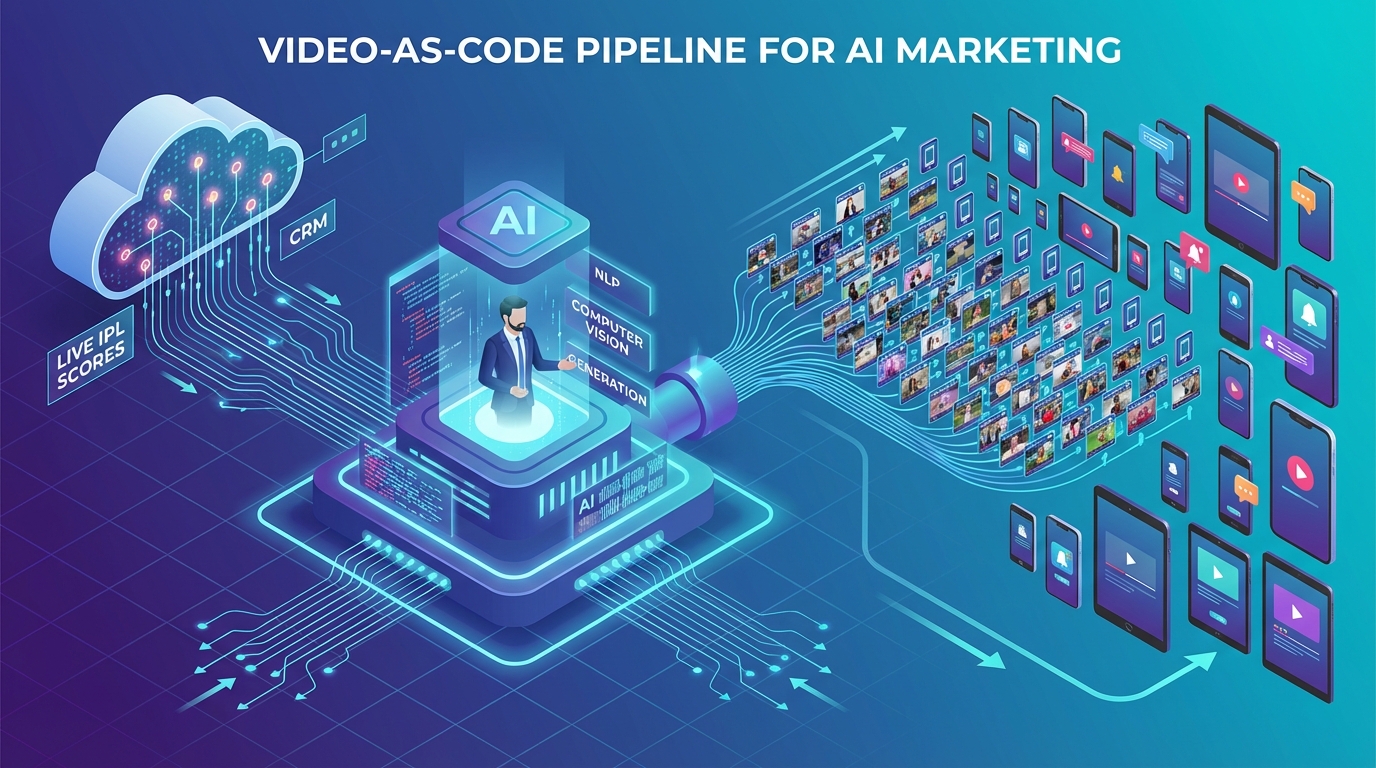
The Five Pillars of Automation
- The Template Layer: Instead of static files, brands develop “Liquid Templates.” These are pre-approved creative frameworks where elements like background colors, text overlays, product images, and even the AI avatar’s script are dynamic variables.
- The Data Layer: This is the engine room. It pulls from CRM data (customer names, preferred languages), live score APIs (IPL wickets, runs, toss results), and catalog feeds (real-time pricing or stock levels).
- The Trigger Layer: Automation requires a “When-This-Then-That” logic. For example, When a wicket falls in the 15th over, Then trigger a 15-second “Celebrate with 15% Off” video to all users in the winning team’s home city.
- The Rendering Layer: In 2026, cloud-based rendering must be elastic. During an IPL final or the morning of Holi, demand spikes. Enterprise systems must handle 1,000+ concurrent renders without latency. Learn more in the fastest avatar video generator guide.
- The Governance Layer: Brand safety is non-negotiable. Every automated output must pass through real-time profanity filters, brand-color compliance checks, and legal disclaimer overlays before it hits a consumer’s screen.
By integrating these layers, brands can transition from “Broadcasting” to “Precision Interaction.” This isn't just about volume; it's about the psychological impact of a user receiving a Holi greeting that mentions their name, their city, and their favorite IPL team—all in their native tongue. Explore how this is powered by AI voice cloning for Indian accents.
Source: Ipsos Report on Digital Marketing in India 2025-2026
2. The Holi Sprint: Bulk Localization and Cultural Relevance
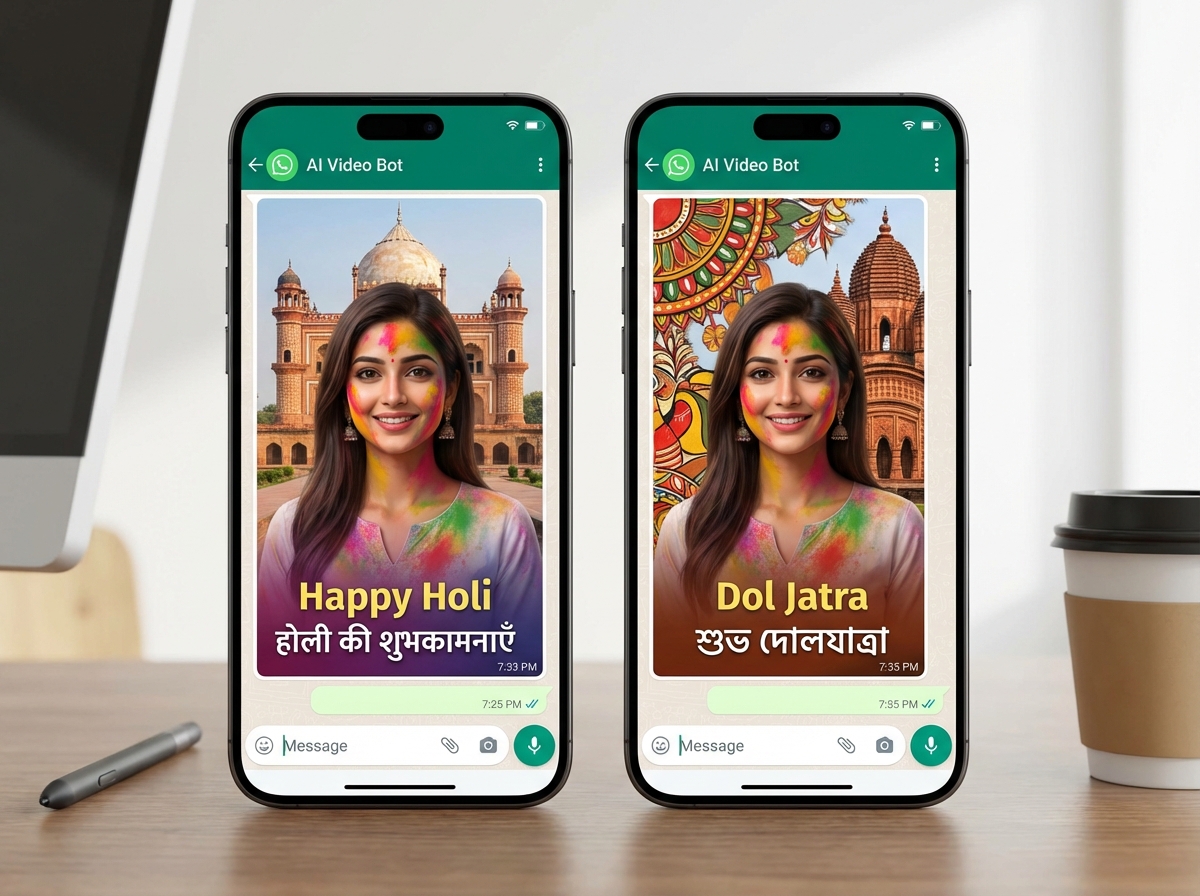
Holi 2026 (March 4) represents the first major festive spending spike of the year. For D2C and FMCG brands, the goal is “Holi greeting videos bulk AI creator” capabilities that go beyond a generic “Happy Holi” message. The 2026 consumer expects cultural nuance. A greeting sent to a user in Lucknow should feel different—in dialect, visual motifs, and offer—than one sent to a user in Chennai.
Workflow for a Localized Holi Campaign
To execute this at scale, the workflow follows a strict automation path:
- Input Assets: Brands upload a “Festive Pack” containing 3D gulal animations, regional music beds, and high-resolution product renders.
- Dynamic Scripting: Using AI, the system generates scripts in Hindi, Tamil, Telugu, Marathi, and Bengali. These aren't just translations; they are transcreations that use local idioms.
- Avatar Integration: A photorealistic AI avatar acts as the brand ambassador. Studio by TrueFan AI's 175+ language support and AI avatars ensure that the lip-sync is perfect across every dialect, eliminating the “uncanny valley” effect that plagues cheaper AI tools. See more on real-time interactive AI avatars in India.
- Distribution via WhatsApp: With over 820 million active internet users in India, WhatsApp remains the primary delivery vehicle. Automated webhooks send these personalized videos directly to the user's chat, resulting in open rates that dwarf traditional email or SMS. Follow this WhatsApp video commerce integration setup.
Filling the Content Gap: Hyper-Local Dialect Nuance
Most competitors focus on “Standard Hindi.” However, data from IAMAI/ET GovTech shows that Indic content growth is driven by Tier 2 and Tier 3 cities. Superior automation in 2026 includes “Dialect Mapping,” where the AI adjusts the tone and vocabulary based on the user's specific pincode, ensuring the brand sounds like a local friend rather than a distant corporation.
Source: Indian Express Holi 2026 Dates
3. The IPL Engine: Real-Time Match-Day Triggers
If Holi is a sprint, the IPL is a marathon. Spanning from February to May 2026, the T20 cricket season video marketing strategy requires a “Live Engine” approach. Brands like Dream11, which spend upwards of ₹1,200 crore during this period, have set a high bar for engagement. To compete, mid-market and enterprise brands must use “IPL video marketing automation real-time” to stay relevant during the 4-hour match window.
Real-Time Use Cases
- The Toss Trigger: Within 60 seconds of the toss, a video is generated featuring an avatar discussing the decision (Bat/Bowl) and offering a “Toss Special” discount valid only until the first ball is bowled.
- The Milestone Moment: When a popular player hits a 50 or 100, the system auto-generates a “Celebration Reel” with the user's name on a virtual jersey, encouraging them to share the milestone on Instagram Stories.
- The Fantasy Pivot: For gaming brands, Dream11 video marketing AI campaigns involve sending personalized “Lineup Reminders” that show the user's current fantasy points vs. their friends, using dynamic video leaderboards.
Technical Blueprint for Match-Day Latency
The biggest hurdle in IPL automation is latency. A video delivered 10 minutes after a wicket is “old news.” The 2026 standard is a <120 second “Event-to-Inbox” SLA. This requires a direct pipeline between live sports data providers (like Opta or Sportradar) and the AI video rendering farm. The system must pre-render the “base” of the video and only “stitch” the dynamic data (the specific score or player name) at the last millisecond to save time.
Source: ETBrandEquity on IPL Sponsorship Spends
4. Cricket-First Personalization: Fans, Segments, and Sponsors
In India, cricket is a religion, and personalization is the prayer. “Personalized fan videos cricket AI scale” is the strategy of treating every fan like a VIP. This involves more than just putting a name in a text box; it involves “Visual Contextualization.”
Variables for Deep Personalization
- Team Affinity: The entire color palette of the video (UI, background, avatar clothing) changes based on the user's supported team (e.g., Yellow for CSK, Blue for MI).
- Geo-Fencing: If a user is detected near a stadium in Bengaluru, the video includes a “Visit our Booth at Gate 4” CTA.
- Sponsor Entitlements: For multi-sponsor campaigns, the AI dynamically swaps the “Presented By” logo based on the region. A user in Delhi might see a different co-brand than a user in Mumbai, maximizing the ROI for regional sponsors.
Filling the Content Gap: The “Momentary” Story
While most brands focus on “Post-Match Highlights,” the 2026 gap is in “In-Match Moments.” This includes automated 10-second “Reaction Videos” that can be used as WhatsApp Statuses or Reels. By providing fans with the tools to express their real-time emotions through brand-sponsored AI video, companies turn their audience into a decentralized marketing force.
Source: Nielsen Sports Marketing Strategy 2026
5. Enterprise Governance: Safety, Scale, and Compliance
As AI video becomes the primary communication tool, the risks of “Deepfake” misuse or brand dilution increase. Enterprise-grade AI video Holi IPL campaign automation India 2026 must be built on a foundation of “Responsible AI.”
Security and Compliance Standards
- ISO 27001 & SOC 2: These are no longer “nice-to-haves.” Any platform handling millions of customer PII (Personally Identifiable Information) data points must meet global security benchmarks.
- Content Traceability: Every video generated should have a digital fingerprint or invisible watermark. This allows brands to track the origin of a video if it goes viral or is used in an unauthorized context.
- Consent-First Architecture: In compliance with India’s Digital Personal Data Protection (DPDP) Act, automation workflows must include a “Consent Check” step. The system should only generate a personalized video if the user has an active opt-in record in the CRM.
Brand Safety Filters
During the high-emotion environment of an IPL match, users might attempt to “game” the system by inputting offensive names or scripts for the AI avatar to say. Solutions like Studio by TrueFan AI demonstrate ROI through their robust, multi-layered moderation APIs that catch 99.9% of “jailbreak” attempts in real-time, ensuring the brand's reputation remains untarnished even at massive scale.
Source: PwC 2026 AI Business Predictions
6. The 14-Day Launch Playbook and ROI Measurement
Launching a massive AI video campaign doesn't require a six-month lead time. In the 2026 market, agility is a competitive advantage. Here is the blueprint to go from zero to live for the Holi-IPL window.
The 14-Day Execution Roadmap
- Days 1-3 (Discovery & Data): Identify the core audience segments. Map your CRM fields to the video variables (Name, Team, Language).
- Days 4-7 (Creative & Template): Design the “Master Templates” for Holi and IPL. Record or select your AI avatars. Set up the logic for regional language festival videos (Hindi, Tamil, Telugu).
- Days 8-10 (Integration & Testing): Connect your Live Score API and WhatsApp Business API. Run “Stress Tests” by simulating 5,000 renders in 10 minutes to ensure the pipeline doesn't break.
- Days 11-13 (Governance & Legal): Final sign-off on brand safety filters and legal disclaimers. Ensure all sponsor logos are correctly mapped to their respective regions.
- Day 14 (Go-Live): Launch the Holi “Teaser” campaign. Monitor real-time dashboards for CTR and VTR (View-Through Rate).
Measuring Success in 2026
- Efficiency Gain: How much did the “Cost Per Creative” drop compared to traditional video production? (Target: >80% reduction).
- Engagement Lift: What was the delta in CTR for a personalized video vs. a static image? (Target: 3x - 5x increase).
- Conversion Impact: Did the real-time match-day offers lead to a measurable spike in sales or app sessions? (Target: 20% uplift during match hours).
Source: Kantar Marketing Trends 2026
Summary of 2026 Market Data & Sources:
- AI Market Growth: India's GenAI economy is set to hit ₹1.4 lakh crore by 2027. Source: exchange4media/BCG
- Internet Scale: 900M+ users expected by 2026, with Indic content as the primary driver. Source: ET/IAMAI
- Ad Spend: Digital marketing spends in India are crossing the ₹1.11 lakh crore mark. Source: Ipsos
- Cricket Dominance: Top advertisers like Dream11 are spending ₹1,200–₹1,400 crore per season. Source: ETBrandEquity
- Holi 2026 Timing: Holi is confirmed for March 4, 2026. Source: Indian Express/Drikpanchang
Recommended Internal Links
Frequently Asked Questions
How does AI video automation handle the diversity of Indian languages during Holi?
In 2026, automation tools use “Neural Transcreation.” This means the AI doesn't just translate words; it understands the cultural context. For a Holi campaign, the AI will use different greetings like “Holi Hai” in the North and “Dol Jatra” references in West Bengal, ensuring the avatar's lip-sync and tone match the local dialect perfectly.
Can we use real IPL players or influencers in these automated videos?
Yes, through “Digital Twin” technology. Brands can license the likeness of a player or influencer, create an AI avatar of them, and then use automation to have that player “personally” greet thousands of fans by name. This creates a massive “Wow” factor while staying 100% legally compliant. Learn more about real-time interactive AI avatars in India.
What happens if the live score API fails during a crucial IPL match?
Superior systems use “Fallback Logic.” If the real-time data stream is interrupted, the automation engine automatically switches to “Evergreen” templates—such as general team support videos or generic festive greetings—ensuring that the user never receives a broken or outdated piece of content.
Is it possible to integrate these videos with our existing WhatsApp Business account?
Absolutely. Most enterprise AI video platforms offer direct API integration. When a trigger event occurs (like a customer making a purchase or a wicket falling), the system generates the video and pushes it through your official WhatsApp Business API provider (WABA) as a template message. See the WhatsApp video commerce integration setup guide.
How do we ensure the AI doesn't generate “hallucinated” or off-brand content?
This is managed through “Constrained Generation.” Unlike open-ended AI, campaign automation uses “Walled Garden” templates. The AI is only allowed to change specific variables (like the name or the offer) within a pre-approved script structure. Studio by TrueFan AI provides an additional layer of real-time moderation to ensure every single video stays within brand guidelines.
What is the typical render time for a personalized 15-second IPL video?
In 2026, the industry standard is under 30 seconds for a high-definition render. This speed is critical for “Moment Marketing,” where the relevance of the content expires the moment the next over begins or the next wicket falls. See performance insights in the fastest avatar video generator benchmarks.
How do we track the ROI of these personalized video campaigns?
Tracking is done via “Unique URL Attribution.” Each video sent to a user contains a personalized CTA link. When the user clicks the link to claim their Holi discount or IPL offer, the CRM tracks that specific video's contribution to the final sale, providing a clear line of sight from AI generation to revenue.