
Sustainable festival rewards 2026: Enterprise playbook for eco-friendly Holi marketing and green loyalty programs in India
Estimated reading time: ~12 minutes
Key Takeaways
- Shift from transactional points to values-based loyalty using a measurable Sustainability Score.
- Adopt green tier progression (Seed, Sapling, Banyan) tied to verified environmental impact, not just spend.
- Leverage carbon footprint gamification with impact points, streaks, and regional leaderboards for engagement.
- Scale trust with personalized environmental impact videos and transparent organic colors supply proof.
- Execute a disciplined T-21 to T+7 roadmap, ensure DPDP compliance, and prove ROI with unified KPIs.
Sustainable festival rewards (sustainable festival marketing 2026) are defined as measurable, gamified incentives that turn every Holi purchase into visible climate action—such as water saved, plastic avoided, or CO2 reduced—celebrated via personalized environmental impact videos and responsibly designed offers. In 2026, Indian enterprises are shifting from generic festive discounts to high-utility, eco-friendly Holi marketing strategies that align with the values of a climate-conscious middle class. This playbook outlines how to deploy green loyalty programs in India that drive conscious consumer retention while meeting stringent ESG (Environmental, Social, and Governance) mandates.
1. The 2026 Imperative: Why Eco-Friendly Holi Marketing is a Loyalty Requirement
The Indian consumer landscape in 2026 is defined by a radical shift in Gen Z and Millennial expectations. According to the Deloitte India 2025 Gen Z & Millennial Survey, over 65% of young Indian consumers now prioritize brands that demonstrate authentic sustainability over those that merely make environmental claims. For these cohorts, Holi—a festival of renewal—is the ultimate litmus test for brand integrity. Enterprises that continue to push water-intensive activations or single-use plastic freebies risk significant brand erosion and “green-hushing” accusations.
Eco-friendly Holi marketing has evolved from a niche CSR activity into a core driver of conscious consumer retention. The 2026 market demands a transition from “transactional loyalty” (points for spend) to “values-based loyalty” (rewards for impact). By integrating climate action campaigns into the festive lifecycle, brands can achieve a 15–20% uplift in repeat purchase rates among eco-conscious segments. This is particularly critical during Holi, where the cultural emphasis on “safe” and “organic” provides a natural entry point for sustainability score marketing.
Furthermore, India’s policy momentum, highlighted during the PIB India-AI Impact Summit 2026, emphasizes the role of responsible AI in personalizing consumer journeys while maintaining data sovereignty. Enterprises are now expected to provide transparent, verifiable proof of their environmental impact. This means moving beyond vague “save water” slogans toward precise metrics: liters of water conserved per transaction, grams of heavy metals avoided through organic colors marketing campaigns, and the total carbon footprint reduction achieved through circular economy rewards.
Sources:
- Deloitte India: 2025 Gen Z & Millennial Survey
- PIB: India-AI Impact Summit 2026
- Social Samosa: 2025 Trends Report
2. Blueprint for Green Loyalty Programs India: Structure and Mechanics
Building effective green loyalty programs in India requires a departure from traditional tiering logic. In 2026, the most successful enterprise programs utilize green tier progression, where a customer’s status is determined by their “Sustainability Score” rather than their total spend. This score is a composite metric reflecting responsible consumption rewards earned through actions like choosing plastic-free festival offers, opting for low-carbon delivery slots, or participating in zero-waste challenges.
Core Pillars of the Green Loyalty Framework:
- Responsible Consumption Rewards: Customers earn points for purchasing eco-certified products, such as plant-based pigments or water-efficient cleaning kits. These points are higher-weighted than standard spend points to incentivize behavioral change.
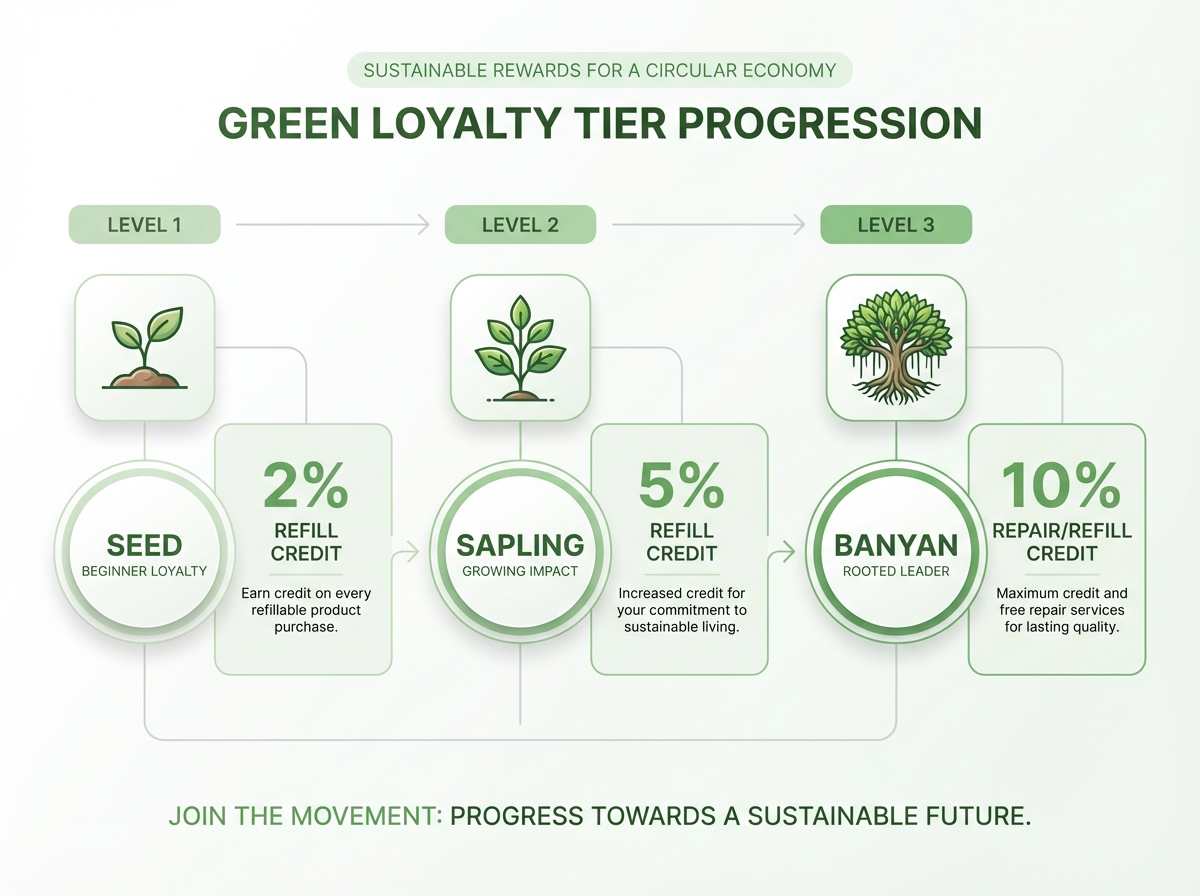
- Green Tier Progression: Tiers are structured to reflect cumulative environmental impact:
- Seed (0–199 Points): Entry-level access, featuring 2% refill credits and educational content on dry Holi celebrations.
- Sapling (200–499 Points): Mid-tier status, offering 5% refill credits and early access to exclusive plastic-free festival offers.
- Banyan (500+ Points): Elite status, providing 10% repair/refill credits, VIP access to climate action campaigns, and invitations to community clean-up drives.
- Circular Economy Rewards: Incentives for closing the loop, such as “return-to-earn” credits for packaging or vouchers for repair services that extend product lifecycles.
This structure ensures that the loyalty program serves as a continuous engagement engine. By rewarding the process of consumption—not just the final sale—enterprises can maintain a T-21 to T+7 engagement cadence that keeps the brand top-of-mind long after the Holi colors have faded. The integration of sustainability score marketing into the user dashboard allows customers to see their real-time contribution to national conservation goals, fostering a sense of collective achievement.
Sources:
- India CSR & Sustainability Forum: Sustainability Carnival 2026
- Global Sustainability Awards: Carbon Reduction Categories
3. Carbon Footprint Gamification: Turning Impact into Engagement
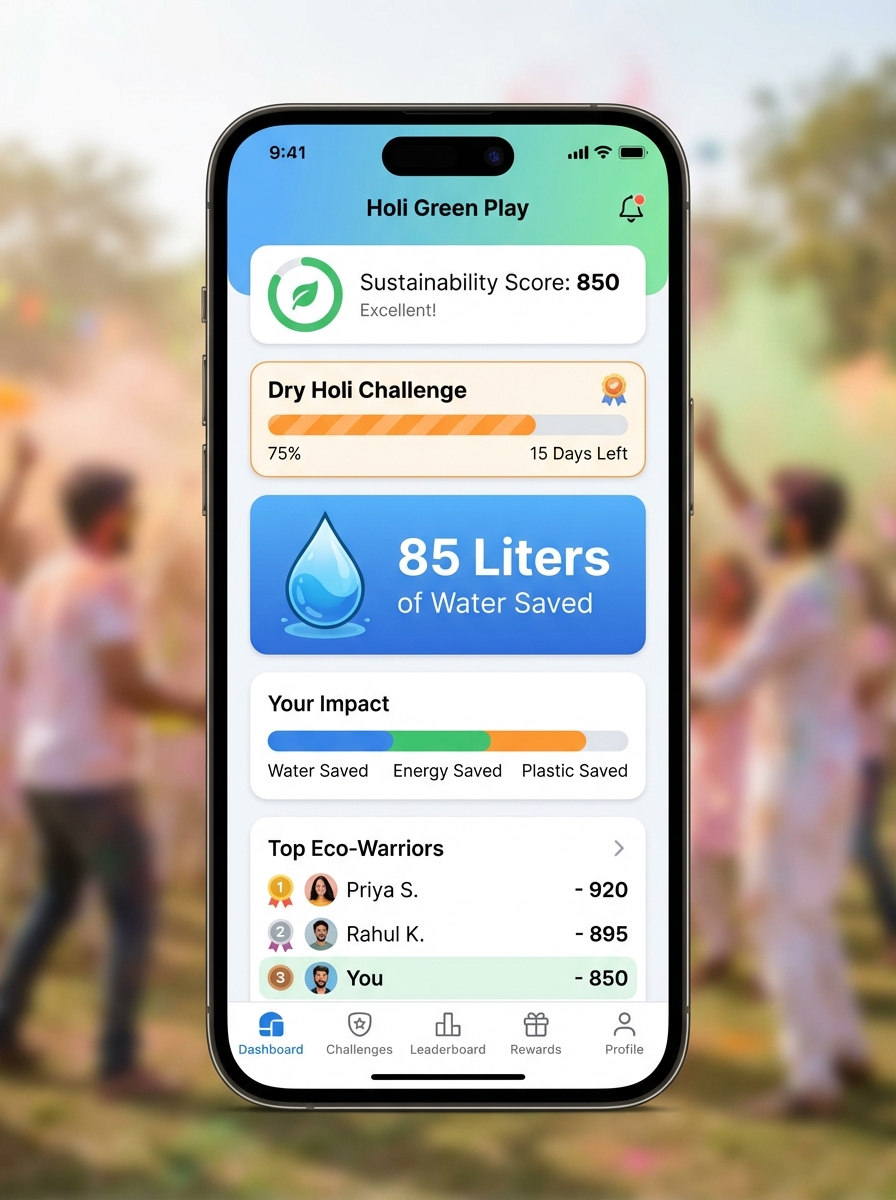
Carbon footprint gamification is the strategic application of game-design elements to environmental data, making the invisible impact of a Holi purchase visible and rewarding. In 2026, enterprises are using sophisticated actions-to-impact mapping to quantify the CO2e, water, and plastic savings of every customer interaction. For instance, choosing a “Dry Holi” bundle might be mapped to 85 liters of water saved, which is then converted into 85 “Impact Points” on the user’s leaderboard.
Key Gamification Mechanics for Holi 2026:
- Zero-Waste Challenges: Time-bound missions such as “Refill 3 times before Holi” or “Host a plastic-free party” drive high-frequency engagement. These challenges are often tied to social proof, where users can share their progress on WhatsApp to earn referral multipliers.
- Streaks and Leaderboards: Regional leaderboards (e.g., “Top 10 Eco-Warriors in Mumbai”) tap into local pride. Micro-habit streaks—rewarding users for 7, 21, or 42 days of sustainable choices—ensure that the loyalty program remains active outside of peak festival windows.
- Sustainability Score Marketing: This involves displaying a verified “Eco-Badge” on the user’s profile. The score is calculated using standardized factors (e.g., 1 kg CO2e avoided = 10 points) and is supported by transparent methodology notes to prevent greenwashing.
The effectiveness of carbon footprint gamification lies in its ability to provide immediate feedback. When a customer opts for organic colors marketing campaigns, they receive an instant notification detailing the heavy metals they’ve kept out of the water table. This real-time validation is essential for capturing the attention of Gen Z, who demand instant, data-backed gratification.
Sources:
4. Scaling Impact with Environmental Impact Videos and Organic Colors
To truly resonate in 2026, sustainability narratives must be personalized and visual. Platforms like TrueFan AI enable enterprises to bridge the gap between abstract climate goals and tangible customer experiences by generating environmental impact videos at scale. These videos serve as a “digital certificate” of the user’s Holi contributions, featuring personalized overlays that state: “Namaste [Name], your Holi choices avoided 1.8 kg of CO2e and saved 120 liters of water.”
The Role of Personalized Video in Holi Marketing:
TrueFan AI's 175+ language support and Personalised Celebrity Videos provide the necessary infrastructure to localize sustainability narratives across India’s diverse demographic landscape. During Holi, a brand can deploy thousands of unique video variants that reflect the user’s specific tier, city, and language preference (e.g., Hinglish for urban centers, regional dialects for Tier 2/3 cities). This level of hyper-personalization drives a 17% higher WhatsApp read rate compared to static images, as seen in recent enterprise benchmarks.
Executing Organic Colors Marketing Campaigns:
Organic colors marketing campaigns must go beyond “natural” labels. In 2026, “good” looks like providing third-party lab reports and artisan spotlights within the video journey. Brands should unbox plastic-free festival offers—such as refillable gulaal tins and cloth bags—to demonstrate a commitment to the circular economy. By showing the face of the artisan who created the natural pigments, enterprises build a bridge of trust that justifies the premium price point of eco-friendly products.
The integration of video into the zero-waste challenges lifecycle is particularly potent. A “Thank You” video triggered immediately after a customer returns their packaging not only reinforces the behavior but also provides a shareable asset that acts as organic eco-friendly Holi marketing for the brand.
Sources:
- TrueFan AI: Holi 2026 Campaign Guide
- Goldmedal: “Save Water Holi” News & Media
- TrueFan AI: Video Personalization at Scale
5. Operationalizing Circular Economy Rewards and Data Compliance
Transitioning to a circular economy rewards model requires robust reverse logistics and a data-driven approach to customer behavior. Instead of one-time merchandise, enterprises in 2026 are offering durable, repairable, and refillable alternatives. For example, a “Plastic-Free Holi Kit” might include a high-grade steel water bottle and a QR code that tracks the number of times it has been refilled, adding to the user’s sustainability score.
Data Schema for Green Loyalty Programs:
To operationalize this at scale, the CRM must track specific eco-attributes:
- Action_Type: (e.g., Refill, Return, Organic Purchase)
- Impact_Factors: (CO2e, water, plastic avoided per SKU)
- Tier_Status: (Seed, Sapling, Banyan)
- Consent_Flag: (DPDP-aligned opt-in for personalized video)
Responsible consumption rewards must be delivered in compliance with India’s Digital Personal Data Protection (DPDP) Act (interactive video data capture and consent). This means ensuring purpose limitation and data minimization in every WhatsApp journey. Enterprises must be transparent about how impact scores are calculated, providing links to methodology notes and supplier certifications. Solutions like TrueFan AI demonstrate ROI through increased watch-through rates and higher conversion on eco-friendly product lines while maintaining a SOC 2 and ISO 27001 security posture, ensuring that customer data is handled with enterprise-grade governance.
By incentivizing the return of packaging through circular economy rewards (e.g., “Return 5 packs, get a 10% discount on your next organic color purchase”), brands can reduce their own scope 3 emissions while building a loyal community of “prosumers” who are actively invested in the brand’s sustainability journey.
Sources:
6. Enterprise Execution Timeline: T-21 to T+7 for Holi 2026
A successful sustainable festival rewards program requires a disciplined execution timeline that builds momentum before the festival and sustains it afterward. See the Holi marketing campaigns in India 2026 roadmap.
The Holi 2026 Roadmap:
- T-21 to T-14 (Preparation): Finalize impact factors for all SKUs. Curate organic colors suppliers and secure third-party certifications. Build video templates with dynamic overlays for CO2e and water savings. Seed creator collaborations in vernacular languages.
- T-13 to T-7 (Launch): Activate pre-commit rewards (e.g., “Pledge a Dry Holi”). Distribute plastic-free festival offers and kits. Publish teaser environmental impact videos to build anticipation. Open the first wave of zero-waste challenges.
- T-6 to T-1 (Scaling): Scale paid and creator distribution. Activate regional language variants for all communications. Set up on-ground QR kiosks at retail points for easy refill/return tracking.
- Holi (T0): Deploy real-time “Thank You” videos. Update leaderboards hourly to reflect national impact tallies. Trigger surprise tier upgrades for top contributors.
- T+1 to T+7 (Retention): Send personalized impact recap videos. Award digital certificates and “Eco-Warrior” badges. Launch a survey to measure perceived authenticity. Announce community grants funded by the program’s savings.
This timeline ensures that the brand is not just “selling” during Holi but is actively participating in the festival's cultural and environmental renewal. The post-festival phase (T+1 to T+7) is particularly crucial for conscious consumer retention, as it reinforces the value of the customer’s choices and sets the stage for the next sustainable festival rewards cycle.
Sources:
7. Measurement and ROI: Proving the Value of Sustainability
The success of green loyalty programs in India is measured through a dual lens: commercial performance and environmental impact. In 2026, CSR and Marketing departments must collaborate to report on these KPIs to both the board and the consumer.
Key Performance Indicators (KPIs):
- Commercial ROI: Repeat purchase uplift in the “eco-cohort” vs. the control group. Increase in Average Order Value (AOV) for plastic-free festival offers. Long-term LTV (Lifetime Value) delta for users in the Banyan tier.
- Environmental Impact: Aggregated CO2e avoided across the campaign. Total liters of water saved (verified via “Dry Holi” pledges). Grams of plastic diverted from landfills through circular economy rewards.
- Engagement Metrics: Watch-through rates for environmental impact videos in live commerce. WhatsApp CTR for zero-waste challenges. Referral K-factor for eco-conscious Gen Z targeting.
By utilizing sustainability score marketing, enterprises can transform these metrics into a powerful brand narrative. Reporting these results through CSR-ready dashboards and submitting them for recognition at forums like the India CSR & Sustainability Carnival 2026 further solidifies the brand’s position as a leader in the green economy. Ultimately, sustainable festival rewards are about more than just one festival; they are about building a resilient, trust-based relationship with the next generation of Indian consumers.
Sources:
- Global Sustainability Awards: Impact Reporting Standards
- India CSR & Sustainability Forum: 2026 Awards
Recommended Internal Links
- Sustainable festival marketing 2026
- Interactive video data capture (DPDP-aligned)
- Live commerce for Holi marketing 2026
- Holi marketing campaigns in India 2026
- Quick commerce video personalization in India
- DPDP-compliant personalization strategies
Frequently Asked Questions
What are sustainable festival rewards?
Sustainable festival rewards are incentives—such as points, tiers, or exclusive offers—given to customers for making environmentally responsible choices during festivals. These include purchasing organic colors, opting for plastic-free packaging, or participating in water-conservation challenges.
How does carbon footprint gamification work for Holi?
It involves assigning environmental impact values (like CO2e or water saved) to specific actions. Users earn points based on these values, which are tracked on leaderboards and streaks, making the act of sustainable shopping a competitive and rewarding experience.
Why is green tier progression better than traditional loyalty tiers?
Green tier progression rewards the quality of consumption rather than just the quantity. By moving from “Seed” to “Banyan” based on a sustainability score, customers feel a sense of purpose and alignment with the brand’s ESG goals, leading to higher retention.
How can enterprises scale personalized environmental impact videos?
By leveraging automated engines like TrueFan AI, enterprises can generate thousands of personalized videos that detail a user's specific environmental contributions in their preferred language, delivering them directly via WhatsApp for maximum engagement.
What is sustainability score marketing?
Sustainability score marketing is the practice of quantifying and communicating a customer’s individual environmental impact as a verified score. This score is used in marketing materials, user dashboards, and social sharing to provide transparent proof of a brand’s sustainability claims.
How do circular economy rewards benefit Indian brands?
They reduce waste and lower scope 3 emissions by incentivizing customers to return packaging or choose refills. This not only meets regulatory requirements but also creates a “closed-loop” relationship with the customer, increasing the frequency of brand interactions.



