Realistic Indian Face AI Avatar 2026: India-First Comparison, Benchmarks, and How-To Guide
Estimated reading time: ~10 minutes
Key Takeaways
- Realism in Indian avatars requires phenotype fidelity, skin-tone accuracy, and Indian prosody—not just a darker skin tone.
- A localized benchmark suite across lighting, visemes, and latency exposes the uncanny valley and ensures performance in Indian contexts.
- Studio by TrueFan AI leads India-first enterprise use cases with DPDP alignment, WhatsApp distribution, and INR billing.
- DPDP compliance (consent, watermarking, data residency) is essential for BFSI, Healthcare, and public-sector deployments.
- A 2026-ready workflow—smart image sourcing, phenotype mapping, Indian-accent scripting, and QA—delivers higher ROI and authenticity.
The digital landscape in India has undergone a seismic shift as we move through 2026. For marketers, creators, and enterprises, the era of “generic” AI is over. If you are searching for a realistic Indian face AI avatar 2026, you likely already know that global tools often fall short when it comes to the nuances of the Indian phenotype, regional accents, and the specific lighting conditions of the subcontinent. This guide is the most practical comparison for anyone searching for a realistic Indian face AI avatar 2026 and trying to decide which AI avatar with Indian features India actually delivers.
In a market where India’s AI video sector is projected to hit $1.2 billion by the end of 2026, the stakes for authenticity have never been higher. Consumers are no longer satisfied with “Westernized” avatars speaking in robotic tones; they demand representation that looks, sounds, and feels like home.
1. The Anatomy of an Authentic Indian AI Avatar in 2026
What does “authentic” actually mean in the context of 2026 AI? It is no longer just about a brown-skinned character. It is about the intersection of phenotype fidelity, skin-tone accuracy, and linguistic prosody. Platforms like Studio by TrueFan AI enable brands to bridge this gap by focusing on India-specific datasets that avoid the “Western bias” common in early-generation AI tools.
Phenotype Fidelity: Beyond the Surface
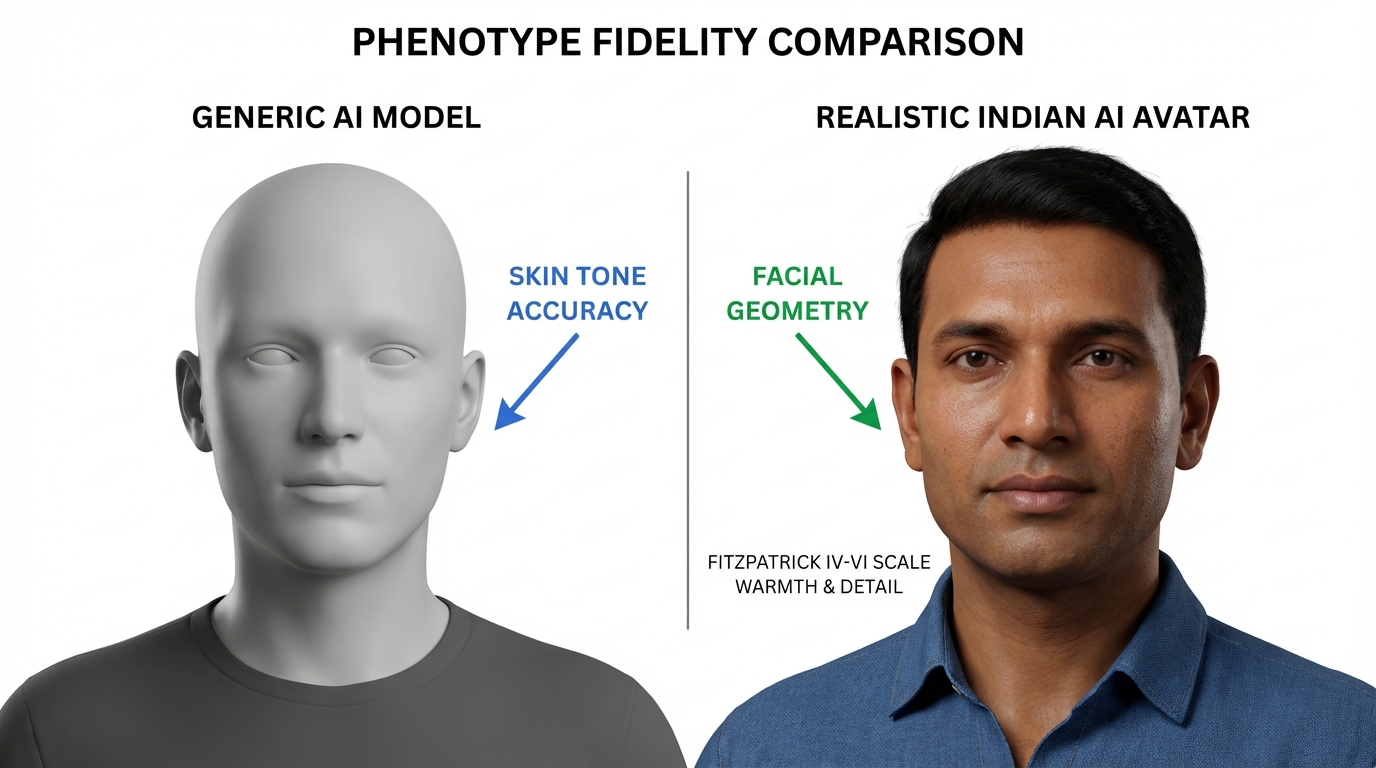
Authentic Indian phenotype rendering requires the AI to understand South Asian facial morphology. This includes specific eye shapes, nose structures, and jawline geometry that differ significantly from Caucasian or East Asian models. In 2026, high-fidelity tools must render hair textures—ranging from silky straight to dense curls—without the “plastic” sheen that plagued 2024 models.
Skin-Tone Fidelity and the Fitzpatrick Scale
One of the biggest content gaps in global AI tools is the failure to accurately render skin tones across the Fitzpatrick IV–VI scale (common in South Asia). Many tools produce a “grey cast” or over-smooth the skin, losing the natural warmth and texture. A realistic Indian face AI avatar must maintain color stability under varied lighting—whether it’s the harsh 5600K daylight of a Mumbai afternoon or the warm 3200K indoor lighting of a traditional Indian home.
The Linguistic Moat: Accents and Prosody
The launch of models like Sarvam AI’s Bulbul has proven that India’s voice-first moat is real. An authentic avatar in 2026 must handle:
- Neutral Indian English: The standard for corporate communications.
- Hinglish & Code-Switching: The natural way 70% of urban Indians communicate.
- Regional Phonemes: Correct handling of retroflex stops (/ʈ/) and Dravidian vowel lengths in Tamil, Telugu, and Kannada.
Source: Analytics India Magazine - India’s Voice-First Moat
2. The 2026 Benchmark Suite: How We Test for Realism
To provide a definitive comparison, we have developed a rigorous testing framework specifically for the Indian market. These benchmarks are designed to expose the “uncanny valley” effects that often occur when Western tools attempt to render South Asian features.
The Lighting & Tone Battery
We test avatars across three specific setups:
- High-Noon Daylight: Checking for highlight bloom on the forehead and nose.
- Warm Indoor (Tungsten): Ensuring the skin tone doesn't shift toward an unnatural orange or muddy brown.
- Mixed Source with Backlight: Testing the AI's ability to maintain edge definition around dark hair against a bright background.
Viseme and Lip-Sync Accuracy
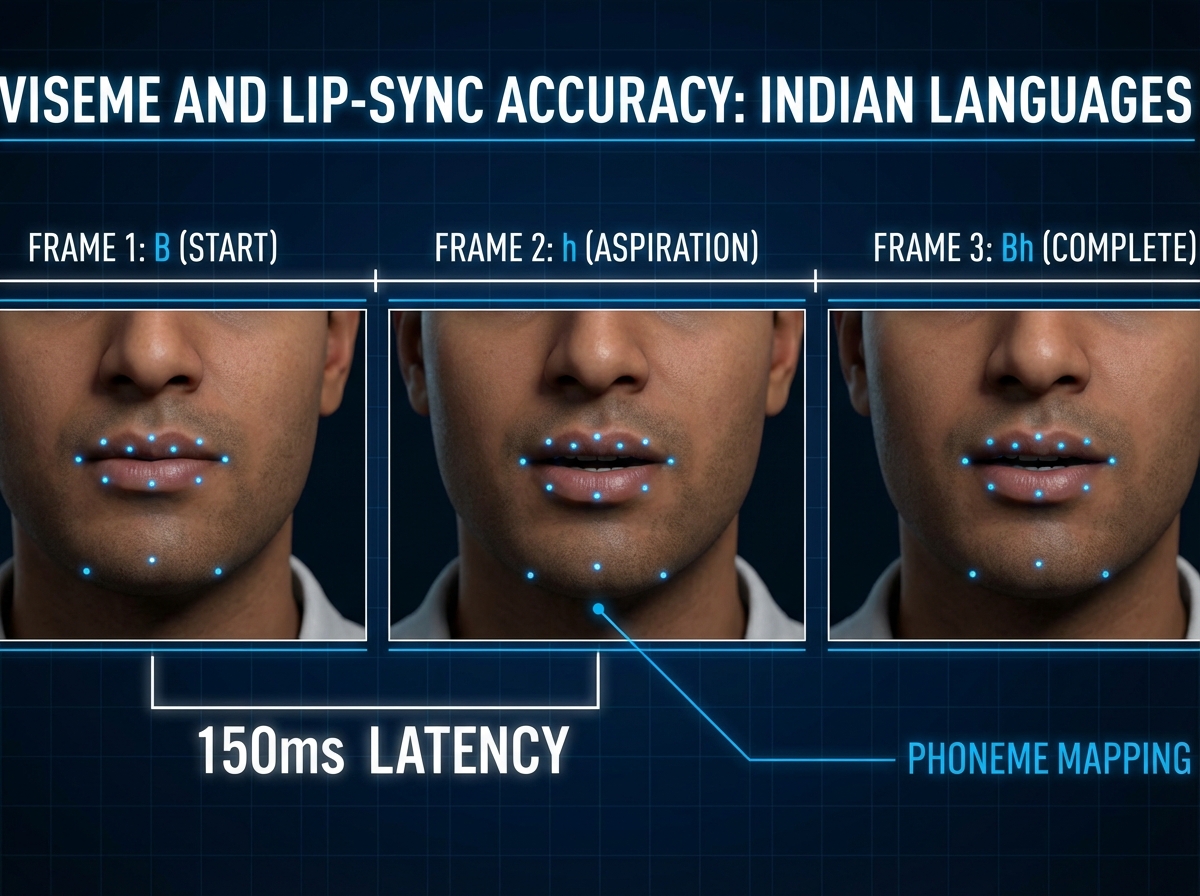
For a Hindi AI avatar realistic face, the lip-sync must be frame-perfect. We analyze visemes (the visual representation of phonemes) for specific Hindi sounds that do not exist in English. If the mouth movement doesn't match the aspirated “Bh” or the dental “Th” sounds, the illusion of reality is broken instantly. In 2026, the industry standard for latency in real-time avatars has dropped to under 150ms, making two-way conversations possible.
ROI and Engagement Metrics
Data from early 2026 shows that 78% of Indian consumers prefer vernacular AI avatars over neutral English ones. Furthermore, the average ROI for AI-driven WhatsApp video campaigns in India reached 4.5x this year. This is why choosing a tool that integrates with local distribution channels is critical. See our enterprise video analytics platform guide for details.
Source: TrueFan AI - Real-Time Avatars for 2026
3. Indian Avatar AI Tool Comparison 2026
When comparing an AI avatar vs Western tools Indian market, the differences often come down to localization and compliance. Below is a deep dive into the top contenders for 2026.
Studio by TrueFan AI (The India-First Leader)
Studio by TrueFan AI has emerged as the gold standard for enterprise-grade Indian avatars. Unlike global competitors, their library is built on “digital twins” of real Indian influencers and actors, such as Gunika, Annie, and Aryan.
- Linguistic Depth: Studio by TrueFan AI's 175+ language support and AI avatars cover everything from neutral Indian English to deep regional dialects.
- Compliance: It is one of the few platforms fully aligned with India’s DPDP (Digital Personal Data Protection) Act, offering ISO 27001 and SOC 2 certification.
- Distribution: Built-in WhatsApp API integration allows brands to send personalized video messages at scale—a feature often missing in Western stacks.
- Pricing: Competitive INR-based pricing starting at ₹2,999/month.
HeyGen (The Global Creative Choice)
HeyGen remains a powerful tool for solo creators due to its speed and user-friendly interface. However, when used for the Indian market, users must be diligent. See the HeyGen Live Avatar implementation guide.
- Pros: Excellent video-to-video translation and high-speed rendering.
- Cons: While they have added Indian voices, the phenotype rendering can sometimes lean toward a “global neutral” look that lacks the specific ethnic markers of a South Asian AI avatar generator.
- Verdict: Great for quick social media clips, but requires careful “skin-tone QA” for high-stakes Indian brand campaigns.
Synthesia and DeepBrain AI (The Enterprise Training Giants)
These platforms are the “old guard” of AI video. They offer massive libraries and structured workflows.
- Strengths: Highly stable for corporate training and internal communications.
- India Gaps: Their Hindi viseme accuracy often lags behind India-optimized tools. Additionally, procurement in USD and lack of local WhatsApp integration can be a hurdle for Indian D2C brands.
Comparison Table: 2026 Performance Metrics
| Feature | Studio by TrueFan AI | HeyGen | Synthesia |
|---|---|---|---|
| Phenotype Accuracy | High (India-Specific) | Medium-High | Medium |
| Skin Tone Stability | Fitzpatrick IV–VI Optimized | General Optimization | General Optimization |
| Regional Languages | 175+ (Strong Regional) | 100+ (Global Focus) | 140+ (Global Focus) |
| Compliance | DPDP, ISO 27001, SOC 2 | GDPR, SOC 2 | GDPR, SOC 2 |
| Local Distribution | WhatsApp API / INR Billing | Web-only / USD Billing | Web-only / USD Billing |
Source: Features overview (Studio by TrueFan AI) — see the product site
4. How-To Guide: Creating an Authentic Indian Avatar from Photo
Creating a realistic talking head Indian face AI from a photo requires more than just uploading a selfie. To avoid the “uncanny valley,” follow this 2026-optimized workflow.
Step 1: Source Image Selection
Don't settle for one photo. To create realistic Indian avatar from photo assets, you should provide 10–15 high-resolution images.
- Angles: Include front-facing, three-quarter, and profile views.
- Lighting: Use natural, diffused light. Avoid heavy filters that wash out the natural melanin of Indian skin tones.
Step 2: Training and Phenotype Mapping
If you are using a professional platform, the AI will map your facial geometry. Ensure the tool recognizes South Asian features. In Studio by TrueFan AI, you can choose to use a pre-licensed avatar like Gunika or Aryan if you don't want to train a custom one. This ensures 100% legal compliance and “consent-first” usage.
Step 3: Scripting for the Indian Ear
Indian prosody is unique. When writing your script:
- Punctuation is Key: Use commas and ellipses to force the AI to take natural breaths.
- Phonetic Spelling: For regional names or brands, use phonetic spelling (e.g., “Thiruvananthapuram”) to ensure the AI avatar Indian accent generator hits the right syllables. Explore our guide to AI voice cloning for Indian accents.
Step 4: Rendering and Post-Production QA
Once rendered, check the “plosives” (sounds like P, B, T). In Hindi and regional languages, these sounds are more aspirated. If the lips don't reflect this, the video will feel “dubbed” rather than “real.”
Source: Sarvam AI Bulbul Regional Accents
5. Strategic Use Cases: Dominating the Indian Market with AI Video
The ROI of AI video in India is no longer theoretical. Solutions like Studio by TrueFan AI demonstrate ROI through hyper-personalization that was previously impossible at scale.
D2C and E-commerce: The WhatsApp Revolution
In India, WhatsApp (WhatsApp Business webhook guide) is the primary OS for commerce. Brands are now using AI avatars to send personalized “Order Confirmed” or “Abandoned Cart” videos in the customer's native tongue. Learn more about personalized video messaging automation for WhatsApp.
- Metric: 92% of D2C brands in India now use AI avatars for personalized customer support.
- Impact: A 35% increase in conversion rates compared to text-based notifications.
EdTech and Corporate Training
The Indian looking AI presenter avatar is the new face of EdTech. By localizing the presenter's look and accent to the student's region (e.g., a Tamil-speaking avatar for students in Chennai), engagement rates have soared.
- Case Study: A leading Indian EdTech firm reduced content production costs by 80% while increasing student completion rates by 22% using localized AI presenters.
Real-Time CX and Two-Way Conversations
The biggest trend of 2026 is the “Interactive Avatar.” These are not pre-recorded videos but real-time AI agents that can answer customer queries via video call or web interface.
Source: Two-Way Conversation AI Video
6. Compliance and the DPDP Act: Navigating the Legal Landscape
As of 2026, the Digital Personal Data Protection (DPDP) Act is fully enforceable in India. This has massive implications for anyone using an authentic Indian avatar video creator.
Consent-First Architecture
You cannot legally use someone's likeness without explicit, revocable consent. Global tools often operate in a legal “grey area” regarding training data. India-first platforms have built “walled gardens” where every avatar is either fully licensed or a fictional composite, protecting brands from massive fines.
Watermarking and Traceability
To combat deepfakes, the Indian government now mandates that all AI-generated content must be clearly watermarked. Tools that provide “invisible watermarking” or metadata tags are preferred by enterprise legal teams to ensure traceability and brand safety. Explore the enterprise video ROI metrics dashboard.
Data Residency
Under the DPDP Act, certain classes of personal data must be stored within Indian borders. Choosing a provider with local server instances is no longer an option—it’s a requirement for BFSI and Healthcare sectors.
Source: Ministry of Electronics and Information Technology (MeitY) - DPDP Act
Final Verdict: Choosing Your Stack
If you are a solo creator looking for speed, global tools are a viable starting point. However, for any brand or enterprise serious about the Indian market, the choice is clear. You need a platform that understands the “soul” of Indian communication—from the way we code-switch between Hindi and English to the specific way light hits our skin. Try the AI video ROI calculator for India.
Ready to lead the 2026 video revolution?
Book a demo with Studio by TrueFan AI today and experience the future of India-first AI video.
External Sources & Citations:
Frequently Asked Questions
How do I ensure my AI avatar doesn't look “Westernized”?
To avoid a Western bias, you must use a tool trained on South Asian datasets. Look for features like “Fitzpatrick Scale Optimization” and “Regional Phenotype Mapping.” Using an Indian AI avatar generator free trial can help you test if the tool handles Indian features correctly before you commit to a paid plan.
Can I use AI avatars for official government or banking communications in India?
Yes, provided the platform is DPDP-compliant and ISO 27001 certified. Studio by TrueFan AI's 175+ language support and AI avatars are frequently used in these sectors because they offer the necessary security protocols and “walled garden” moderation to prevent misuse.
What is the difference between a “Digital Twin” and a “CGI Avatar”?
A Digital Twin is a photorealistic replica of a real human being (like the avatars Gunika or Aryan), whereas a CGI avatar is a completely computer-generated character. In 2026, Digital Twins are preferred for brand trust as they avoid the “cartoonish” feel of CGI.
How does the “Bulbul” model affect AI video quality?
The Bulbul model, launched by Sarvam AI, specifically improves the prosody and accent accuracy of Indian languages. When integrated into an AI video stack, it ensures the avatar's mouth movements and vocal inflections are perfectly synced for languages like Hindi, Tamil, and Malayalam.
Is it possible to integrate these avatars into my existing CRM?
Most professional tools in 2026 offer robust APIs and Webhooks. This allows you to trigger a video generation the moment a lead is captured in your CRM (like Salesforce or HubSpot) and deliver it instantly via WhatsApp or Email. See the WhatsApp video commerce integration setup.
Why is 2026 considered the “tipping point” for Indian AI avatars?
2026 is the year where three technologies converged: 5G ubiquity (allowing for seamless 4K video streaming), the maturity of the DPDP Act (providing legal clarity), and the breakthrough in real-time viseme accuracy for Dravidian and Indo-Aryan languages.