AI Voice Agent for Lead Generation: The Enterprise SaaS Buyer’s Playbook for 2026
Estimated reading time: 8 minutes
Key Takeaways
- AI voice agents provide 24/7 speed-to-lead, increasing conversion rates by engaging prospects within the critical first minute of intent.
- Modern systems leverage LLM orchestration and low-latency ASR to handle complex objections and mimic human-like conversation.
- Compliance with India’s DPDP Act and TRAI’s DLT mandates is a non-negotiable requirement for enterprise-grade deployments.
- Integrating voice agents with personalized video follow-ups via Studio by Truefan AI significantly boosts meeting show rates.
In the hyper-competitive landscape of enterprise software, deploying an ai voice agent for lead generation has shifted from a "nice-to-have" experiment to a core revenue driver. As we enter 2025 and look toward 2026, the traditional Sales Development Representative (SDR) model is facing a breaking point. Rising headcount costs, inconsistent follow-up times, and the sheer volume of inbound signals have created a "leaky bucket" in the demand generation funnel. For enterprise SaaS leaders, the challenge is no longer just finding leads, but engaging them at the exact moment of intent.
An ai voice agent for lead generation is defined as a production-grade, low-latency autonomous system that engages prospects over voice calls, qualifies fit using Large Language Models (LLMs), and handles complex objections in real-time. Unlike the rigid IVR systems of the past, these agents mimic human turn-taking, understand regional accents, and seamlessly book meetings into CRM calendars. In a market where agentic AI is becoming the standard—with 45% of enterprise SaaS stacks expected to be AI-native by late 2025—speed-to-lead is the ultimate competitive advantage. Research indicates that leads contacted within 60 seconds are 391% more likely to convert, a benchmark that human teams simply cannot hit consistently across time zones.
This playbook provides a comprehensive framework for VPs of Sales, RevOps, and Demand Gen leaders to evaluate, implement, and scale AI voice agents within an enterprise SaaS environment, ensuring compliance with evolving regulations like India’s DPDP Act and TRAI’s DLT mandates.
What is an AI Voice Agent and How It Drives Lead Generation for SaaS
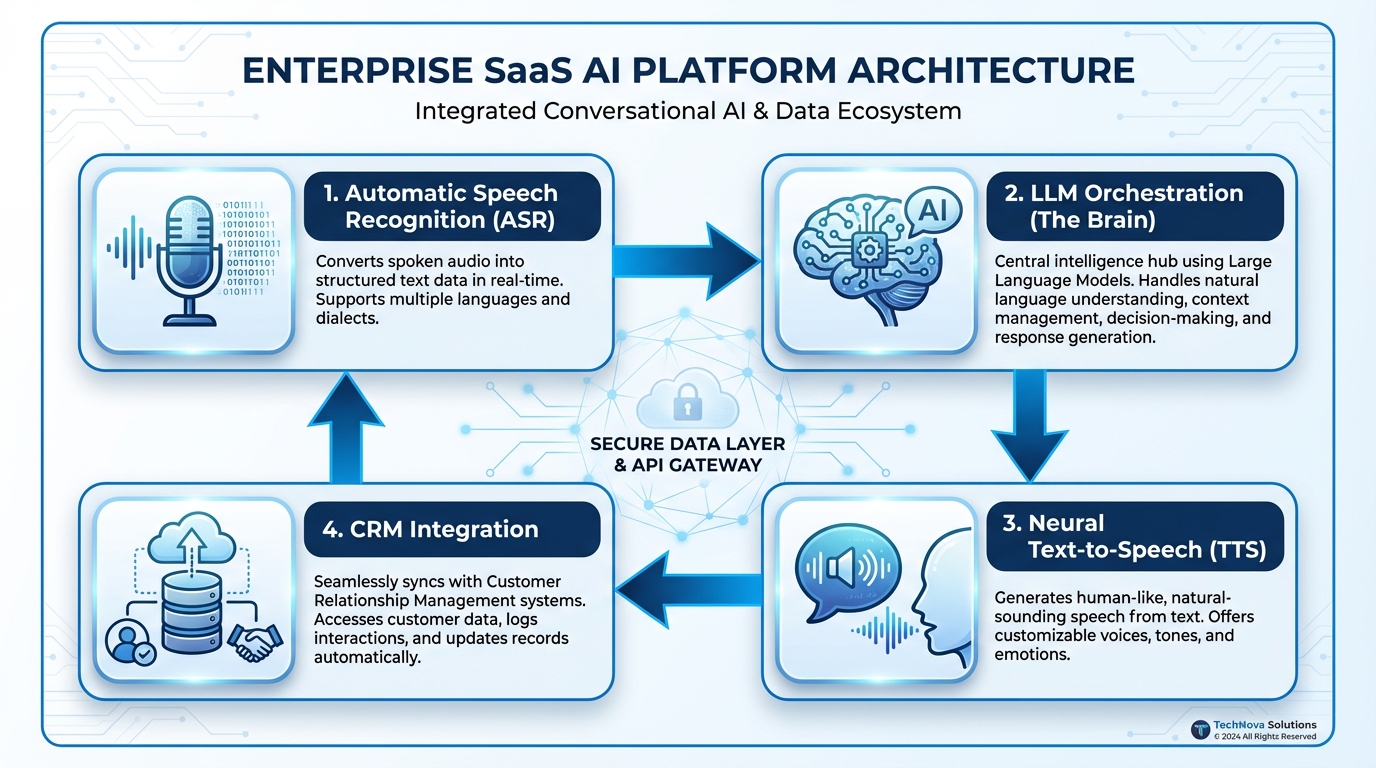
To understand the ROI of an ai voice agent, one must look under the hood at the convergence of four critical technologies that have matured significantly in 2025:
- Automatic Speech Recognition (ASR): Modern ASR now handles "barge-ins" (when a human interrupts the AI) with sub-100ms detection, ensuring the conversation feels fluid rather than robotic.
- Large Language Model (LLM) Orchestration: This is the "brain" that manages context. It doesn't just read a script; it understands intent, handles objections (e.g., "We don't have the budget until Q3"), and follows complex logic paths based on lead responses.
- Neural Text-to-Speech (TTS): 2025-era TTS provides human-like prosody, allowing the agent to adjust its tone, speed, and warmth based on the sentiment of the prospect.
- Telephony & CRM Integration: The agent is useless if it exists in a vacuum. Enterprise-grade agents integrate directly with Salesforce, HubSpot, and Zoho to log call recordings, update lead scores, and trigger post-call workflows.
The Speed-to-Lead Revolution
In SaaS, the "Golden Window" for lead response is under five minutes. Beyond this, conversion rates drop by over 10x. An AI voice agent eliminates this bottleneck by providing 24/7 coverage. When a prospect downloads a whitepaper or requests a demo, the agent can initiate a qualification call within seconds, regardless of whether it’s 2:00 PM in Mumbai or 2:00 AM in San Francisco.
Source: TrueFan Guide on AI Voice Agents for Lead Gen
2026 Trends Shaping AI Voice Agents in Enterprise SaaS
The landscape of lead generation is being rewritten by several macro trends that buyers must account for in their 2026 planning:
1. The Rise of Agentic AI
We are moving from "Copilots" (AI that helps humans) to "Agents" (AI that performs tasks autonomously). In the SaaS context, this means an ai voice agent doesn't just qualify a lead; it orchestrates the next steps—sending a calendar invite, updating the "Intent" field in the CRM, and even triggering a personalized video follow-up.
2. Hyper-Personalization at Scale
By 2026, generic outreach will be ignored. AI agents now leverage firmographic data (company size, recent funding, tech stack) from tools like 6sense or Apollo in real-time to tailor the opening hook of a cold call.
3. Usage-Based Pricing Dominance
The industry is moving away from seat-based licenses for AI. According to 2025 market data, 60% of SaaS vendors have adopted usage-based models. For voice agents, this means paying per "Qualified Meeting" or per "Successful Connect," aligning the vendor’s incentives directly with the buyer’s pipeline goals.
4. Pan-India Multilingual Support
For SaaS companies targeting the Indian market, English-only outreach is a limitation. Modern agents support Hindi, Tamil, Telugu, and Bengali with native-level fluency and cultural nuance, which is critical for penetrating Tier-2 and Tier-3 markets.
Source: Top 7 SaaS Platforms Going AI-Native by 2026 - Analytics India Magazine

Enterprise SaaS Use Cases that Deliver Near-Term ROI
For an ai voice agent for lead generation to be successful, it must be deployed where the friction is highest. Here are the four most impactful use cases for 2025:
1. Inbound Speed-to-Lead Callback
When a high-intent lead fills out a "Contact Sales" form, the AI agent calls them instantly. It qualifies the lead based on BANT (Budget, Authority, Need, Timeline) or MEDDICC criteria. If the lead is "hot," the agent can perform a live transfer to an Account Executive (AE).
2. Outbound Cold Calling & ABM
Autonomous SDRs can penetrate a list of 10,000 prospects in the time it takes a human to call 50. The AI handles the "grunt work" of navigating gatekeepers and IVRs, only engaging the human team when a meeting is booked.
3. Event & Webinar Follow-Up
Post-event fatigue often leads to missed opportunities. An AI agent can call 500 webinar attendees within an hour of the session ending, asking for feedback and offering a deeper technical dive, significantly increasing the MQL-to-SQL conversion rate.
4. Trial-to-Paid Conversion
For PLG (Product-Led Growth) SaaS, the transition from free trial to paid is critical. An AI agent can call users who have reached a specific usage milestone (or those who have gone dormant) to offer a personalized walkthrough or a discount code, driving expansion revenue.
India-First Compliance: DLT, DPDP, and Trust
For enterprise buyers in India, compliance is not optional—it is a prerequisite. Any ai voice agent deployment must navigate a complex regulatory environment:
TRAI TCCCPR 2018 & DLT Compliance
The Telecom Regulatory Authority of India (TRAI) requires all commercial communications to be registered on Distributed Ledger Technology (DLT) platforms.
- Header Registration: Your "Sender ID" must be whitelisted.
- Template Scrubbing: Every script the AI uses must be pre-approved as a template on the DLT portal.
- Consent Management: The system must check the "Do Not Disturb" (DND) registry before dialing and maintain a clear opt-out mechanism.
The DPDP Act 2023
The Digital Personal Data Protection (DPDP) Act mandates strict rules on how personal data is processed.
- Explicit Consent: The AI must inform the lead that the call is being recorded and processed by AI, obtaining verbal consent.
- Data Minimization: Only data necessary for qualification should be processed.
- Right to Erasure: Your AI vendor must provide a way for leads to request the deletion of their voice data and transcripts.
Security Posture
Enterprise SaaS buyers should demand ISO 27001 and SOC 2 Type II certifications. These ensure that the voice data—which often contains sensitive business intelligence—is encrypted and handled within a secure governance framework.
Source: MeitY DPDP Act 2023 Official Text
The Buyer’s Evaluation Checklist
When vetting an ai voice agent for lead generation, use this checklist to separate "wrapper" startups from enterprise-grade platforms:
| Feature Category | Critical Requirement | Why It Matters |
|---|---|---|
| Conversation Quality | Latency < 300ms | Anything higher feels like a walkie-talkie and kills rapport. |
| Linguistic Depth | Accent Robustness | Must understand "Indian English" and regional dialects without failing. |
| CRM Integration | Bi-directional Sync | Must write back call summaries, sentiment, and next steps to Salesforce/HubSpot. |
| Compliance | DLT & DPDP Ready | Prevents legal liability and ensures high call-connect rates. |
| Analytics | CPQM Dashboard | You need to see the "Cost Per Qualified Meeting" in real-time. |
| Personalization | API-driven Triggers | Can the agent trigger a follow-up action (like a video) immediately? |
Implementation Blueprint: The 30-60-90 Day Plan
Scaling an ai voice agent requires a phased approach to ensure model accuracy and team alignment.
Days 1–30: The Pilot Phase
- Select a Narrow Use Case: Start with inbound "Contact Sales" follow-ups or webinar attendees.
- Script & DLT Setup: Draft your qualification scripts and get them approved on DLT.
- Technical Integration: Connect your telephony (Twilio/Vonage) and CRM sandbox.
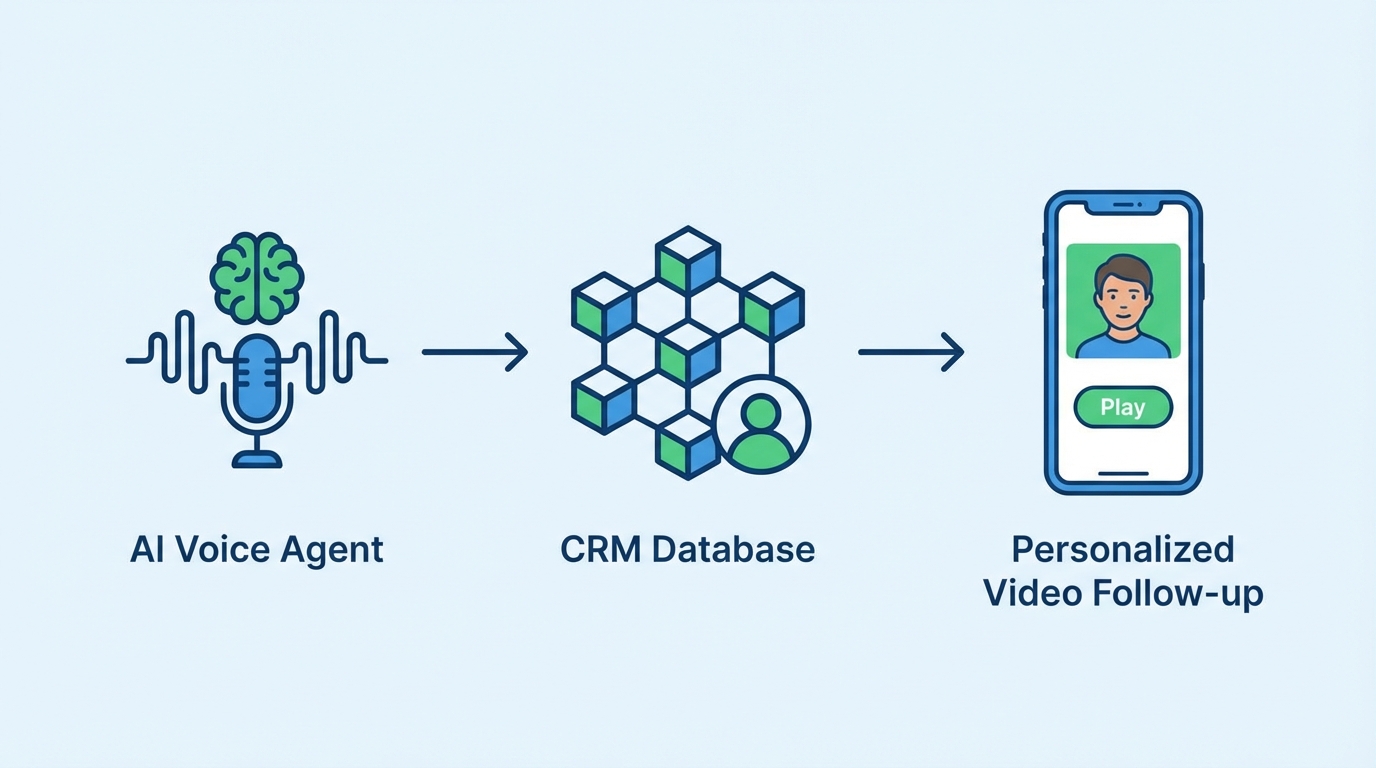
- Platforms like Studio by Truefan AI enable teams to visualize the entire customer journey, from the first voice interaction to the final conversion point, ensuring no lead is left behind during the pilot.
Days 31–60: The Expansion Phase
- Multilingual Rollout: Introduce Hindi or regional language scripts based on your lead distribution.
- A/B Testing: Test different opening hooks. Does a "problem-first" approach work better than a "benefit-first" approach?
- Human Handoff Optimization: Refine the "Live Transfer" process so AEs are prepared when the AI drops a lead into their lap.
Days 61–90: The Scale Phase
- Full Outbound Integration: Move from warm follow-ups to cold ABM outreach.
- Advanced Analytics: Tie call outcomes to "Pipeline Generated" and "Closed-Won" revenue.
- Governance Audit: Conduct a quarterly review of DPDP compliance and DLT template performance.
Metrics and the ROI Model Executives Expect
To justify the investment in an ai voice agent, RevOps leaders must focus on unit economics.
Key Performance Indicators (KPIs)
- Contact Rate: (Connected Calls / Total Dials). Target: >25% for inbound, >10% for cold outbound.
- Qualification Rate: (Qualified Leads / Connected Calls). This measures script effectiveness.
- Cost Per Qualified Meeting (CPQM): (Total AI Spend / Meetings Booked).
- Speed-to-Lead: The average time from form-fill to AI-dial. Target: <30 seconds.
The ROI Formula
ROI = [(Meetings Booked x Show Rate x Close Rate x ACV) - AI Operating Cost] / AI Operating Cost
Solutions like Studio by Truefan AI demonstrate ROI through their ability to significantly increase the "Show Rate" (the percentage of booked meetings that actually happen) by sending personalized, high-impact reminders that a standard calendar invite cannot match.
Maximize Conversion with Post-Call Personalization
The biggest challenge with an ai voice agent for lead generation isn't the call itself—it's what happens after the call. A lead might agree to a meeting on the phone but fail to show up. This is where the Personalization Layer' becomes a force multiplier.
The TrueFan Enterprise Integration
Once the AI voice agent completes a call and marks a lead as "Qualified," it can trigger an automated workflow. Within 30 seconds, the lead receives a WhatsApp or email containing a personalized video.
Studio by Truefan AI's 175+ language support and AI avatars allow SaaS companies to create a video where a brand spokesperson (or even a celebrity) thanks the prospect by name for the call and briefly reiterates the value proposition discussed. This "wow factor" has been shown to increase meeting show rates by up to 35% in enterprise segments.
Technical Trigger Example:
When the voice agent logs a "Meeting Booked" status in HubSpot, a webhook hits the TrueFan API:
POST https://newvideorequest.truefans.in/api/post_new_request
The payload includes the lead’s name and the specific pain point identified by the AI voice agent, generating a unique video URL instantly.
Scripts, Objections, and Governance
A successful ai voice agent is only as good as its "Playbook." Enterprise SaaS scripts must balance compliance with persuasion.
The Compliant Intro
"Hi [Name], this is [Agent Name] calling from [SaaS Company] on a recorded line. I’m an AI assistant following up on your demo request. Do you have two minutes to see if we’re a fit?"
Handling Common Objections
- "Send me an email": "I certainly will, [Name]. But to make sure I send the right technical docs, are you more focused on [Feature A] or [Feature B]?"
- "We already use [Competitor]": "Many of our best clients did too. They switched because of our [USP]. Would you be open to a 10-minute comparison next Tuesday?"
Governance & Bias Monitoring
Enterprise teams must conduct weekly "Call Listening" sessions (similar to human QA) to ensure the AI isn't hallucinating or showing bias in its qualification logic. Version control for prompts is essential—never push a script change to production without testing it in a sandbox.
Risks and Mitigation Strategies
- Spam Labeling: If an agent calls too many people who haven't opted in, your numbers will be flagged. Mitigation: Use DLT-registered headers and "warm up" your caller IDs.
- Model Drift: LLMs can occasionally provide inconsistent answers. Mitigation: Use "Guardrails" (like NeMo Guardrails) to restrict the AI's output to a specific knowledge base.
- Cultural Sensitivity: An AI might be too "pushy" for certain regional cultures. Mitigation: Localize scripts not just for language, but for etiquette and tone.
Pricing Patterns and Commercial Negotiation
When negotiating with an ai voice agent vendor, look for these structures:
- The Usage-Based Model: Typically $0.10 to $0.50 per minute of "Talk Time."
- The Success-Based Model: A lower base fee plus a "Bounty" for every meeting that actually shows up.
- Enterprise Platform Fee: Covers SSO, SOC 2 compliance, dedicated support, and custom CRM integrations.
Negotiation Tip: Ask for "Pilot Credits." Most enterprise vendors will provide 500-1,000 free minutes to prove the CPQM before you commit to a large annual contract.
Conclusion: The Path to 2026
The transition to an ai voice agent for lead generation is not just a technical upgrade; it is a strategic shift in how enterprise SaaS companies manage their most valuable asset: prospect attention. By combining the 24/7 scalability of voice agents with the hyper-personalization of video follow-ups, revenue leaders can finally close the gap between demand generation and pipeline reality.
As you evaluate your stack for 2026, focus on the "Trust Stack"—compliance, integration, and transparency. The winners will not be those who make the most calls, but those who provide the most seamless, personalized, and respectful buyer journey.
Resources for Further Reading
- TRAI TCCCPR 2018 Regulations
- Digital Personal Data Protection Act 2023 - MeitY
- AI Agent Trends 2026 - Stan Ventures
- Gartner: The Future of B2B Sales Interactions
- TrueFan Enterprise: Personalized Video at Scale
Frequently Asked Questions
1. Can the AI handle interruptions?
Yes. Modern agents use "Full Duplex" audio, meaning they listen and speak simultaneously. If a prospect says "Wait, stop," the AI ceases speaking immediately and acknowledges the interruption.
2. How does the AI handle "Gatekeepers" or IVRs?
Advanced agents can navigate "Press 1 for Sales" menus and interact with office assistants to reach the intended prospect, though success rates vary by industry.
3. Is the voice data stored in India?
This depends on the vendor. Under the DPDP Act, you should prioritize vendors that offer local data residency or are compliant with cross-border data transfer regulations.
4. How can I ensure leads don't drop off after the AI call?
Platforms like Studio by Truefan AI provide the answer by automatically generating a personalized video follow-up within seconds of the call ending. This keeps the momentum high and puts a "human face" (via AI avatars) on the automated interaction, which significantly reduces no-show rates.
5. Does the AI sound "too real"? Is that a problem?
Transparency is key. Ethically and legally (under various emerging AI acts), it is best practice to disclose that the caller is an AI assistant. Surprisingly, prospects often respond better to honest AI than to a human who sounds like they are reading a script.