RCS business messaging video marketing India 2026 — The enterprise guide to AI-powered, personalized video at scale
Estimated reading time: ~17 minutes
Key Takeaways
- RCS becomes India’s verified, high-trust channel in 2026, ideal for delivering personalized, video-first brand experiences.
- Omnichannel strategy pairs RCS with WhatsApp, using intelligent fallbacks to ensure reach and maximize conversions.
- API-first architecture connects CDP/CRM data to AI video rendering and RBM delivery for at-scale personalization.
- Measurement shifts to ROI with granular funnel metrics (start, watch rate, CTA clicks) and holdout testing.
- DPDP compliance and security require verified senders, consent-first data flows, and ISO/SOC controls.
In the rapidly shifting landscape of digital engagement, RCS business messaging video marketing India 2026 has emerged as the definitive frontier for enterprise growth. As traditional SMS fades into the background, Rich Communication Services (RCS) provides a verified, interactive, and media-rich environment directly within the native Android Messages app. For Indian enterprises, this represents a unique opportunity to deliver high-impact, personalized video content to a massive, mobile-first audience with unprecedented trust and deliverability.
Rich Communication Services (RCS) serves as the next-generation upgrade to SMS and MMS, supporting verified branding, rich media carousels, and interactive suggested actions. Unlike fragmented third-party apps, RCS is integrated into the default messaging experience, offering a “clean” channel for brand-to-consumer communication. With iOS now supporting RCS on newer versions and carrier-enabled networks, the reach of this channel has expanded beyond its Android roots to cover nearly the entire smartphone population in India.
The enterprise thesis for India in 2026 is clear: a dominant Android base, combined with carrier-level anti-spam hardening, makes RCS the primary channel for verified engagement. By leveraging API-first orchestration, brands can now trigger personalized AI videos at scale, moving beyond generic broadcasts to one-to-one storytelling. This guide explores how to navigate this evolution, integrate superior video tech, and achieve measurable ROI in the 2026 market.
- Verified Reach: RCS provides a “Verified Sender” badge, significantly increasing trust and open rates compared to unverified SMS.
- Interactive UX: Suggested replies and actions (e.g., “Pay Now,” “Book Slot”) allow users to convert without leaving the message thread.
- Omnichannel Synergy: RCS complements WhatsApp by providing a fallback or primary channel for users who prefer native messaging or have specific data privacy preferences.
Business messaging evolution India 2026: The New Inflection Point
The year 2026 marks a critical inflection point for the business messaging evolution India 2026. The market has moved past the experimental phase of RCS, driven by a massive Android-dominant base and the implementation of carrier-level spam controls. According to recent reports, Google has partnered with Airtel to integrate network-level filtering, effectively reducing the noise that once plagued early rich messaging attempts. This hardening of the channel has restored consumer trust, making it a premium environment for high-value video content.
India’s momentum in this space is unparalleled globally. Juniper Research indicates that India and China will account for approximately 30% of all global RCS business messages by the end of 2025, with that trajectory steepening into 2026. Platforms like TrueFan AI enable enterprises to capitalize on this scale by generating hyper-personalized video assets that fit perfectly within the RCS framework. This synergy between a trusted delivery channel and high-quality, personalized content is what defines the current era of Indian martech.
The shift is also fueled by the sheer volume of engagement. Tanla’s recent case studies highlight that RCS in India has surpassed 1.5 billion monthly messages, with enterprise adoption growing at a CAGR of 35–40%. For brands, the value proposition is simple: RCS offers the rich media capabilities of a mobile app with the frictionless reach of a text message. This makes it uniquely suited for video-forward engagement, where rich cards with video previews and suggested CTA chips drive deep funnel actions.
Sources:
- Tanla: Google RCS enabling growth in India
- Juniper Research: India and China RCS forecast
- TechCrunch: Google and Airtel anti-spam partnership
RCS vs WhatsApp video marketing: Building an Omnichannel Powerhouse
When evaluating RCS vs WhatsApp video marketing, enterprises must view them as complementary forces rather than competitors. While WhatsApp remains the king of conversational ubiquity and end-to-end encryption (E2EE) in India, RCS offers a distinct advantage in terms of native integration and “app-like” interactivity without the need for a third-party download. RCS rich cards and carousels provide a structured UI that is often more conducive to transactional video journeys, such as policy renewals or product upgrades. See the WhatsApp AI Video Shopping Experience to understand complementary use cases.
Route Mobile’s developer insights suggest that RCS read likelihood is significantly higher for certain demographics who view WhatsApp as a purely personal space. By using an omnichannel orchestration approach, brands can implement eligibility and fallback logic. For instance, if a high-value video message fails to deliver on RCS due to device incompatibility, the system can automatically trigger a fallback to WhatsApp or a rich-link SMS, ensuring 100% reach across the customer base.
The cost and policy frameworks also differ. WhatsApp has strict template approval workflows and category-based pricing, whereas RCS often follows a more flexible per-message or session-based model depending on the RBM (RCS Business Messaging) partner. Vendor-reported benchmarks from providers like Meta Reach suggest that RCS can deliver up to 67% higher conversions in specific sectors like e-commerce and BFSI when compared to traditional SMS. This makes it a vital component of any omnichannel video personalization RCS WhatsApp strategy. Explore the WhatsApp Business Commerce Automation 2026: Growth Playbook for deeper automation ideas.
Sources:
- Route Mobile: RCS Business Messaging overview
- Meta Reach: RCS conversion benchmarks
- CleverTap: RCS as the next big engagement edge
Designing RCS personalized video campaigns enterprise: Use Cases and UX
Successful RCS personalized video campaigns enterprise require a deep understanding of both technical constraints and user psychology. Personalization in 2026 goes far beyond “Hi [Name].” It involves tokenizing variables like last purchase, loyalty tier, and even local language to create a truly bespoke experience. TrueFan AI’s 175+ language support and Personalized Celebrity Videos are explained in AI Celebrity Video Marketing India, allowing brands to address users in their mother tongue using a celebrity voice that feels authentic and high-stakes.
The UX design for RCS must account for the “quick-play” nature of mobile messaging. Recommended video lengths are typically 15–30 seconds, with file sizes optimized to 10–15MB to ensure near-instant playback. Using H.264 or HEVC encoding ensures compatibility across the diverse Android device ecosystem in India. Additionally, “burned-in” captions are essential, as many users view messages in muted environments, and the first-frame thumbnail must be optimized to drive the initial click.
High-Impact Use Cases for the Indian Market:
- BFSI (Insurance/Banking): A personalized video from a brand ambassador explaining a policy renewal, featuring a “Pay Now” chip that leads directly to a UPI intent. Learn more in insurance CLM video automation India.
- Telecom: ARPU (Average Revenue Per User) upgrade offers using a carousel of 3–5 cards, each featuring a video of a celebrity explaining the benefits of a specific data plan.
- E-commerce: Abandoned cart nudges where a celebrity mentions the specific item left behind, offering a personalized discount code valid for the next 2 hours. See Quick Commerce Video Personalization India.
- OTT/Media: Win-back campaigns featuring a personalized “Coming Soon” trailer based on the user’s previous viewing history, with a “Resume Subscription” action. Explore the Vernacular OTT Retention Marketing 2026 playbook.
Sources:
Enterprise Architecture and RCS messaging API integration marketing
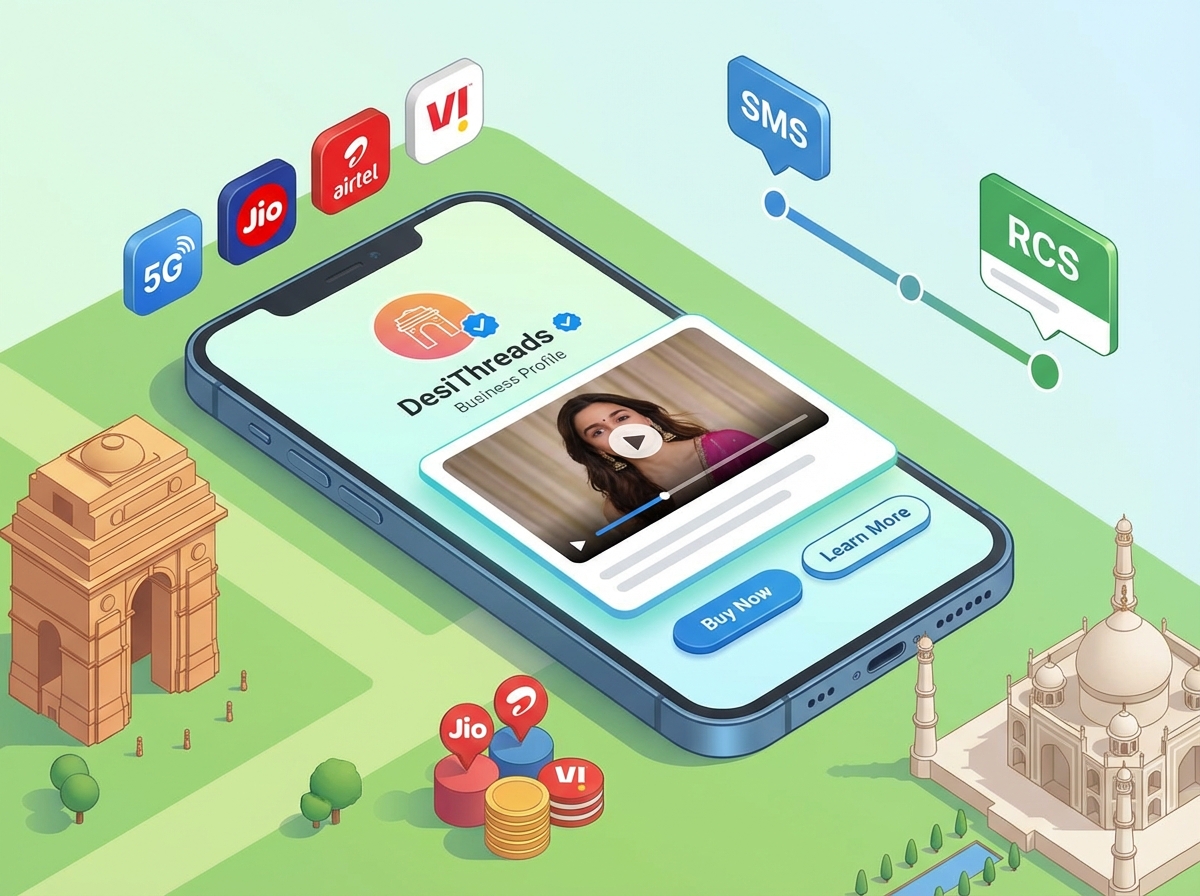
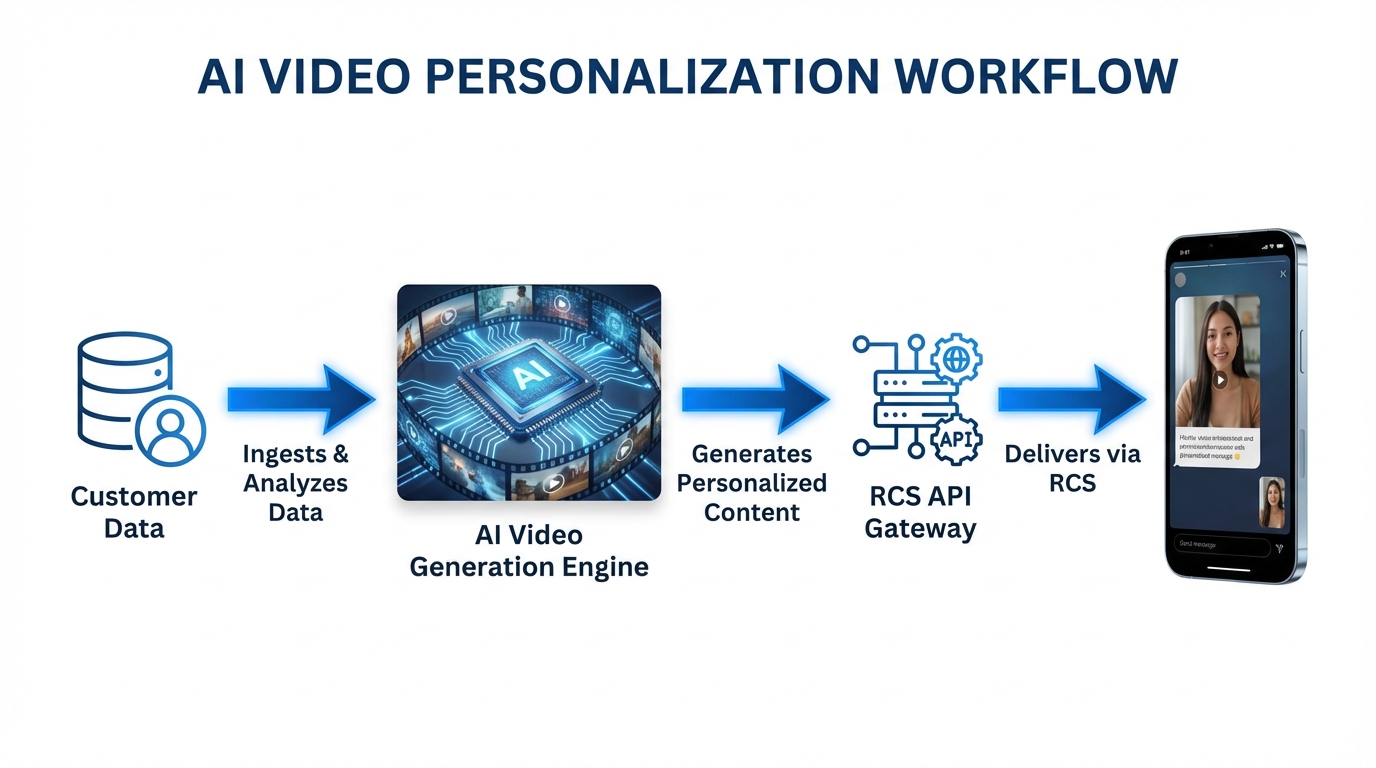
Scaling enterprise RCS video personalization requires a robust, API-first architecture that connects the brand's data layer with the rendering and delivery engines. The process begins at the CDP (Customer Data Platform) or CRM, where user segments are identified based on real-time triggers. These triggers send a payload to the video generation API (see URL to Video AI Generator for E-commerce Automation), which renders a unique video file for each recipient. This file is then hosted on a secure CDN with a signed URL to ensure privacy and low-latency delivery.
The RCS messaging API integration marketing workflow involves registering an “Agent” with an RBM partner like Tanla or Route Mobile. This agent represents the verified brand identity. Once the video is rendered, the RBM API is called to send a “Rich Card” or “Carousel” to the user. This payload includes the video URL, a high-res thumbnail, and a set of suggested chips or actions. Monitoring this flow requires a sophisticated observability stack to track delivery, read receipts, and “suggestion-tap” events.
Technical Architecture Components:
- Data Layer: CDP/CRM providing consent-aware user profiles and event triggers.
- Rendering Engine: High-concurrency GPU farms (like those used by TrueFan AI) capable of sub-30s render times.
- Delivery Layer: RBM Partner API for message routing and carrier-level handshakes.
- Observability: Webhook listeners for real-time tracking of the “Delivered → Read → Play → Click” funnel.
- Security: ISO 27001 and SOC 2 compliant environments to handle PII and brand assets securely.
Sources:
- TrueFan AI: Enterprise AI Video API Guide
- Infobip: Switching from SMS to RCS process
- Postman: Route Mobile RBM API documentation
Economics, ROI, and Measurement of RCS Video Campaigns
Understanding the RCS video campaign ROI enterprise (use the Personalized Video Marketing ROI Calculator) involves a shift from “cost per message” to “cost per conversion.” While the per-unit cost of an RCS message with a personalized video is higher than a standard SMS, the delta in engagement often justifies the investment. Solutions like TrueFan AI demonstrate ROI through massive increases in click-through rates (CTR) and conversion rates, often outperforming traditional digital ads by 3x to 5x in terms of customer acquisition cost (CAC).
Measurement must be granular, tracking the user journey from the moment the message is delivered. Key Performance Indicators (KPIs) include the “Video Start Rate,” “50% Watch Rate,” and “CTA Click-to-Conversion Rate.” By using holdout groups and A/B testing (e.g., comparing a static RCS image vs. a personalized RCS video), enterprises can quantify the exact incrementality of the video component. In the Indian context, where data costs are low but attention is scarce, the “thumb-stopping” power of a personalized celebrity video is a significant competitive advantage.
The economic model should also account for efficiency gains. Traditional video production for millions of users would be cost-prohibitive and logistically impossible. AI-driven rendering allows brands to achieve “One-to-One” marketing at “One-to-Many” costs. For example, a campaign delivering 2.4 million personalized greetings (as seen in Hero MotoCorp's festive campaign) would have taken years of manual editing; with an integrated AI pipeline, it is completed in days, saving thousands of man-hours and significantly reducing the time-to-market.
Sources:
- Juniper Research: RCS for Business Market Report 2026
- Infobip: Key RCS statistics and market insights 2026
- TrueFan AI: Scalable AI Video Creation Guide
Governance, Security, and DPDP Compliance for India
In 2026, rich communication services marketing India must be executed within the strict framework of the Digital Personal Data Protection (DPDP) Act. See DPDP Compliant Personalization: Privacy-First Marketing. This means that every personalized video campaign must have a clear lawful basis, with explicit consent recorded for both the communication channel and the use of personal data for video generation. Enterprises should also consider Interactive Video Data Capture. Minimize PII in payloads by using pseudonymous IDs wherever possible to trigger video renders—see the Data Minimization Personalized Video guide.
Brand safety is another critical pillar. The partnership between Google and Airtel for carrier-level filtering is a double-edged sword; while it reduces spam, it also means that unverified or “spammy” brand content will be blocked more aggressively. Verified sender flows are mandatory. Furthermore, the content itself must be moderated. AI platforms must have built-in filters to prevent the generation of offensive or off-brand content, especially when using celebrity likenesses, to protect both the brand's reputation and the talent's rights.
TrueFan AI maintains a rigorous enterprise posture, holding ISO 27001 and SOC 2 certifications. This ensures that data is handled with the highest security standards, and the “consent-first” celebrity pipeline guarantees that all AI-generated likenesses are legally cleared. For an Indian enterprise, this level of compliance is not just a “nice-to-have” but a prerequisite for operating at scale in a regulated environment.
Sources:
- TechCrunch: Google and Airtel anti-spam hardening
- ET Edge: CleverTap and Infobip RCS enablement in India
The 90-Day Pilot and TrueFan AI Integration Checklist
Launching a successful RCS business messaging video marketing India 2026 initiative requires a pragmatic, phased approach. A 90-day pilot allows for technical validation, creative iteration, and ROI measurement before a full-scale rollout. The goal is to move from “Proof of Concept” to “Production Grade” by testing the integration between the video rendering API and the RBM delivery platform.
90-Day Roadmap:
- Days 0–30 (Design): Select an RBM partner (e.g., Tanla, Route Mobile), register your brand agent, and define 2–3 video templates. Map your CDP fields to the video variables.
- Days 31–60 (Build): Integrate the TrueFan AI API with your messaging orchestration tool. Instrument webhooks for tracking and launch a pilot to a segment of 50k–100k users.
- Days 61–90 (Optimize): Analyze the “Read-to-Conversion” funnel. Compare RCS performance against WhatsApp and SMS holdouts. Refine the scripts and CTA chips based on user behavior.
TrueFan AI Integration Checklist:
- Authentication: Secure API key exchange and OAuth setup.
- Template Approval: Register video-rich card templates with the RBM partner.
- Data Mapping: Ensure first_name, product_id, and language_code are correctly passed to the render job.
- Media Signing: Implement short-lived, signed URLs for video hosting to ensure data privacy.
- Webhook Setup: Configure listeners for message.delivered, message.read, and suggestion.clicked.
- Compliance Review: Verify DPDP consent logs and celebrity usage windows. See the DPDP Consent-First Marketing Guide.
Recommended Internal Links
- WhatsApp AI Video Shopping Experience: Convert Faster
- WhatsApp Business Commerce Automation 2026: Growth Playbook
- AI Celebrity Video Marketing India: Personalized Endorsements
- Insurance CLM Video Automation India: Boost ROI in 2026
- Quick Commerce Video Personalization India: Drive ROI Now
- Vernacular OTT Retention Marketing 2026: Playbook for Growth
- Personalized Video Marketing ROI Calculator: India 2026
- DPDP Compliant Personalization: Privacy-First Marketing
- Data Minimization Personalized Video: DPDP Act Guide 2026
- Interactive Video Data Capture: DPDP-Compliant 2026
- URL to Video AI Generator for E-commerce Automation
Frequently Asked Questions
Does RCS work on iPhones in India in 2026?
Yes, as of 2026, RCS support has been widely rolled out on iOS for users on major Indian carriers like Airtel and Jio. While the feature set may slightly differ from the Android experience, the core rich media and verified sender benefits are consistent across both platforms.
How does RCS differ from WhatsApp for business video?
RCS is a native protocol integrated into the phone's default messaging app, requiring no third-party installation. It offers structured “Rich Cards” and “Carousels” that are highly effective for transactional journeys. WhatsApp is a third-party app with a heavy focus on end-to-end encrypted, two-way conversations. Most enterprises use both as part of an omnichannel strategy.
Can we personalize videos for millions without high latency?
Absolutely. By using high-concurrency GPU farms and optimized rendering pipelines, TrueFan AI can generate personalized videos in under 30 seconds. For massive scheduled broadcasts, videos can be pre-rendered in batches, while for event-triggered messages (like a welcome video), they are rendered on-demand in real time.
What if a user’s phone doesn’t support RCS?
Modern orchestration platforms use fallback logic. If the RBM API detects that a user is not RCS-enabled, it can automatically send a rich link via SMS or route the message to WhatsApp, ensuring the user still receives the personalized content in a compatible format.
How do I ensure my RCS messages aren’t marked as spam?
Use a Verified Sender profile and adhere to anti-spam guidelines set by Google and Indian carriers. Maintain high engagement rates, provide clear opt-out mechanisms, and ensure your content—especially AI-generated video—is relevant and high quality.
What are the typical file requirements for RCS video?
For optimal performance in India, videos should be MP4 (H.264/HEVC), ideally under 15MB, with a 1:1 or 4:5 aspect ratio. Include a high-quality JPEG/PNG thumbnail so the Rich Card looks professional before playback.