
Quick Commerce Festival Marketing 2026: The Jan–Feb Playbook for Same-Hour Delivery
Estimated reading time: 10 min
Key Takeaways
- Shift from broad discounts to hyper-local, real-time relevance using dark store data and geo-personalized videos.
- Build instant shopping conversion funnels that connect personalized video to PDPs with live ETA, stock, and urgency signals.
- Leverage platform partnerships (Instamart, Blinkit, Zepto) with hourly optimization and exclusive festival bundles.
- Track funnel-focused KPIs like Watch-to-Cart, ETA Accuracy Delta, and Revenue Recovered for real impact.
- Mitigate risks with SKU substitution ladders and ethical, consented geo-personalization to preserve trust and compliance.
Quick commerce festival marketing 2026 has evolved into the most competitive phase of India’s retail evolution, where winning the micro-moment is no longer optional for growth marketing leaders. As we enter the Jan–Feb festival cycle, the ability to deliver 10-minute delivery personalization at scale has become the primary differentiator between brands that capture seasonal surges and those that lose out to more agile competitors.
The landscape in 2026 is defined by a shift from broad-based discounting to hyper-local, real-time relevance. Brands are now leveraging dark store densification and network-first last-mile models to ensure that same-hour festival delivery is a reliable promise rather than a marketing gimmick. For performance marketers, this means moving beyond static banners to dynamic, inventory-aware creative systems that can pivot based on local stock levels and rider availability.
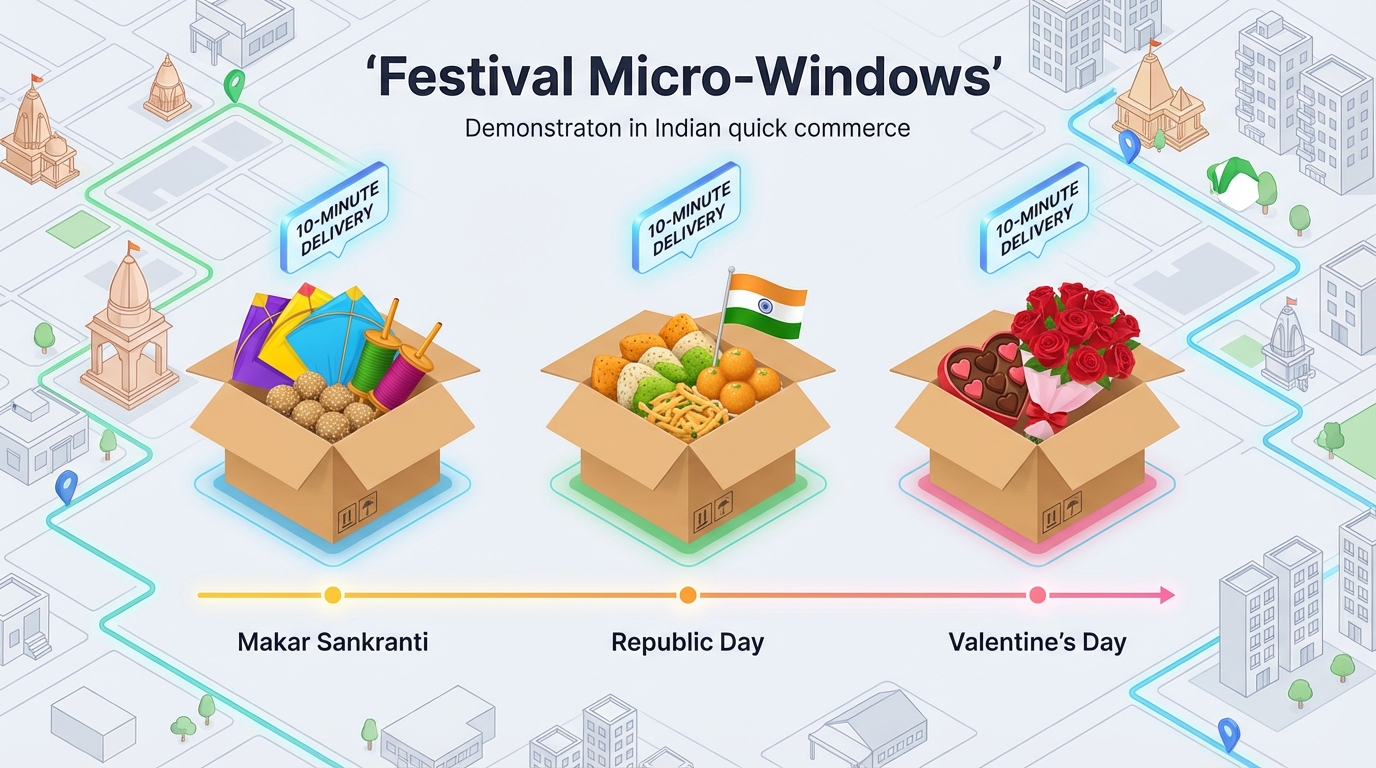
This playbook provides a comprehensive framework for navigating the upcoming cultural windows of Makar Sankranti, Republic Day, and Valentine’s Day. By integrating instant shopping conversion funnels with automated creative workflows, brands can drive measurable lifts in conversion rates (CVR) and average order value (AOV) while maintaining CAC efficiency in a high-density market.
The 2026 Landscape: Why Minutes Matter for Same-Hour Festival Delivery
The Indian quick commerce sector in 2026 is characterized by aggressive non-grocery expansion and sophisticated retail media monetization. Consumer spending habits have shifted toward weekly non-grocery purchases, with a heavy emphasis on instant gratification during cultural moments.
Source: YourStory
Dark store marketing automation has become the backbone of these operations. By 2026, the leading platforms have densified their dark store networks to such an extent that “ETA trust” is now a more significant growth lever than the raw speed of delivery. Brands must now communicate reliability through location-based urgency triggers that reflect the actual operational capacity of the nearest fulfillment center.
Source: Logistics Insider
Furthermore, the competitive intensity of 2026 has forced brands to adopt real-time inventory video alerts. These dynamic creatives pull live SKU availability per dark store, ensuring that a user in South Delhi sees a different offer than a user in North Bangalore based on what is actually on the shelf. This level of precision reduces wasted impressions on out-of-stock (OOS) items and significantly compresses the decision-making window for the consumer.
Source: Inc42
Source: Inc42
Source: Logistics Insider
Source: YourStory
Source: Campaign Asia
Navigating Festival Micro-Windows with Hyperlocal Flash Sale Videos
The Jan–Feb period in India is a rapid-fire sequence of cultural events, each requiring a distinct tactical approach. To succeed, brands must deploy neighborhood-specific quick offers that align with the specific dayparts and geographic nuances of each festival.
Makar Sankranti (Jan 14–15)
Makar Sankranti is a festival of high-frequency, low-ticket purchases that are highly time-sensitive. The morning hours are dominated by kite accessories and til-gur sweets, while the evening shifts toward family snacking combos.
Growth teams should use wind speed triggers near open grounds and target gated societies with terrace access. Creative assets should feature hyperlocal flash sale videos with overlays like “Arrives in 12 min to HSR Layout” or “Kites for your terrace—Only 4 left nearby.” This creates a sense of location-based urgency triggers that are impossible to ignore. Platforms like TrueFan AI enable brands to generate these personalized video assets at scale, ensuring every neighborhood feels like it has a bespoke storefront.
Republic Day (Jan 26)
Republic Day marketing in 2026 focuses on the “Parade Watch Party” and “Breakfast Host” personas. The window is narrow: pre-parade (7 AM – 9 AM) for milk, bread, and tri-color decor, and post-parade (11 AM – 1 PM) for snacks and beverages.
Marketing efforts should target parade routes and cantonment-adjacent zones with instant gratification offer videos. Messaging like “Order before the parade ends” or “Tri-color sweets arriving in 15 min to Indiranagar” drives immediate action. Platform-exclusive festival deals on tri-color snack stacks can be promoted via Blinkit or Zepto tiles to capture the patriotic sentiment of the morning.
Valentine’s Day (Feb 14)
Valentine’s Day is the ultimate test of same-hour festival delivery. The day is segmented into morning gifts (flowers), afternoon beauty/grooming, and evening last-minute desserts.
Brands should heatmap recent purchase density to time hourly drops. For example, a “Just for Koramangala couples” video featuring a limited-time rose and chocolate combo can be triggered when local stock is high. Using real-time inventory video alerts to show “Only 6 bouquets left in Powai” creates a powerful scarcity effect that drives conversion in minutes.
Source: Boston Institute of Analytics
Source: Media4Growth
Building Instant Shopping Conversion Funnels via Dark Store Marketing Automation
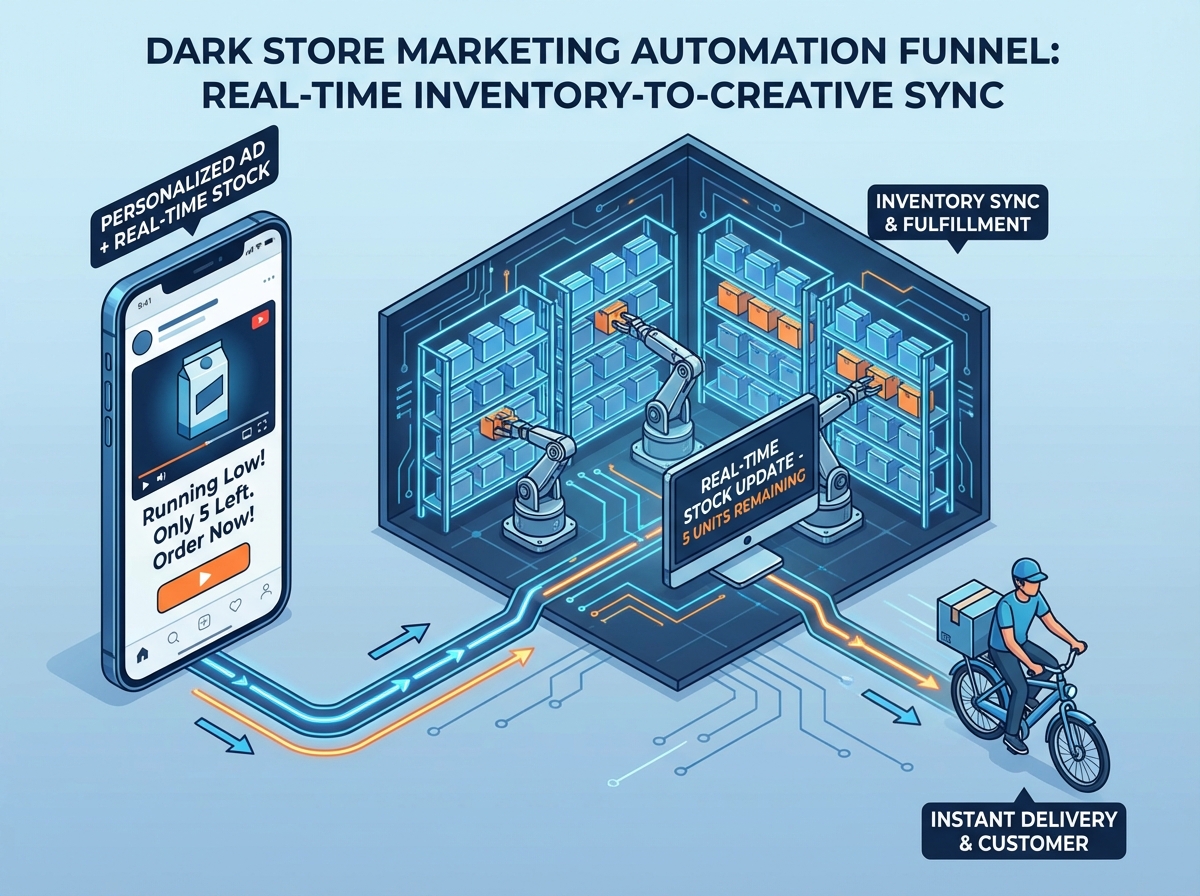
The core of a successful 2026 strategy is the instant shopping conversion funnels. This funnel is defined as a seamless transition from a short, personalized video ad to a platform PDP, ending with a doorstep delivery within the same-hour festival delivery window. Every stage of this funnel must be reinforced with personalized ETA, stock levels, and urgency signals.
Real-Time Inventory Video Alerts
One of the biggest friction points in quick commerce is the “Out of Stock” (OOS) experience. In 2026, leading brands use dark store marketing automation to sync their inventory feeds directly with their creative templates. If a specific SKU goes out of stock in a particular dark store, the creative is automatically paused or swapped for a substitute. This ensures that every dollar spent on media is driving a potential conversion, not a frustrated user. Real-time inventory video alerts resource.
Rapid Fulfillment Personalization
Personalization in 2026 goes beyond using a customer's name. It involves tailoring the creative based on the user's pin code, the nearest dark store's rider density, and the current weather conditions. For instance, if it’s raining in Mumbai during a festival, the creative should automatically pivot from “10-minute delivery” to “Reliable delivery in 30 min,” preserving brand trust while still driving the sale. Rapid fulfillment personalization playbook. TrueFan AI's 175+ language support and Personalised Celebrity Videos allow brands to deliver these complex, localized messages in the native tongue of the consumer, further increasing the resonance of the offer.
Quick Commerce Cart Recovery
Cart abandonment in quick commerce is often a result of a sudden change in ETA or a distraction. A robust quick commerce cart recovery strategy involves re-engaging the user within 10–30 minutes via WhatsApp or in-app notifications. These nudges should include a refreshed ETA and, if the original item is now OOS, a personalized video suggesting a high-quality substitute that is currently available nearby.
Source: Logistics Insider
Source: Fynd
Source: MMA Global Playbook
Strategic Swiggy Instamart Partnerships and Blinkit Zepto Festival Campaigns
To maximize reach, brands must align their internal creative systems with the retail media surfaces of the major platforms. Swiggy Instamart partnerships, Blinkit Zepto festival campaigns, and platform-exclusive festival deals are the primary vehicles for this.
Swiggy Instamart Partnerships
Swiggy Instamart offers a variety of high-impact placements, including co-branded app banners, sponsored shelves, and lockscreen moments. In 2026, successful brands are using geo-timed drops—releasing specific SKUs only in certain neighborhoods at certain times. For example, a premium chocolate brand might partner with Instamart for a “Midnight Valentine Drop” exclusive to premium pin codes in South Mumbai, supported by geo-fenced push notifications.
Blinkit and Zepto Festival Campaigns
Blinkit and Zepto have mastered the art of contextual OOH (Out-of-Home) advertising that syncs with app activity. A billboard near a high-density residential area in Bangalore can display a QR code that leads directly to a neighborhood-specific quick offers page on the app. This synergy between physical presence and digital immediacy is a hallmark of the 2026 playbook.
Retail Media Playbooks
The key to retail media in 2026 is hourly optimization. Brands should negotiate platform-exclusive festival deals that allow them to “own” specific category bundles during peak hours. For Makar Sankranti, this could mean owning the “Festive Essentials” shelf from 6 AM to 10 AM across all major quick commerce apps. Solutions like TrueFan AI demonstrate ROI through their ability to generate thousands of these platform-ready video variants in seconds, allowing brands to test and iterate on different offer structures in real-time.
Source: Dentsu India
Source: Media4Growth
Source: MMA Global Playbook
Measurement, KPIs, and the Creative System that Converts
In the high-velocity world of quick commerce festival marketing 2026, traditional metrics like CPM and CPC are secondary to funnel-specific KPIs that track the journey from “view to doorstep.”
Key Performance Indicators
- Watch-to-Cart Rate: The percentage of users who add an item to their basket after viewing a hyperlocal flash sale video.
- ETA Accuracy Delta: The difference between the promised ETA in the creative and the actual delivery time, and its subsequent impact on repeat purchase rates.
- Revenue Recovered: The total GMV driven through quick commerce cart recovery flows within 60 minutes of abandonment.
- Pin-Code Heatmaps: Visualizing CVR and AOV at a micro-locality level to identify underperforming dark stores or creative fatigue.
Creative Specs for 2026
The most effective video formats are 6–12 seconds long. The first 2 seconds are critical; they must establish the “Geo Anchor” (e.g., “Powai Residents”) and the “Reliability Promise” (e.g., “Arrives in 14 min”). Visual systems should include dynamic price tags, inventory meters, and countdown timers that are mapped to the platform’s live data.
UGC (User Generated Content) accelerators also play a role. Prompting users in society WhatsApp groups to share their “Sankranti snack spread” can spark social proof that drives a localized surge in orders. This community-level marketing, combined with automated video generation, creates a powerful flywheel of engagement and conversion.
Source: Campaign Asia
Source: MMA Global Playbook
Risks, Mitigations, and Compliance in 2026
OOS Volatility and Congestion
The biggest risk is promising a delivery that cannot be fulfilled. Brands must implement “SKU substitution ladders.” If the primary festival bundle goes out of stock, the system should automatically pivot the creative to the next best alternative. During peak congestion, such as the morning of Republic Day, the messaging should automatically shift from “10-minute delivery” to “Reliable festival delivery” to manage consumer expectations and maintain trust. This is particularly important as platforms in 2026 are de-emphasizing hard “10-minute” claims in favor of reliability.
Source: Instagram
Data Privacy and Ethical Creative
With the increased use of location-based urgency triggers, brands must ensure they have explicit consent for geo-personalized messaging. Adhering to local data norms and platform creative specs is non-negotiable. Furthermore, brands must avoid “dark patterns”—such as fake countdown timers or artificial scarcity—that can lead to long-term brand erosion and regulatory scrutiny.
2026 Budgeting and Experimentation
The rising ad spend in India for 2026 is accompanied by a higher appetite for experimentation. CMOs are encouraged to run fast test-learn cycles during the Jan–Feb window. Testing different copy frames for ETA (e.g., “in 12 min” vs. “by 7:30 PM”) or varying the level of geo-granularity (pin code vs. neighborhood name) can provide invaluable insights for the larger festival seasons later in the year.
Source: Instagram
Source: Logistics Insider
Source: Campaign Asia
Conclusion: The Path to Quick Commerce Mastery
The Jan–Feb 2026 festival season represents a massive opportunity for brands that can master the intersection of operations and creative. By moving away from static, one-size-fits-all marketing and embracing a hyperlocal, data-driven approach, growth leaders can unlock new levels of efficiency and customer loyalty.
The key is to build a “Live Stack”—one where inventory, ETA, and creative are in constant sync. Whether it's through hyperlocal flash sale videos for Makar Sankranti or platform-exclusive festival deals for Valentine’s Day, the goal remains the same: to be there for the consumer in the minutes that matter most.
As you plan your 2026 roadmap, consider the role of automation in scaling these efforts. The ability to render thousands of personalized, inventory-aware videos in seconds is no longer a luxury—it is the baseline for success in the age of quick commerce.
Next Steps for Growth Leaders:
- Audit your data feeds: Ensure your dark store inventory and ETA data are accessible via API for creative triggers.
- Pilot a hyperlocal campaign: Choose one festival window (e.g., Valentine’s Day) to test neighborhood-specific quick offers and real-time inventory video alerts.
- Optimize your recovery flow: Set up a 15-minute WhatsApp recovery sequence with personalized video nudges.
Frequently Asked Questions
How do I handle sudden stockouts during a 2-hour festival window?
Use real-time inventory video alerts tied to dark store feeds. Automatically pause ads for OOS items or swap in nearest-available substitutes to protect spend and conversion.
What is the ideal video length for quick commerce ads?
Aim for 6–12 seconds. Hook viewers in the first 2 seconds with a geo-anchor (their neighborhood) and a clear reliability or ETA promise.
How can I improve cart recovery rates on Blinkit or Zepto?
Trigger WhatsApp or push notifications within 10–30 minutes of abandonment. Include a personalized video with refreshed ETA and in-stock substitutes if needed.
Can celebrity endorsements work for hyperlocal campaigns?
Yes. Personalized celebrity videos (with language localization) can mention user names and neighborhoods, dramatically increasing relevance and conversion.
Which platforms should I prioritize for Republic Day 2026?
Adopt a multi-platform approach: Instamart for breakfast bundles and Blinkit/Zepto for watch-party snacks, reinforced by contextual OOH around residential hubs.



