AI video government schemes India 2026: Multilingual, accessible, avatar-led explainers for rural reach
Key Takeaways
- India’s 2026 shift toward AI-first digital public infrastructure demands scalable, multilingual video communication for citizens.
- A Hindi-first master script with automated localization ensures parity across 22+ languages and cultural contexts.
- Avatar-led automation enables rapid, low-bandwidth, and accessible explainer videos with captions, transcripts, and ISL.
- Trust and compliance require GIGW/WCAG adherence, consented avatars, watermarking, and verified distribution.
- Tools like Studio by TrueFan AI cut production costs and accelerate multilingual outreach for public programs.
The mandate for AI video government schemes India 2026 is clear: reach every beneficiary with trustworthy, multilingual explainers that function seamlessly on low-bandwidth networks while meeting stringent accessibility standards. As India moves toward a “Sovereign AI” framework, the challenge for government communicators and NGOs is no longer just about creating content—it is about creating accessible content at a scale previously thought impossible. By building a repeatable system to generate government citizen service videos with AI avatars, departments can now deliver Hindi-first messaging with 22+ regional variants, ensuring no citizen is left behind due to language or literacy barriers.
1. The 2026 Inflection Point: Policy, Budget, and Sovereign AI
The year 2026 represents a structural shift in how the Indian government views artificial intelligence. It is no longer a “frontier technology” but a core component of digital public infrastructure (DPI). This shift is driven by three primary catalysts:
- Budgetary Momentum: The Union Budget 2026 has treated AI as a foundational utility, with significant allocations for the “IndiaAI” mission to build indigenous compute capacity and localized datasets. According to recent industry insights, the tech industry has successfully lobbied for AI to be integrated into the national cybersecurity and fintech boost programs, ensuring that public service delivery is both automated and secure.
Source: ET Edge Insights
- The IndiaAI Innovation Challenge: This 2026 initiative specifically funds deployment-ready AI solutions for public services, including health (AYUSH) and MSME support. The focus is on interoperability and the ability to serve the “last mile” in rural India.
Source: IndiaAI
- Agentic AI Adoption: A 2026 EY India report highlights that India is rapidly transitioning toward “Agentic AI,” where AI systems don’t just generate text but execute complex workflows. For government communications, this means AI can now take a policy document and autonomously produce a 22-language video campaign with minimal human oversight.
Source: EY India Outlook 2026
By 2026, rural internet penetration is projected to surpass 500 million users, with digital news and video consumption reaching over 700 million consumers.
Source: Dalberg/Future of News
2. Multilingual at Scale: Automating Outreach for Bharat
To effectively communicate multilingual government videos AI India, departments must move away from the “one-size-fits-all” English/Hindi approach. The Eighth Schedule of the Indian Constitution recognizes 22 official languages, but the reality of “Bharat” involves hundreds of dialects and code-mixed variations like “Hinglish.”
The Hindi-First Master Strategy
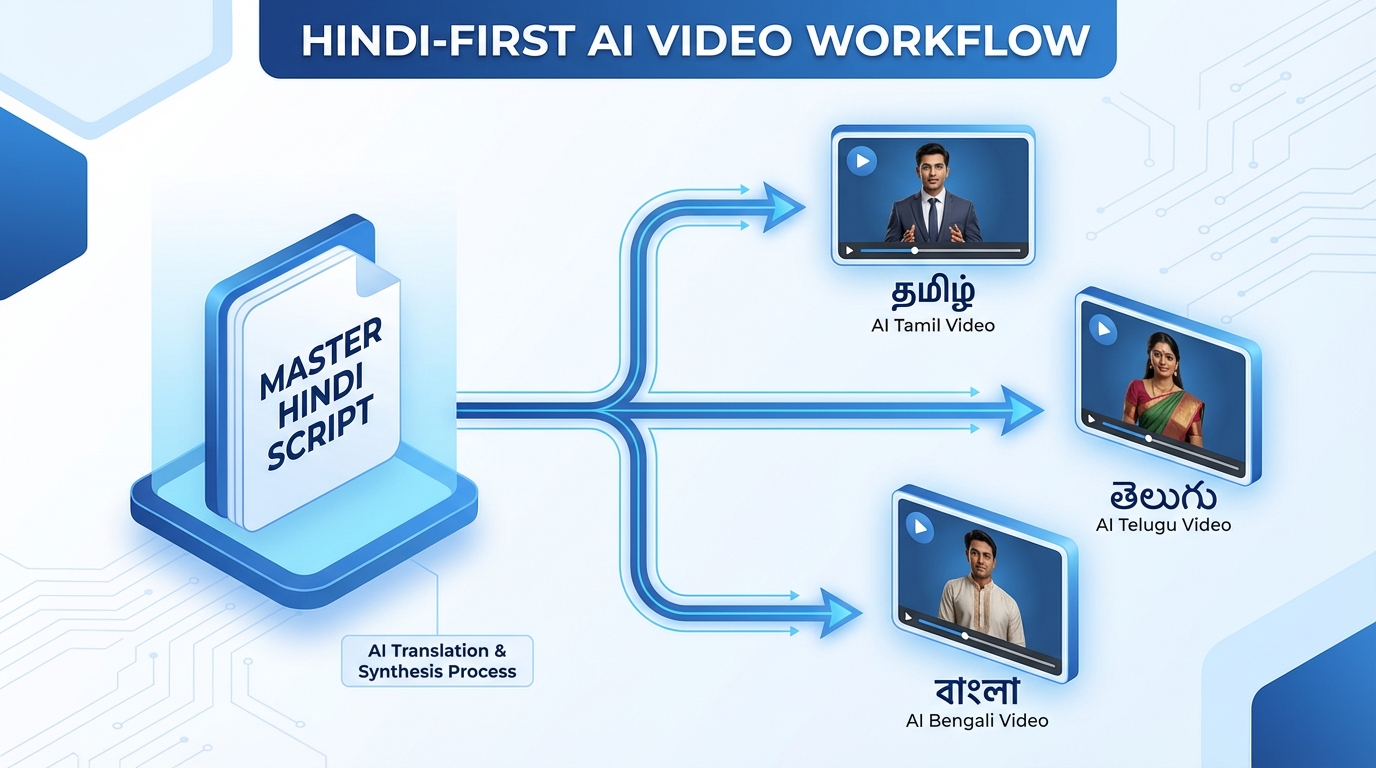
The most efficient workflow for 2026 involves creating a “source-of-truth” Hindi master script. This master template serves as the anchor for all visual assets, on-screen text, and avatar movements. Once the Hindi version is approved by policy owners, automation tools can generate synchronized variants in Tamil, Telugu, Bengali, Marathi, and beyond.
Beyond Translation: Localization and Parity
True automation requires more than just translating words; it requires government Hindi video automation that maintains parity across:
- Terminology Glossaries: Ensuring that technical terms (e.g., “Direct Benefit Transfer” or “e-KYC”) are consistent across all 22 languages.
- Visual Synchronization: Adjusting the timing of on-screen graphics to match the varying lengths of spoken regional languages.
- Cultural Nuance: Selecting avatars that resonate with specific regions—using different attire or personas for a video targeting farmers in Punjab versus weavers in Kanchipuram.
Platforms like Studio by TrueFan AI enable this level of granular control, allowing government teams to duplicate projects and swap languages with a single click while maintaining the integrity of the original policy message.
3. Automation Workflow: From Policy Script to Citizen-Ready Video
The transition from a complex government gazette notification to a 60-second WhatsApp-ready video involves a sophisticated but repeatable pipeline. In 2026, public awareness video automation is defined by its ability to handle high volumes of updates—such as changing deadlines for scheme applications—without restarting the production cycle.
The 2026 Production Pipeline
- Script Kit Development: Policy owners provide the core facts. AI-assisted tools then draft scripts optimized for spoken delivery (short sentences, active voice).
- Template Selection: A consistent “Government Spokesperson” avatar is selected to build long-term trust. Studio by TrueFan AI’s 175+ language support and AI avatars allow for the creation of a digital twin of an actual official or a neutral, photorealistic virtual human.
- One-Click Generation: The system generates the video with perfect lip-sync. In 2026, this process takes minutes, not days.
- Accessibility Integration: Automated generation of captions and transcripts. For priority schemes, an Indian Sign Language (ISL) overlay is added as a picture-in-picture element.
- Quality Assurance (QA): Language validators review the regional outputs for dialect accuracy, ensuring the AI hasn’t used overly formal “textbook” language that rural audiences might find alienating.
- Multi-Format Rendering: Renders are produced in 4K for television/kiosks and 480p (low-bandwidth) for WhatsApp distribution.
This workflow ensures that rural India awareness videos AI are not just high-quality, but also highly distributable in areas where 5G might still be inconsistent.
4. Scheme Deep-Dives: Storyboarding Jan Dhan, PM Kisan, and Aadhaar
To illustrate the power of government citizen service videos, let’s look at three critical storyboards that can be automated using AI avatars.
Jan Dhan Scheme Explainer Video AI
- Objective: Explain zero-balance accounts and insurance benefits.
- Visuals: Show a photorealistic avatar standing in front of a local bank branch or Common Service Centre (CSC).
- Key Beats:
- “Did you know you can open a bank account with zero balance?”
- Visual checklist of documents: Aadhaar card and 2 photos.
- Explanation of the ₹2 Lakh accident insurance cover.
- CTA: Visit your nearest bank or CSC today.
- Official Resource: PMJDY Portal
PM Kisan Video Tutorials AI
- Objective: Guide farmers through the e-KYC process to ensure timely installments.
- Visuals: Screen-recording of the PM-Kisan portal with the AI avatar providing a “voice-over” guide in the corner.
- Key Beats:
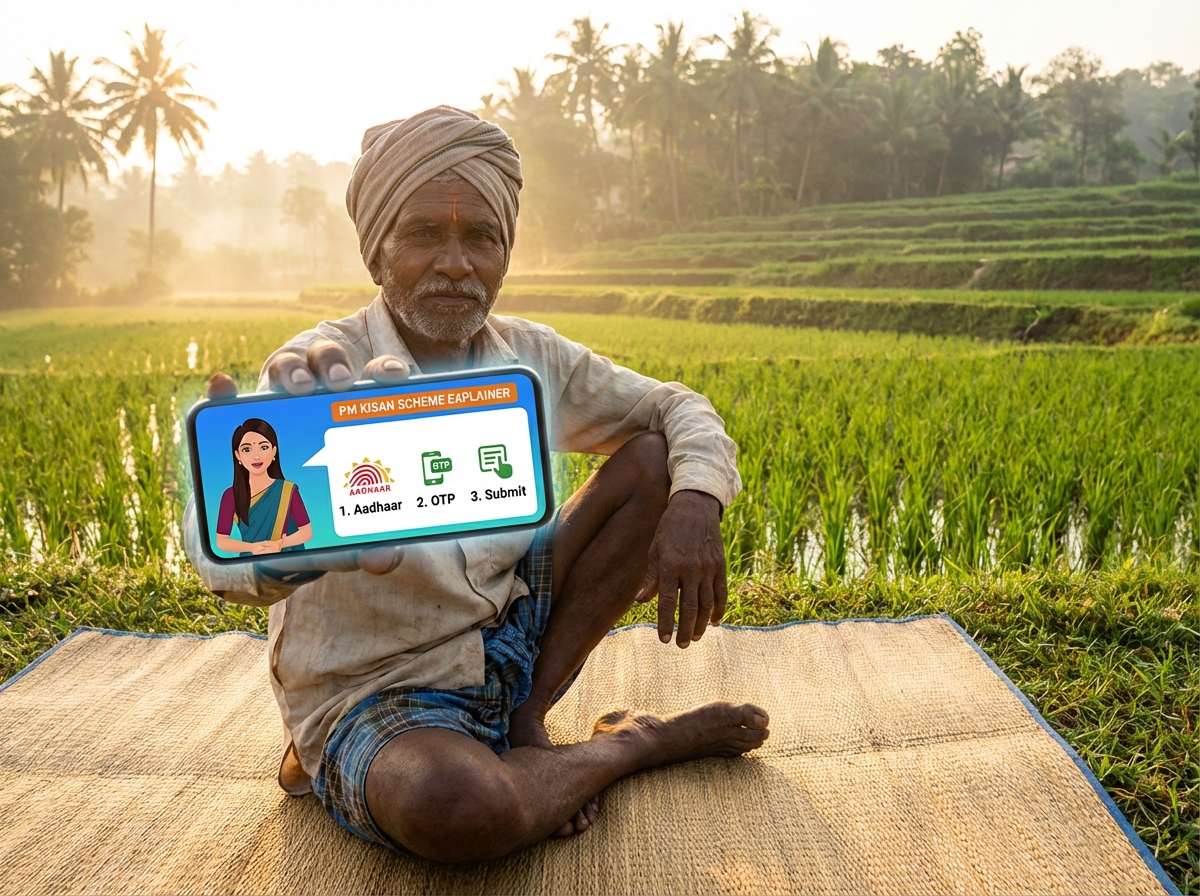
- “Is your e-KYC pending? Follow these 3 steps to receive your next ₹2,000.”
- Step 1: Enter Aadhaar number. Step 2: Enter OTP. Step 3: Click Submit.
- CTA: Check your status on the PM-Kisan app.
- Official Resource: PM-Kisan Portal
Aadhaar Service Explainer AI Video
- Objective: Educate citizens on updating their mobile number and address.
- Visuals: High-contrast graphics showing the “Masked Aadhaar” to promote privacy.
- Key Beats:
- “Keep your Aadhaar updated to access 1,000+ government schemes.”
- How to book an appointment at an Aadhaar Seva Kendra.
- A warning against sharing OTPs with strangers.
- CTA: Use the mAadhaar app for digital updates.
- Official Resource: UIDAI Portal
These social welfare scheme videos act as 24/7 digital assistants, reducing the burden on physical helpdesks and improving the “Ease of Living” for citizens.
5. Public Health & Social Welfare: Rapid Response and Segmented Campaigns
Public health videos AI India require a different approach: speed and empathy. During seasonal disease outbreaks (like Dengue or Malaria) or immunization drives, the government needs to deploy information in hours, not weeks.
Rapid Response Use Cases
- Immunization Drives: Automated reminders for “Mission Indradhanush” in local dialects, sent directly to mothers’ WhatsApp numbers.
- Nutrition (Poshan Abhiyaan): Short, 30-second clips on maternal health and child nutrition, featuring avatars that look like local ASHA workers to build immediate rapport.
- Crisis Management: In the event of a heatwave or flood, AI avatars can deliver localized safety instructions tailored to specific districts.
NGO Awareness Campaign Videos AI
NGOs play a critical role in the last-mile delivery of these schemes. By using NGO awareness campaign videos AI, organizations can co-create content with Self-Help Groups (SHGs).
- Personalization: NGOs can use templates to insert the name of a local village or the address of a specific community center into the video.
- Measurement: By using QR codes in the videos, NGOs can track which regional versions are being watched most frequently, allowing for data-driven adjustments to their outreach strategy.
Solutions like Studio by TrueFan AI demonstrate ROI through reduced production costs—often by as much as 80%—and the ability to pivot messaging instantly as new health data emerges.
6. Accessibility & Compliance: GIGW, WCAG, and Deepfake Safeguards
In 2026, creating accessibility compliant government videos is not optional; it is a legal and ethical mandate. All digital assets must align with the Guidelines for Indian Government Websites (GIGW) and WCAG 2.1 AA standards.
Source: GIGW Portal
The Accessibility Checklist
- Captions/Subtitles: Must be accurate (≥ 99%) and high-contrast.
- Transcripts: A full text version must be available for screen readers.
- Audio Descriptions: For videos with complex visual steps (like filling a form), an audio track must describe the on-screen actions.
- Sign Language: Priority videos should include an Indian Sign Language (ISL) interpreter overlay.
Safeguarding Against Misinformation
The rise of AI also brings the risk of deepfakes. In 2024 and 2025, several cases were reported where AI-generated videos falsely impersonated senior officials to promote fraudulent investment schemes. The Press Information Bureau (PIB) has since intensified its “Fact Check” operations to flag these risks.
Source: NDTV Deepfake Report
Source: Economic Times/PIB Fact Check
To ensure trust in 2026, government videos must:
- Use Consented Avatars: Only use avatars from licensed libraries with clear provenance.
- Embed Watermarks: Use visible and invisible watermarking to prove the video originated from an official department.
- Publish via Verified Channels: Always host videos on .gov.in domains or verified social media handles.
- Audit Trails: Maintain a log of every video generated, the script used, and the official who approved it.
7. Implementation & Distribution: The 2026 Digital Governance Stack
To deploy digital governance video tools effectively, departments need an end-to-end stack that handles everything from creation to analytics.
The Implementation Stack
- Authoring: A centralized library of approved scripts and scheme glossaries.
- Generation: A browser-based platform for rapid avatar-led production.
- Distribution:
- WhatsApp Business API: For direct-to-citizen delivery.
- CSC Kiosks: Offline playback for citizens visiting service centers.
- YouTube Vernacular: Dedicated channels for different regional languages.
- Analytics: Tracking reach by language, completion rates, and the subsequent uptick in scheme applications at the district level.
By integrating these tools, the Indian government can transform from a “document-heavy” bureaucracy into a “video-first” digital service provider, making the vision of “Digital India” a reality for every citizen, regardless of their location or literacy level.
Conclusion
By 2026, India’s public communication will be defined by scalable, inclusive, and trustworthy AI video. A Hindi-first, avatar-led workflow—paired with rigorous accessibility and security practices—makes it possible to deliver clear, multilingual guidance to every citizen, even on low bandwidth. With platforms like Studio by TrueFan AI, government bodies and NGOs can rapidly produce, localize, and distribute compliant explainer videos that reduce friction, build trust, and accelerate benefits delivery at the last mile.
Frequently Asked Questions
How can we ensure dialect accuracy at the district level?
While AI handles the base translation, we recommend a “Human-in-the-loop” system. Local language validators or district-level officials should review the AI-generated scripts to ensure that the vocabulary matches the local dialect (e.g., using specific agricultural terms common in a particular region of Bihar).
Can AI avatars speak “Hinglish” or code-mixed languages?
Yes. For urban and semi-urban audiences, a mix of Hindi and English (Hinglish) often feels more natural and improves comprehension. Modern AI video tools allow you to input code-mixed scripts to match the target audience’s speaking habits.
How do we distribute these videos in areas with very low internet speeds?
Render a specific “Low-Bandwidth” version (480p or even 360p) with highly compressed audio. These files are small enough to be shared via WhatsApp without significant data consumption. Additionally, videos can be pre-loaded onto tablets or SD cards for offline use by field workers.
How does the government protect against deepfake impersonation of ministers?
The government utilizes a multi-layered security approach including digital signatures, official watermarks, and coordination with the PIB Fact Check unit. Studio by TrueFan AI’s 175+ language support and AI avatars are built on a “walled garden” principle, ensuring that only authorized users can generate content, and every output is traceable back to the source.
What is the cost benefit of using AI avatars over traditional video production?
Traditional production involves cameras, lighting, actors, and expensive post-production for every single language. AI video generation eliminates these costs, allowing a single department to produce hundreds of localized videos for the price of one traditional shoot—enabling micro-campaigns that were previously too expensive to justify.