
AI video cart abandonment India 2026: WhatsApp-first playbooks to recover carts and drive repeat purchases
Estimated reading time: 9 minutes
Key Takeaways
- Indian e-commerce faces 70%+ cart abandonment, with mobile abandonment exceeding 75%.
- WhatsApp-first journeys with AI-personalized videos recover up to 3x more carts than email or SMS.
- Use dynamic, localized video elements (name, product, COD, SLA) to reduce friction and boost trust.
- Operationalize recovery via Shopify/WooCommerce data flows, MAP triggers, and Studio by TrueFan AI automation.
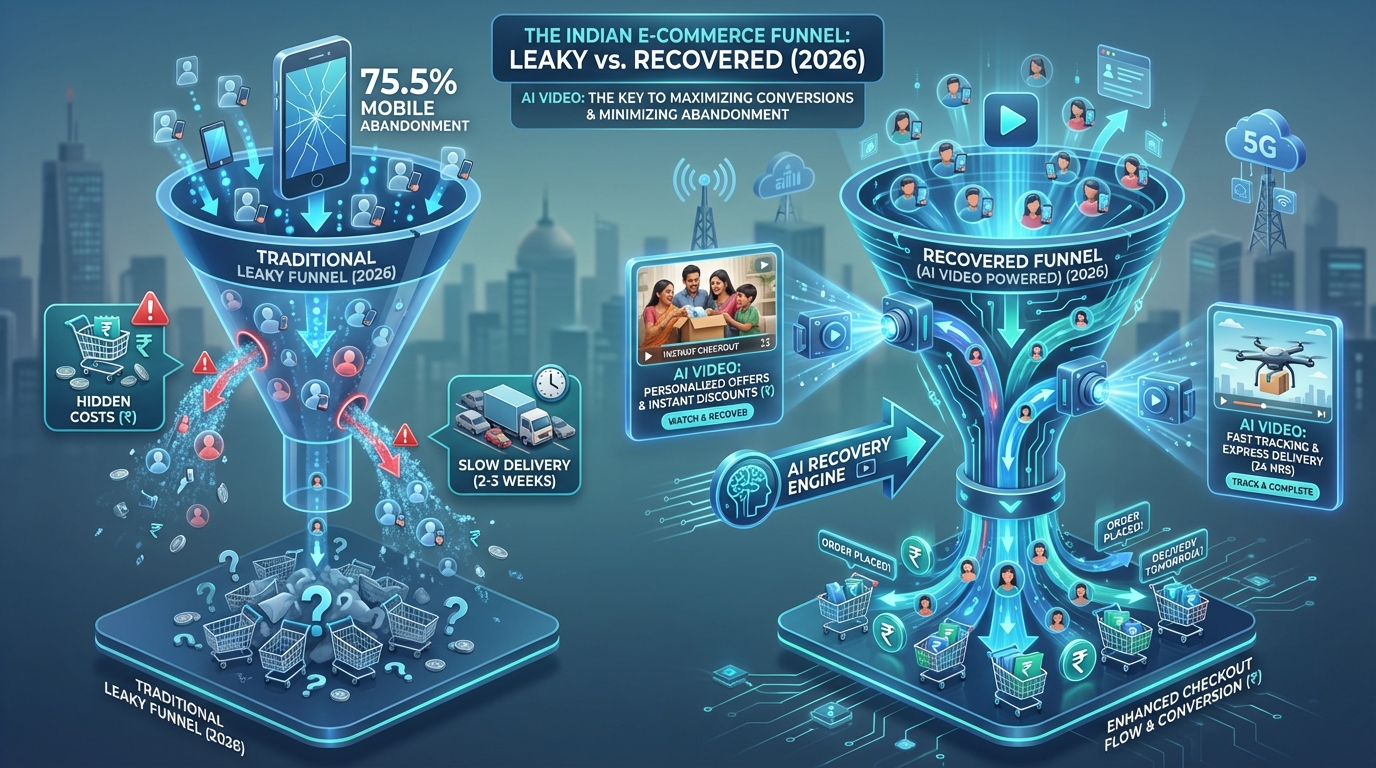
In the hyper-competitive landscape of Indian e-commerce, the “leaky funnel” has reached a critical tipping point. As we navigate 2026, the definition of cart abandonment has evolved from a mere technical metric to a high-stakes battle for customer attention. Cart abandonment is the share of initiated checkouts where users leave without completing payment, and the numbers are staggering. Globally, the average abandonment rate has climbed to 70.22% by 2026, according to Statista. However, in mobile-first India, the challenge is even more acute, with mobile-specific abandonment exceeding 75.5%, as noted by ClickPost.
Source: Statista: Global Shopping Cart Abandonment 2026
Source: ClickPost: India E-commerce Abandonment Trends
The reality for Indian D2C brands is clear: traditional email and SMS nudges are no longer enough. Indian shoppers respond significantly faster on WhatsApp compared to any other channel. Recent data shows that WhatsApp journeys recover up to 3x more carts than email, with brands like Perfora achieving over 13% recovery rates through automated WhatsApp flows. Platforms like Studio by TrueFan AI enable brands to bridge this gap by transforming static text reminders into hyper-personalized, high-converting video experiences. This guide provides an ROI-first, WhatsApp-native playbook to reduce cart abandonment with personalized videos, lift trust, and increase repeat purchases in 30–60 days.
Source: WebEngage: Perfora Case Study
1. The State of Cart Abandonment in India 2026: Benchmarks and Causes
To solve the abandonment problem, we must first understand the unique friction points of the 2026 Indian shopper. While the global average hovers around 70.22%, the Indian market presents a distinct set of challenges and opportunities.
2026 Benchmarks for Indian E-commerce
- Global Average Abandonment: 70.22% across 50+ major studies (Baymard Institute).
- India Mobile Abandonment: ~75.5% (driven by low-intent social traffic and mobile UX friction).
- Desktop Abandonment: ~66–67% (typically higher intent, but lower volume).
- Social Commerce Abandonment: ~91% (shoppers clicking from Instagram/YouTube often “window shop” without intent).
Source: Baymard Institute: Cart Abandonment Statistics
India-Specific Friction Points
Why do Indian shoppers drop off? In 2026, the reasons have shifted toward trust and transparency:
- Hidden Costs (39%): Unexpected shipping fees or “convenience charges” at the final step remain the primary driver of drop-offs.
- Delivery Speed (21%): With the rise of quick commerce, a 5–7 day delivery window is now perceived as “slow,” leading to abandonment in favor of faster alternatives.
- Payment Trust & RTO Anxiety (19%): Concerns over payment security and the complexity of Cash on Delivery (COD) verification often stall the checkout process.
- Language Barriers: As e-commerce penetrates Tier 2 and Tier 3 cities, the lack of localized communication in regional languages creates a cognitive barrier.
For growth teams, the implication is clear: you cannot rely on a “one-size-fits-all” recovery strategy. To achieve a high abandoned cart video marketing ROI India, brands must prioritize WhatsApp-first recovery that addresses these specific friction points through visual, localized, and trust-building content.
2. Why AI-Personalized Video Outperforms Text Nudges
In 2026, the “attention economy” is dominated by short-form video. A text-based SMS saying “You forgot something!” is easily ignored. In contrast, an AI-personalized video—where a human presenter addresses the shopper by name and references their specific cart items—cuts through the noise.
The Anatomy of an AI-Personalized Video
These are dynamically generated clips (10–30 seconds) optimized for WhatsApp delivery. They leverage:
- Dynamic Variables: The user’s name, the exact product name, the current price, and a unique discount code.
- Visual Social Proof: Showing the product’s 4.5-star rating or a “limited stock” alert within the video frame.
- Localized Presenters: Using avatars that reflect the regional demographics of the shopper.
Key Conversion Levers
- Attention and Trust: Seeing a human face (even an AI-generated one) increases message salience. Subtitles enhance comprehension for users who watch videos on mute in public spaces.
- Contextual Relevance: Referencing the exact items in the cart reduces the “mental load” for the shopper. Mentioning a specific COD confirmation or a clear delivery SLA (Service Level Agreement) reduces payment anxiety.
- Native Format: Short-form video is the native language of the 2026 Indian internet user. According to TrueFan AI’s research on social commerce, influencer-led personalized videos see a 45% higher engagement rate than static banners.
By integrating customer retention videos AI India into your CRM, you transform a cold reminder into a warm, personalized invitation to complete the purchase.
3. Channels That Convert: WhatsApp-First with Omnichannel Backup
While email and SMS have their place, WhatsApp cart reminder videos automation is the undisputed leader for recovery in India. The goal is to create a seamless journey that leads the user from a WhatsApp notification back to a pre-filled checkout page.
The WhatsApp Strategy
- Template Types:
- Cart Reminders: Sent 30 minutes after abandonment.
- Checkout Reminders: Sent if the user reached the payment page but didn’t pay.
- COD Confirmations: A critical step to reduce Return to Origin (RTO) by asking the user to confirm their order via video nudge.
- Deep-Link Integration: Every video must be accompanied by a UTM-tagged deep link that takes the user directly to their pre-filled cart. In 2026, “one-click checkout” via WhatsApp Pay or UPI is the gold standard.
- Fallback Logic:
- T+30m: WhatsApp Video (Highest priority).
- T+8h: Email with a GIF preview of the video (if WhatsApp is unopened).
- T+24h: SMS with a shortened custom link for urgency.
This multi-layered approach ensures that you reach the shopper where they are most active without being intrusive. Using personalized checkout reminder videos specifically for payment failures can recover up to 20% of “lost” revenue that was previously attributed to technical glitches.
4. Shopify and WooCommerce Execution: Data Flows and Technical Setup
To execute AI video for Shopify cart recovery or WooCommerce cart recovery video AI, you need a robust data pipeline. The process involves mapping e-commerce events to an AI video generation engine.
Triggers and Data Mapping
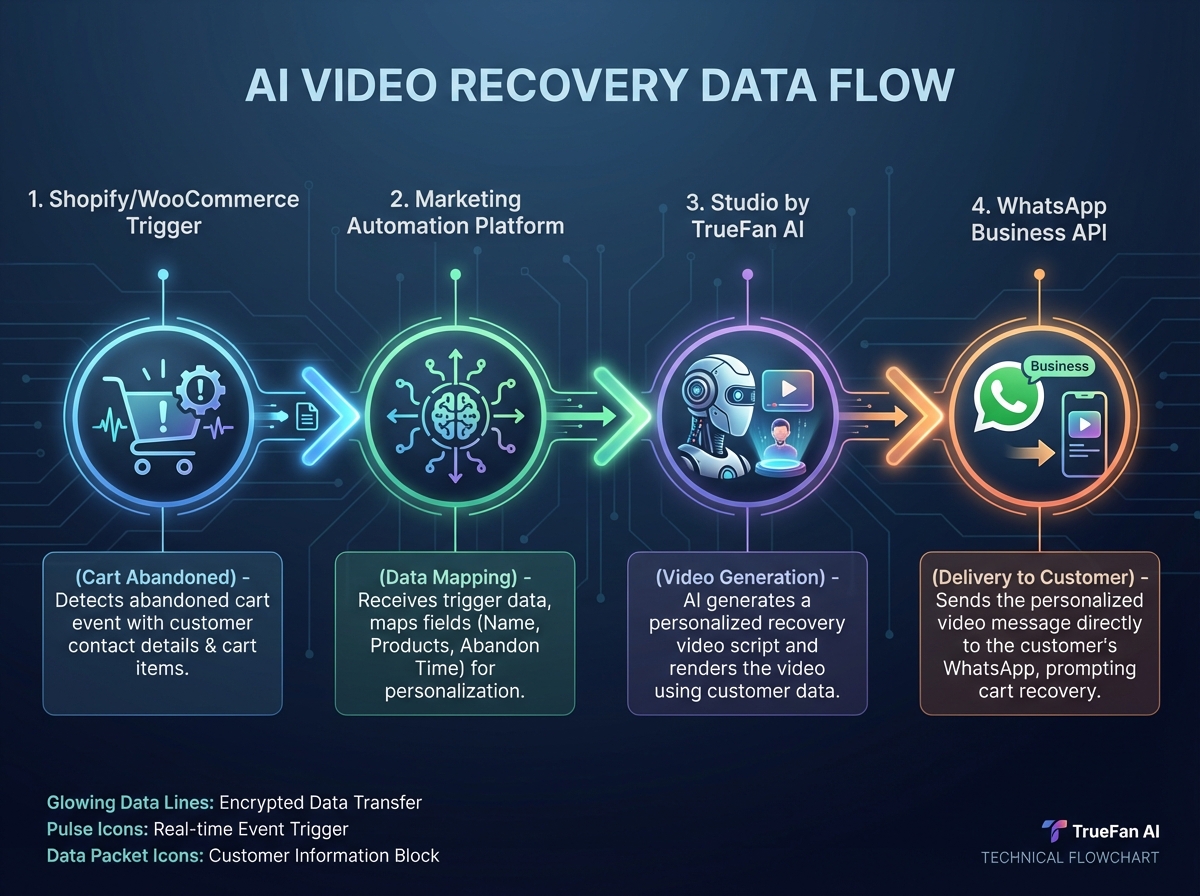
Your e-commerce platform (Shopify/WooCommerce) should trigger events to your Marketing Automation Platform (MAP) like WebEngage or Klaviyo.
- Event: Checkout Started (but not Order Placed).
- Data Captured: User Name, Phone Number, Product Name, Product Image URL, Cart Value, Language Preference (based on IP or past behavior).
Technical Integration with Studio by TrueFan AI
Studio by TrueFan AI’s 175+ language support and AI avatars allow brands to automate this at scale. The technical flow looks like this:
- Trigger: Shopify sends a webhook to your MAP when a cart is abandoned.
- Generation: The MAP calls the TrueFan AI API, passing the user’s name and product details.
- Rendering: Studio by TrueFan AI generates a personalized 15-second video in under 60 seconds. Generative Video AI Shootout
- Delivery: The video URL is pushed to your WhatsApp Business Service Provider (BSP) and sent as a template message.
This level of automation ensures that every single abandoned cart receives a personalized video nudge without any manual intervention from your marketing team. Furthermore, AI personalized follow-up videos Shopify can be used post-purchase to drive reviews and cross-sells, turning a one-time buyer into a loyalist.
5. Automation Recipes for D2C Retention Video Marketing Automation
Effective D2C retention video marketing automation requires a library of “recipes”—pre-defined rules that dictate when and what to send.
Recipe A: Personalized Cart Recovery Videos AI (The 3-Step Nudge)
- Nudge 1 (T+30m): “Hey [Name], we noticed you left your [Product] behind! Here is a quick look at why people love it.” (Video shows product benefits + 5% discount).
- Nudge 2 (T+8h): “Still thinking about it? Your cart is reserved for only 4 more hours.” (Video emphasizes urgency and social proof).
- Nudge 3 (T+24h): “Final call, [Name]! Your 10% discount expires in 60 minutes.” (High-incentive video).
Recipe B: AI Video Win-Back Campaigns India (Lapsed Buyers)
Target users who haven’t purchased in 30, 60, or 90 days.
- Script: “Hi [Name], it’s been a while! We’ve missed you at [Brand Name]. Check out these new arrivals we picked just for you based on your last purchase of [Previous Product].” AI UGC Video Creator India
- Personalization: Reference their last purchase and regional festivals (e.g., Diwali or Holi) to make the message feel timely.
Recipe C: Repeat Purchase Video Campaigns D2C (Consumables)
For brands selling skincare, health supplements, or coffee, trigger a video 5 days before the expected depletion of the product.
- Script: “Running low on [Product]? Don’t break your routine! Tap below to refill in one click and get free shipping.”
Using retention marketing video automation tools allows you to run these complex, multi-cohort campaigns simultaneously, ensuring that no revenue opportunity is missed.
6. Measuring ROI and Compliance (DPDP Act 2023)
To justify the investment, brands must look beyond open rates and focus on the abandoned cart video marketing ROI India.
The KPI Tree
- Video Watch Rate: What percentage of users watched at least 50% of the video? (Target: >60%).
- Checkout Completion Rate: The percentage of users who clicked the video and completed the purchase.
- RTO Reduction: For COD orders, does a video confirmation nudge reduce the number of refused deliveries? (Target: 15–20% reduction).
- Revenue Recovered: Total incremental revenue generated by the video flows.
Solutions like Studio by TrueFan AI demonstrate ROI through higher engagement metrics and significant reductions in RTO, which is a major cost center for Indian D2C brands.
Data Privacy and Compliance
In 2026, compliance with the Digital Personal Data Protection (DPDP) Act 2023 is non-negotiable. Brands must ensure:
- Explicit Consent: Users must opt-in to receive WhatsApp communications.
- Data Minimization: Only use the data necessary for personalization (e.g., don’t store sensitive health data if not required).
- Right to Erasure: Provide a clear “Unsubscribe” or “Stop” option in every WhatsApp message.
- Security: Ensure your AI video partner is ISO 27001 and SOC 2 certified to protect customer data during the generation process.
Source: PRS India: Digital Personal Data Protection Act 2023 Summary
7. Implementation Checklist
30-Day Rollout Checklist
- Week 1: Audit your current abandonment rate and identify the biggest drop-off points (Shipping, Trust, or Price).
- Week 2: Set up your data mapping between Shopify/WooCommerce and your MAP.
- Week 3: Create your first AI video template in Studio by TrueFan AI (choose an avatar, script, and language). AI video prompt engineering 2026 masterclass
- Week 4: Launch a pilot “Recipe A” flow for 20% of your abandoned carts and measure the lift against your baseline.
By following this playbook, Indian D2C brands can turn cart abandonment from a source of frustration into a powerful engine for growth and customer loyalty in 2026.
Conclusion
Cart abandonment in India’s mobile-first market won’t be solved by legacy nudges. A WhatsApp-native, AI-personalized video strategy—powered by clean data flows and automation through platforms like Studio by TrueFan AI—can recover more carts, reduce RTO, and compound lifetime value. Start with the core WhatsApp flow, iterate on creatives and cohorts, and measure outcomes across watch rate, completion, and recovered revenue.
Frequently Asked Questions
How much does it cost to implement AI video for cart recovery?
Costs typically include a per-video generation fee and the WhatsApp template message fee. Compared to margin recovered from a ₹2,000 cart, ROI is often 5x–10x. Studio by TrueFan AI offers tiered pricing that scales with volume for both growing D2C brands and enterprises.
Will sending videos on WhatsApp get my number banned?
No—if you use official WhatsApp Business APIs and approved templates. Keep content helpful (not spammy), and include clear opt-out instructions to maintain a high quality score.
How long does it take to see results?
Most brands see their first recovered orders within 7–10 days of launching the initial personalized cart recovery video flow, with meaningful trendlines after 30 days.
Can these AI-personalized videos work with WooCommerce?
Yes. WooCommerce supports cart recovery via webhooks and API integrations with major MAPs. The same data mapping and delivery templates apply.
Do we need to film new content every time?
No. You create or select a base avatar once. The AI personalizes name, product, offer, and language dynamically for each user at send-time.



