CTV Performance Video Marketing India: How to Scale AI Video Ads on Smart TV and OTT in 2026
8 min read
Key Takeaways
- CTV has evolved into a core performance channel in India, reaching over 60 million households with high attention spans.
- AI-driven creative automation is the only way to scale the hundreds of localized video variants required for the Indian market.
- Measurement is no longer a "black box" thanks to QR code tracking and cross-device attribution models.
- A full-funnel strategy that uses CTV for awareness and mobile for retargeting maximizes ROAS in 2026.
The digital advertising landscape in India has reached a definitive tipping point. As we move through 2026, the dominance of social media as the sole driver of performance is being challenged by the explosive rise of the "big screen" in the living room. For media buyers and performance marketers, CTV performance video marketing India has transitioned from a branding luxury to a core performance necessity. With over 60 million CTV households and a projected ₹2,500 crore in dedicated ad spend, the ability to scale high-converting video ads on Smart TVs and OTT platforms is now the primary differentiator for high-growth brands.
Performance video beyond social media is no longer just about "reach"; it is about precision, addressability, and measurable ROI. In this guide, we explore how to navigate the complex ecosystem of connected TV video ads 2026, leveraging AI-driven creative automation and advanced attribution to dominate the Indian market.
1. The 2026 Market Outlook: India’s CTV and OTT Explosion
The Indian advertising ecosystem is witnessing a massive structural shift. According to the latest WPP TYNY reports, retail media and CTV are the twin engines powering India’s projected ₹2 lakh crore total advertising expenditure (AdEx) in 2026. This growth is driven by a fundamental change in how Indian consumers consume long-form content.
The Scale of the Opportunity
By early 2026, the CTV user base in India has surged, following an 87% year-on-year growth that brought the addressable audience to over 129 million users. This isn't just a metropolitan phenomenon; the proliferation of affordable Smart TVs and fiber-to-the-home (FTTH) connections has brought high-quality streaming to Tier 2 and Tier 3 cities.
Key statistics defining the 2026 landscape include:
- Budget Migration: Approximately 35% of traditional linear TV ad budgets in India have officially shifted to CTV as of 2026.
- Household Penetration: 60 million households are now reachable via CTV, offering a "lean-back" environment with significantly higher attention spans than "lean-forward" social feeds.
- Ad Spend: The CTV-specific ad market has hit the ₹2,500 crore mark, reflecting a mature ecosystem ready for performance-driven campaigns.
Defining the Inventory: CTV vs. OTT
To master CTV performance video marketing India, marketers must distinguish between the device and the delivery:
- Connected TV (CTV): Refers to the hardware—Smart TVs, Android TV boxes, Fire TV sticks, and OEM FAST (Free Ad-supported Streaming TV) channels. It offers the "big screen" experience with digital targeting.
- Over-the-Top (OTT): Refers to the service or app—JioCinema, Sony LIV, Disney+ Hotstar, Zee5. These apps are accessible across CTV, mobile, and desktop, creating a multi-screen environment for performance video beyond social media.
Source: exchange4media - CTV Ad Spends, BestMediaInfo - WPP TYNY 2026
2. OTT Video Advertising Automation: The New Production Playbook
The biggest barrier to scaling connected TV video ads 2026 has historically been the cost and time of production. Performance marketing requires constant testing—different hooks, offers, and localizations. Traditional video production cannot keep up with the demand for 50+ variants per week. This is where OTT video advertising automation becomes critical.
The Automated Production Pipeline
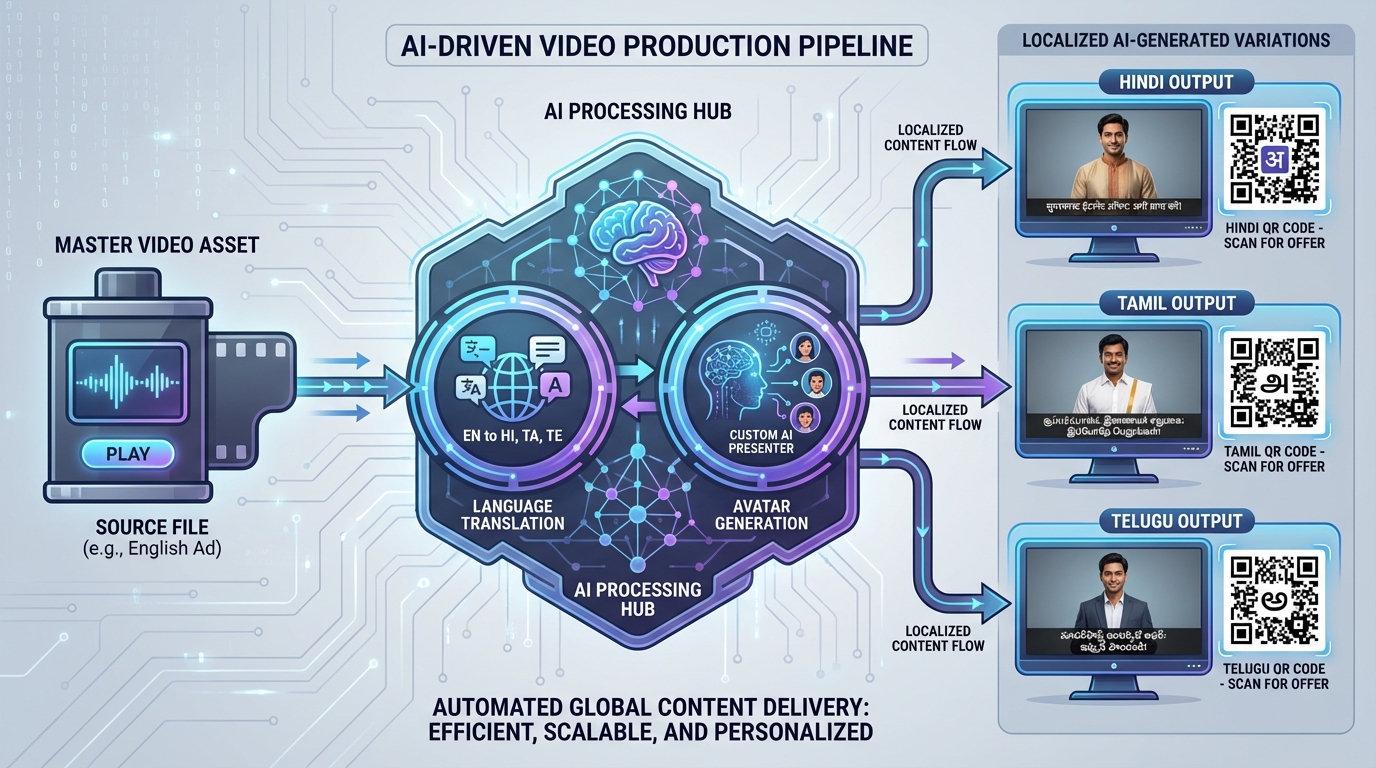
In 2026, leading performance agencies have moved to a "feed-based" creative model. Instead of editing individual videos, marketers use an input layer consisting of product feeds, regional pricing, and language matrices.
- Input Layer: Dynamic data points like "Discount %," "City Name," or "Festival Offer" are pulled from a central spreadsheet or API.
- Creative Layer: Modular templates are designed with "safe zones" for QR codes and CTAs. These templates are built for 16:9 (CTV) and 9:16 (Mobile) aspect ratios simultaneously.
- Localization: India’s linguistic diversity requires more than just subtitles. Automation tools now handle AI-driven voiceovers and lip-syncing in Hindi, Tamil, Telugu, Bengali, and Marathi.
- QA Layer: Automated checks ensure that audio levels meet the broadcast standard of -24 LKFS ±2 and that all brand colors are consistent across variants.
Platforms like Studio by Truefan AI enable performance marketers to bypass traditional production bottlenecks by generating hundreds of personalized video variants from a single script or product feed, ensuring that every ad is relevant to the specific viewer's region and language. For production-grade pipelines, see the latest infrastructure guides.
Technical Compliance for India
Unlike social media, CTV and OTT platforms often have stricter technical requirements. Automation must account for:
- VAST/VPAID Compatibility: Ensuring tags work across different SSPs (Supply Side Platforms).
- SSAI (Server-Side Ad Insertion): Preparing creatives that can be seamlessly stitched into the stream to prevent ad-blockers and buffering.
3. Smart TV Ad Campaigns AI: Creative Strategies for High Conversion
Creative is the most significant lever for ROAS in smart TV ad campaigns AI. In 2026, the focus has shifted from high-gloss cinematic ads to "Performance-First" creative that utilizes AI to drive action.
AI-Powered Presenters and Avatars
One of the most effective trends in 2026 is the use of AI avatars as on-screen presenters. These virtual humans can deliver personalized instructions—such as "Scan the QR code now to get 20% off in Bengaluru"—with a level of speed and cost-efficiency that human actors cannot match.
Studio by Truefan AI's 175+ language support and AI avatars allow brands to localize campaigns for India’s diverse linguistic landscape, ensuring that a viewer in Chennai sees a Tamil-speaking avatar while a viewer in Lucknow sees a Hindi-speaking one, all within the same campaign flight.
The "Testing" Framework for CTV
To optimize for performance, marketers should run weekly creative learning agendas. Key elements to test include:
- The Hook: Test an "Offer-First" vs. a "Problem-First" opening in the first 3 seconds.
- QR Code Prominence: Experiment with the size, color contrast, and dwell time of the QR code on the screen.
- CTA Phrasing: Compare "Download the App" with "Get Your Exclusive Offer."
- Vernacular vs. Hinglish: Determine if pure regional language or a mix (Hinglish) performs better for specific urban cohorts.
Performance marketing trends for Indian brands emphasize that AI-powered optimization is no longer optional; it is the only way to manage the complexity of multi-channel performance at scale.
Source: Webenza - Performance Marketing Trends India
4. Performance Marketing CTV India: KPIs, ROAS, and Attribution Tracking
The "black box" of TV measurement has been cracked. In 2026, CTV attribution tracking India relies on a sophisticated mix of deterministic and probabilistic data to prove the value of every rupee spent.
Defining the KPI Hierarchy
Performance marketers must look beyond "Impressions" and "Completion Rates." The new hierarchy includes:
- Primary KPIs: Site visits, App installs (via QR scans), and direct purchases.
- Secondary KPIs: QR scan rate, add-to-cart, and landing page dwell time.
- Derived KPIs: Incremental ROAS and Cost Per Incremental Visit (CPIV).
The Attribution Stack
Tracking a "lean-back" medium like CTV requires a cross-device approach.
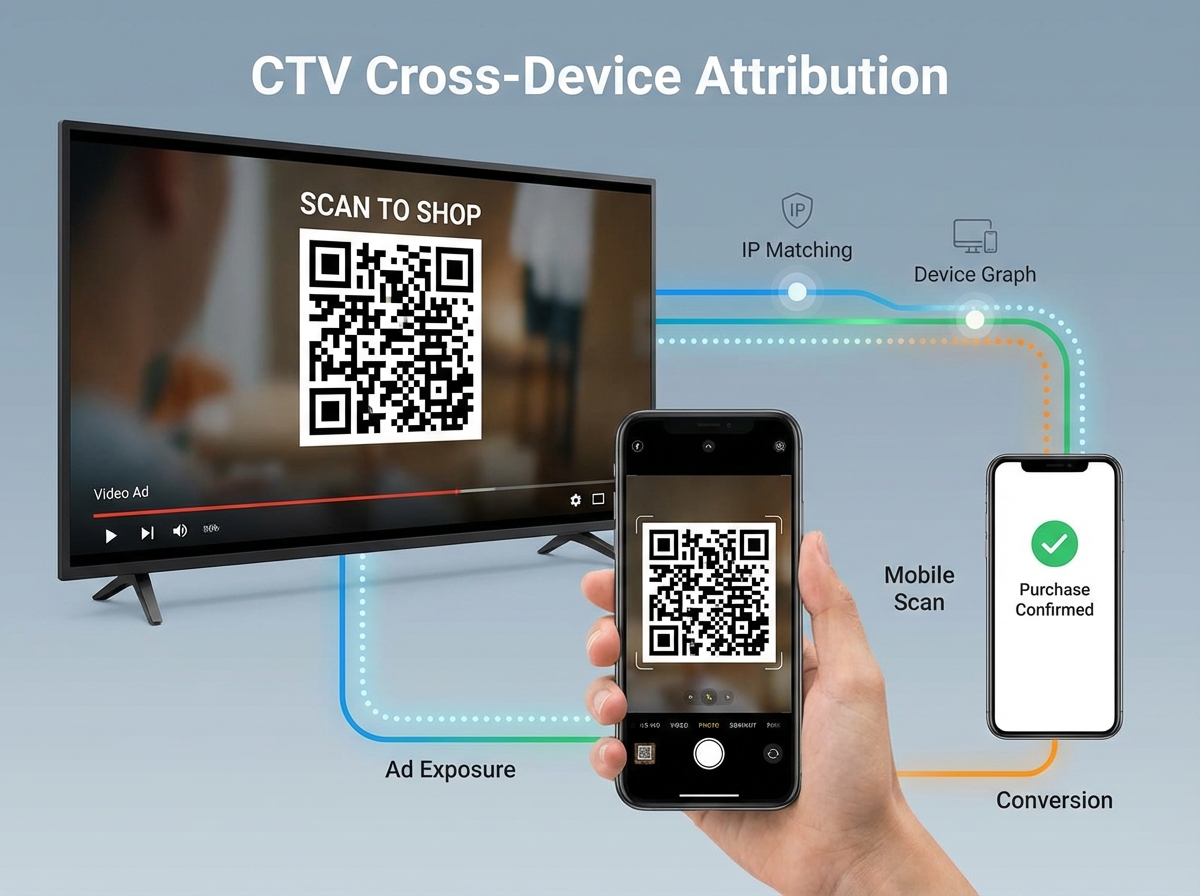
- Deterministic Tracking: When a user scans a QR code on their TV using their mobile phone, the UTM-parameterized link provides a direct, 1:1 link between the CTV exposure and the conversion.
- Probabilistic Attribution: Using IP matching and device graphs, platforms can associate a CTV ad exposure at a specific household with a subsequent app install or website visit from a mobile device on the same Wi-Fi network.
- Incrementality Testing: This is the gold standard in 2026. By using "Geo-Holdouts" (e.g., running ads in Mumbai but not in Delhi), brands can measure the true "lift" generated by CTV compared to a baseline.
Solutions like Studio by Truefan AI demonstrate ROI through consistent creative IDs and metadata exports that allow these attribution models to function seamlessly, ensuring that every creative variant is tracked from the moment it is rendered to the moment it converts.
5. Full-Funnel Orchestration: Connected Device Video Strategy
A successful connected device video strategy treats the TV not as an island, but as the "top of the funnel" that feeds the rest of the ecosystem. In 2026, the most successful campaigns use CTV to build high-quality awareness and then use mobile/desktop for the final "nudge."
The Sequential Storytelling Model
- Phase 1 (CTV): A 30-second high-impact ad introduces the brand and the value proposition on the big screen. The goal is household-level reach and "brand favorability."
- Phase 2 (Mobile Retargeting): Within 24 hours of the CTV exposure, the same household receives a 15-second "Urgency" ad on their mobile devices (via social or display) with a direct "Shop Now" link.
- Phase 3 (Conversion): If the user hasn't converted, a final personalized video via WhatsApp or SMS—localized in their regional language—provides a final discount code.
Frequency Management across Devices
One of the biggest pitfalls in cross-device video marketing is over-saturation. In 2026, programmatic platforms allow for "Household Frequency Capping." This ensures that a family isn't bombarded with the same ad 20 times a day across their TV, tablets, and phones, which preserves brand sentiment and reduces wasted spend.
6. Programmatic Video CTV: Buying Routes, Brand Safety, and Fraud Control
As 35% of TV budgets shift to digital, the "how" of buying has changed. Programmatic video CTV campaigns are now the default for performance buyers in India because they offer the targeting and flexibility that direct "bulk" buys lack.
Buying Routes in 2026
- Programmatic Guaranteed (PG): Best for securing "premium" inventory during high-traffic events like the IPL or major Bollywood premieres. You get guaranteed volume with programmatic targeting.
- Private Marketplaces (PMPs): The "sweet spot" for performance. Marketers bid on curated inventory from top broadcasters (Jio, Hotstar) with floor prices, ensuring higher quality than the open auction.
- Open Auction: High risk, high reward. Best for massive reach at low CPMs, but requires stringent brand safety filters.
Brand Safety and Fraud Prevention
The rise of CTV has unfortunately attracted sophisticated ad fraud. In 2026, performance marketers must implement:
- SSAI Log Auditing: Verifying that the ad was actually "stitched" into the content and not just "fired" in the background.
- App-ads.txt & Sellers.json: Only buying from verified sellers to avoid "spoofed" inventory.
- IVT (Invalid Traffic) Filters: Using partners like IAS or DoubleVerify to ensure that "views" are coming from real humans, not bot farms. Brand safety enforcement guide provides more details on AI-driven protection.
Source: exchange4media - CTV Budget Shift
7. The 2026 Launch Checklist
To succeed in CTV performance video marketing India, your execution must be flawless. Use this checklist to ensure your campaign is ready for the 2026 market.
- Creative Specs: 16:9 aspect ratio, 4K resolution (where supported), 15–30 second duration.
- Audio Normalization: Audio mixed to -24 LKFS ±2 for broadcast compliance.
- QR Code Optimization: High contrast, placed in a "safe zone" (not too close to the edge), and visible for at least 10 seconds.
- Localization: Voiceover and subtitles in at least the top 3 regional languages for your target market.
- Attribution Setup: UTMs for QR codes, MMP (Mobile Measurement Partner) integration for cross-device tracking.
- Frequency Caps: Set at the household level (e.g., 3 exposures per week).
- Brand Safety: PMP-first strategy with IVT filters enabled.
Conclusion
The era of "spraying and praying" on television is over. CTV performance video marketing India has matured into a data-driven, automated, and highly accountable channel. By moving performance video beyond social media and into the living room, brands can capture the highest quality attention available in the digital age.
Success in this new frontier requires three things:
- AI-driven creative scale to handle localization and testing.
- Cross-device orchestration to turn views into actions.
- Rigorous attribution to prove every rupee of ROAS.
As the Indian consumer continues to upgrade their home entertainment, the brands that master the "big screen" will be the ones that win the market in 2026 and beyond.
Frequently Asked Questions
What are typical CPMs for CTV in India compared to social media?
In 2026, CTV CPMs in India typically range from ₹400 to ₹800 for premium PMP inventory. While this is higher than standard social media video CPMs (which might range from ₹150 to ₹300), the "Attention Adjusted" ROI is often higher on CTV due to 95%+ completion rates and the lack of "scroll-past" behavior.
How do QR codes actually drive performance on a non-clickable screen?
QR codes act as the "bridge" between the lean-back TV experience and the lean-forward mobile experience. In 2026, best practices include using "Dynamic QRs" that can change the offer based on the time of day or the viewer's location. High-performing campaigns see QR scan rates between 0.5% and 1.5% when the offer is compelling.
Which Indian languages should I prioritize for a national CTV campaign?
While Hindi is essential for North and Central India, performance data shows that Tamil, Telugu, and Kannada often deliver higher ROAS for e-commerce and fintech categories due to higher digital maturity in Southern markets. A "Vernacular-First" strategy is highly recommended.
How do I measure "Incrementality" on CTV?
The most effective method is the "Matched Market Test." You select two similar regions (e.g., Pune and Ahmedabad), run CTV ads in one and keep the other as a control. By comparing the "organic" lift in app installs or site visits between the two cities, you can calculate the exact contribution of your CTV spend.
How can AI avatars fit regulated categories (like Insurance or Gaming) ethically?
Ethical AI use is paramount in 2026. Platforms like Studio by Truefan AI include built-in moderation filters, a "consent-first" model for all avatar likenesses, and digital watermarking to ensure transparency. Furthermore, their ISO 27001 and SOC 2 certifications ensure that enterprise-level data security and compliance standards are met for regulated industries.
Can I use CTV for "App Install" campaigns?
Yes. By pairing a CTV ad with a QR code that leads directly to the iOS App Store or Google Play Store, and using an MMP like AppsFlyer or Adjust, you can track "View-Through Installs" where a user sees the ad on TV and later downloads the app on their phone.



