AI Video Regional OTT Content India 2026: 10x-Faster Multilingual Trailers, Dubbing, and Promos for Vernacular Audiences
Estimated reading time: ~12 minutes
Key Takeaways
- AI localization enables 5–7x faster, up to 10x cheaper multilingual dubbing and promo production for India’s regional OTT growth in 2026.
- High-impact stack: neural TTS, voice cloning, phoneme-aligned lip-sync, glossary-constrained MT, and automated OST/motion graphics.
- Language nuance matters—workflows tuned for Bengali, Tamil, and Telugu deliver natural tone, timing, and cultural relevance.
- Automated promo pipelines generate trailers, episodic clips, and social assets that lift CTR and completion rates across platforms.
- An enterprise-grade platform like Studio by TrueFan AI supports rapid implementation with HITL, APIs, and governance to scale to 6 languages in 60 days.
AI video regional OTT content India 2026 solutions now let platforms like Hoichoi, Sun NXT, aha, and ZEE5 regional compress dubbing and promo timelines by 5–7x and costs by up to 10x versus traditional studios while expanding reach across Bengali, Tamil, Telugu, Malayalam, and Kannada. As India’s OTT video consumption moves decisively toward regional languages and Connected TV (CTV) in 2026, the demand for rapid localization at scale has reached a critical tipping point. Platforms like Studio by TrueFan AI enable these streaming giants to bypass the traditional studio bottlenecks that previously throttled their expansion into Tier-2 and Tier-3 markets.
The shift is no longer speculative; it is a fundamental market reality. Regional content yields 1.5–2x higher engagement compared to English-language counterparts in India, while simultaneously offering lower CPC (Cost Per Click) and CPA (Cost Per Acquisition) metrics. With CTV growth exploding and rural internet penetration deepening, the need for OTT platform video localization at scale has become the primary differentiator between market leaders and those struggling with high churn.
1. The Vernacular Tsunami: Why 2026 is the Year of Regional OTT
The Indian media landscape in 2026 is defined by a “vernacular-first” architecture. According to recent data, over 73% of India’s internet subscribers now prefer consuming content in their native regional languages. This isn't just a preference; it's a behavioral shift that has seen regional language streams account for over 52% of total OTT viewing as of early 2026.
The CTV and Tier-2/3 Catalyst
2026 has officially been dubbed the “Year of Connected TV” in India. Two key trends are driving this: the massive expansion of local-language content and the precision targeting capabilities of CTV platforms. As EY India notes, platforms are prioritizing local-language UX and ad formats to capture the attention of the next 200 million viewers. This demographic resides largely in Tier-2 and Tier-3 cities, where vernacular streaming content AI is the only viable way to produce the sheer volume of localized marketing assets required to stay relevant.
The ROI of Localization
The financial incentive for OTT content localization AI scale is staggering. Digital marketing trends for 2026 indicate that regional content generates significantly higher engagement rates. For an OTT platform, this translates to:
- 15–30% lift in completion rates for localized trailers.
- 2–3x higher Click-Through Rates (CTR) on regional social media promos.
- Significant reduction in CAC as regional creatives outperform generic Hindi or English ads in local feeds.
Sources:
- IndiaDigitalAdvertising.com – Digital Marketing Trends for 2026
- Campaign India – 2026: The Year of Connected TV
- EY India – Indian Media and Entertainment Report 2026
2. From Studio Bottlenecks to AI Automation: The Efficiency Revolution
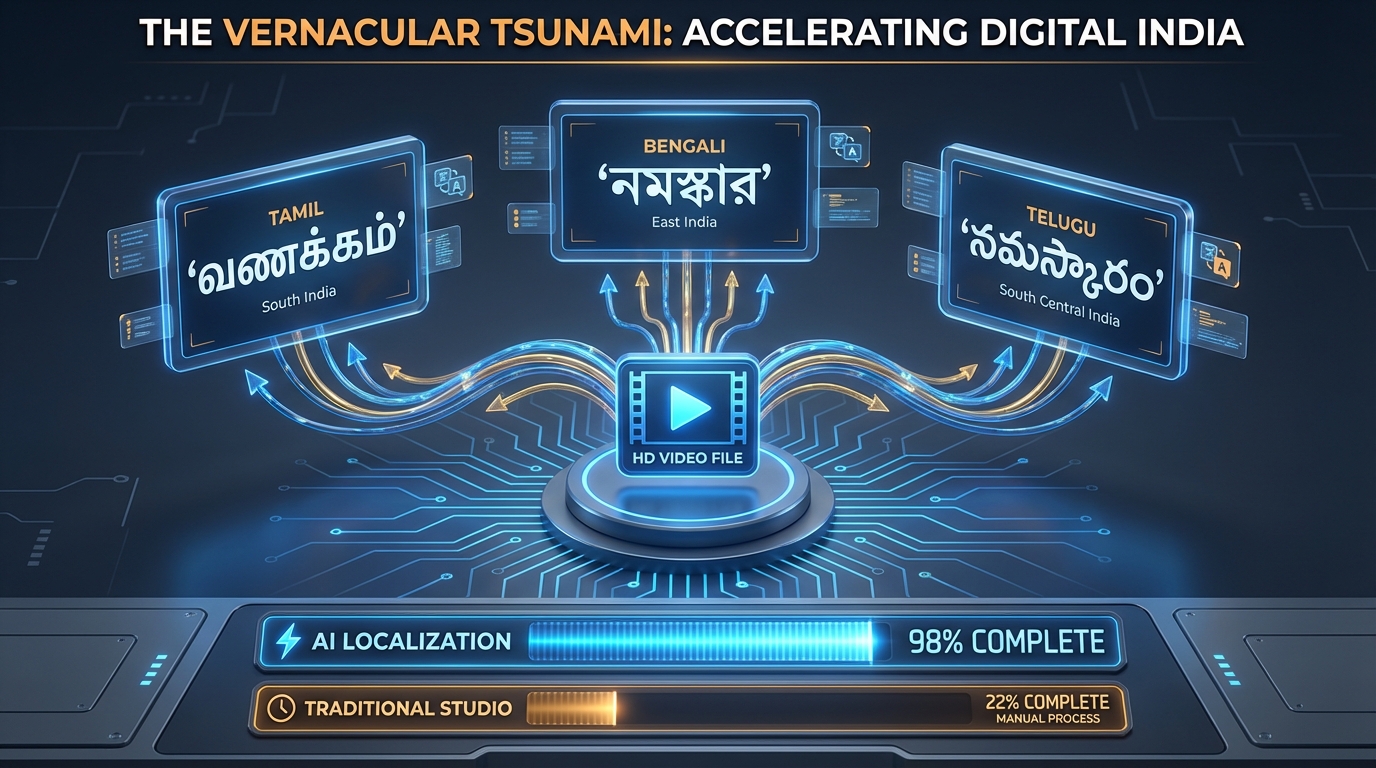
Traditional dubbing and promo creation have long been the “speed limiters” of the OTT industry. The legacy workflow—involving human translation, voice actor casting, studio bookings, manual lip-sync direction, and multi-pass QC—often takes weeks for a single series. In the fast-paced world of AI video regional OTT India 2026, these timelines are no longer acceptable.
The Traditional vs. AI-Augmented Stack
The traditional flow is plagued by scheduling delays and limited language concurrency. If you want to launch a show simultaneously in five languages, you need five separate studio teams. Conversely, an AI-augmented stack utilizes:
- Neural TTS & Voice Cloning: AI voice cloning for Indian accents generating natural, context-aware voice-overs with speaker style control.
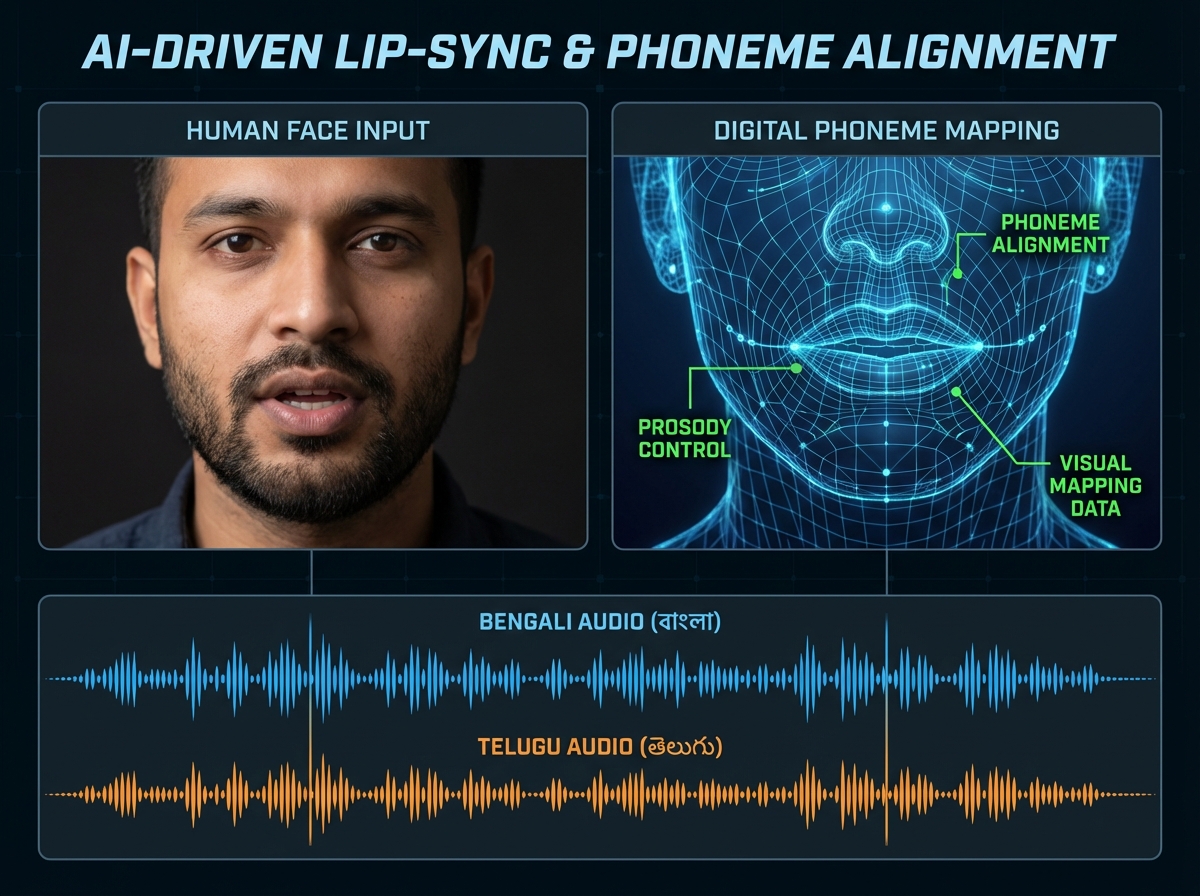
- Phoneme-Aligned Lip-Sync: Lip-sync accuracy benchmark for India ensuring the visual mouth movements match the target language audio with high precision.
- Machine Translation with Glossary Constraints: Maintaining consistency in character names, fictional locations, and cultural idioms.
- Automated OST & Motion Graphics: Instantly translating on-screen text while maintaining brand fonts and kerning.
Quantified Deltas for 2026
For OTT teams, the transition to regional entertainment video automation delivers measurable performance gains. We are seeing a 5–7x faster turnaround—moving from days to hours for promos, and weeks to days for full episodes. Furthermore, unit costs for high-volume social clips and episodic teasers have dropped by up to 10x. This allows platforms to flood the market with localized assets that were previously cost-prohibitive.
Sources:
3. Mastering the Linguistic Nuance: Bengali, Tamil, Telugu, and Beyond
One of the biggest gaps in current AI discourse is the failure to recognize that “Indian languages” are not a monolith. Achieving broadcast-quality vernacular content dubbing AI requires a deep understanding of the phonetic and cultural nuances of each specific region.
Bengali Tamil Telugu Dubbing AI: The Technical Challenges
- Bengali: AI systems must handle the distinction between soft dental and retroflex consonants. Furthermore, the choice of honorifics (আপনি vs. তুমি) is critical for character consistency. Subtitle rendering must also account for the complex ligatures of the Bengali script to ensure mobile legibility.
- Tamil: As an agglutinative language, Tamil words can be significantly longer than their English or Hindi counterparts. South Indian content dubbing AI must manage these syllabic durations to maintain lip-sync without making the speech sound unnaturally fast.
- Telugu: The language features distinct vowel lengths and retroflex consonants. For platforms like aha, retaining the “mass-market” punchy delivery style of Telugu cinema is essential. The AI must be tuned to a filmic register rather than a flat, robotic tone.
Platform-Specific Workflows: Hoichoi vs. aha
The tone of the content dictates the AI configuration. AI dubbing for Hoichoi aha requires different “voice skins.” For Hoichoi’s gritty crime thrillers, the AI must maintain a dark, raspy timbre in Bengali. For aha, the focus is often on high-energy, vibrant Telugu dialogues. Studio by TrueFan AI's 175+ language support and AI avatars allow for this level of granular customization, ensuring that the localized version feels like an original production, not a secondary thought.
4. Automated Promo Pipelines: Trailers, Episodic Clips, and Social Assets
In 2026, a single trailer is no longer enough. To win the attention economy, OTT platforms need a regional language trailer creator capable of generating dozens of variants for different platforms and demographics.
Regional Trailer Automation AI
Modern systems now auto-select “hero shots,” detect emotional peaks through computer vision, and align beat-cuts to music cues. When combined with a regional series promo video AI, platforms can instantly generate localized “supers” (on-screen text) and end-cards for every target language.
Vernacular Episode Clips AI & Social Assets
The growth of “snackable” content means that vernacular episode clips AI is now a core requirement. These systems:
- Detect Character Entrances: Automatically cut 15-second clips of fan-favorite characters.
- Identify Catchphrases: Use NLP to find and clip iconic dialogues for social sharing.
- Optimize for Platform Specs: Export 9:16 vertical videos for Instagram Reels and YouTube Shorts with burned-in, high-contrast captions for silent autoplay.
These regional OTT social media clips are essential for driving “FOMO” (Fear Of Missing Out) and social discovery in vernacular circles, where WhatsApp and Telegram are primary content discovery engines.
Sources:
5. The Enterprise Stack: Studio by TrueFan AI
To execute this vision, platforms require a robust, enterprise-grade infrastructure. Solutions like Studio by TrueFan AI demonstrate ROI through a combination of speed, quality, and safety that consumer-grade tools cannot match.
Capabilities for OTT Localization
- Production-Grade Lip-Sync: Moving beyond simple “talking heads,” the platform offers phoneme-level alignment that meets the strict 120ms tolerance required for broadcast.
- Licensed AI Avatars: For character-led marketing, platforms can use an AI avatar for OTT promos. These are not CGI; they are digital twins of real influencers and actors, ensuring a “human” connection with the audience.
- In-Browser Editor: A “Canva-like” experience for OTT editors to quickly adjust subtitles, OST overlays, and aspect ratios without needing a heavy VFX suite.
- API & Webhook Integration: Seamlessly connecting to existing Content Management Systems (CMS) or Media Asset Management (MAM) tools like S3 or GCS for automated batch processing.
Safety, Governance, and Compliance
In the era of deepfakes, brand safety is paramount. The enterprise stack includes:
- Consent-First Model: Every voice and likeness is fully licensed and talent-approved.
- Real-Time Moderation: Automated filters for profanity, hate speech, and sensitive political topics across all 175+ languages.
- Traceability: Watermarked outputs and audit logs to ensure compliance with evolving Indian digital media regulations.
6. Implementation Blueprint: Scaling to 6 Languages in 60 Days
Transitioning to an AI-driven multilingual series marketing AI workflow doesn't happen overnight, but it is significantly faster than traditional scaling.
Phase 1: Audit and Pilot (Weeks 1–2)
Choose a flagship series and its trailer. Define your target languages (e.g., Hindi, Bengali, Tamil, Telugu, Malayalam, Kannada). Establish your KPIs: Are you looking for a lift in watch time, a reduction in CPV (Cost Per View), or faster time-to-market?
Phase 2: Pipeline Integration (Weeks 3–4)
Stand up your workspace and configure brand templates. This is where you set your “Human-in-the-Loop” (HITL) gates. While the AI does 90% of the work, a native speaker should perform a final “idiom check” to ensure cultural nuances are preserved.
Phase 3: Scale and Optimize (Weeks 5–8)
Expand from trailers to episodic promos and social clips. Start A/B testing different “hooks” in each language. For example, a romantic hook might perform better in Bengali, while an action-heavy hook might drive more clicks in Telugu. Use the data to refine your creative themes per region.
7. Frequently Asked Questions (FAQs)
See the consolidated FAQ section at the end of this article for detailed answers to the most common questions.
Conclusion: The Future is Local
The era of “one-size-fits-all” marketing in the Indian OTT space is over. As we move through 2026, the ability to speak to a viewer in their mother tongue—with the right accent, the right idioms, and the right cultural context—is the only way to achieve true market penetration.
By leveraging OTT content localization AI scale, platforms can finally match the speed of their production with the speed of their audience's appetite. Whether it's a gritty Bengali thriller or a high-octane Telugu drama, the tools now exist to make every viewer feel like the content was made specifically for them.
Ready to scale your regional reach? Book a 30-day enterprise localization pilot with Studio by TrueFan AI to stand up your dubbing, trailer automation, and regional OTT social media clips across 6 languages and hit measurable lifts in your next campaign cycle.
Frequently Asked Questions
How does Bengali Tamil Telugu dubbing AI ensure natural lip-sync?
Modern AI uses phoneme alignment, where the software analyzes the specific sounds of the target language and maps them to the visual movements of the actor's mouth. By controlling prosody (the rhythm and intonation of speech) and enforcing strict glossary constraints, the AI ensures that the dubbed audio feels organic to the visual performance. See the lip-sync accuracy benchmark for India for details.
Can we auto-create regional language trailer variants in hours?
Yes. By using a regional trailer automation AI combined with a regional language trailer creator, platforms can ingest a master trailer and output localized versions for 5+ languages in a single afternoon. This includes localized voice-overs, translated on-screen text, and platform-specific aspect ratios.
What is included in OTT platform video localization beyond just dubbing?
A comprehensive localization strategy includes translation and QC of scripts, subtitle generation, on-screen text (OST) localization, metadata translation (titles/descriptions), thumbnail localization, and the creation of various aspect-ratio variants (9:16, 1:1) for social media.
How do we produce regional OTT social media clips at volume?
Platforms use automated clip detection to identify high-engagement moments in an episode. These are then processed through a vernacular episode clips AI that adds captions, localized branding, and “hooks” designed for silent autoplay on social feeds, allowing for hundreds of assets to be generated weekly.
How does Studio by TrueFan AI handle talent approvals for AI avatars?
Studio by TrueFan AI operates on a consent-first model where all AI avatars for OTT promos are either fictional or created with the explicit, licensed consent of the talent. The platform includes robust moderation, watermarking, and audit logs to ensure that the use of digital twins remains compliant with brand guidelines and legal requirements.
What is the expected ROI for regional entertainment video automation?
Most platforms see a 5–7x reduction in production time and up to a 10x reduction in unit costs. More importantly, they typically experience a 15–30% lift in completion rates and a 2–3x increase in CTR for their localized marketing campaigns, directly impacting subscriber acquisition and retention.