
Nano-influencer tier-3 marketing 2026: A hyperlocal playbook for India’s regional expansion
Estimated reading time: 16 minutes
Key Takeaways
- Tier-3 growth in 2026 hinges on hyperlocal nano-influencers, community leaders, and village-level brand ambassadors.
- Shift budgets from CPM to outcome-tied micro-activations with pin-code level tracking (QR/coupon redemptions).
- Prioritize authentic, vernacular content optimized for WhatsApp status, Reels, Shorts, ShareChat, and Moj.
- Deploy grassroots/neighborhood marketing automation to scale personalized video variants and approvals.
- Prove success with hyperlocal ROI metrics: watch-through, shares, store footfall, redemptions, and creator-level attribution.
Nano-influencer tier-3 marketing 2026 is the most reliable path to authentic, affordable growth in India’s tier-3 towns—if brands pair hyperlocal influencer activation India with community leader partnerships, village-level brand ambassadors, and grassroots marketing automation tied to hyperlocal ROI measurement. As the digital landscape saturates in Tier-1 metros, the next billion users are found in the pin codes of “Bharat,” where trust is not built through celebrity endorsements but through the recommendation of a neighbor, a local teacher, or a trusted kirana owner.
The shift toward regional micro-influence campaigns is no longer a peripheral strategy; it is the core engine for enterprise growth in the coming year. By 2026, the Indian influencer marketing industry is projected to reach approximately ₹3,375 crore, growing at a compound annual growth rate (CAGR) of 18%. This surge is driven by a fundamental migration of marketing budgets away from broad-reach macro-influencers toward nano-creators who command deep, localized authority within specific linguistic and cultural pockets.
To succeed in this environment, CMOs and growth leaders must move beyond vanity metrics. The 2026 playbook requires a sophisticated blend of community-driven brand adoption and high-tech neighborhood marketing automation. This guide provides the strategic framework necessary to operationalize these grassroots efforts, ensuring that every rupee spent in Tier-3 India translates into measurable footfall, trial, and long-term brand loyalty.
Why tier-3 is different (and more valuable) in 2026
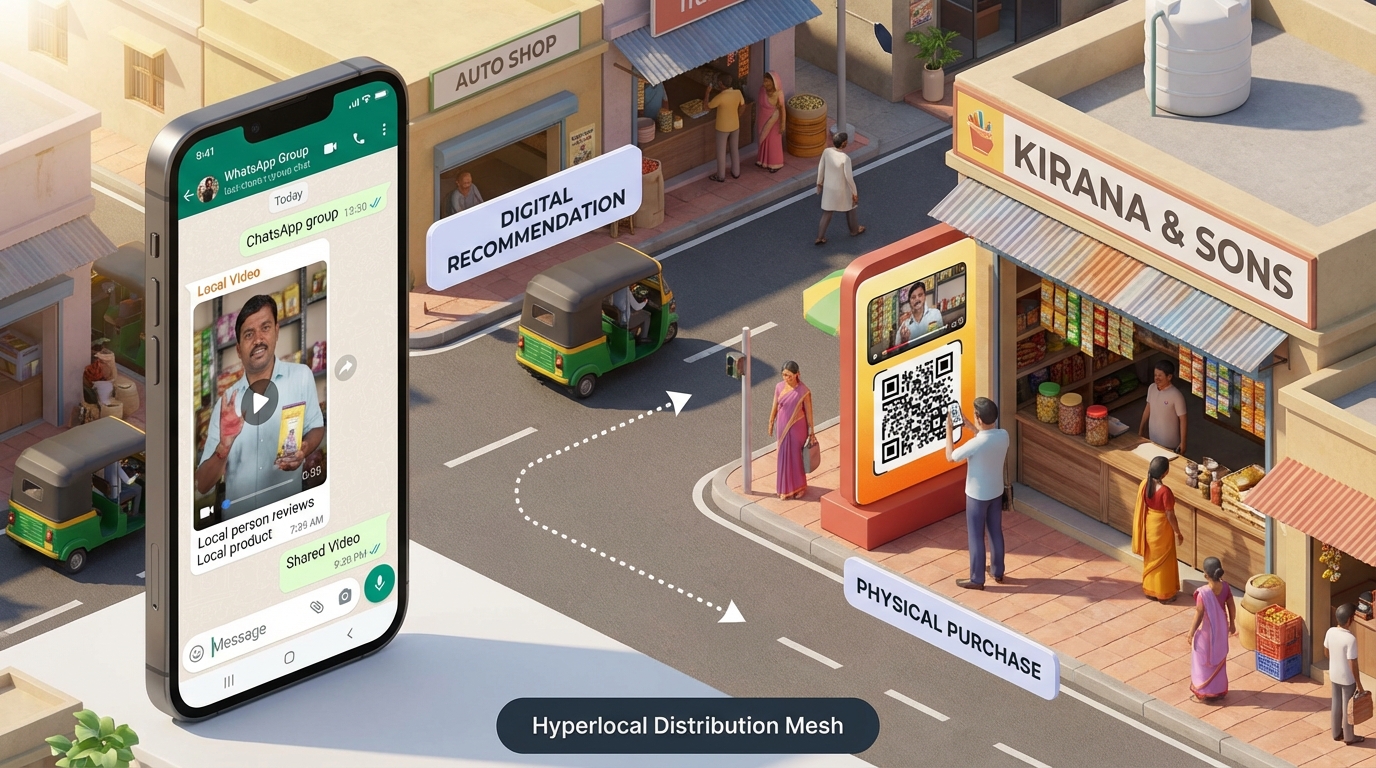
The behavioral gap between urban and rural digital consumers has widened, making traditional top-down marketing increasingly ineffective. In Tier-3 towns—typically defined as regions with populations between 100,000 and 500,000—discovery happens through a unique “distribution mesh.” This mesh consists of localized WhatsApp groups, regional short-form video platforms like Moj and ShareChat, and offline community nodes such as Self-Help Groups (SHGs) and local mandis.
In 2026, the media mix for a successful regional micro-influence campaign must reflect this reality. While Instagram Reels remain relevant, the “WhatsApp status” has become the primary vehicle for trust-based commerce in Bharat. Research indicates that short-form video is currently experiencing its “WhatsApp moment,” where content is shared not just for entertainment but as a functional tool for product discovery and peer validation. Brands that fail to penetrate these private, high-trust digital circles will find themselves locked out of the Tier-3 market.
Furthermore, the budget logic has shifted from traditional CPM (Cost Per Mille) models to outcome-tied micro-activations. In these regions, a nano-influencer with 5,000 followers often generates higher quality engagement than a macro-influencer with a million followers. This is because the nano-influencer is a known entity in their community; their recommendation carries the weight of a personal testimonial. By 2026, the most successful brands will be those that map their spending to specific pin-code level outcomes, such as unique QR code redemptions at local retailers or assisted conversions through village-level brand ambassadors.
Source: EY India Influencer Marketing Report
Source: Short-form video trends in Bharat
Source: 2026 Influencer Marketing Projections
Who to partner with—community leader partnerships and local entrepreneur collaborations
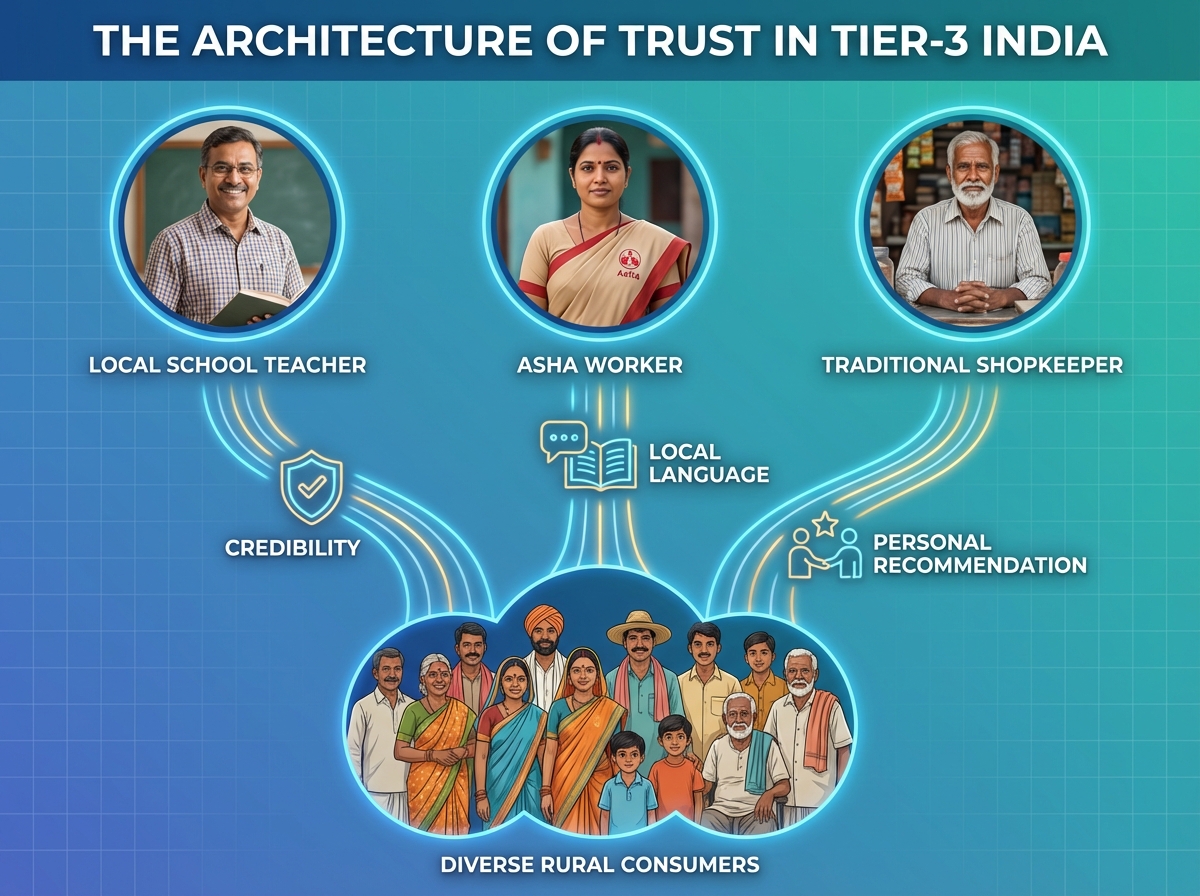
The architecture of trust in Tier-3 India is hierarchical and community-centric. To achieve community-driven brand adoption, enterprises must identify and partner with “trusted nodes”—individuals who already hold social capital within their wards or villages. These are not just content creators; they are community leader partnerships that bridge the gap between a digital message and an offline purchase.
Key partners include Panchayat members, ASHA (Accredited Social Health Activist) workers, local school teachers, and NGO coordinators. These individuals act as the ultimate gatekeepers of credibility. For instance, an ASHA worker recommending a nutritional supplement carries more weight than any digital ad. Similarly, local entrepreneur collaborations with kirana store owners or micro-entrepreneurs like tailors and delivery agents provide a “lived experience” narrative. When a local tailor explains how a specific fintech app helped them manage their business credit, it creates a relatable case study that resonates far more than a generic corporate tutorial.
To operationalize this, brands are increasingly adopting the village-level brand ambassadors model. These ambassadors are vetted locals trained to perform four critical roles: the storyteller (creating on-camera content), the convener (organizing local demos), the WhatsApp admin (distributing content to local groups), and the product explainer (providing post-purchase support). This multi-layered approach ensures that the brand is present at every stage of the consumer journey, from initial awareness to the final “hand-holding” required for first-time digital users.
Source: The rise of nano-influencers in India
Source: Why smaller creators win on trust
Hyperlocal influencer activation India—step-by-step playbook
Executing a successful hyperlocal influencer activation India requires a transition from manual outreach to a structured, data-driven workflow. The sheer scale of Tier-3 India—with thousands of towns and hundreds of dialects—demands a playbook that is both granular and scalable. The first step is community mapping by pin code. Brands must move beyond state-level targeting and identify 50–100 nano-creators per target town, capturing not just their follower count but their specific dialect, offline footprint, and presence in local WhatsApp communities.
The second phase involves rural influencer onboarding. This is often a coverage gap in traditional influencer marketing, where creators in smaller towns lack the professional infrastructure of their urban counterparts. A robust onboarding process includes background checks, dialect matching, and training on disclosure norms and brand FAQs. This ensures that the content produced is not only authentic but also compliant with evolving regulatory standards in the influencer space.
Once onboarded, the distribution mesh must be activated. This involves a sequenced content calendar that aligns with local festivals, harvest seasons (mandis), and school calendars. Content should not live on a single platform; it must be cross-pollinated across Instagram, YouTube Shorts, ShareChat, and Moj, with a heavy emphasis on WhatsApp status updates. To drive measurable action, every piece of content should be paired with a unique QR code or coupon tied to a specific local retailer. This allows the brand to track “sell-through” at the shop level, providing a clear link between digital engagement and physical sales.
Source: Short-form video adoption across Bharat
Source: Influencer marketing trends for 2026
Content that converts—authentic local content creation and tier-3 trust building videos
In the context of nano-influencer tier-3 marketing 2026, the “aesthetic” of the content is secondary to its “authenticity.” Tier-3 consumers have a high sensitivity to content that feels “too polished” or “too Mumbai.” Authentic local content creation relies on the “neighbor helps neighbor” narrative. This involves using local language influencer content that utilizes specific regional dialects and cultural nuances that a generic Hindi script would miss.
Platforms like TrueFan AI enable enterprises to bridge this localization gap by generating hundreds of personalized video variants that speak directly to the consumer in their native tongue. By utilizing TrueFan AI's 175+ language support and Personalised Celebrity Videos, brands can create a sense of “hyper-relevance” that was previously impossible at scale. For example, a video featuring a local hero or a relatable creator mentioning a specific town landmark or a local festival can increase engagement rates by up to 3x compared to generic assets.
The content stack for Tier-3 should include 30–45 second Reels for discovery, 10–15 second WhatsApp teasers for quick sharing, and 60–90 second “explainer” videos for product demos. These tier-3 trust building videos are essential for overcoming the “skepticism barrier” prevalent in new digital adopters. Narrative formulas like “Try it at my shop” or “How I used it in my business” provide the social proof necessary for a consumer to move from curiosity to purchase. Additionally, providing after-sales guidance via video helps reduce “buyer’s remorse” and builds the foundation for long-term advocacy.
Source: Vernacular video consumption in India
Source: The importance of regional content
Scale with confidence—grassroots marketing automation and neighborhood marketing automation
The primary challenge of hyperlocal marketing is the “complexity tax”—the operational overhead of managing thousands of creators and localized assets. This is where grassroots marketing automation becomes indispensable. Enterprises need a system that can auto-generate localized video variants whenever a new pin code or retail partner is activated. This neighborhood marketing automation ensures that the brand message remains consistent while the delivery remains hyper-local.
A sophisticated automation blueprint includes templates tied to specific pin codes and rules-based engines that trigger content delivery based on local events, such as a local fair or a sudden change in weather (relevant for agri-brands). Governance is equally critical; automated approval flows and brand safety checklists ensure that nano-creators, who may not be familiar with corporate guardrails, do not inadvertently misrepresent the brand. This level of control allows a small central team to manage a national network of thousands of village-level brand ambassadors.
Solutions like TrueFan AI demonstrate ROI through their ability to handle these complex workflows, offering API-triggered personalization that can render and deliver a personalized video in under 30 seconds. This allows brands like Zomato or Hero MotoCorp to send millions of personalized festive greetings or service reminders that feel like a 1-on-1 conversation. By automating the last mile of content creation, brands can focus on strategy and relationship building rather than the logistics of video editing and distribution.
Source: Influencer marketing budget shifts for 2025-2026
Source: EY India Media & Entertainment Report
Prove it works—hyperlocal ROI measurement and grassroots engagement analytics
To justify the investment in nano-influencer tier-3 marketing 2026, brands must move beyond “likes” and “comments” toward hyperlocal ROI measurement. This involves a KPI framework that tracks the consumer journey from digital discovery to offline adoption. At the discovery stage, metrics like “watch-through rate” (aiming for ≥50%) and “shares in local WhatsApp groups” are the primary indicators of resonance. However, the true measure of success in Tier-3 is the “trial” and “adoption” phase.
Grassroots engagement analytics should focus on unique QR code redemptions, store footfall lift, and assisted conversions. By geofencing offers and using creator-specific codes, brands can attribute a direct sales lift to a specific town or even a specific creator. This data allows for a “survival of the fittest” approach to creator management, where high-performing ambassadors receive higher incentive slabs while underperforming ones are replaced or retrained.
Furthermore, analyzing the “comment quality” is vital. In Tier-3 communities, comments often contain specific questions about price, availability, and usage. Tracking these trust cues provides invaluable feedback for the product and sales teams. A weekly dashboard that aggregates these insights at a town level allows brands to iterate their scripts and offers in real-time, ensuring that the campaign remains responsive to local market dynamics. This level of granular attribution is what separates a successful regional expansion from a failed experiment.
Source: Maturation of the influencer market in India
Source: Digital adoption trends in Tier-2 and Tier-3
90-Day execution blueprint for regional micro-influence campaigns
Scaling a hyperlocal strategy requires a disciplined, phased approach. The following 90-day blueprint is designed to take an enterprise from a pilot phase to a full-scale regional rollout, ensuring that the infrastructure for grassroots marketing automation is in place before the campaign goes live.
Days 0–15: Discovery and design
The initial two weeks are dedicated to community mapping and infrastructure setup. Brands should select 10–15 pilot tier-3 towns and identify the key community leader partnerships and nano-creators within those regions. Simultaneously, the technical foundation must be laid—this includes setting up the TrueFan AI workspace, defining the API triggers for personalization, and creating the legal guardrails for creator onboarding. Establishing a baseline for store footfall and sales in these target pin codes is essential for future ROI measurement.
Days 16–45: Pilot activation
During this phase, the focus shifts to rural influencer onboarding and content production. Creators are trained using AI-generated explainer videos in their local dialects, ensuring they understand the brand story and disclosure requirements. The first wave of content—focusing on problem-solution and product demos—is launched across the “distribution mesh.” Unique QR codes are attached to every asset, and the first sets of grassroots engagement analytics are collected to monitor initial resonance and redemption rates.
Days 46–75: Optimize and expand
With data from the pilot towns, the strategy is refined. Scripts are iterated based on watch-through insights, and the campaign expands to an additional 15–25 towns. This is where neighborhood marketing automation becomes critical, as the volume of localized assets begins to scale. Automated templates are used to refresh content for local festivals or store-specific offers, ensuring the brand remains top-of-mind without increasing the manual workload of the marketing team.
Days 76–90: Prove ROI and institutionalize
The final 15 days are focused on analyzing the hyperlocal ROI measurement outcomes. Successful village-level brand ambassadors are moved into long-term retainer models with performance-based incentive slabs. The results—showing the lift in sales, brand awareness, and community trust—are presented to stakeholders to secure the budget for a national rollout. By day 90, the brand has not just run a campaign; it has built a permanent, scalable influence network in Tier-3 India.
Frequently Asked Questions
How do you find reliable nano-influencers in Tier-3 Indian towns?
Finding reliable creators requires a combination of digital scraping and offline verification. Brands use tools to identify creators with high engagement in specific pin codes, followed by a vetting process that involves checking their standing within local community groups and their ability to communicate in the local dialect.
What is the typical ROI for a regional micro-influence campaign?
While ROI varies by category, successful campaigns in Tier-3 India often see a 2x to 4x higher conversion rate compared to Tier-1 digital ads. This is due to the lower cost of nano-creators and the significantly higher trust levels associated with local recommendations.
How does TrueFan AI help in scaling these hyperlocal campaigns?
TrueFan AI's platform allows brands to automate the creation of thousands of personalized, localized videos. By using AI-driven talking avatars and support for over 175 languages, TrueFan AI ensures that every consumer receives a message that feels personally crafted for them, regardless of their location or language.
Is WhatsApp a viable platform for influencer marketing in 2026?
Absolutely. In Tier-3 India, WhatsApp is the primary “trust layer.” Influencers sharing product demos or offers via their WhatsApp status or in local community groups often drive more direct sales than public posts on Instagram or YouTube.
How do you ensure brand safety when working with thousands of nano-creators?
Brand safety is managed through grassroots marketing automation tools that include automated approval layers, keyword filters, and strict content templates. Additionally, providing creators with pre-approved “asset packs” and AI-generated scripts helps maintain a consistent brand voice.
What are the most effective content formats for Tier-3 consumers?
The most effective formats are those that prioritize utility and social proof. This includes short-form “how-to” videos, “neighbor-style” testimonials, and festive greetings that include a localized offer or a call-to-action for a nearby retail store.