
Vernacular Voice Commerce Video India 2026: A Blueprint for Hindi, Tamil, Telugu Voice-Activated Shopping at Enterprise Scale
Estimated reading time: 12 minutes
Key Takeaways
- By 2026, voice-first and video commerce in vernacular languages becomes a must-have for reaching Bharat’s next 500M shoppers.
- Winning requires a robust ASR–NLU–TTS stack tuned for noisy environments, dialects, and Hinglish.
- AI avatars and voice-activated videos in Hindi, Tamil, and Telugu build trust, reduce returns, and lift conversions.
- Adopt AEO (Answer Engine Optimization) with structured data and speakable content to dominate voice search.
- Plan with a 3-phase roadmap and track KPIs like CVR, RTO, CAC, and voice query accuracy for ROI.
Vernacular voice commerce video India 2026 is no longer a futuristic concept; it is the operational standard for brands targeting the next 500 million shoppers in the Bharat market. As we approach 2026, the intersection of voice-first interfaces and short-form video content has created a new paradigm for digital retail. For e-commerce product teams and rural market leaders, the challenge is no longer just “going digital,” but “going local” through an audio-visual shopping experience that mirrors the trust and ease of an in-person interaction.
By 2026, India is projected to have over 900 million smartphone users, with the vast majority of new internet entrants coming from non-metro cities where regional languages like Hindi, Tamil, and Telugu are the primary modes of communication. Platforms like Studio by TrueFan AI enable enterprises to bridge the digital divide by transforming static product catalogs into interactive, voice-activated video journeys that resonate with the cultural and linguistic nuances of the Indian heartland.
1. The Bharat Opportunity: Why Voice and Video are Non-Negotiable in 2026
The “Bharat” market—comprising Tier-2, Tier-3, and rural areas—is the primary engine of India’s e-commerce growth. However, this demographic faces unique barriers: varying literacy levels, a preference for oral communication, and a deep-seated need for visual proof before purchase.
The Shift to Audio-Visual Trust
In 2026, the traditional text-heavy search bar is becoming obsolete for the rural shopper. Data from Redseer indicates that short-form video consumption in rural India has grown by 45% year-on-year, with users spending an average of 95 minutes per day on video platforms. When shopping, these users demand the same format. They want to see the product in action and hear about its benefits in their mother tongue.
Key 2026 Statistics & Trends:
- Smartphone Penetration: India will reach ~900 million smartphone users by 2026, with 65% of these users residing in non-metro areas.
- Voice Adoption: 40% of all e-commerce queries in India are now initiated via voice, a 3x increase from 2023.
- Video Commerce Growth: The video commerce market in India is expected to hit $15 billion by 2026, driven by rural demand for “live” and “explainer” content.
- Language Preference: 90% of new internet users in India prefer content in their local language over English.
Source: BuildMyStore/Deloitte
Source: Projected 2026 Market Data
Source: Redseer SFV Report
Source: Royalways 2026 Trends
Trust Drivers for Rural Shoppers
For a farmer in Madhya Pradesh or a small-business owner in Tamil Nadu, trust is built through:
- Regional Language Support: Eliminating the “language tax” where users struggle with English interfaces.
- Transparent Pricing: Voice-narrated price breakdowns and COD (Cash on Delivery) confirmations.
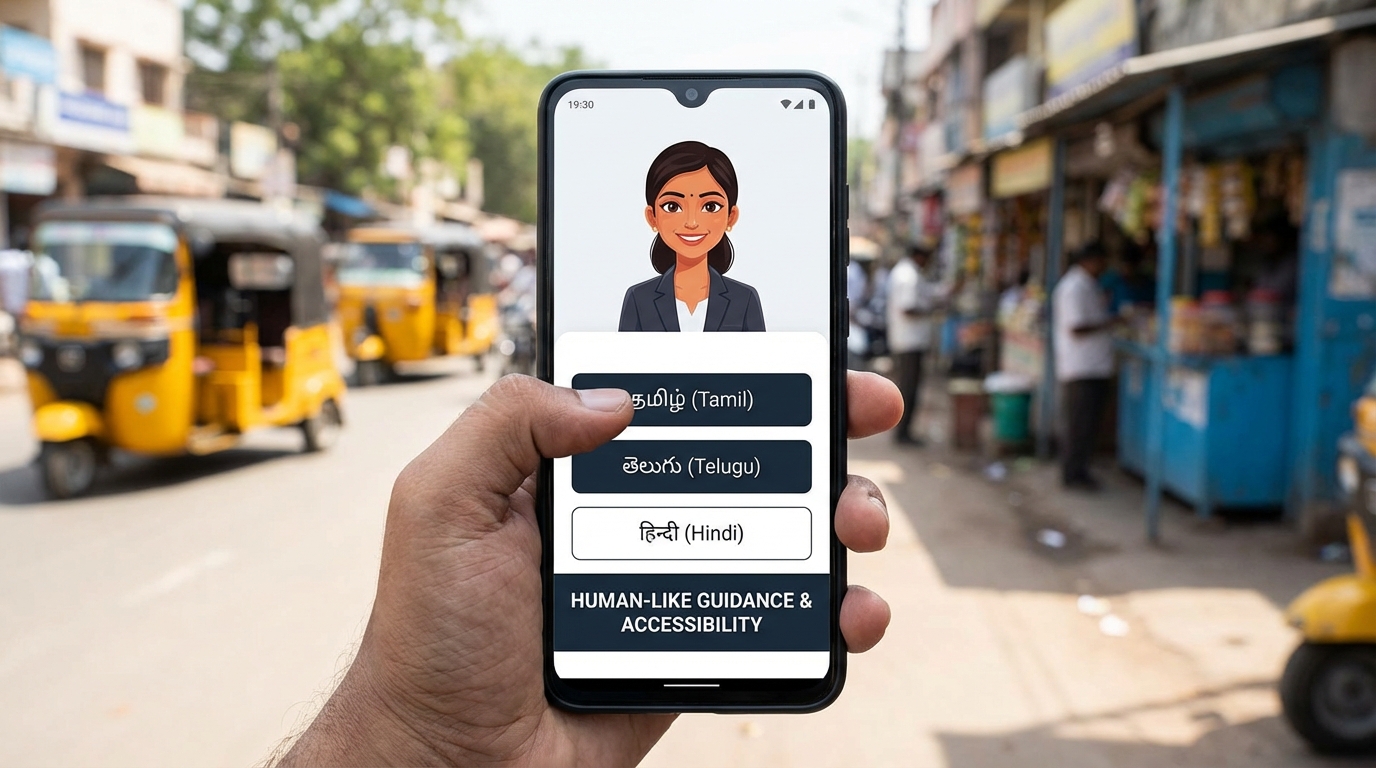
- Human-like Guidance: AI avatars that look and speak like local community members, explaining complex product features (e.g., how to use a specific pesticide or assemble a mixer-grinder).
2. Designing a Hindi Voice Shopping AI Platform That Actually Converts
Hindi is the most spoken language in India, but “Standard Hindi” is rarely what shoppers use. A successful Hindi voice shopping AI platform must account for “Hinglish” (code-switching) and regional dialects.
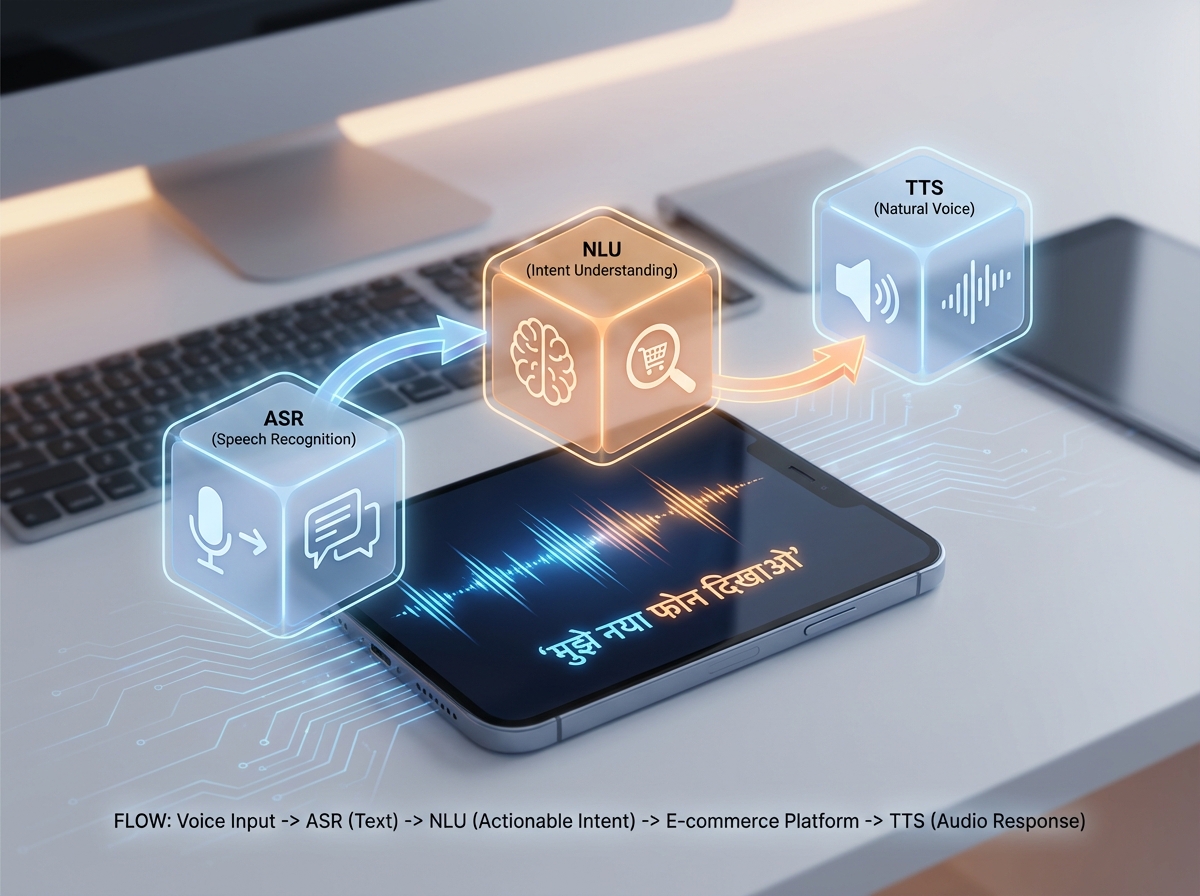
Technical Components of the Hindi Voice Stack
To build a high-converting platform, the following layers are essential:
- Automatic Speech Recognition (ASR): Must be tuned for noisy environments (busy markets, wind noise) and recognize colloquialisms.
- Natural Language Understanding (NLU): Needs to parse commerce-specific intents. For example, if a user says, “Mujhe 10,000 ke andar accha camera wala phone dikhao” (Show me a good camera phone under 10,000), the NLU must extract the category (phone), the constraint (under 10,000), and the feature priority (camera).
- Text-to-Speech (TTS): Moving beyond robotic voices to natural prosody. The AI should sound like a helpful shop assistant, not a machine. Explore AI voice cloning for Indian accents to achieve lifelike output.
Sample Hindi Intents and Logic
| User Utterance | Intent | Action |
|---|---|---|
| “Ye lal wala suit dikhao” | Visual Search / Referent Resolution | Highlight the red suit in the current video grid. |
| “Iska delivery kab tak hoga?” | Logistics Query | Fetch Pincode-based ETA from OMS. |
| “Ispe koi discount hai kya?” | Offer Discovery | Trigger a voice-over explaining current bank offers. |
Flipkart’s early adoption of a Hindi voice assistant set the stage for this evolution, proving that voice reduces the “search-to-cart” time by up to 30% for first-time users.
Source: The Hindu
3. Voice-Activated Product Videos in Tamil and Telugu: Localization Done Right
While Hindi covers a large swath of the North, the Southern markets of Tamil Nadu and Andhra Pradesh/Telangana represent some of the highest per-capita spending in Indian e-commerce. However, these markets are fiercely protective of their linguistic identity.
The Power of Voice-Activated Product Videos
Voice-activated product videos in Tamil and Telugu allow users to interact with the video itself. Instead of scrolling through a timeline, a user can simply ask a question while the video is playing.
Implementation Requirements:
- Accent Coverage: ASR models must distinguish between the Madurai and Chennai Tamil accents, or the Telangana and Andhra Telugu dialects.
- Lip-Sync Accuracy: Studio by TrueFan AI’s 175+ language support and avatars ensure that visual mouth movements match phonetic sounds of Tamil and Telugu, preventing the “uncanny valley.” Learn more about AI voice cloning for Indian accents.
- Chapterized Metadata: Videos should be tagged with voice-responsive timecodes. If a user asks, “ఈ ఉత్పత్తి వారంటీ ఎంత?” (What is the warranty on this product?), the video should instantly skip to the warranty section.
Cultural Nuances in Video Content
In 2026, localization goes beyond translation. It involves:
- Visual Context: Showing products in settings familiar to the region (e.g., a South Indian kitchen for appliance ads).
- Measurement Units: Using local terms (e.g., “gaj” or “bigha” in agri-commerce).
- Voice Personas: Using a “Periyavar” (elder) persona for financial products or a “Thozhi” (friend) persona for fashion in Tamil markets.
4. Building a Multilingual Voice Commerce Platform: The Enterprise Architecture
For a CIO, the goal is to build a scalable, secure, and integrated system. A multilingual voice commerce platform is not a standalone app but a layer that sits atop your existing e-commerce stack.
The 2026 Reference Architecture
- Ingestion Layer: Connects to your PIM (Product Information Management) and OMS (Order Management System) to pull real-time data.
- Intelligence Layer: The “brain” containing ASR, NLU, and TTS engines optimized for Indian languages.
- Media Orchestration: Generates AI avatars and video scripts; must handle batch rendering for thousands of SKUs.
- Experience Layer: Deliver content via Web SDKs, App integrations, or the WhatsApp Business API.
- Security & Compliance: ISO 27001, SOC 2, and strict data localization to adhere to India’s DPDP Act.
Integration with WhatsApp
In rural India, WhatsApp is the internet. A voice-first strategy must include a WhatsApp loop:
- User sends a voice note in Telugu asking about a product.
- The platform responds with a personalized AI avatar video in Telugu.
- The user completes the purchase via a UPI deep link within the chat.
Source: TrueFan AI Blog on Voice Commerce 2026
5. AI Avatar Voice Assistant Commerce: Humanizing the Digital Storefront
The primary reason for cart abandonment in rural markets is “product ambiguity.” Users are unsure if the product they see is the one they will get. AI avatar voice assistant commerce solves this by providing a “human” face to the digital transaction.
Use Cases for AI Avatars
- Virtual Sales Agents: Avatars that greet users in their local language and guide them through the onboarding process.
- Agri-Advisory: For rural India video commerce solutions, avatars can act as virtual “Krishi Mitras” (farming friends), explaining the dosage of fertilizers or the features of a tractor.
- Size & Fit Advisors: In fashion, an avatar can explain how a saree should be draped or how a brand’s “Large” compares to local tailoring measurements.
Accessibility Shopping Videos Rural
Accessibility is a major theme for 2026. For users with low literacy, text-based interfaces are a wall. Voice-first video shopping India breaks this wall. By providing:
- On-screen Captions: Synchronized with the voice-over in the local script (Devanagari, Tamil, etc.).
- High-Contrast UI: Optimized for outdoor use in bright sunlight (common in rural agricultural settings).
- Audio Descriptions: For visually impaired users, describing the product’s appearance via voice.
Source: ROI Hunt 2026 eCommerce Trends
6. Winning Voice Search Video Products India Through AEO
As voice search becomes the dominant discovery method, SEO is evolving into AEO (Answer Engine Optimization). To win voice search for video-first commerce in India, brands must structure their data so that AI assistants (like Alexa, Google Assistant, or in-app bots) can easily find and “speak” their content.
Strategic Actions for AEO
- VideoObject Schema: Every product video must have schema markup including
transcript,contentUrl, andthumbnailUrlin multiple languages. - Speakable Schema: Identify specific sections of your product descriptions or FAQs that are optimized for text-to-speech readout.
- Long-Tail Vernacular Keywords: Optimize for how people speak, not how they type. Instead of “Best DSLR 2026,” optimize for “Sabse accha camera kaunsa hai?”
- Micro-Moments: Create 15-second “intent-based” clips that answer specific questions (e.g., “How to clean this chimney?”) which can appear in Google’s “Video Perspectives” or “Shorts” carousels.
Source: India Digital Advertising 2026 Focus
7. Implementation Roadmap, KPIs, and ROI for Rural Markets
Launching a vernacular voice commerce video India 2026 initiative requires a structured 90-to-180-day roadmap.
The 3-Phase Roadmap
- Phase 1: Foundation (Weeks 1–6): Identify top 100 high-volume SKUs. Set up the ASR/TTS pipeline for Hindi. Integrate with existing PIM.
- Phase 2: Pilot & Localization (Weeks 7–14): Launch the Hindi voice-video pilot on the mobile app and WhatsApp. Begin training AI avatars for Tamil and Telugu.
- Phase 3: Scale & Optimization (Weeks 15–26): Roll out full multilingual support. Implement AEO strategies. Monitor KPIs and refine NLU models based on real user queries.
Measuring Success
Solutions like Studio by TrueFan AI demonstrate ROI through measurable uplifts in the following metrics:
- Conversion Rate (CVR): Expect a 15–25% increase in regional cohorts compared to text-only pages.
- Return Rate (RTO): A 10–15% reduction in returns, as video-based guidance ensures users have a clearer understanding of the product before buying.
- Customer Acquisition Cost (CAC): Lower CAC in rural markets by leveraging high-engagement video content that goes viral on local social platforms.
- Voice Query Accuracy: Track the Word Error Rate (WER) to ensure the AI is learning local slang and accents.
Source: PaidMediaWorld 2026 Trends
Accessibility and Rural-Readiness Checklist
- Multilingual Captions: Are there captions in Hindi, Tamil, and Telugu for every video?
- Low-Bandwidth Optimization: Does the video player support adaptive bitrate streaming for 2G/3G areas?
- Voice-First Navigation: Can a user navigate from the homepage to checkout using only voice?
- Offline Fallback: Can product videos be cached for viewing in areas with intermittent connectivity?
- Cultural Representation: Do the AI avatars reflect the diversity of the target region?
Conclusion
By 2026, winning in Bharat means meeting shoppers where they are: in their language, on voice, and through video. Brands that invest in an India-tuned ASR–NLU–TTS stack, localize content for Hindi, Tamil, and Telugu, and humanize journeys with AI avatars will reduce friction, build trust, and unlock new revenue. Pair this with AEO best practices and a structured rollout plan, and vernacular voice-video commerce becomes a durable competitive edge.
Frequently Asked Questions
What exactly is “vernacular voice commerce video India 2026”?
It refers to an integrated shopping experience where users interact with e-commerce platforms using their native language (voice) and receive information through interactive, AI-generated videos. It combines ASR (speech-to-text), NLU (intent understanding), and AI avatars to create a seamless, hands-free shopping journey tailored for the Indian market.
How does a Hindi voice shopping AI platform handle different dialects?
A robust platform uses deep learning models trained on diverse datasets covering dialects from Bihar, Uttar Pradesh, Rajasthan, and Haryana. It also supports code-switching to understand Hinglish (a mix of Hindi and English) common among urban and semi-urban shoppers.
How can I scale video production for 10,000+ SKUs in multiple languages?
Manual production doesn’t scale. Platforms like Studio by TrueFan AI enable automated SKU-to-video generation. Connect your product feed and the AI generates scripts, selects the right avatar, and renders high-definition videos with accurate lip-sync in 175+ languages within minutes.
What are the main ROI drivers for rural India video commerce solutions?
Higher trust (and thus conversion), reduced RTO due to better product understanding, and stronger engagement. In rural markets, video content enjoys a 3x higher share rate than text, lowering organic acquisition costs.
How do voice-activated product videos in Tamil and Telugu improve the user experience?
They enable non-linear exploration. Instead of watching an entire video, users can ask specific questions (e.g., “Iska material kya hai?”), and the video jumps to the relevant chapter—mimicking the experience of asking a shopkeeper.
Is data privacy a concern with voice commerce in India?
Yes. With the DPDP Act in force, enterprise solutions must encrypt voice recordings, redact PII, and capture explicit consent before processing voice data. Using a SOC 2–certified platform and practicing data localization is critical for compliance.



