Monsoon Preparedness Marketing 2026: Weather-Triggered Personalization to Drive March–April Sales in India
Estimated reading time: 10 minutes
Key Takeaways
- Shift from seasonal calendars to real-time, weather-triggered automation to capture March–April purchase intent
- Use climate-based personalization with IMD data, risk layers, and CRM insights to localize offers
- Deploy regional monsoon marketing 2–4 weeks before local onset dates for maximum impact
- Retailers should activate pre-monsoon appliance sales and bundled recommendations to lift AOV
- Insurance brands must ensure IRDAI-compliant education-led creative to build trust and conversions
The strategic orchestration of monsoon preparedness marketing 2026 represents a critical pivot for Indian retail and insurance sectors, moving from reactive seasonal campaigns to predictive, weather-aware engagement. As the March–April urgency window approaches, brands must leverage weather-triggered offer automation and climate-based personalization to capture shifting consumer intent. This comprehensive guide outlines the playbooks necessary to dominate the pre-monsoon landscape by aligning regional monsoon marketing with real-time meteorological data.
1. The Strategic Imperative of Monsoon Preparedness Marketing 2026
In the context of the Indian subcontinent, monsoon preparedness marketing 2026 is defined as the sophisticated coordination of localized, weather-aware messaging and creative assets that anticipate India Meteorological Department (IMD) forecasted onset dates. The objective is to capture the high-intent purchase window for home appliances, waterproofing services, and insurance products before the first rains hit. By 2026, India's consumer electronics sector is projected to reach a valuation of $21.18 billion, with a significant 35% of annual sales concentrated in the pre-monsoon and festive windows.
The necessity for this approach is driven by the extreme regional variability of the Indian monsoon. According to the IMD’s "New Normal Dates of Onset," the monsoon typically arrives in Kerala by June 1st but may not reach Rajasthan until early July. Marketers cannot afford a "one-size-fits-all" national campaign. Instead, they must deploy regional monsoon marketing strategies that activate 2–4 weeks prior to the specific onset date for each district. This ensures that inventory, service slots, and promotional offers are perfectly synchronized with local climate shifts.
Success in 2026 requires moving beyond simple calendar-based planning. Brands must integrate live IMD progress maps to adjust their marketing spend and creative delivery in real-time. This level of agility allows for the optimization of supply chains and the mitigation of "peak-season rush" bottlenecks, particularly in the appliance servicing and home protection sectors.
Source: India Meteorological Department (IMD) – Progress of SW Monsoon
Source: IMD – New normal dates of onset/progress/withdrawal
Source: IMD – Monsoon 2024: A Report
2. Foundations of Climate-Based Personalization and Automation
To execute a high-performance campaign, brands must establish a robust data stack that facilitates climate-based personalization. This involves tailoring content and offers based on a consumer’s hyperlocal climate risk and forecast signals, such as rainfall probability, humidity levels, and flood alerts. Platforms like TrueFan AI enable marketing teams to bridge the gap between abstract weather data and high-converting creative assets, ensuring that every message is contextually relevant to the recipient's immediate environment.
The foundational data stack for 2026 should integrate four primary layers:
- Weather Inputs: Real-time 7–14 day rainfall probability, humidity indices, and severe weather alerts sourced from IMD and local providers.
- Risk Layers: Hyperlocal data including flood-prone wards, building age for home insurance propensity, and seasonal health risks like mosquito-borne disease indices.
- Commerce/CRM Data: Historical purchase data, last appliance service dates, warranty status, and primary language preferences.
- Creative Rules: A logic-based engine that maps regional languages and preferred communication channels (WhatsApp, SMS, Email) to specific weather triggers.
The execution window is divided into three critical phases. The "Education Phase" (T–21 to T–7 days before expected onset) focuses on checklists and soft offers. The "Urgency Phase" (T–7 to T–0) utilizes weather-triggered offer automation to drive immediate action through limited-time discounts and slot scarcity messaging. Finally, the "Support Phase" (Post-onset) focuses on reactive claims education and replenishment offers. Research indicates that by 2026, over 85% of Indian enterprises will utilize real-time weather APIs to optimize these marketing logistics.
Source: TrueFan AI Enterprise Overview
Source: ET BrandEquity – Shark Awards 2025 Winners (Weather API Integration)
3. Retail Playbooks: Driving Pre-Monsoon Appliance Sales and Essentials
The retail sector stands to gain the most from precisely timed pre-monsoon appliance sales campaigns. By utilizing automated triggers, retailers can convert seasonal necessity into immediate revenue. TrueFan AI's 175+ language support and Personalised Celebrity Videos allow brands to deliver these urgent messages with a level of trust and cultural resonance that generic ads cannot match.
Playbook A: AC Servicing Reminder Videos
As humidity levels rise in March and April, the demand for AC maintenance spikes. The trigger logic for this playbook activates when the 7-day average humidity exceeds 65% or rainfall probability hits 60%, provided the customer's last service was over 9 months ago. Personalized videos can dynamically include the customer's name, city, and the nearest service center's available slots. This reduces friction and prevents the loss of customers to local unorganized service providers.
Playbook B: Waterproofing Service Marketing
Waterproofing is a high-consideration purchase that requires early intervention. Using IMD onset maps, brands should target districts 21 days before the predicted rains. Creative assets should include home protection product videos showing the risks of seepage, paired with a "Free Inspection" offer. By 2026, the use of AR-based checklists and map-based personalization will be standard for high-end home maintenance brands.
Playbook C: Rain Gear Personalization Marketing
For the apparel and accessories sector, rain gear personalization marketing must be hyperlocal. If the rainfall probability for a specific city exceeds 50%, automated campaigns should serve size and style-based recommendations. For instance, a commuter in Mumbai might receive a video for a heavy-duty "golf" umbrella, while a student in Bangalore receives a "compact" variant. Umbrella brand campaigns that mention the specific city's rain intensity in the first 5 seconds of a video see a 40% higher retention rate.
Playbook D: Seasonal Product Recommendation Bundles
Maximizing average order value (AOV) requires intelligent seasonal product recommendation logic. If a customer books an AC service, the system should automatically recommend surge protectors or dehumidifiers. These bundles should be presented with a "Deliver before first rains" promise, creating a psychological trigger of preparedness that outweighs price sensitivity.
Source: TrueFan AI – Personalized Video Software Guide
Source: TrueFan AI – Video Personalization ROI Metrics
4. Insurance Playbooks: Scaling Awareness and Conversion via Personalization
The insurance sector in India is undergoing a digital transformation, with the market expected to grow at a CAGR of 24% through 2026. Weather insurance video campaigns are becoming the gold standard for driving awareness in flood-prone and high-rainfall regions. These campaigns must be executed with strict adherence to IRDAI guidelines to ensure transparency and trust.
Playbook A: Flood Insurance Awareness Videos
Targeting low-lying localities with flood insurance awareness videos 14 days before the monsoon onset is a high-impact strategy. These videos should use map-based personalization to highlight the customer's specific risk zone and provide a step-by-step guide on the claims process. It is vital to link the official IRDAI "How to make a claim" page to provide authoritative backing to the campaign.
Playbook B: Monsoon Health Insurance Offers
Post-onset, the risk of vector-borne diseases like dengue and malaria increases. Monsoon health insurance offers should trigger 2–3 weeks after the first rains in a region. The content should focus on OPD cashless benefits, home care coverage, and family plan upsells. Using vernacular explanations is essential here, as health insurance terms can be complex; delivering this information in the customer's native tongue significantly lowers the barrier to entry.
Playbook C: Monsoon Travel Insurance
With the rise of "monsoon tourism" in regions like the Western Ghats and Northeast India, monsoon travel insurance is a growing niche. Triggers should be based on trip bookings to high-volatility regions. Personalized videos can show historic disruption probabilities contextually, encouraging travelers to opt for delay and cancellation covers.
All insurance creative must include necessary disclosures and avoid deterministic promises regarding claim approvals. By providing educational content that aligns with IRDAI standards, brands build long-term trustworthiness while driving short-term conversions.
Source: IRDAI – How to make a claim (Property)
Source: IRDAI – Regulatory Guidelines
5. Regional Monsoon Marketing: Localizing for the Indian Subcontinent
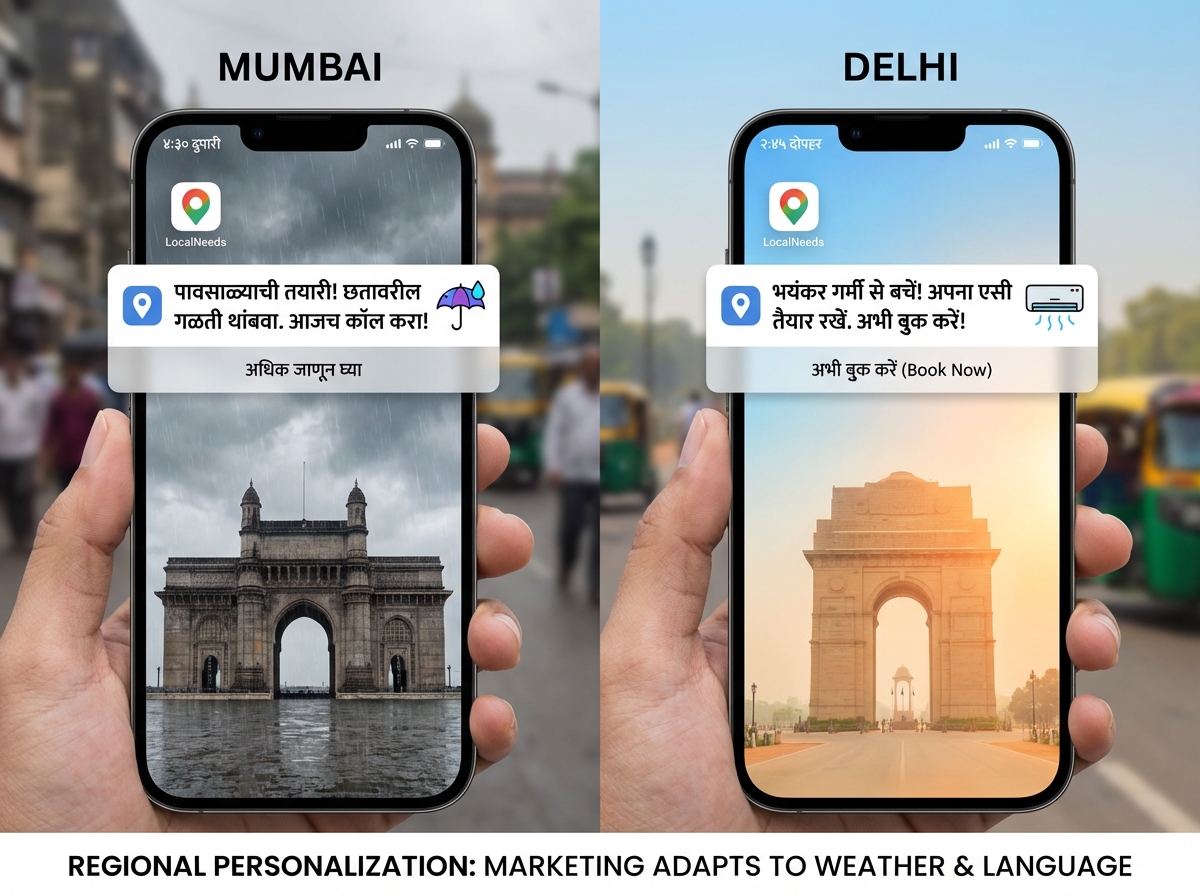
Effective regional monsoon marketing requires a deep understanding of India's linguistic and cultural diversity. A campaign that resonates in Kerala will likely fail in Punjab due to differences in climate patterns, language, and consumer behavior. By 2026, the primary vehicle for these alerts—the WhatsApp Business API—is forecasted to exceed 1.5 trillion interactions in India, making it the essential channel for localized delivery.
To successfully localize, brands should:
- Build a Monsoon Onset Calendar: Use IMD's district-level data to create a staggered campaign schedule. Early-onset zones like the Konkan coast require March activations, while Northern states can wait until late April or May.
- Implement a Vernacular-First Strategy: Auto-localize all video and text content into Hindi, Marathi, Bengali, Tamil, Telugu, and other regional languages. This ensures high comprehension and response rates, particularly for complex products like insurance or technical home services.
- Sequence Offers by Micro-Region: In high-rainfall zones, lead with waterproofing and flood insurance. In high-humidity but lower-rainfall zones, lead with AC servicing and dehumidifiers.
This granular approach to climate-based personalization ensures that marketing budgets are not wasted on regions where the monsoon is still weeks away. It also positions the brand as a helpful, local partner rather than a distant corporate entity.
Source: IMD – Progress of SW Monsoon
Source: TrueFan AI – Enterprise Capabilities
6. Technical Architecture and Measurement of Weather-Triggered Offer Automation
The technical execution of weather-triggered offer automation relies on a seamless flow between weather APIs, CRM systems, and creative rendering engines. Integrated onboarding workflows and solutions like TrueFan AI demonstrate ROI through a significant reduction in customer acquisition costs (CAC) and a marked increase in engagement rates during high-volatility weather events.
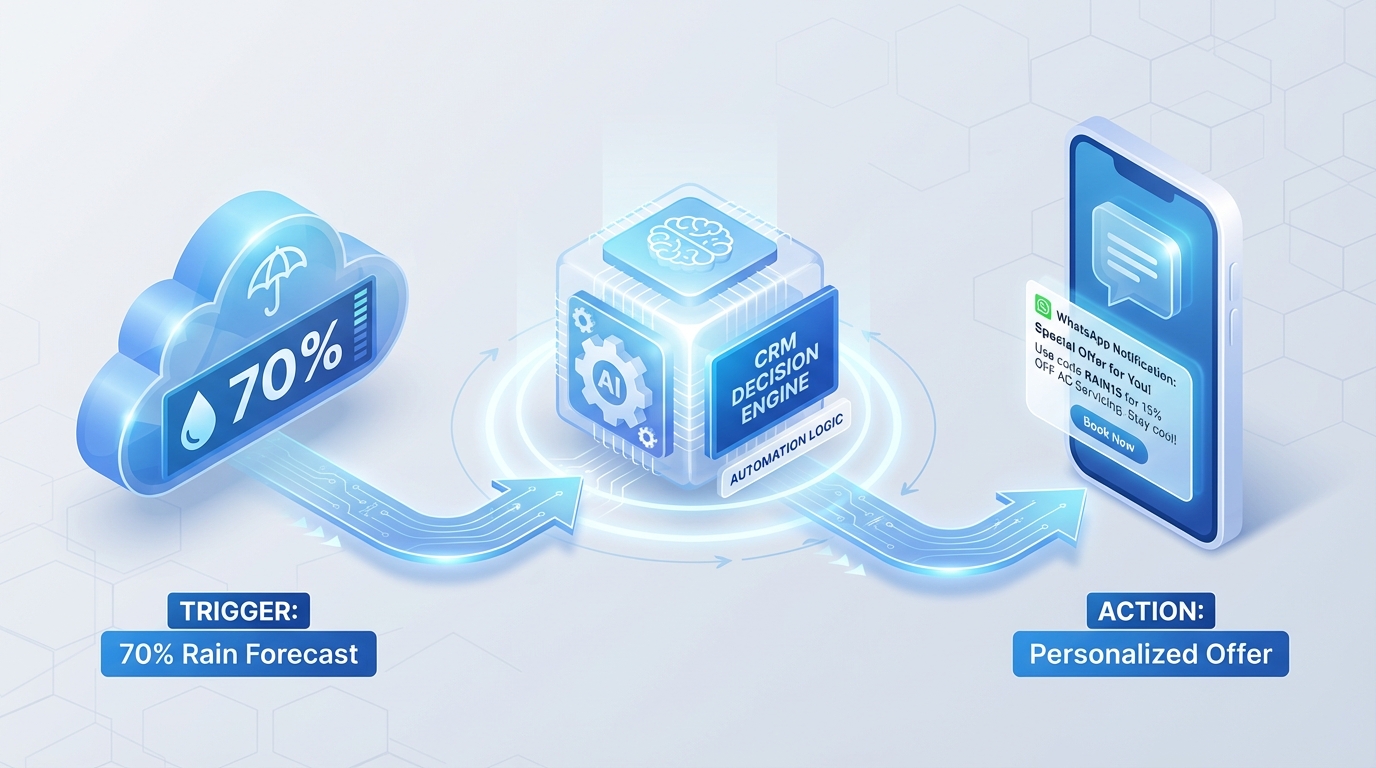
The Automation Logic
The system operates on a "Trigger-Decision-Action" framework:
- Trigger: A weather API signals a 70% rainfall probability for "District X" in the next 10 days.
- Decision: The CRM identifies customers in "District X" who own an AC but haven't serviced it in 12 months.
- Action: The system triggers a personalized video via WhatsApp in the customer's preferred language, featuring a discount code valid until the predicted onset date.
Measuring Success
KPIs for these campaigns must be viewed through an enterprise lens. Beyond standard CTR and conversion rates, brands should measure:
- Service Slot Utilization: The percentage of maintenance slots filled before the peak monsoon rush.
- Claim Inquiry Reduction: The decrease in customer support volume due to proactive, educational video content.
- Incrementality: Comparing the performance of weather-triggered cohorts against geo-matched baselines that received standard seasonal ads.
By 2026, personalized video content is anticipated to drive a 4.5x higher conversion rate compared to static display ads in the monsoon retail cycle. This data-driven approach allows for continuous optimization of hooks, CTAs, and offer framing.
Source: TrueFan AI – Video Personalization ROI Metrics
Source: ET BrandEquity – Shark Awards 2025 (Monsoon Mode Case Study)
Conclusion
Mastering monsoon preparedness marketing 2026 requires a sophisticated blend of meteorological data, automated logic, and personalized creative. By focusing on the March–April window and deploying pre-monsoon appliance sales and insurance campaigns that leverage weather-triggered offer automation, brands can drive unprecedented engagement. The shift toward climate-based personalization is no longer optional; it is the new standard for any enterprise looking to maintain relevance in India's dynamic seasonal economy. As you prepare for the 2026 season, ensure your martech stack is equipped to handle the hyperlocal, vernacular, and real-time demands of the modern Indian consumer.
Frequently Asked Questions
What is weather-triggered offer automation?
It is an orchestration system that monitors real-time forecast signals—such as rainfall probability or IMD alerts—and matches them with customer data to deploy personalized offers. This ensures that marketing messages are delivered exactly when the consumer's need is highest.
How does regional monsoon marketing improve ROI?
By aligning campaign timing with the actual IMD onset dates for specific districts and using local languages, brands reduce wasted ad spend and hit demand windows with much higher precision than national campaigns.
What is climate-based personalization?
This is a strategy where marketing creative and product recommendations are tailored based on the recipient's hyperlocal weather risks (e.g., flood alerts, high humidity) and historical profile.
How do insurance brands ensure compliance in these campaigns?
Insurance companies must follow IRDAI guidelines by including all necessary benefit disclosures, avoiding deterministic claims about payouts, and providing links to official resources like the IRDAI claims guidance page.
How does TrueFan AI handle data security for enterprise clients?
TrueFan AI maintains a robust security posture with ISO 27001 and SOC 2 compliance, ensuring that all customer data used for video personalization is handled with enterprise-grade protection and consent-first protocols.