
Metaverse marketing strategies 2026: The enterprise roadmap to immersive video, AR/VR and Web3 commerce
Estimated reading time: 12 minutes
Key Takeaways
- 2026 shifts the metaverse from hype to ROI-driven programs spanning AR-enhanced video, 3D product interfaces, and Web3 loyalty.
- AR product visualization and virtual try-ons reduce returns and boost conversions with true-to-scale previews and interactive 3D.
- Personalized virtual stores/showrooms run on first-party data, adaptive streaming, and measure Time-in-AR and Product View Depth.
- NFT-gated experiences and blockchain-verified video establish trust and unlock token-redeemable offers.
- Follow a phased rollout across 3D content ops, identity/CDP, and wallet support, including localization for India.
What “metaverse marketing strategies 2026” really means for enterprise commerce
The digital landscape of 2026 has moved beyond the experimental “hype cycle” of the early 2020s. For enterprise leaders, metaverse marketing strategies 2026 represent a shift from speculative virtual worlds to a practical, ROI-driven mesh of persistent 3D web, AR-powered shoppable video, and tokenized commerce.
By 2026, the global XR market is projected to reach nearly $90 billion, with enterprise adoption driving over 60% of total industry revenue. This evolution is no longer about “being in the metaverse”; it is about integrating immersive shopping experiences into the existing commerce stack to drive provable growth.
For CIOs and CMOs, the mandate is clear: transition from static 2D interfaces to a spatial web where the metaverse customer journey is fluid, personalized, and high-converting. This roadmap provides the blueprint for standing up these experiences with security, scale, and regional relevance.
Source: Digital Marketing Trends 2026
Source: AR | Metaverse | Spatial Computing Industry Statistics 2026
In the 2026 horizon, metaverse marketing strategies 2026 are defined as the coordinated use of spatial computing and decentralized identity to collapse the distance between discovery and purchase. It is a convergence of AR-enhanced video, 3D product interfaces, and Web3-enabled loyalty.
The modern metaverse customer journey extends the classic marketing funnel into a persistent loop of engagement. Awareness is no longer just a video view; it is an interactive 3D encounter. Consideration is not just a product description; it is a virtual try-on that lives within the user’s physical space.
Enterprises are now leveraging immersive shopping experiences to capture first-party data in a cookieless world. By 2026, 25% of consumers are expected to spend at least one hour daily in these environments for shopping, work, or social interaction, making it a critical touchpoint for brand presence.
This strategy requires a shift toward “Spatial SEO” and “3D Content Ops.” Brands must manage a library of digital twins that can be deployed across virtual showrooms, AR ads, and token-gated video premieres, ensuring a consistent brand voice across all immersive layers.
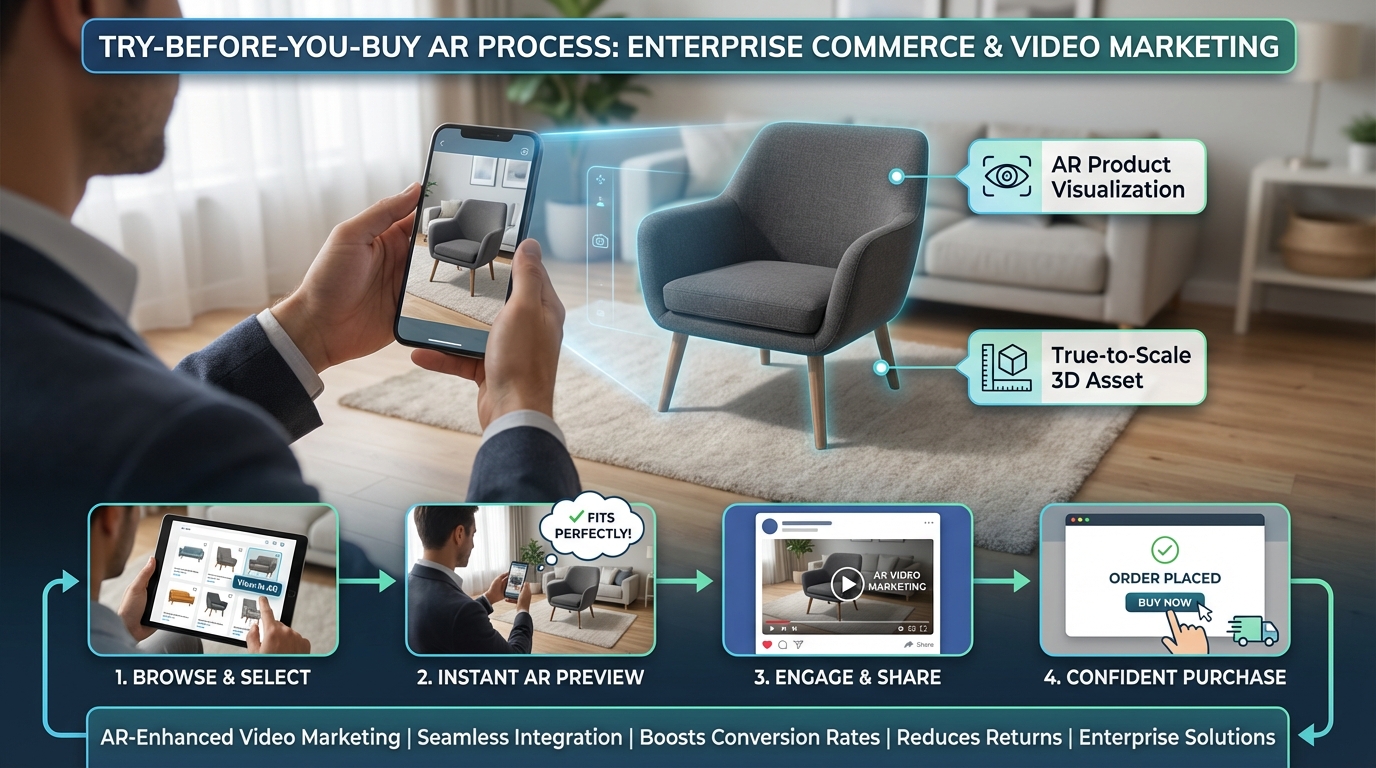
AR-enhanced video marketing that drives try-before-you-buy
The most immediate ROI in the spatial web comes from AR-enhanced video marketing. This involves video content with embedded AR triggers that allow users to transition from watching a product demonstration to placing that product in their own room with a single tap.
AR product visualization videos have become the gold standard for high-consideration categories like furniture, electronics, and automotive. By preloading lightweight GLB and USdz assets, enterprises can offer “true-to-scale” previews that reduce return rates by up to 40% in some sectors.
Furthermore, 3D product demonstration videos allow for “exploded views” and material swaps in real-time. Platforms like TrueFan AI (see AI celebrity video marketing in India) enable enterprises to bridge the gap between static content and interactive spatial experiences by automating the production of high-fidelity, personalized video assets.
For beauty and fashion, virtual try-on video campaigns utilize advanced face and hand tracking. These campaigns are no longer just filters; they are calibrated, high-fidelity simulations that account for lighting and skin texture, providing a level of realism that was impossible just two years ago.
Digital twin marketing videos are the engine behind this scale. A single high-fidelity 3D master can generate thousands of localized, multi-variant video creatives. This “create once, deploy everywhere” approach is essential for maintaining margins while delivering hyper-personalized immersive content.
Personalizing virtual store tours and virtual showrooms at scale
The 2026 enterprise does not build a single virtual store; it builds a dynamic engine for virtual store tour personalization. These tours are tailored using first-party data, ensuring that a loyalty member sees a different curated aisle than a first-time visitor.
In a virtual showroom personalization model, the environment itself is a variable. Influencer guides, product highlights, and even the ambient lighting can change based on the viewer’s past browsing history or current intent signals, creating a truly bespoke shopping environment.
Implementation requires a robust “Content Ops” pipeline. This includes scene graph templates that allow for dynamic asset swaps and live-text feeds for real-time pricing. Accessibility is also a mandate, with 2026 standards requiring spatial audio descriptions and screen-reader metadata for all 3D assets.
The KPIs for these experiences have evolved. Beyond simple click-through rates, enterprises now measure “Product View Depth” and “Time-in-AR.” These metrics provide a much clearer picture of intent, allowing for more accurate attribution in an increasingly complex omnichannel environment.
Success in this space depends on the ability to deliver these high-bandwidth experiences over varying network conditions. Edge rendering and adaptive bitrate streaming for 3D assets ensure that a virtual showroom is as responsive on a mid-range smartphone in Mumbai as it is on a high-end headset in New York.
Source: Top Digital Marketing Trends 2026
Source: Modern Marketing Mix Modeling 2026
Web3 commerce video campaigns and NFT-gated video experiences
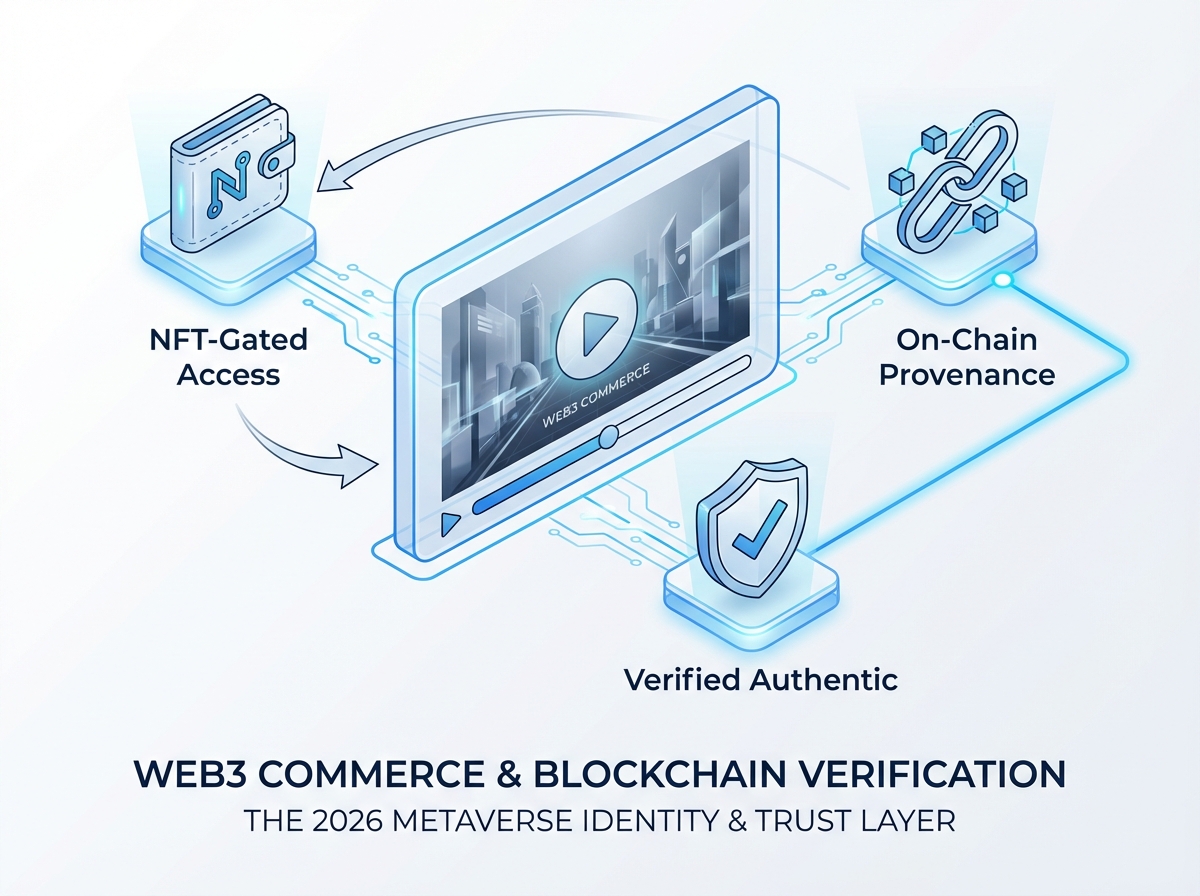
Web3 has matured into the “Identity Layer” of the metaverse. Web3 commerce video campaigns now use wallet-aware triggers to offer exclusive discounts or early access based on a user’s on-chain history, such as owning a specific brand NFT or a “Proof of Attendance” token from a virtual event.
NFT-gated video experiences provide a new frontier for loyalty. Exclusive product launches or backstage content are locked behind a digital credential. To minimize friction, enterprises have adopted “progressive disclosure” flows, where users can log in via social accounts while a custodial wallet is created in the background.
A critical coverage gap often missed is the necessity of blockchain-verified video content. As deepfakes become more sophisticated, brands must use on-chain provenance to verify the authenticity of their marketing assets. This ensures that the “celebrity” in a video is indeed an authorized, consented digital twin.
This verification layer builds trust, which is the primary currency of 2026. By embedding metadata and on-chain logs into video files, enterprises can prove the source, edit history, and publishing event of every piece of content, protecting both the brand and the consumer from malicious synthetic media.
The integration of Web3 also enables “Token-Redeemable Offers” directly inside shoppable videos. A user watching a virtual fashion show can click a “Claim” button that interacts with their wallet, instantly granting them a digital wearable or a physical discount code, closing the loop between engagement and ownership.
Mapping the metaverse customer journey and virtual event personalization
The metaverse customer journey is no longer a linear path; it is a cross-surface experience. It might begin with a QR-to-AR trigger on a physical product package, lead to a personalized virtual store tour, and culminate in a community quest within a gated virtual environment.
Virtual event personalization is the key to retention in this journey. For a 2026 product launch, the event is not a static broadcast. It is a segmented experience where different attendee groups receive different content tracks, localized MC intros, and real-time product interactions based on their tier.
To manage this, enterprises are adopting “Real-Time Rendering” pipelines. These systems can generate personalized event openers or mid-event shout-outs in under 30 seconds, making every attendee feel like the event was designed specifically for them. This level of intimacy drives unprecedented NPS and repeat purchase rates.
The data generated from these journeys is a goldmine for “Zero-Party Data” collection. By observing how users interact with 3D objects—which features they zoom in on, which colors they test—brands gain insights into product preferences that traditional surveys could never capture.
Finally, the journey must be instrumented for “Identity Resolution.” Whether a user is on a mobile AR app, a web-based 3D showroom, or a VR headset, their preferences and loyalty status must follow them. This requires a unified CDP (Customer Data Platform) that can handle spatial and on-chain data points.
Source: GWI Connecting the Dots 2026
Virtual reality commerce India: a localization playbook
When discussing virtual reality commerce India, the strategy must be “mobile-first and bandwidth-aware.” While high-end VR is growing in experiential retail hubs, the mass market interacts with the metaverse through AR on mid-range smartphones.
Localization is the non-negotiable pillar of success in the Indian market. TrueFan AI's 175+ language support and Personalised Celebrity Videos (personalised celebrity endorsement SaaS) allow brands to scale these virtual interactions across diverse demographics without the prohibitive costs of traditional production.
An effective India playbook includes:
- Adaptive Bitrate 3D: Delivering lower-LOD (Level of Detail) models for users on 4G/5G in Tier 2 cities while serving high-fidelity assets to users on fiber.
- Regional Voiceovers: Moving beyond simple subtitles to native, AI-generated voiceovers that retain the emotional resonance of the brand ambassador (Tier 2 festival commerce automation).
- WhatsApp Integration: Using the WhatsApp Business API to trigger personalized AR videos and virtual tour links (ONDC personalized video onboarding), meeting the user where they already spend their time.
- UPI-Enabled Checkout: Ensuring that the “Buy” button in a shoppable video leads directly to a seamless UPI payment flow (UPI business account activation), minimizing drop-offs at the final stage.
The Indian consumer in 2026 expects “High-Tech, High-Touch” experiences. This means using AR-enhanced video marketing to provide the guidance of an in-store assistant through a digital avatar or a personalized celebrity guide, bridging the gap between digital convenience and human-centric service.
Reference architecture, KPIs, and a phased 2026 rollout plan
To execute these metaverse marketing strategies 2026, enterprises need a robust reference architecture. This includes a 3D Content Pipeline (PIM/DAM), an Experience Layer (AR/VR modules), an Identity Layer (CDP/Wallets), and a Trust Layer (Blockchain verification).
Solutions like TrueFan AI demonstrate ROI through significant lifts in view-through rates and add-to-cart actions, often exceeding 30% compared to non-personalized immersive content (post-purchase engagement automation guide). This performance data is critical for moving metaverse initiatives from “innovation budgets” to “core marketing spend.”
A recommended 4-quarter rollout for 2026:
- Q1: Foundation. Establish the 3D asset pipeline and pilot AR product visualization videos for top-performing SKUs.
- Q2: Personalization. Integrate CDP segments to launch virtual store tour personalization and localized video campaigns.
- Q3: Web3 Integration. Deploy Web3 commerce video campaigns and custodial wallet support for NFT-gated rewards.
- Q4: Scale & Trust. Implement blockchain-verified video content logs and scale virtual event personalization for holiday season launches (Q1 2026 festival retention strategies).
Key performance indicators must be weighted by funnel stage. Awareness should focus on VTR and CTR; Consideration on “Time-in-AR” and “Hotspot Engagement”; and Conversion on ATC and AOV. Loyalty is measured by “Token Redemption Rate” and “Repeat Immersive Sessions.”
By following this phased approach, enterprises can manage the technical debt of 3D asset creation while proving value at every step. The goal is not a “big bang” metaverse launch, but a steady integration of immersive capabilities that enhance the existing customer experience.
Source: 2026 AI Business Predictions: PwC
Source: Globant's Tech Trends 2026
Buyer’s Checklist for Immersive Commerce
Frequently Asked Questions
What is the expected ROI for AR-enhanced video marketing in 2026?
Enterprises typically see a 20-40% reduction in product returns and a 15-25% increase in conversion rates when implementing high-fidelity AR try-ons and 3D visualizations.
How do we manage the high cost of 3D asset creation?
By using “Digital Twin” strategies, a single 3D master can be used for AR, VR, web-based 3D, and automated video generation, significantly lowering the per-channel cost of content.
Is Web3 commerce necessary for a metaverse strategy?
While not mandatory, Web3 provides the identity and loyalty layer that allows for persistent customer relationships and secure, token-gated access to exclusive experiences.
How does TrueFan AI ensure brand safety in metaverse campaigns?
TrueFan AI utilizes a consent-first model with celebrities and incorporates built-in moderation filters to prevent the generation of unapproved or harmful content, ensuring enterprise-grade brand protection.
Can these immersive experiences work on low-bandwidth networks?
Yes, by using adaptive bitrate streaming for 3D assets and edge rendering, brands can deliver responsive immersive experiences even in regions with variable connectivity like Tier 2/3 India.
What is the difference between a virtual store and a virtual showroom?
A virtual store is typically a digital twin of a physical retail space, while a virtual showroom is a dynamic, often abstract environment designed to highlight specific product features and stories.



