Pharma B2B Doctor Engagement 2026: Budget-led, compliant, personalized video strategies for India’s HCPs
Key Takeaways
- 2026 engagement must align with India’s Union Budget priorities and UCPMP 2024 to secure funding and institutional adoption.
- Personalized, education-first video is the core channel for HCPs, with consented, compliant delivery via approved platforms.
- Omnichannel orchestration with event-driven automation elevates rep enablement and post-conference follow-ups.
- Doctor appreciation and loyalty evolve into mastery-based learning, multilingual microlearning, and compliant recognition.
- Governance focuses on education quality and compliance health metrics, not just clicks and views.
The landscape of pharma B2B doctor engagement 2026 will be shaped by Union Budget healthcare allocations, UCPMP 2024 compliance, and the rise of personalized, education-first video formats delivered via approved channels. As pharmaceutical marketing directors and medtech leaders navigate an increasingly complex regulatory environment in India, the shift toward data-driven, compliance-first engagement has become a strategic necessity rather than a digital luxury.
In 2026, pharma B2B doctor engagement 2026 is defined as a sophisticated, multi-layered approach to engaging healthcare professionals (HCPs) through relevant, educational, and personalized content. This strategy leverages omnichannel workflows tied directly to national budget priorities and ethical policy frameworks, ensuring that every touchpoint adds clinical value while maintaining the highest standards of pharma compliance marketing India. By integrating healthcare professional video marketing with real-time data signals, brands can move beyond generic broadcasting to achieve true “segment-of-one” relevance.
1. Aligning HCP Programs with India’s Union Budget 2025–26 and 2026–27 Priorities
Securing internal funding and institutional adoption for HCP programs in 2026 requires a deep alignment with the Government of India’s fiscal priorities. The Union Budget 2025–26 (marketing strategies) has allocated approximately ₹99,858 crore (US$ 11.50 billion) to the healthcare sector, emphasizing the strengthening of cancer care, mental health infrastructure, and digital public goods. For pharma leaders, this means that pharma B2B doctor engagement 2026 must mirror these public health goals to remain relevant to hospital committees and formulary decision-makers.
Strategic alignment involves translating high-level policy into actionable healthcare policy update videos that help doctors navigate changes in eligibility, coding, and government-led vaccination or NCD programs. When a budget emphasizes preventive care and digital health infrastructure, engagement programs should focus on how specific therapies fit into these new care pathways. This approach ensures that marketing efforts are perceived as educational support rather than mere commercial promotion, which is critical under the current regulatory scrutiny.
Furthermore, the rise of hybrid roles—such as digital medical advisors and AI-clinical analysts—reflects a broader industry trend toward patient-centricity and digitally enabled models. As procurement complexity increases, launch teams must adapt to multi-committee decision-making processes that prioritize long-term outcomes over short-term costs. Aligning content and timing to government program cycles and hospital tender calendars is no longer optional; it is the blueprint for commercial excellence in a budget-conscious environment.
Source: Union Budget 2025–26 Analysis (PRS India)
Source: IBEF Healthcare Industry Report
Source: Express Pharma 2026 Trends
2. The Strategic Lever of Healthcare Professional Video Marketing and Personalization
In 2026, healthcare professional video marketing has emerged as the primary vehicle for high-impact engagement, outperforming static content across nearly every clinical specialty. Modern physicians in India prefer short-form, evidence-led videos that fit seamlessly into their high-pressure workflows, often favoring asynchronous viewing on mobile devices. Research indicates that WhatsApp Business API, when used with explicit consent, significantly outperforms traditional email and SMS for HCP communication in the Indian market.
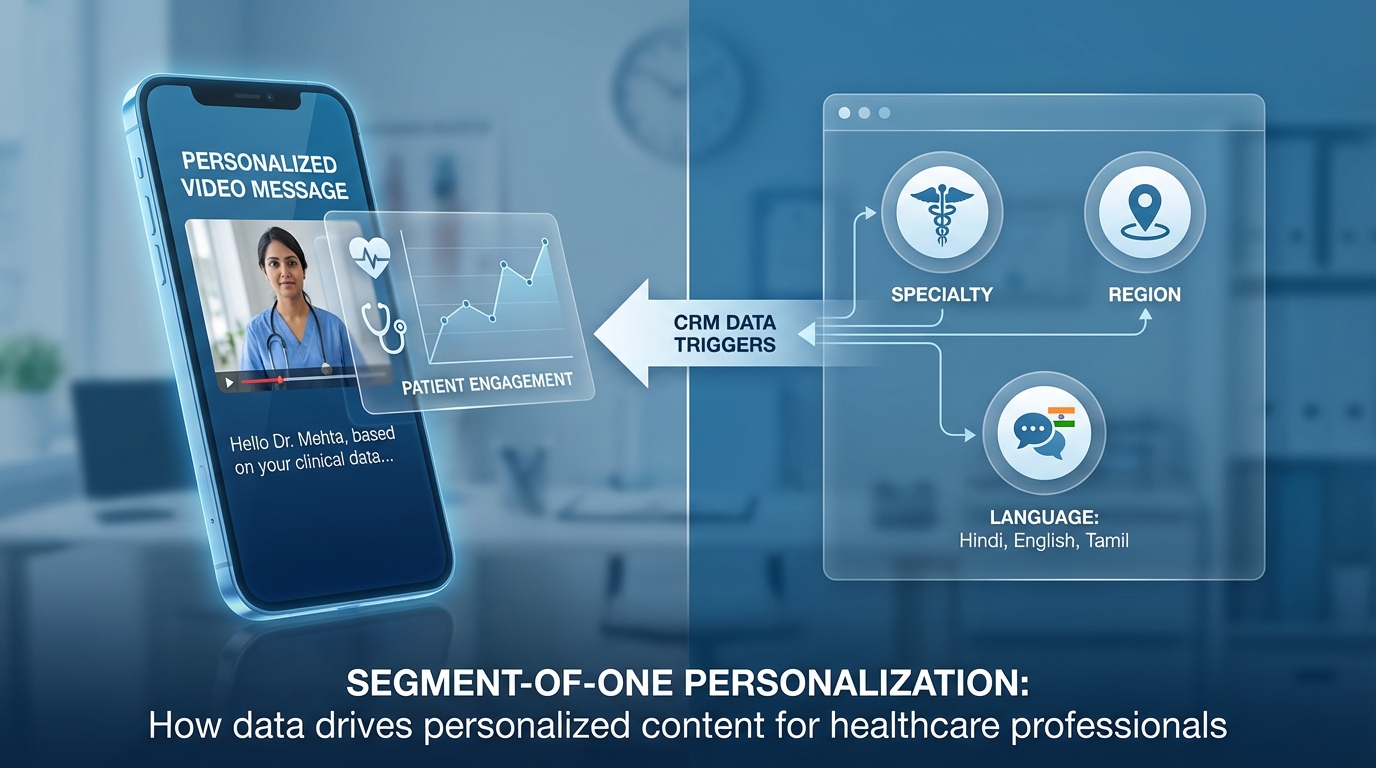
Effective doctor relationship personalization involves tailoring these video narratives based on a physician’s specialty, sub-specialty, and even their specific practice setting (Tier-1 vs. Tier-2/3). For example, a cardiologist in a metro hospital may require deep-dive data on RCT outcomes, while a general practitioner in a Tier-3 town might prioritize information on access programs and simplified diagnostic pathways. Platforms like TrueFan AI enable brands to execute this level of hyper-personalization at scale, ensuring that every doctor feels the content was created specifically for their clinical needs.
The logic for personalization is driven by CRM and CDP data, including engagement history, CME interests, and even regional language preferences (Regional Language Video SEO). By delivering a 60-second video that addresses a doctor by name and provides a specialty-specific guideline update, pharma companies can drastically reduce the cognitive load on the HCP. This “science-first” personalization builds trust and positions the brand as a partner in the doctor’s professional development rather than just a product manufacturer.
Source: Bain & Company Physician Digital Engagement
Source: BCG Biopharma Trends 2026
3. Scripting Pharmaceutical Education Videos for Ethical Prescription Influence
The core of pharma B2B doctor engagement 2026 lies in the production of high-quality pharmaceutical education videos that are co-created with Medical Affairs teams. These assets must be clinical, fair-balanced, and strictly adherent to UCPMP 2024 guidelines, focusing on Mechanism of Action (MoA), indications, and safety updates. In an era of “educational influence,” the goal is to provide doctors with the evidence they need to make informed prescribing decisions without the use of non-permitted inducements.
A successful script blueprint for 2026 typically follows a 90-second structure: the first 5 seconds feature a personalized greeting and a clinical scenario; the next 40 seconds summarize evidence from RCTs or real-world data; the following 30 seconds discuss implications for practice; and the final 15 seconds provide a clear next step, such as downloading a full slide deck or scheduling an MSL meeting. This format ensures that the most critical scientific information is delivered upfront, respecting the doctor’s limited time while maintaining regulatory compliance.
Prescription influence marketing in 2026 is about being the most reliable source of truth in a crowded digital space. This requires “asset hygiene,” where every video variant is MLR-ready, includes necessary PI (Prescribing Information) overlays, and features audit-ready metadata. By linking these videos to peer-reviewed sources and transparently stating limitations, pharma companies can foster long-term medical professional retention strategies based on scientific credibility and mutual respect.
Source: UCPMP 2024 Official Code
Source: Valuebound UCPMP Compliance Guide
4. Omnichannel Orchestration: HCP Engagement Automation and Rep Enablement
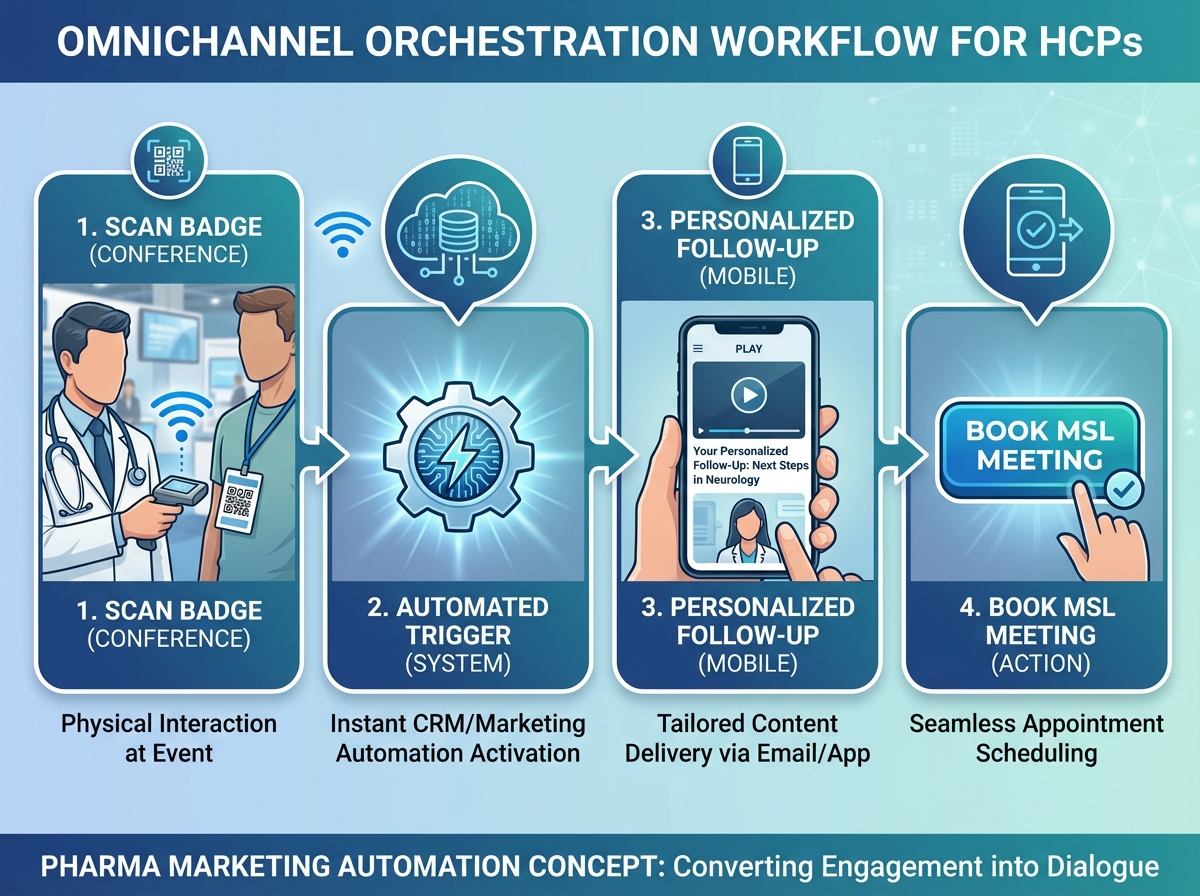
The integration of HCP engagement automation (ONDC Personalized Video Onboarding) allows pharma brands to move from manual, rep-dependent outreach to event-driven orchestration. By triggering personalized video content based on specific actions—such as a conference badge scan or a missed field visit—companies can maintain a consistent presence without overwhelming the doctor. This automation must be built on a foundation of consent capture and persistent audit trails to satisfy the rigorous requirements of pharma compliance marketing India.
One of the most effective applications of this technology is medical conference follow-up automation. Instead of waiting weeks for a follow-up, a doctor can receive a personalized session-summary video within 24 hours of attending a symposium. This video can include a “thank you” for their participation, a recap of the key clinical takeaways, and a direct link to book a deep-dive session with a Medical Science Liaison (MSL). This rapid, high-value response significantly increases the ROI of expensive medical events.
Furthermore, medical rep enablement videos are transforming the quality of field interactions. Reps can now send 30-second pre-call intro videos that contextualize the upcoming discussion to the HCP’s specific interests, or post-call recap videos that summarize the evidence discussed. These tools empower the field force to act as “orchestrators” of a personalized experience, ensuring that every interaction—whether digital or face-to-face—is meaningful and data-driven.
Source: Indegene: Content Automation for Life Sciences
Source: Salesforce Life Sciences Cloud Insights
5. Compliant Doctor Appreciation and Relationship Management Strategies
In 2026, doctor appreciation campaigns pharma must be navigated with extreme caution to ensure they do not violate UCPMP 2024’s strict prohibition on gifts and inducements. The focus has shifted toward non-promotional, education-based gratitude that celebrates the doctor’s contribution to public health. For instance, personalized videos for National Doctor’s Day (Cultural Celebration Marketing Automation) that highlight a physician’s impact on their local community or their years of service in a specific therapeutic area are highly effective for relationship building without crossing ethical lines.
Doctor loyalty programs automation has also evolved into a “mastery-based” learning journey. Instead of monetary rewards, these programs offer clinical utility, such as CME reminders, practice management tools, and peer recognition vignettes. By reducing the cognitive load on clinicians through microlearning and providing multilingual support, pharma companies can support medical professional retention strategies that actually improve the doctor’s daily practice and patient outcomes.
The workforce context in India’s healthcare sector also plays a role in engagement. With rising workloads and a move toward more operational efficiency, doctors value partners who provide “frictionless” information. TrueFan AI’s 175+ language support and Personalised Celebrity Videos (AI Celebrity Video Marketing India) allow brands to deliver these appreciation messages in the doctor’s native tongue with perfect lip-sync, creating a memorable and emotionally resonant experience that stands out from the deluge of generic corporate communications.
Source: ManpowerGroup India HCLS Outlook 2026
Source: Asian Hospital & Healthcare Management Trends
6. Launch Excellence and Clinical Trial Recruitment in the Medtech Era
For medical device companies, medical device launch campaigns in 2026 require a sophisticated mix of KOL explainer series, workflow integration demos, and hospital committee briefing clips. As procurement becomes more centralized and multi-stakeholder driven, medtech leaders must use video to clearly communicate the value proposition of their devices to both clinical and administrative decision-makers. This includes providing troubleshooting videos and refresher microlearning modules that ensure safe and effective usage post-launch.
In the realm of clinical research, clinical trial recruitment videos have become essential for reaching both HCPs and potential patient communities. These videos must be IRB/IEC-compliant and ethics-first, using clear, localized language to explain the risks and benefits of participation. By using community-lived experience storytellers and providing a direct CTA to investigator sites, pharma companies can accelerate recruitment timelines while maintaining the highest ethical standards.
The complexity of the Indian biotech and medtech landscape, as highlighted by industry leaders, necessitates a move toward more transparent and evidence-based communication. Whether it is a new drug launch or a medical device rollout, the ability to deliver consistent, high-quality educational content across diverse geographies is a major competitive advantage. Solutions like TrueFan AI demonstrate ROI through their ability to render these complex, personalized assets in under 30 seconds, allowing for rapid deployment during critical launch windows.
Source: ET Pharma: Bharat Biotech Interview
Source: Simon-Kucher HCLS Trends 2026
7. Governance, KPIs, and the Future of Pharma B2B Engagement
The success of pharma B2B doctor engagement 2026 is measured through a combination of leading engagement indicators and compliance health metrics. Key performance indicators (KPIs) include video completion rates, click-through rates (CTR) to scientific resources, and MSL booking conversion rates. However, in 2026, “education quality” metrics—such as recall accuracy and survey-based confidence scores—are becoming just as important as traditional engagement data.
Compliance health is the non-negotiable foundation of this entire framework. Companies must track opt-out rates, approval timelines, and audit log completeness to ensure they remain on the right side of UCPMP 2024. A “zero-exception” policy for promotional conduct is the standard for top-tier pharma organizations. By using automated governance tools, brands can ensure that every personalized video is not only effective but also fully documented and audit-ready.
As we look toward the end of the decade, the role of AI in pharma marketing will only grow. The ability to update clinical lines via virtual reshoots without needing the original speaker to return to the studio will allow for unprecedented agility in responding to new data or regulatory changes. Organizations that embrace these technologies today will be the ones that define the future of ethical, high-impact doctor engagement in India.
Frequently Asked Questions
What is pharma B2B doctor engagement 2026 and why is it different from 2024–25 approaches?
In 2026, engagement is defined by extreme personalization and strict adherence to UCPMP 2024. Unlike the broader digital strategies of 2024, the 2026 approach uses real-time data triggers and hyper-personalized video to provide clinical value at the “segment-of-one” level, moving away from generic mass-mailing.
How do we ensure healthcare professional video marketing complies with UCPMP 2024?
Compliance is ensured by focusing strictly on educational content, avoiding any form of inducements or gifts, and maintaining a rigorous MLR (Medical, Legal, Regulatory) approval process. All digital interactions must be supported by verifiable evidence and include necessary safety disclosures.
What triggers power HCP engagement automation, and which channels are compliant in India?
Common triggers include medical conference scans, CRM updates, or specific interactions on a physician portal. In India, compliant channels include Veeva Approved Email, authenticated HCP portals, and WhatsApp Business API, provided that explicit, recordable consent has been obtained from the doctor.
How are doctor loyalty programs automation made compliant in India?
Compliant loyalty programs in 2026 focus on “learning mastery” and clinical utility rather than monetary or material rewards. They offer value through CME credits, exclusive access to scientific data, and practice-enhancing tools, all of which are permitted under the “education” exceptions of UCPMP.
Can TrueFan AI help with medical rep enablement and clinical trial recruitment?
Yes, TrueFan AI’s 175+ language support and Personalised Celebrity Videos can be used to create batch-personalized rep intro videos and localized, ethics-first clinical trial explainers. This helps in maintaining a personal touch at scale while ensuring that the messaging remains consistent and compliant across different regions.
Source: UCPMP 2024 PDF (DoP Portal)