
Sovereign AI UAE: Local Data Residency (Dubai), G42 AI Cloud, Arabic Sovereign LLMs, and Bank-Grade Data Sovereignty by 2026
Estimated reading time: ~11 minutes
Key Takeaways
- By 2026, UAE enterprises must prove verifiable data sovereignty across policy, infrastructure, and model layers.
- Local data residency in Dubai is not enough; control over keys, models, and governance is essential.
- G42/Core42 provides the sovereign compute backbone for high-security, in-country LLM workloads.
- Arabic-first models like Jais and Falcon anchor sovereign LLM strategies with cultural and dialectal fidelity.
- Banks need zero-trust architectures with CMK/HSM control, tokenization, and auditable pipelines to pass 2026 reviews.
Sovereign AI UAE has emerged as a critical 2026 priority for enterprises, combining rigorous policy alignment, localized infrastructure, and Arabic model sovereignty to ensure that sensitive data, computational power, and AI-driven decisioning remain under national jurisdictional control. As the digital economy matures, the necessity of keeping high-value intellectual property and citizen data within the Emirates is no longer a luxury but a regulatory mandate. Organizations must now navigate a complex landscape of local data residency (Dubai/UAE) requirements, sovereign compute environments like the G42 AI cloud, and the deployment of a sovereign LLM Arabic to maintain competitive advantage. By 2026, the convergence of the UAE AI law 2026 and sectoral regulations will mandate that data sovereignty for banks and public entities is verifiable, auditable, and resilient against external dependencies.
Recent industry data underscores this shift, with 98% of UAE executives identifying AI resilience and sovereignty as essential components of their operational strategy by 2026. This trend is further supported by the rapid evolution of AI-native data centres, which are reimagining the UAE’s infrastructure to support the massive computational demands of generative models while adhering to strict residency protocols. For the C-suite, the payoff is clear: achieving sovereign AI status ensures compliance with the Personal Data Protection Law (PDPL), mitigates the risks of cross-border data volatility, and fosters a culture of domestic innovation that is culturally and linguistically aligned with the region.
Sources:
- IBM Newsroom: Technologies Defining UAE Business Landscape 2026
- Khaleej Times: Reimagining Data Centres for the UAE’s AI Journey
What “Sovereign AI UAE” Really Means: Policy, Infrastructure, and Model Layers
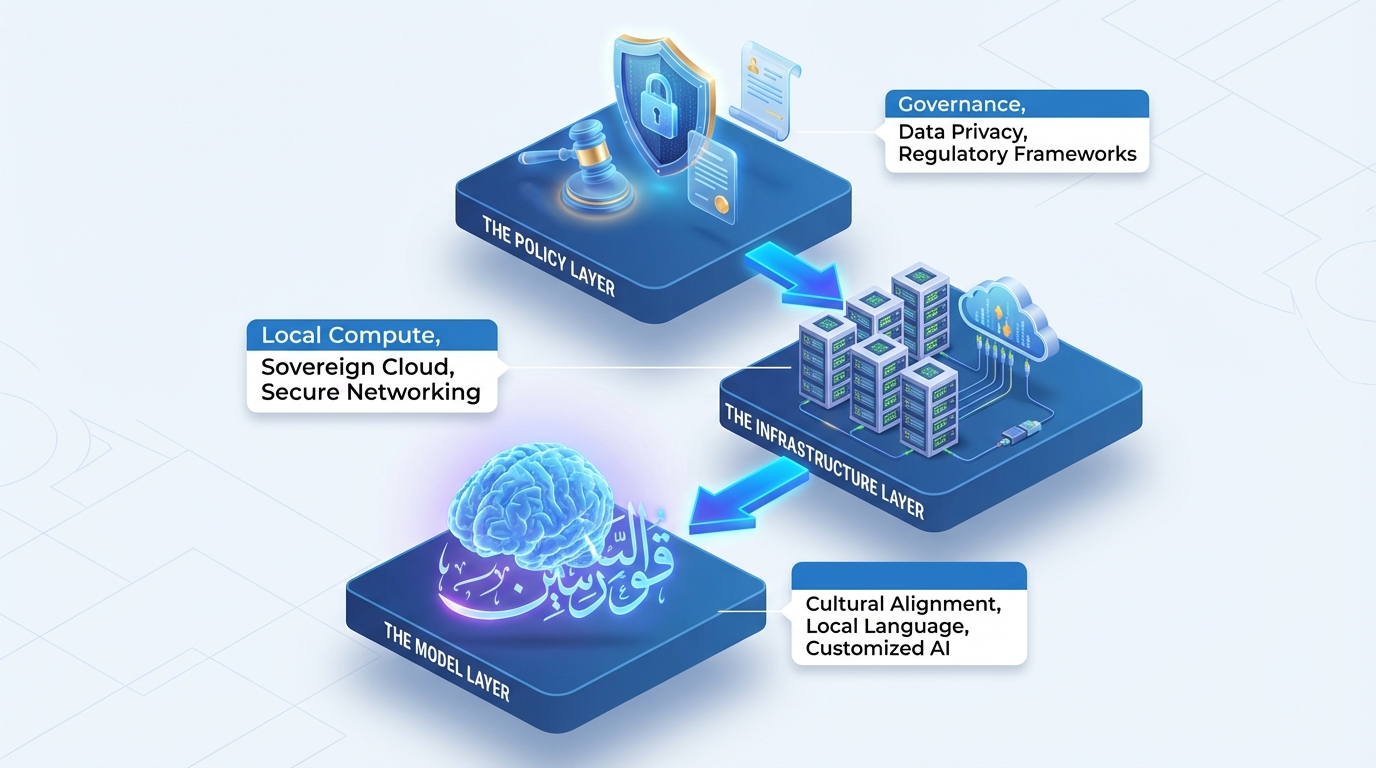
To understand Sovereign AI UAE, one must view it as a multi-layered architecture where data, model weights, training compute, and governance reside entirely under UAE jurisdictional controls. It is not merely about where a server sits; it is about who holds the keys to the encryption, who governs the model’s ethical boundaries, and how the system responds to local legal discovery. By 2026, this concept will be formalized through three distinct layers: the policy layer, the infrastructure layer, and the model layer.
The policy layer is anchored by the PDPL and the Dubai Data Law, which emphasize data minimization, lawful basis for processing, and the protection of data subject rights. For regulated sectors, the Central Bank of the UAE (CBUAE) provides specific guidance for banks, moving toward risk-tiered obligations that will be fully enforceable by 2026. This ensures that AI systems are not “black boxes” operated from abroad but are transparent entities subject to local audits. Regional forecasts suggest that these policies will evolve to include mandatory AI impact assessments, particularly for high-risk applications in finance and healthcare.
The infrastructure layer involves the transition to sovereign cloud environments and AI-native data centres. These facilities utilize intent-based networking and self-optimizing fabrics to handle the high-density workloads required for LLM inference. Sovereignty at this layer means that Key Management Systems (KMS) are under UAE control, and private connectivity ensures that data never traverses the public internet. Finally, the model layer focuses on the sovereign LLM Arabic—models like Jais or Falcon that are hosted and fine-tuned within residency boundaries. This prevents “model drift” caused by external updates and ensures that the AI’s linguistic and cultural nuances remain faithful to the UAE’s heritage.
Sources:
- Deloitte: 2026 AI Predictions Shaping the Middle East
- IndexBox: Five Trends Shaping the UAE’s AI Landscape in 2026
Local Data Residency Dubai vs. Data Sovereignty: Practical Implementation for 2026
While often used interchangeably, local data residency Dubai and data sovereignty represent two different levels of compliance. Data residency refers specifically to the geographical location where data is stored and processed—essentially ensuring that the bits and bytes stay within Dubai or UAE borders. Data sovereignty, however, is the extension of jurisdictional control over that data, the models derived from it, and the governance frameworks surrounding them. In 2026, an enterprise might meet residency requirements by using a local data centre but fail sovereignty requirements if the AI model's “brain” is controlled by a vendor in a different jurisdiction.
For enterprises to prepare, the first step is building a comprehensive data map and Record of Processing Activities (RoPA). This involves identifying not just Personal Identifiable Information (PII) and Payment Card Industry (PCI) data, but also model artifacts such as weights, prompts, and logs. Organizations must establish data classification levels aligned with PDPL principles, ensuring that “Highly Confidential” data never leaves the sovereign boundary. Implementing privacy-enhancing techniques, such as field-level encryption and tokenization, allows for a split between model training (which may require high-security zones) and analytics (which may use de-identified data).
As we approach 2026, GCC governments are increasingly emphasizing domestic innovation to reduce external dependencies. This shift is driving a “sovereign-first” procurement strategy where local processing is prioritized over global hyperscale convenience. Enterprises must establish cross-border transfer assessments (TIA) and implement Standard Contractual Clause (SCC) equivalents for any data that must leave the country, though the trend is clearly moving toward keeping the entire AI lifecycle—from data ingestion to inference—within the UAE.
Sources:
- Esferasoft: The Future of AI Consulting in the UAE — Trends to Watch in 2026
- IndexBox: Trends Shaping the UAE’s AI Landscape
Inside G42 AI Cloud and Core42: The UAE’s Sovereign Compute Backbone
The G42 AI cloud, managed through its subsidiary Core42, serves as the primary engine for Sovereign AI UAE. This infrastructure is designed to provide the high-performance compute (HPC) required for massive AI models while maintaining the security posture required by government and regulated entities. The G42 ecosystem offers in-country data centres that align with local workloads, providing private tenancy options that isolate an enterprise's data from other cloud users. This is critical for banks and government agencies that require a “walled garden” approach to their AI deployments.
Market momentum for this sovereign backbone was significantly boosted by Microsoft’s $1.5 billion investment in G42. This partnership is designed to accelerate the deployment of secure AI infrastructure, backed by international security assurances while keeping the physical and logical control within the UAE. Furthermore, the launch of a Responsible AI foundation in Abu Dhabi ensures that the compute power provided by G42 is used ethically and in accordance with regional values. For the enterprise, this means access to cutting-edge GPU clusters without the jurisdictional risk of using offshore cloud regions.
Integrating with the G42 AI cloud requires a structured checklist. Enterprises should utilize private link peering to connect their existing Virtual Private Clouds (VPC) to the G42 backbone, ensuring that all traffic remains on private fibers. Key Management Systems should be HSM-backed (Hardware Security Module) and remain under the sole control of the enterprise. Additionally, implementing Role-Based Access Control (RBAC) with step-up authentication for model weights and secrets is essential. By 2026, immutable logging to a centralized Security Information and Event Management (SIEM) system will be a standard requirement for any sovereign AI workload.
Sources:
- Economic Times: Microsoft to Invest $1.5 Billion in Emirati AI Firm G42
- Economic Times: Microsoft to Launch Responsible AI Foundation in Abu Dhabi
UAE AI Law 2026: Navigating Compliance, Risk Tiering, and Readiness
The anticipated UAE AI law 2026 is set to provide the definitive legal framework for the development and deployment of artificial intelligence within the country. Industry experts expect a risk-tiered approach similar to the EU AI Act but tailored to the specific economic and cultural context of the Emirates. Under this framework, AI systems will likely be categorized into minimal, limited, and high-risk tiers. High-risk systems—such as those used in critical infrastructure, law enforcement, or financial credit scoring—will face the most stringent requirements for transparency, accountability, and human oversight.
Practical readiness for the UAE AI law 2026 involves creating a comprehensive AI system inventory. Organizations must document every model in use, its purpose, the data it consumes, and its potential impact on users. This documentation should take the form of “Model Cards” and “Data Sheets,” providing a clear audit trail for regulators. Establishing an internal AI Governance Board is also crucial; this body should define approval gates for new AI projects and ensure that Human-in-the-Loop (HITL) checkpoints are integrated into automated workflows.
Beyond documentation, technical safeguards like red-teaming and safety evaluations are becoming mandatory. These evaluations must specifically target regional risks, such as Arabic language hallucinations, cultural bias, or toxicity that violates local norms. Content provenance—the ability to prove the origin and integrity of AI-generated content—will also be a key requirement. With 98% of UAE executives prioritizing AI resilience, aligning governance structures with the 2026 legal horizon is a strategic necessity to avoid costly retrofitting of non-compliant systems.
Sources:
- Deloitte: 2026 AI Predictions Shaping the Middle East
- IBM Newsroom: Technologies Defining UAE Business Landscape 2026
Choosing a Sovereign LLM Arabic: Jais, Falcon, and Sector-Specific Options
Selecting a sovereign LLM Arabic is perhaps the most visible aspect of a sovereignty strategy. A sovereign model is one where the training data, the fine-tuning process, and the final weights are all managed within the UAE. This ensures that the model’s linguistic capabilities—covering both Modern Standard Arabic (MSA) and regional dialects—are optimized for the local market. Models like Jais, developed by G42’s Inception, and the Falcon family from the Technology Innovation Institute (TII), have set the global standard for Arabic-centric generative AI.
The Jais model is particularly noteworthy for its ability to handle “code-switching”—the common practice in the UAE of mixing Arabic and English in professional conversation. For enterprises in the Banking, Financial Services, and Insurance (BFSI) sector, Jais provides the named-entity fidelity required to process complex financial documents accurately. On the other hand, the Falcon family offers open-weight variants that allow enterprises to host the model on their own sovereign infrastructure, giving them total control over the model’s lifecycle and preventing any data leakage to third-party API providers.
When evaluating a sovereign LLM Arabic, enterprises must look beyond simple benchmarks. Selection criteria should include the model's ability to handle specific dialects, its deployment flexibility (on-premise vs. sovereign cloud), and the availability of safety filters that respect regional faith and cultural sensitivities. Furthermore, the model must be supported by a robust tooling ecosystem, including prompt management libraries, evaluation harnesses, and automated drift monitoring. By 2026, the ability to perform reproducible fine-tuning on de-identified local datasets will be the hallmark of a mature sovereign AI program.
Sources:
- Analytics India Magazine: Soon UAE Will Dethrone OpenAI
- Analytics India Magazine: Abu Dhabi Launches AI Company AI71

Data Sovereignty for Banks: Architectures and Operating Models That Pass Audit
For the financial sector, data sovereignty for banks is not just about compliance; it is about maintaining the trust of depositors and regulators. A bank-grade sovereign AI architecture requires a zero-trust approach to networking. This involves segmenting VPCs into distinct zones: a PII zone for sensitive customer data, an analytics zone for de-identified processing, and a model zone for hosting the LLM. All communication between these zones must occur over private endpoints, with no exposure to the public internet.
The data layer must implement field-level encryption, where sensitive fields are encrypted before they even reach the data lake. For model training, tokenization should be used to replace PII with non-sensitive placeholders, ensuring that the model “learns” patterns without ever “seeing” actual customer identities. Key management is the cornerstone of this architecture; banks must use customer-managed keys (CMK) stored in a local HSM. This ensures that even if the cloud provider is compromised, the data remains unreadable without the bank's specific authorization.
Operating this architecture requires a 90-day implementation blueprint. In the first 15 days, banks should appoint a governance board and complete data mapping. By day 45, the sovereign infrastructure on G42 AI cloud should be established, and the first fine-tuning of a sovereign LLM Arabic should begin. The subsequent 30 days focus on red-teaming and safety evaluations, followed by a pilot in a controlled environment, such as automated customer service or internal document search. By day 90, a full audit pack—including lineage, logs, and impact assessments—should be ready for regulatory review.
Sources:
- Gulf Business: Dell Trends — AI Adoption in UAE’s Public Sector
- Trends Research: How the UAE Can Shape Space Cloud Sovereignty
How TrueFan AI Enterprise Helps Execute: Arabic at Scale and Governance by Design
Executing a sovereign AI strategy requires partners that understand the intersection of high-scale content operations and rigorous governance. Platforms like TrueFan AI enable enterprises to bridge the gap between sovereign infrastructure and engaging customer experiences. By providing a suite of tools designed for the Middle Eastern market, TrueFan AI ensures that organizations can deploy AI-driven communication that is both culturally resonant and fully compliant with local data residency Dubai mandates.
TrueFan AI's 175+ language support and Personalised Celebrity Videos offer a unique way for brands to connect with their audience at scale. For a sovereign program, this means having access to Arabic-first templates that respect dialectal nuances and cultural norms. The platform is built with governance by design, incorporating ISO 27001 and SOC 2 controls, and allowing for cloud-agnostic deployments. This means the processing can be hosted within the customer’s chosen sovereign cloud, such as G42, ensuring that PII never leaves the client’s VPC and that all encryption keys remain under the bank’s control.
Solutions like TrueFan AI demonstrate ROI through measurable engagement uplift and rapid content operations for regulated communications. Whether it is through native WhatsApp Business API integration for compliant outreach or real-time personalization triggered by CRM events, the platform maintains a full audit trail of every interaction. This level of transparency is essential for meeting the requirements of the UAE AI law 2026, as it provides the immutable logs and policy blocks needed to prevent the generation of offensive or non-compliant content.
Sources:
- TrueFan AI Enterprise: Executive Capabilities and Governance Framework
- Dubai Chronicle: Five AI Trends Set to Drive UAE Enterprises
Frequently Asked Questions (FAQ)
1. What is the difference between data residency and data sovereignty in the UAE?
Data residency refers to the physical location of data storage within UAE borders (e.g., local data residency Dubai). Data sovereignty is broader, encompassing the legal and jurisdictional control over that data, the AI models trained on it, and the governance frameworks that prevent external interference or access by foreign entities.
2. How does the UAE AI Law 2026 impact financial institutions?
The UAE AI law 2026 is expected to categorize most banking AI applications as “high-risk.” This will mandate strict data sovereignty for banks, requiring verifiable audit trails, human-in-the-loop oversight, and mandatory AI impact assessments to ensure financial stability and consumer protection.
3. Which Arabic LLM is best for enterprise deployment in Dubai?
The choice depends on the use case. Jais is excellent for high-accuracy financial and legal tasks due to its deep training in Modern Standard Arabic. Falcon is preferred for organizations that want to host open-weight models on their own sovereign compute to maintain total control over model weights.
4. Can I use global cloud providers for Sovereign AI UAE?
Yes, provided they offer a “Sovereign Cloud” region within the UAE (like Microsoft’s partnership with G42). The key is ensuring that the data, the KMS, and the administrative access are all restricted to UAE-based personnel and jurisdictions.
5. How does TrueFan AI ensure compliance with UAE data residency?
TrueFan AI ensures compliance by offering cloud-agnostic deployment options. This allows the platform’s processing engine to sit within the customer’s local VPC on the G42 AI cloud, ensuring that all customer data and PII remain within the geographical and jurisdictional boundaries of the UAE.
Conclusion and Next Steps
Achieving Sovereign AI UAE is a multi-faceted journey that requires the alignment of policy, infrastructure, and specialized model capabilities. By 2026, the organizations that lead the market will be those that have successfully transitioned their AI workloads to sovereign environments like the G42 AI cloud, adopted a sovereign LLM Arabic for their core communications, and implemented the rigorous controls required for data sovereignty for banks. The upcoming UAE AI law 2026 will only accelerate this trend, making readiness a matter of immediate strategic importance.
To begin, enterprises should identify a high-impact Arabic use case—such as automated customer engagement or regulatory reporting—and stand up a sovereign pipeline. Measuring the safety, cultural alignment, and ROI of this pilot will provide the blueprint for scaling AI across the organization. For those looking to accelerate this process, booking an enterprise workshop for sovereign Arabic content operations can provide the necessary expertise to navigate this complex landscape while ensuring full auditability and compliance.
Sources:
Recommended Internal Links
No eligible enterprise-category internal blog posts were found in Strapi for this topic at this time (searched titles included PDPL, data residency Dubai, G42/Core42, UAE AI law 2026, sovereign LLM Arabic, Jais/Falcon, banking data sovereignty). As a result, no inline URLs were added. We will update with internal links as soon as relevant enterprise posts are available.
Frequently Asked Questions
What is the difference between data residency and data sovereignty in the UAE?
Data residency is about physically storing and processing data within UAE borders. Data sovereignty extends to who controls encryption keys, model weights, access, and governance—ensuring UAE jurisdiction over data and AI systems.
How does the UAE AI Law 2026 impact financial institutions?
Most banking AI uses will be deemed high-risk, requiring human oversight, impact assessments, robust audit trails, and demonstrable data sovereignty to satisfy regulators and protect consumers.
Which Arabic LLM is best for enterprise deployment in Dubai?
Jais suits high-accuracy financial/legal tasks and code-switching, while Falcon’s open weights benefit teams needing full lifecycle control on sovereign infrastructure.
Can I use global cloud providers for Sovereign AI UAE?
Yes—if they provide a UAE sovereign region and ensure in-country KMS, admin access, and data paths. Partnerships like Microsoft–G42 help meet these controls.
How does TrueFan AI ensure compliance with UAE data residency?
TrueFan AI supports cloud-agnostic, in-VPC deployments on sovereign clouds like G42, ensuring PII remains in-country and keys stay customer-controlled.



