The GenAI ROI Calculator for Marketing: CFO-Grade AI Video ROI Metrics, Enterprise Investment Justification, and a 2025 Implementation Strategy
Estimated reading time: ~14 minutes
Key Takeaways
- Use a CFO-grade GenAI ROI calculator to quantify revenue uplift, cost savings, and time-to-market for AI video.
- Build a board-ready business case with IRR, NPV, and a 6–9 month payback target.
- Model TCO and operational impacts, including governance, training, and sustainability metrics (kWh, CO2e).
- Follow a 30-60-90 day roadmap from pilot design to scale, instrumented with A/B tests and sensitivity analysis.
- Prioritize compliance and vendor governance (DPDP, audit logs, watermarking) to derisk scale.
This GenAI ROI calculator for marketing quantifies the business impact of AI video across revenue uplift, cost savings, and time-to-market. Use it to build a CFO-ready enterprise AI investment justification with clear AI video marketing ROI metrics, risk controls, and a 30-60-90-day implementation strategy.
The era of “experimental AI” has transitioned into a period of rigorous fiscal scrutiny. As we move through 2025 and into 2026, enterprise leaders are adopting what industry analysts call “GenAI gap year solutions.” This pragmatic, pilot-first approach right-sizes ambitions by limiting scope to measurable use-cases, instrumenting every experiment for ROI, and consolidating efforts under clear AI governance frameworks.
CFOs are no longer satisfied with “engagement” metrics; they demand a payback horizon of less than 6–9 months for pilots and a clear Net Present Value (NPV) over a three-year horizon. Platforms like TrueFan AI enable this transition by providing the infrastructure for personalized video at scale, featuring under 30-second renders and 175+ language support to meet the localization needs of the modern enterprise.
Sources:
- TrueFan AI Enterprise Capabilities
- Google Cloud: ROI of AI 2025
- Digital Personal Data Protection (DPDP) Act 2023 — Official PDF
The GenAI ROI Calculator Marketing Framework: Quantifying Value
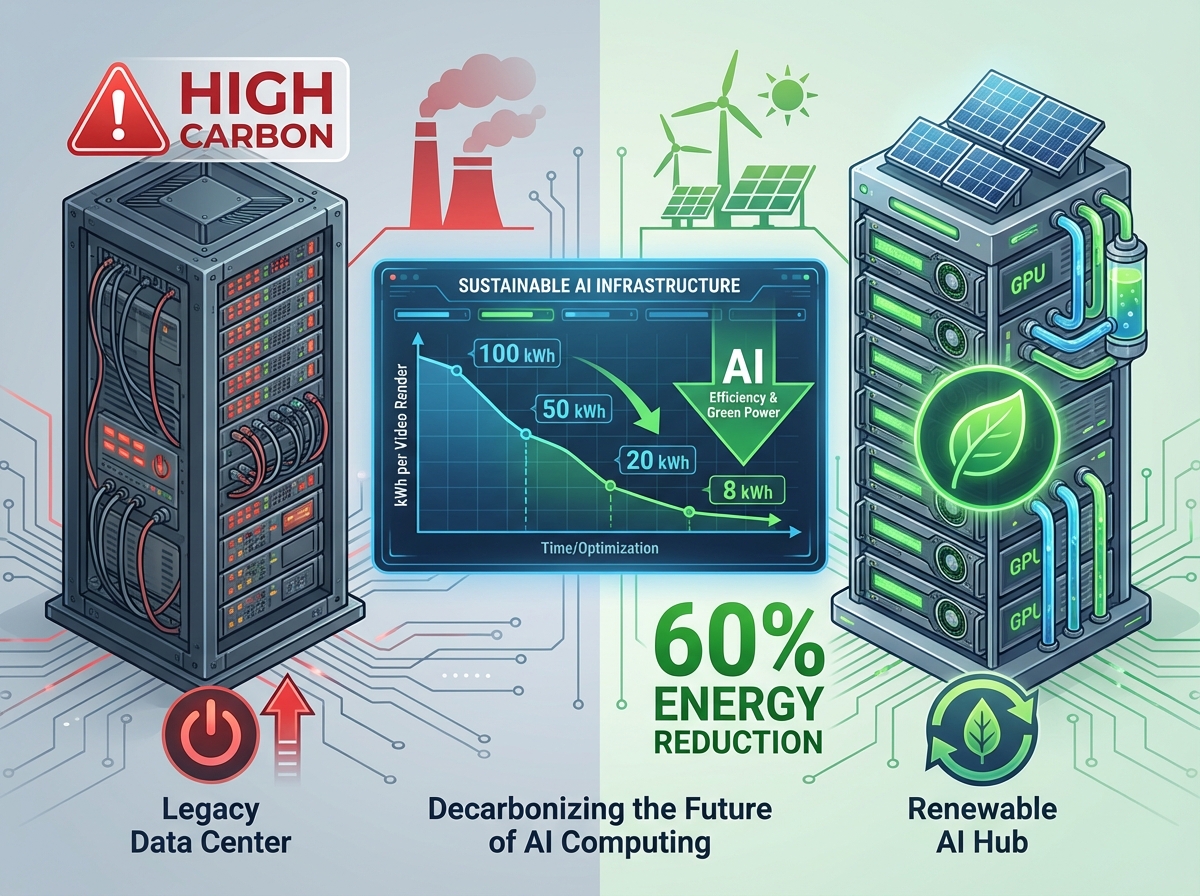
To secure a budget in 2026, marketing leaders must present a mathematical model that accounts for both the “hard” and “soft” benefits of AI integration. The fundamental ROI for AI video marketing is calculated as: ROI = (Total Quantified Benefits − Total Costs) / Total Costs. This formula must be supported by a sensitivity analysis that accounts for variable adoption rates and lift assumptions.
The primary outputs of your GenAI ROI calculator marketing tool should include the Internal Rate of Return (IRR) and the Payback Period. The IRR represents the discount rate at which the NPV of all cash flows from the project equals zero; in 2026, most enterprise boards require an IRR that significantly exceeds the corporate hurdle rate, often 15-20% for technology investments.
The calculator requires granular inputs across several categories. Baseline funnel metrics—such as Monthly Active Users (MAUs), stage-wise conversion rates (from view to purchase), and Lifetime Value (LTV)—form the foundation. You must then layer in media benchmarks, including current Customer Acquisition Cost (CAC) and target Cost Per Lead (CPL).
Production costs represent a significant area for cost avoidance. By tracking current agency spend, reshoot frequencies, and localization budgets, the calculator can demonstrate the efficiency of virtual reshoots and automated batch creation. For instance, moving from manual video editing to an automated pipeline can reduce creative cycle times from weeks to minutes.
Sources:
Enterprise AI Investment Justification: CFO-Ready Business Cases
Building a robust enterprise AI investment justification requires moving beyond theoretical gains to specific, high-impact use cases. In the B2B sector, Account-Based Marketing (ABM) pipeline acceleration is a primary driver. By using hyper-personalized videos tailored to specific industry pain points and account roles, enterprises can see a measurable uplift in meeting rates and deal velocity.
In the B2C and D2C sectors, commerce recovery flows offer the most immediate ROI. For example, cart abandonment videos delivered via WhatsApp—featuring localized brand personas and dynamic offer swaps—directly impact the bottom line (WhatsApp Business commerce automation 2026 guide). Data from the Indian market shows that Goibibo achieved a 38x ROI by integrating personalized celebrity video nudges (AI celebrity video marketing in India) into their conversion-recovery workflows.
Retention and cross-sell programs in the Banking, Financial Services, and Insurance (BFSI) and Telecom sectors also provide strong justification. Lifecycle personalization across 175+ languages allows for renewal nudges and bill explanations that reduce churn. The calculator should model this as: Churn Reduction (%) × LTV Saved, minus the platform and implementation costs.
Risk management is an integral part of the business case. Every initiative must align with AI governance frameworks that ensure DPDP compliance in India (DPDP-compliant personalization strategies). This includes maintaining valid consent artifacts (interactive video data capture), purpose limitation, and reasonable security safeguards to protect Personal Identifiable Information (PII) throughout the video generation lifecycle.
Sources:
- WebEngage: Goibibo uplift in conversions case study
- EY India: DPDP Act overview
- TrueFan AI: 175+ language support and personalized celebrity videos
Marketing Automation Cost-Benefit: Analyzing TCO and Efficiency
A comprehensive marketing automation cost-benefit analysis must account for the Total Cost of Ownership (TCO). Direct costs include enterprise licensing, compute usage, storage, and API integration. However, indirect costs—such as change management, employee training, and the operational overhead of governance review boards—are often overlooked and can impact the payback period.
On the benefit side, creative velocity is a transformative metric. Traditional production might limit a brand to five video variants per campaign; AI-driven batch automation allows for 1,000+ variants per day. This scale enables Dynamic Creative Optimization (DCO), where agentic AI workflows orchestrate the delivery of the most relevant video variant to each user, lowering the overall CPA.
Labor savings are another critical component. By quantifying the hours saved per campaign through automated localization and virtual reshoots, organizations can reallocate creative talent to higher-value strategic tasks. Solutions like TrueFan AI demonstrate ROI through these production efficiencies, allowing brands to scale their content output without a linear increase in headcount or budget.
Furthermore, media efficiency lift should be calculated by comparing the Click-Through Rate (CTR) of personalized AI video against static or generic video controls. In the Indian market, personalized celebrity video content has shown a 17% uplift in WhatsApp read rates (WhatsApp catalog video marketing insights), which translates directly to improved media spend efficiency and lower blended CAC.
Sources:
- Rocketium Academy: Creating personalized ads at scale
- TrueFan AI: Enterprise security posture comparison
Sustainable AI Infrastructure and Energy-Efficient AI Platforms
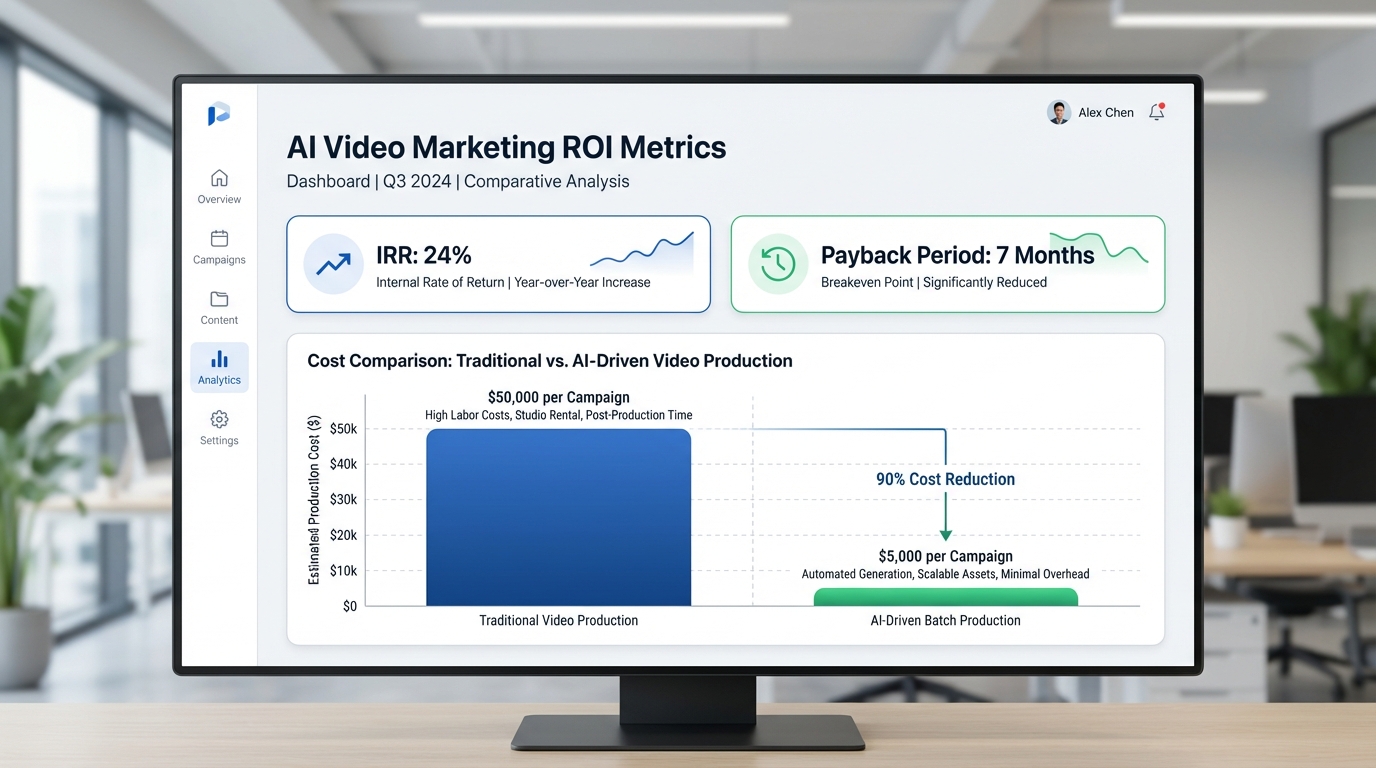
In 2026, sustainability is no longer a “nice-to-have” but a mandatory line item in the enterprise TCO. CFOs are increasingly required to report on the environmental impact of their AI workloads. Therefore, selecting energy-efficient AI platforms is a strategic necessity to mitigate carbon-related financial risks and meet board-level ESG targets.
The GenAI ROI calculator for marketing must include metrics for sustainable AI infrastructure. This includes calculating the kilowatt-hours (kWh) per video render and applying regional carbon factors to determine the CO2e (carbon dioxide equivalent) per campaign. Data centers currently consume approximately 2% of global electricity, a figure projected to rise as GenAI adoption accelerates.
To optimize for energy efficiency, enterprises should evaluate vendors based on their Power Usage Effectiveness (PUE) and their use of GPU-accelerated inference. GPU-based parallel processing significantly reduces the energy required per unit of work compared to traditional CPU-based rendering. Cloud-agnostic GPU farms that schedule workloads during peak renewable energy hours further enhance the sustainability profile.
CFOs should look for platforms that provide sustainability dashboards, offering transparency into the water usage effectiveness (WUE) and the percentage of carbon-free energy used in the rendering process. Integrating these costs into the ROI model ensures that the “green cost” of AI is accounted for upfront, preventing future budgetary shocks as carbon pricing becomes more prevalent.
Sources:
- NVIDIA: Sustainable computing for data centers
- Google Cloud: Measuring the environmental impact of AI inference
- Deloitte TMT Predictions 2025: Sustainable data centers for GenAI
AI Implementation Strategy 2025: The 30-60-90 Day Roadmap
A successful AI implementation strategy 2025 begins with a disciplined 30-day pilot phase. During the first 30 days, the focus is on pilot design and instrumentation. Organizations should select one revenue-generating use case, such as cart recovery, and one efficiency-focused use case, such as automated localization. Defining KPI baselines and setting clear go/no-go thresholds is essential for maintaining CFO confidence.
The 31–60 day phase focuses on integrations and launch. This involves wiring CDP and CRM feeds via APIs and webhooks to trigger video generation in real-time. During this period, marketing teams should launch A/B tests across different segments and languages, using virtual reshoots to iterate on scripts based on initial performance data. Monitoring energy and compute dashboards ensures the project stays within sustainability targets.
In the final 61–90 day window, the focus shifts to the scale decision and long-term roadmap. Leaders should run a final sensitivity analysis in the GenAI ROI calculator marketing tool to finalize the business case with actual performance data. This period concludes with the preparation of a board pack that includes the NPV, IRR, and a multi-quarter rollout plan that aligns with the 2026 budget.
Throughout this process, change management is vital. Establishing cross-functional squads, often co-led by women in tech AI adoption initiatives, ensures that the implementation is inclusive and that the AI-generated content resonates across diverse regional and linguistic segments. Measuring adoption velocity and enablement completion rates helps track the internal success of the transition.
Sources:
Governance, Risk, and Vendor Evaluation for AI Video
Robust AI governance frameworks are the bedrock of enterprise AI adoption. These frameworks encompass the policies and audits that ensure ethical and compliant operations. For Indian enterprises, the DPDP Act 2023 mandates strict adherence to data principal rights, breach intimation, and the implementation of reasonable security safeguards. Any vendor evaluation must prioritize these compliance capabilities.
When assessing energy-efficient AI platforms, the procurement dossier should include ISO 27001 and SOC 2 Type II reports, penetration test summaries, and Data Processing Agreements (DPAs). Transparency in model provenance and content moderation policies is non-negotiable. Furthermore, the ability to provide audit logs (interactive video data capture guide) and watermarking for AI-generated content is essential for maintaining brand trust and regulatory compliance.
The vendor’s infrastructure must support the ROI drivers identified in your calculator. For example, if your business case relies on creative velocity, the platform must demonstrate the ability to handle large-scale bursts, such as the 354,000 videos per day generated for Zomato or the 2.4 million greetings for Hero MotoCorp. These proofs of scale validate the platform's ability to deliver on the promised ROI.
Finally, the integration of personalization ROI measurement tools within the vendor platform allows for continuous optimization. By having real-time visibility into how different video variants perform across channels like WhatsApp, Email, and SMS, marketing leaders can make data-driven decisions that maximize the NPV of their AI investments while minimizing the TCO.
Sources:
The GenAI ROI Calculator Marketing Framework: Quantifying Value (Addendum for BFSI)
Product-specific tactics that close the gap — 80C ELSS personalized calculators + tax saving ROI calculators
Furthermore, tax saving ROI calculators (tax saving ROI calculators) should be used to compare different instruments. For instance, comparing the net-of-cost returns of ELSS versus NPS or traditional insurance helps the user make an informed choice.
Product-specific tactics that close the gap (existing section retained)
80C ELSS personalized calculators + tax saving ROI calculators
In 2026, interactive tools are the primary drivers of high-intent leads. 80C ELSS personalized calculators allow users to pull their transaction data via account aggregators to see their real-time 80C status. These tools should provide clear outputs: the deduction applied, the net tax saved (Deduction × slab rate), and the projected corpus after the 3-year lock-in.
Furthermore, tax saving ROI calculators should be used to compare different instruments. For instance, comparing the net-of-cost returns of ELSS versus NPS or traditional insurance helps the user make an informed choice. TrueFan AI's 175+ language support and Personalised Celebrity Videos can be integrated directly into these calculators, where a celebrity explains the results of the calculation to the user, significantly increasing the trust factor and completion rates.
Recommended Internal Links
- Guide to building tax saving ROI calculators
- WhatsApp Business commerce automation (2026)
- DPDP-compliant personalization strategies
- Interactive video data capture
- Interactive video data capture guide
- WhatsApp catalog video marketing
- AI celebrity video marketing in India
- AI Impact Summit 2026 — TrueFan
Frequently Asked Questions
What is the typical payback period for an enterprise AI video marketing investment?
In the current fiscal climate, most enterprises target a payback period of 6 to 9 months for their initial pilots. By focusing on high-intent use cases like commerce recovery or ABM, many organizations achieve this by the end of their 90-day implementation strategy.
How does the DPDP Act 2023 impact AI video personalization in India?
The DPDP Act requires that all data processing be based on valid consent or legitimate use. For AI video, this means marketers must ensure clear notice is provided to users, and that the data used for personalization is limited to the specific purpose for which it was collected.
What are the primary drivers of AI adoption enterprise costs?
Beyond the initial license fees, the primary costs include API integration, compute usage (often billed per render), and the human-in-the-loop costs for governance and QA. Change management and employee training are also significant indirect costs that should be modeled in your ROI calculator.
How can we measure the sustainability of our AI video campaigns?
Sustainability is measured by tracking the kWh consumed per video render and the associated carbon emissions based on the data center's energy mix. Choosing energy-efficient AI platforms that utilize GPU-accelerated inference is the most effective way to reduce the environmental footprint of these campaigns.
Why should we use TrueFan AI for our enterprise video needs?
TrueFan AI provides a secure, scalable infrastructure designed for the needs of large enterprises. With support for 175+ languages, under 30-second render times, and a proven track record of delivering millions of personalized videos for brands like Zomato and Hero MotoCorp, it offers the reliability and performance required to achieve a high NPV on AI investments.
What is the difference between NPV and IRR in the context of AI marketing?
Net Present Value (NPV) is the total value of the project's benefits minus its costs, adjusted for the time value of money. Internal Rate of Return (IRR) is the annual rate of growth an investment is expected to generate. CFOs use NPV to understand the absolute value created and IRR to compare the project against other potential investments.