Gen Z creator automation 2026: How India’s brands can scale authentic Reels and Shorts with enterprise-grade orchestration
Estimated reading time: 6 minutes
Key Takeaways
- India's 116 million Gen Z consumers are driving a shift toward AI-first creator orchestration.
- Automated UGC campaign orchestration allows brands to manage thousands of micro-creators with localized content.
- Successful 2026 strategies prioritize lo-fi aesthetics and vernacular-first content for Reels and Shorts.
- Enterprise automation can reduce content creation costs by up to 95% while improving ROI.
Digital Marketing Heads and Brand Managers in India are currently facing a paradigm shift. As we enter the era of Gen Z creator automation 2026, the traditional manual approach to influencer marketing is no longer viable for brands aiming to capture the attention of India’s 116 million Gen Z consumers.
The scale of this opportunity is staggering. Recent data indicates that approximately 83% of Gen Z Indians identify as content creators, a wave significantly led by women in small-town "Bharat" (Tier-2 and Tier-3 cities). This demographic is not just consuming content; they are actively shaping the digital narrative through Instagram Reels and YouTube Shorts.
For enterprise brands, 2026 is defined by the rise of "Brands 3.0"—entities that are AI-first, focused on Bharat consumers, and driven by Gen Z demand. The core promise of this new era is the ability to deploy automated, brand-safe, and data-driven short-form video workflows. This allows organizations to orchestrate thousands of micro-creators with real-time personalization and enterprise-grade measurement.
Source: Times of India: 83% of Gen Z Indians are content creators
Source: Entrepreneur India: Brands 3.0: Gen Z, AI-first brands, and Bharat consumers
The 2026 Playbook for UGC Campaign Orchestration India
The winning strategy for 2026 blends micro-creator automated outreach, UGC campaign orchestration India, and social media video automation. By delivering culturally native Reels and Shorts at scale, brands can move beyond vanity metrics toward influencer ROI measurement India and deep creator performance analytics.
This playbook ensures that while the volume of content increases, governance and brand safety remain uncompromised. It is about moving from "one-off" viral hits to a systematic engine of authentic youth content marketing.
Why 2026 is the inflection point for Gen Z creator automation 2026
In 2026, Artificial Intelligence has transitioned from a supportive tool to the primary marketing engine. Planning, creative optimization, and performance measurement are now largely AI-managed within the Indian market. This shift is driven by the necessity to manage the sheer volume of content required to stay relevant on algorithmic feeds.
Consumer signals have also evolved. Gen Z has moved from passive scrolling to intentional discovery, using social platforms as primary search engines. They prioritize community over celebrity, seeking out creators who mirror their lived experiences rather than polished, high-budget advertisements.
Platforms like TrueFan AI enable brands to navigate this complexity by providing the infrastructure for personalization at scale. With the rise of on-platform conversion and user-controlled feeds, the ability to deliver hyper-localized content is the only way to maintain a competitive edge.
Furthermore, the creator supply has exploded. Gen Z "side hustles" now frequently include UGC content creation, affiliate video production, and social reselling. This has expanded the authentic creator inventory, making Gen Z creator automation 2026 the only logical path for brands to manage these vast networks efficiently.
Source: India Digital Advertising: Digital Marketing Trends for 2026 India Market Focus
Source: Royalways: 13 Digital Marketing Trends for 2026
Source: MEXC India: Gen Z Trends and Community over Celebrity
Source: GripInvest: Gen Z Side Hustles and UGC Momentum
UGC campaign orchestration India — the enterprise blueprint
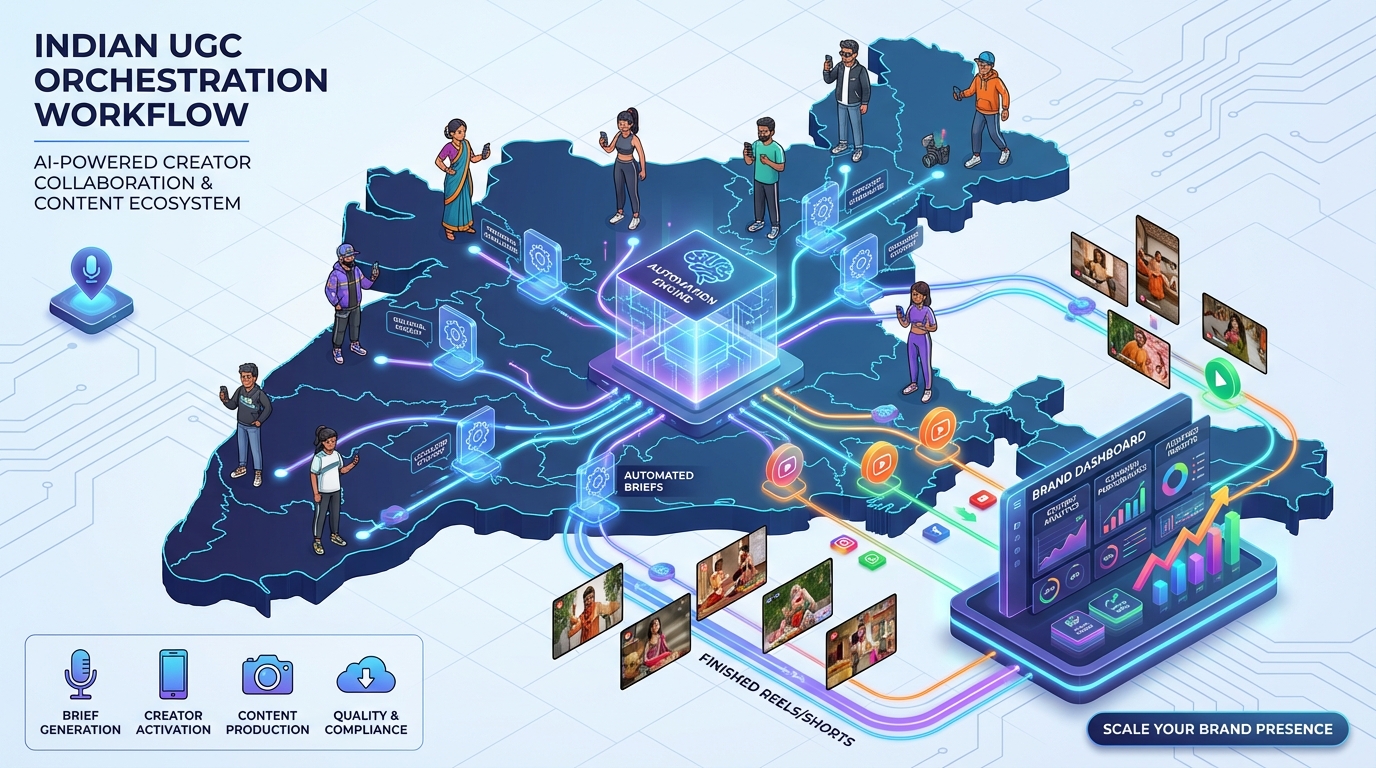
Enterprise UGC campaign orchestration India is defined as a systematic framework to brief, co-create, approve, publish, and attribute user-generated content across thousands of creators simultaneously. It replaces the fragmented "agency-led" model with a centralized, automated system.
A robust orchestration system must include modular creative beats. Instead of a single long brief, brands provide templates for specific hooks, value propositions, and calls-to-action (CTAs). This allows for auto-varianting by region and language—ensuring a campaign resonates equally in Hindi, Tamil, Bengali, and Marathi while retaining the brand’s core tone.
From a governance perspective, the blueprint requires role-based approvals and audit logs. As brands scale to thousands of creators, manual oversight becomes impossible. Automated policy guardrails must be in place to ensure every piece of content meets legal and brand safety standards before it goes live.
Integration is the final piece of the blueprint. Orchestration platforms must sync assets and performance data back to the brand’s source of truth, whether that is a CRM, CDP, or Marketing Automation (MA) suite. This ensures that creator-led content is not an island, but a fully integrated part of the omnichannel customer journey.
Instagram Reels brand partnerships that feel native, not ads
The most successful Instagram Reels brand partnerships in 2026 are those that are indistinguishable from organic content. This requires co-developing content on the creator’s native "format rails"—using their specific camera language, visual grammar, and regional slang.
Creative frameworks for Reels have moved beyond simple product placements. Brands are now utilizing "meme remixes" where the product makes a subtle cameo, or challenge formats anchored on a specific product benefit. The "3-shot problem/solution" demo remains a high-performer, provided it uses on-screen captions and fast-paced editing native to the platform.
Meta’s own guidance emphasizes that Reels performance is boosted when brands lean into "lo-fi" aesthetics. High production value can often signal an "ad" to Gen Z, leading to immediate skips. By automating the distribution of templated scripts and dynamic CTAs, brands can ensure their Reels partnerships maintain this essential "native" feel at scale.
Effective orchestration also includes automated moderation to enforce disclosure and policy. This ensures that while the content feels organic, it remains fully compliant with ASCI (Advertising Standards Council of India) guidelines, protecting the brand from regulatory risks.
Source: Social Samosa: Instagram Reels Playbook and Analytics Hub
YouTube Shorts influencer marketing across the funnel
While Reels often drive discovery, YouTube Shorts influencer marketing has become a powerhouse for full-funnel conversion in India. To succeed, brands must map their Shorts content to specific stages of the buyer journey.
At the upper funnel, the focus is on 6–8 second "teases" with cultural hooks and brand memory cues. The mid-funnel utilizes UGC "stitches" and feature demos to provide social proof. The lower funnel is where the conversion happens, using pinned comment CTAs, urgency-driven offers, and Shorts Shopping tags.
Execution at scale requires series planning—deploying 3–5 Shorts per phase of the launch. This is where social media video automation becomes critical. Brands can no longer afford to manually edit vernacular intros and outros for every regional market; these must be generated and distributed through automated workflows.
India’s leading brands are already automating short-form media buying and creative optimization to match this funnel-based approach. By using creator performance analytics, they can identify which creator archetypes are driving "top-of-funnel" awareness versus "bottom-of-funnel" sales, and reallocate budgets in real-time.
Micro-creator automated outreach without losing authenticity
In 2026, the "micro-creator" (defined in India as those with 5k to 100k followers) is the primary driver of trust. These creators often command higher engagement and deeper community ties than celebrity influencers. However, managing 500 micro-creators is significantly more difficult than managing five celebrities.
The solution is a micro-creator automated outreach engine. This system uses discovery rules based on niche tags, regional languages, and audience overlap thresholds. Instead of manual emails, the engine sends dynamic briefs matched to the creator’s specific style archetype and audience psychographics. UGC campaign orchestration India
Authenticity is maintained through structured feedback loops. Rather than dictating every word, brands provide "creative guardrails" and batch feedback summaries. This allows the creator to maintain their unique voice while ensuring the brand’s message is delivered accurately.
These outreach engines must be integrated with creator CRMs to track deliverables and performance via shared dashboards. This level of transparency ensures that both the brand and the creator are aligned on goals, leading to longer-term, more productive partnerships.
Authentic youth content marketing: language, culture, and speed
Authentic youth content marketing is not a static strategy; it is a process of constant iteration. In the Indian context, this means embracing "meme-speed" iteration—the ability to create and deploy content variants on a trending sound or format within hours, not weeks.
Localization is the cornerstone of authenticity in Bharat. It is no longer enough to translate English scripts into Hindi. Brands must prioritize "vernacular-first" content that retains the cultural nuances and tone of the target region. This includes using local slang and "lo-fi-by-design" compositions that look like they were shot on a smartphone.
TrueFan AI's 175+ language support and Personalised Celebrity Videos allow brands to achieve this level of localization without the need for massive production crews. By using virtual reshoots and AI-driven lip-syncing, brands can swap lines or offers to suit different regional markets instantly.
This approach aligns with the "Brands 3.0" trend, where AI-first brands use localization to drive growth in Tier-2 and Tier-3 cities. Speed and cultural relevance are the new currencies of Gen Z engagement.
Social commerce creator videos that convert
The rise of social commerce has transformed the role of creator content. Social commerce creator videos are no longer just about awareness; they are shoppable assets designed for on-platform conversion. This includes Reels and Shorts with tagged products, affiliate codes, and storefront links.
In 2026, user-controlled feeds mean that CTAs must be designed natively. A "Buy Now" button is less effective than a pinned comment with a creator-specific discount code and a sense of urgency. Brands are also using automated FAQ reply videos—where a creator "answers" a common objection in a follow-up Short—to drive conversion.
To measure the success of these videos, influencer ROI measurement India must move beyond clicks. Brands are now using UTM parameters and creator-specific codes to track the entire path to purchase, from the initial view to the final checkout.
Social media video automation allows brands to generate these product explainers and offer variants at scale. By automating the "boring" parts of content creation—like resizing for different platforms or adding captions—creators can focus on the creative storytelling that actually drives sales.
Source: WHY TAP: Social Media Trends 2026: On-Platform Conversion
Viral campaign automation platform — what’s real vs myth
The idea of a "guaranteed viral" campaign is a myth. However, a viral campaign automation platform can significantly increase the probability of virality by optimizing for shareability signals. These signals include novelty, identity (content that makes the user look good), and utility.
In 2026, viral success is a result of AI-managed optimization. Brands use "test matrices" to A/B test different hooks and first-3-second visuals. By analyzing early platform signals—such as view-through rates and remix rates—the platform can automatically "push" the top-performing creative to a wider audience.
The reality of 2026 is that marketing teams have shifted their focus from manual execution to creative strategy and incrementality. The "automation" part of the platform handles the heavy lifting of distribution and optimization, while the humans focus on the "big idea" that resonates with the community.
This shift has led to massive efficiency gains. For example, some Indian media brands have reduced the time taken to create automated trailer edits from 16 hours to less than one hour, representing a 95% cost reduction.
Source: Neuron.expert: AI to take over marketing engine by 2026
Measurement frameworks and ROI math
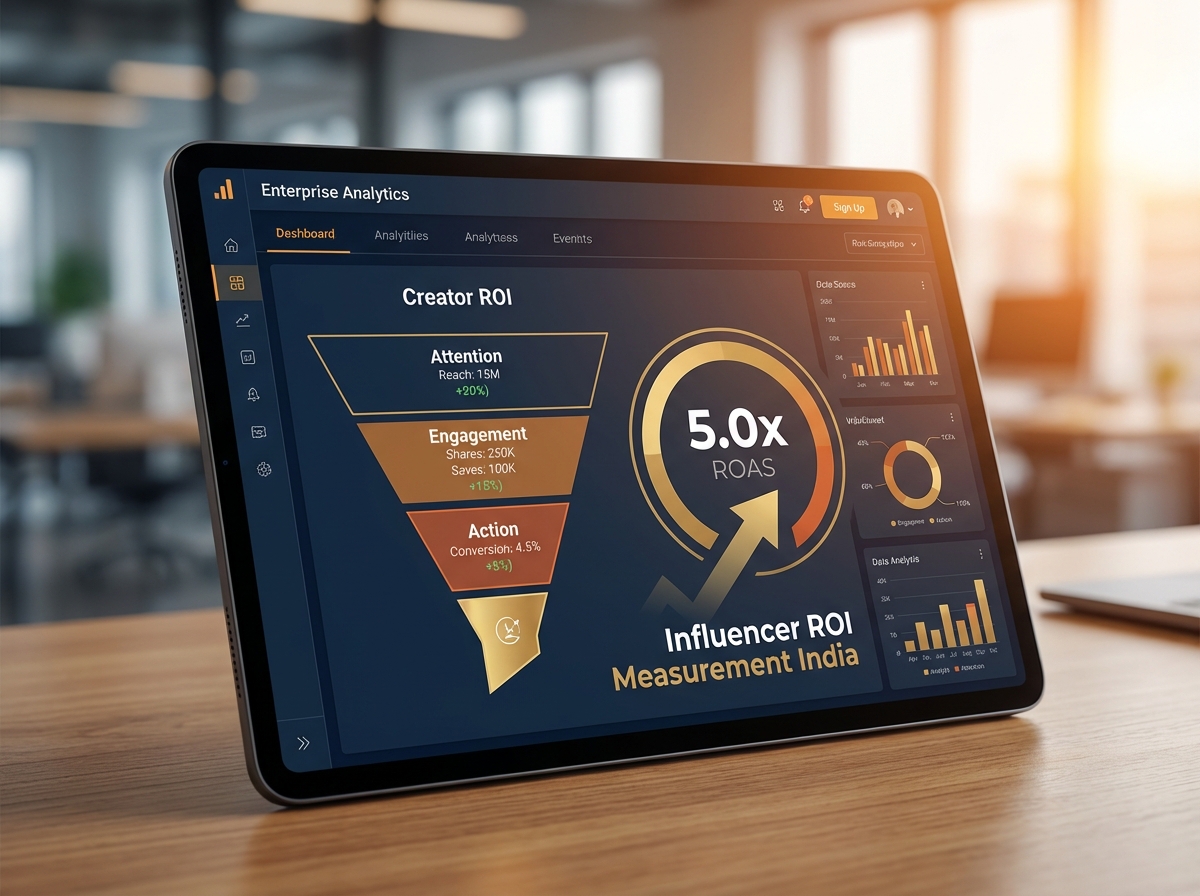
To accurately measure influencer ROI measurement India, brands should adopt the following formula:
ROI = (Attributable Revenue Uplift − (Creator Fees + Media Spend + Platform Costs)) ÷ (Creator Fees + Media Spend + Platform Costs)
2026 Measurement Matrix
| Metric Category | Key Performance Indicators (KPIs) | 2026 Benchmark (India) |
|---|---|---|
| Attention | 3s View Rate, Avg. Watch Time % | >45% Watch Time for Shorts |
| Engagement | Share Rate, Remix Rate, Saves | >3% Share-to-View Ratio |
| Action | Link CTR, Coupon Redemption | >1.5% CTR for Social Commerce |
| Economics | CPA, Incremental ROAS | 3x - 5x ROAS for Mature Brands |
In 2026, the shift in practice is clear: AI handles the planning and optimization, while human teams focus on creator performance analytics and incrementality. This allows for a more scientific approach to creative A/B testing, focusing on hook lines and first-3-second visual impact.
Frequently Asked Questions
1. How does Gen Z creator automation 2026 maintain brand safety?
Automation platforms use AI-driven moderation filters to scan all creator content for political, offensive, or discriminatory language. Additionally, enterprise systems like TrueFan AI include role-based approval workflows, ensuring a human brand manager can give the final "green light" before any content is published.
2. Can automated outreach really feel "authentic" to micro-creators?
Yes, by using dynamic templates that adapt to the creator's specific style and past performance. Instead of a "one-size-fits-all" brief, the automation engine suggests creative directions that align with the creator's existing content, making the partnership feel like a natural extension of their brand.
3. What is the typical ROI uplift for automated UGC campaigns in India?
Brands using automated orchestration often see a 30-50% reduction in CPA (Cost Per Acquisition) compared to manual influencer campaigns. This is driven by the ability to test thousands of creative variants and shift budget to high-performing creators in real-time.
4. How do you handle localization across 175+ languages?
The system uses advanced AI for virtual reshoots and lip-syncing. A single "hero" video can be automatically localized into regional dialects like Bhojpuri or Haryanvi, retaining the original creator's voice and tone while making the message culturally relevant to the local audience.
5. Is this technology suitable for small businesses or just enterprises?
While the technology is built for enterprise-grade scale (handling thousands of videos), the principles of social media video automation are increasingly accessible. However, the full suite of security, SSO, and CRM integrations is specifically designed to meet the needs of large-scale organizations.
Conclusion: The Future of India’s Creator Economy
The competitive edge for Indian brands in 2026 lies in the ability to orchestrate the Gen Z creator base with precision, personalization, and speed. By moving away from manual, fragmented campaigns and toward Gen Z creator automation 2026, brands can finally achieve the scale required to dominate the "Bharat" market.
The integration of UGC campaign orchestration India with advanced creator performance analytics ensures that every marketing rupee is spent on content that actually moves the needle. As we look toward the future, the "creator economy" will simply become the "economy," and automation will be the engine that drives it.
Ready to scale?
- See Studio by Truefan AI in action: Request an enterprise demo for Reels and Shorts automation.
- Calculate your ROI: Get a custom ROI model for your next creator-led product launch.
- Download the Playbook: Get our "UGC Campaign Orchestration India — 30-Day Blueprint."



