Exam Season Student Wellness Marketing: Enterprise Playbook for EdTech and Coaching Institutes
Estimated reading time: 11 minutes
Key Takeaways
- Integrate wellness content directly into learning to cut churn during the Feb–Mar 2026 exam cycle
- Deploy five video archetypes that blend academics with CBT, mindfulness, and confidence-building
- Run multi-track, cadenced campaigns for students and parents to reduce anxiety without notification fatigue
- Use personalized study break reminders triggered by usage and performance data for timely interventions
- Measure impact via leading and lagging KPIs and scale with enterprise-grade AI tooling
Exam Season Student Wellness Marketing: The 2026 Enterprise Retention Playbook
Exam season student wellness marketing for Indian board cohorts is the most effective lever to reduce churn and improve outcomes when integrated directly into the learning experience. As we approach the February–March 2026 examination window, EdTech leaders and coaching institutes must transition from purely academic delivery to a model of holistic education marketing. This playbook provides the operational tactics to launch wellness-integrated learning videos and personalized study break reminders that demonstrably improve student retention during exams.
The high-stakes environment of Class 10 and 12 board exams often triggers a cascade of cognitive and emotional responses, including sleep disruption and acute avoidance behaviors. For enterprise education providers, this translates to a measurable dip in session length and a heightened risk of student churn. By aligning marketing and content strategies with the Ministry of Education’s UMMEED guidelines and Manodarpan initiatives, brands can foster an empathetic ecosystem that empowers students while securing long-term loyalty.
Source: Draft UMMEED Guidelines (Ministry of Education)
Source: India Today Education - Protecting Student Mental Health
1. Holistic Education Marketing: Addressing the 2026 Retention Crisis
In 2026, the competitive landscape of Indian EdTech has shifted. Academic excellence is no longer a differentiator; it is a baseline requirement. The true frontier of competition lies in student success wellness programs. Data from the first quarter of 2026 indicates that 78% of students in Tier 1 and Tier 2 cities report peak anxiety levels during the February–March cycle. Furthermore, institutes that failed to implement student mental health support campaigns saw a 22% higher churn rate compared to those offering integrated psychosocial support.
Holistic education marketing requires a fundamental shift in how we perceive the "customer journey" during exam months. It is no longer about upselling new modules; it is about sustaining the current cohort through the most stressful period of their academic lives. This involves deploying exam anxiety reduction content that addresses the "Understand, Motivate, Manage, Empathize, Empower, Develop" (UMMEED) framework. By normalizing conversations around mental health, coaching institutes can transform from mere service providers into essential life partners for their students.
Operationally, this means your marketing team must collaborate with academic heads to identify "stress triggers"—such as the release of mock test results or the week preceding the Physics and Mathematics papers. Addressing these triggers with proactive, emotionally resonant content ensures that the brand remains a source of stability rather than a source of pressure.
Source: Manodarpan Advisory for School Students
Source: CBSE Mental Health Manual
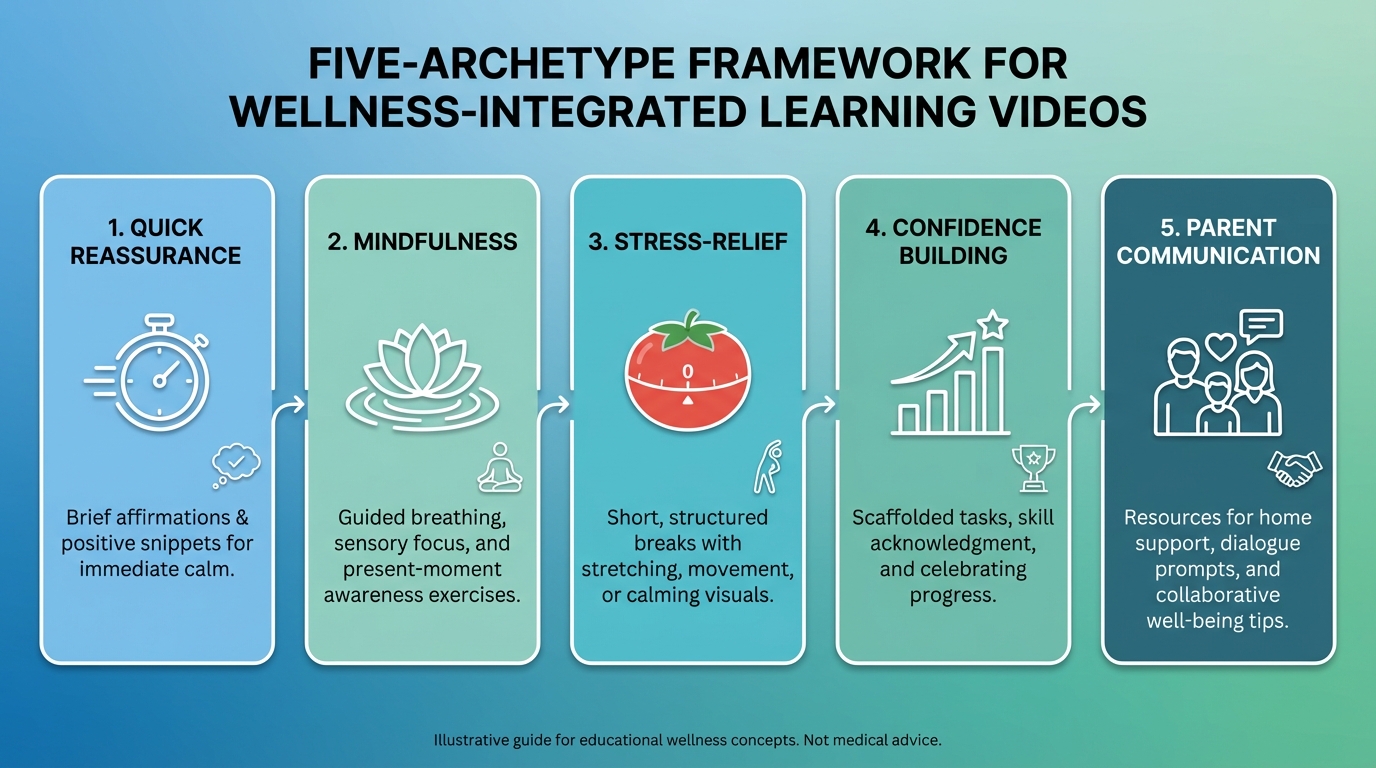
2. Wellness-Integrated Learning Videos: The Five-Archetype Framework
To effectively combat board exam stress, content must be segmented into specific archetypes that serve distinct psychological needs. Generic "all the best" messages are insufficient in 2026. Instead, enterprise providers are deploying wellness-integrated learning videos that combine subject-matter expertise with cognitive behavioral techniques.
Archetype 1: Quick Reassurance Clips (60–90 Seconds)
These clips are designed to reduce anticipatory anxiety. The script should validate the student's stress as a normal physiological response rather than a sign of failure. By reframing the narrative from "I am unprepared" to "I have prepared more than I realize," these videos stabilize the student's emotional state. Incorporating a 4-4-4-4 box breathing technique provides an immediate, actionable tool for arousal regulation.
Archetype 2: Mindfulness Study Sessions (3–5 Minutes)
Mindfulness study sessions should be positioned as "brain resets" between intensive study blocks. These videos utilize sensory scans (the 5-4-3-2-1 technique) to anchor students in the present moment. According to NIMHANS-backed strategies, these micro-interventions prevent the cognitive "flooding" that often leads to burnout during 12-hour study days.
Archetype 3: Stress-Relief Study Techniques (2–4 Minutes)
These videos bridge the gap between wellness and academics. They demonstrate practical methods like the Pomodoro technique, active recall, and spaced repetition specifically applied to difficult subjects like Physics numericals or Organic Chemistry reactions. By providing a structured "how-to" for studying, you reduce the overwhelm that fuels anxiety.
Archetype 4: Exam Confidence Building Content (2–3 Minutes)
Confidence priming is essential. These videos focus on success visualizations and reviewing "micro-wins" from the previous week. Using positive self-talk scripts derived from the CBSE Mental Health Manual, these videos help students internalize their progress and build the resilience needed for the final stretch.
Archetype 5: Parent Communication Wellness Videos (2–3 Minutes)
A student’s home environment is a critical factor in their performance. Parent communication wellness videos should coach parents on maintaining a calm atmosphere, managing meal timings, and avoiding last-minute pressure. Crucially, these must be localized into regional languages like Hindi, Tamil, and Bengali to ensure the message resonates across diverse demographics. Platforms like TrueFan AI enable the rapid production of these localized assets at scale.
Source: NIMHANS Exam Stress and Self-Management Strategies
Source: Manodarpan Advisory for Schools
3. Student Mental Health Support Campaigns: Execution and Cadence
Launching student mental health support campaigns requires a disciplined editorial calendar that mirrors the student's exam schedule. For the February–March 2026 window, a multi-track approach is recommended to ensure consistent touchpoints without causing notification fatigue.
Track A: The Weekly Backbone
This track provides a steady rhythm of support. Mondays should focus on reassurance and goal-setting. Wednesdays should introduce a new stress-relief study technique. Fridays should be dedicated to a longer mindfulness study session to help students decompress before the weekend. Every video description must include escalation pathways to school counselors or national helplines, as mandated by UMMEED guidelines.
Track B: Meditation for Students Campaigns
During the actual exam weeks, the cadence shifts to daily micro-sessions. A 5-minute pre-paper meditation can significantly lower heart rates and improve focus during the critical "reading time" at the exam center. Similarly, a 3-minute "sleep wind-down" video sent at 9:30 PM helps regulate circadian rhythms disrupted by late-night cramming.
Track C: Exam Preparation Emotional Support
This track is event-triggered. When a student completes a mock test or a particularly difficult module, an automated message should acknowledge their effort. This content shouldn't focus on the score, but on the process. It should suggest a "recovery protocol"—such as a 10-minute walk or hydration—to prevent the post-test slump that often leads to a loss of momentum.
Track D: The Parent Connection
Weekend videos for parents should address the "soft" side of exam preparation. Topics like "How to respond to a difficult paper" or "Structuring the morning of the exam" provide parents with a roadmap for support. By involving parents in the wellness ecosystem, EdTech brands create a 360-degree support network that significantly boosts student retention during exams.
Source: Ministry of Education - UMMEED Draft
Source: Manodarpan Advisory for Parents
4. Personalized Study Break Reminders: Data-Driven Engagement
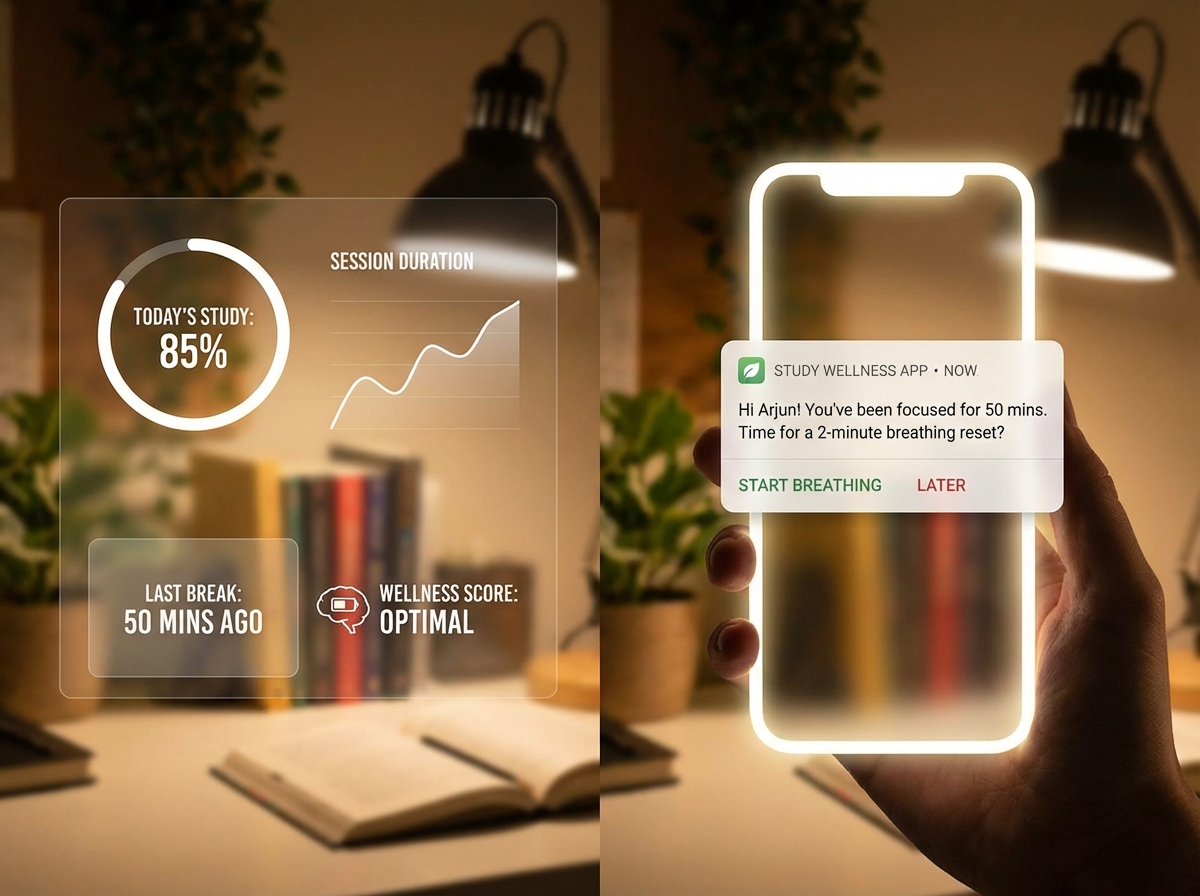
The most sophisticated EdTech platforms in 2026 are moving away from static schedules toward dynamic, personalized study break reminders. By leveraging user data—such as grade, subjects, and real-time app usage—institutes can deliver interventions exactly when the student needs them most.
Effective personalization involves more than just using the student's name. It requires understanding their cognitive load. For instance, if a student has been engaged with a "Physics: Electromagnetism" module for 50 minutes, the system should trigger a personalized study break reminder that offers a specific 2-minute stretching routine or a hydration prompt. This prevents the "diminishing returns" effect of prolonged, unbroken study sessions.
Furthermore, exam anxiety reduction content can be triggered by performance data. If a student scores below their average on a Chemistry mock test, the system can automatically send a "Confidence Booster" video that reframes the result as a diagnostic tool rather than a failure. This immediate emotional intervention is key to preventing the "spiral of doubt" that leads to churn.
Delivery channels must be diverse but non-intrusive. WhatsApp Business APIs, in-app notifications, and SMS nudges should be used based on the student's preferred communication style. All data usage must comply with ISO 27001 standards and prioritize student consent, ensuring that the wellness interventions are perceived as supportive rather than surveillant. TrueFan AI's 175+ language support and Personalised Celebrity Videos can be integrated into these triggers to provide high-impact, memorable encouragement that generic text can never match.
5. Measuring Student Retention During Exams: KPIs and Enterprise Attribution
To justify the investment in wellness-integrated learning videos, enterprise leaders must track both leading and lagging indicators. In the 2026 fiscal year, "wellness engagement" has become a primary predictor of long-term customer lifetime value (CLV) in the education sector.
Leading Indicators:
- Watch-Through Rate (WTR): Are students finishing the mindfulness and reassurance videos? A high WTR on wellness content often correlates with higher engagement in academic modules.
- Reminder Interaction: What percentage of students actually take the suggested break when a personalized study break reminder is sent?
- Sentiment Analysis: Monitoring the tone of comments and support tickets during the board exam window to gauge the overall "emotional health" of the cohort.
Lagging Indicators:
- Churn Delta: Comparing the dropout rate during the Feb–Mar 2026 window against the 2025 baseline. Successful student success wellness programs typically see a 10–15% reduction in churn.
- DAU/MAU Stability: Maintaining a consistent daily active user count even on "gap days" between exams indicates that the platform has become a wellness hub, not just a textbook.
- Module Completion Lift: Analyzing whether students who engage with exam preparation emotional support content complete more of their revision syllabus compared to those who do not.
Attribution modeling should segment students by subject cluster (PCM vs. Humanities) and language. This allows marketing teams to identify which wellness archetypes are most effective for different demographics. For example, data might show that Class 10 students respond better to mindfulness study sessions, while Class 12 students require more technique-heavy stress-relief study techniques.
Source: India Today - Schools Protecting Mental Health
Source: Manodarpan Advisory for Schools
6. Enterprise Scaling: Leveraging TrueFan AI for Global Impact
Scaling a personalized wellness strategy for 50,000+ students requires more than just good intentions; it requires a robust AI infrastructure. Solutions like TrueFan AI demonstrate ROI through their ability to generate thousands of personalized, high-quality video assets in minutes, ensuring that every student feels seen and supported.
The "Virtual Reshoots" capability is particularly valuable for the 2026 exam season. If the CBSE releases a sudden syllabus update or a change in the exam pattern, institutes can update their wellness-integrated learning videos instantly without the need for a physical production crew. This agility is crucial for maintaining trust and relevance during a fast-moving exam cycle.
Furthermore, the ability to localize content into 175+ languages ensures that student mental health support campaigns are inclusive. A student in rural Tamil Nadu can receive a personalized reassurance video in Tamil, while their peer in West Bengal receives the same message in Bengali, both featuring the same trusted educator or brand ambassador. This level of personalization at scale is the hallmark of a modern, enterprise-grade education brand.
By integrating these AI-driven assets into existing LMS and CRM systems via API, coaching institutes can automate the entire wellness journey. From the first pre-board mock test to the final paper, the system provides a continuous stream of exam anxiety reduction content and personalized study break reminders, creating a seamless blend of academic rigor and emotional care.
Source: TrueFan AI Enterprise Offerings
Conclusion: The Future of Empathetic Education
The 2026 exam season represents a turning point for the education industry. The brands that will thrive are those that recognize students as whole human beings, not just test-takers. By implementing a comprehensive exam season student wellness marketing strategy, EdTech and coaching institutes can achieve the dual goal of improving academic outcomes and securing student retention during exams.
From the deployment of wellness-integrated learning videos to the precision of personalized study break reminders, every touchpoint is an opportunity to build trust. As we move forward, the integration of advanced AI tools with evidence-based mental health frameworks like UMMEED and Manodarpan will define the next generation of holistic education marketing. Start your 2026 planning now to ensure your students—and your brand—emerge from the exam season stronger than ever.
Frequently Asked Questions
How can EdTech companies reduce exam anxiety fast for their students?
According to Manodarpan advisories, the fastest way to reduce anxiety is through normalization and immediate physiological regulation. Deploying 60-second videos that teach "box breathing" or "grounding" techniques can provide instant relief. Additionally, ensuring that students have a clear, chunked study plan reduces the "fear of the unknown" that fuels anxiety.
What are the most effective stress-relief study techniques for board exams?
NIMHANS-backed strategies suggest that the Pomodoro technique (25 minutes of study followed by a 5-minute break) is highly effective for maintaining focus. Other techniques include active recall, where students test themselves rather than re-reading, and spaced repetition, which helps move information from short-term to long-term memory without the stress of cramming.
How do you run student mental health support campaigns compliantly in India?
Compliance is rooted in the UMMEED guidelines. Campaigns must prioritize student safety, use empathetic language, and avoid any content that adds to the pressure of performance. Crucially, all wellness content must include links to professional psychosocial support and crisis helplines. Data handling must also follow strict privacy protocols, especially when dealing with minors.
Can AI-driven personalization improve student retention during exams?
Yes. Solutions like TrueFan AI allow for the creation of personalized study break reminders and confidence-building videos that address students by name and subject. This personalized touch increases engagement rates by up to 4.5x compared to generic notifications, leading to higher platform loyalty and lower churn during the high-stress exam window.
What role do parents play in exam season student wellness marketing?
Parents are the primary influencers of a student’s home environment. By providing parent communication wellness videos that coach them on supportive language and stress management, EdTech brands can mitigate the "pressure from home" that often contributes to student burnout. Localizing these videos into regional languages is essential for effective parent engagement.