Q1 Playbook for B2B Procurement Acceleration 2026: Role-Aligned Video Strategies to Build Buying Committee Consensus Fast
Estimated reading time: ~13 minutes
Key Takeaways
- Map multi-stakeholder decision dynamics and deliver role-aligned videos for CFO, CTO, and CMO to accelerate consensus.
- Use chapterized vendor selection videos and scorecard-aligned summaries to reduce analysis paralysis mid-funnel.
- Scale RFP response personalization with AI, tying chapters to specific tender requirements for faster iterations.
- Deploy procurement compliance micro-videos to de-risk legal review and cut redline cycles.
- Operationalize a 30/60/90-day plan and trigger-based enablement to measure and boost consensus velocity in Q1.
The landscape of enterprise sales has undergone a seismic shift, where B2B procurement acceleration 2026 now hinges on orchestrated, multi-stakeholder video personalization across the entire buying journey. In the high-stakes environment of Q1, compressing decision cycles is no longer a luxury but a survival mandate for revenue teams aiming to capture early-year budget allocations. By aligning CFO, CTO, and CMO priorities through automated vendor evaluation content, organizations can effectively speed time-to-contract and bypass traditional procurement bottlenecks.
As fiscal year 2026 planning intensifies, the pressure on procurement departments to deliver rapid ROI has reached an all-time high. Research from ETCIO indicates that over 90% of enterprise stakeholders now prioritize rapid response and issue resolution as a primary vendor selection criterion. Consequently, vendors that utilize hyper-personalized, role-aligned video content to de-risk complex technical and financial choices are winning the calendar priority in Q1. This playbook provides the strategic framework for executing a multi-stakeholder video strategy that drives B2B procurement acceleration 2026.
Map the Buying Committee with Multi-Stakeholder Decision Mapping
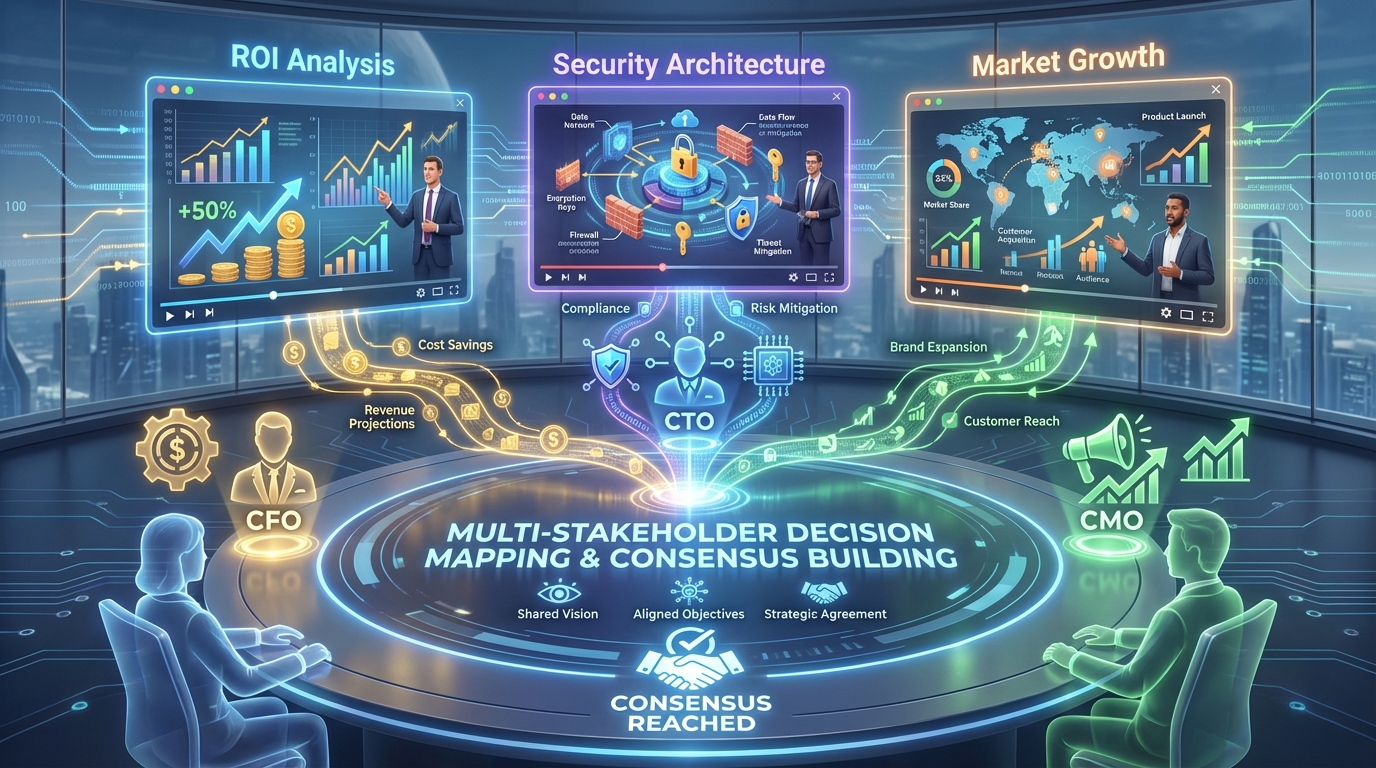
Achieving B2B procurement acceleration 2026 requires a granular understanding of the modern enterprise buying committee, which now averages 11 to 20 stakeholders in high-value deals. Multi-stakeholder decision mapping is the process of creating a structured inventory of every influencer—from the economic buyer to the technical gatekeeper—and identifying the specific evidence required to move them from skepticism to approval. Without this map, sales teams often fall into the trap of sending generic content that fails to address the unique risk profiles of different departments.
In 2026, the "one-size-fits-all" pitch deck is effectively obsolete. To drive buying committee consensus building, your decision map must account for the divergent goals of the C-suite. The CFO focuses on the payback period and risk-adjusted ROI; the CTO scrutinizes integration paths and security posture; and the CMO demands immediate time-to-value and adoption readiness. By mapping these requirements early in Q1, you can deploy targeted video assets that preemptively answer objections before they reach the formal RFP stage.
| Role | Primary Decision Criteria | Critical Objections | Required Evidence | Video Asset Type |
|---|---|---|---|---|
| CFO | TCO, OpEx vs CapEx, Payback Period | "Is the ROI model too optimistic?" | Sensitivity analysis, 24-month TCO | Budget approval stakeholder videos |
| CTO/CIO | Security, Scalability, Integration | "Will this increase technical debt?" | Reference architecture, API docs | Technical deep-dive chapters |
| CMO/CRO | Revenue impact, Adoption speed | "Will my team actually use this?" | Use-case storyboards, Case proof | Outcome-focused explainers |
| Legal/Infosec | Compliance, Data Residency | "Does this meet SOC 2/ISO 27001?" | Security certs, DPA walkthrough | Procurement compliance videos |
CFO CTO CMO Aligned Messaging Frameworks
To operationalize this map, organizations must adopt CFO CTO CMO aligned messaging that translates the same core solution into three distinct value languages. For the CFO, the narrative must be purely financial, focusing on how the investment optimizes the balance sheet. For the CTO, the messaging shifts to technical resilience and interoperability. For the CMO, the focus is on growth levers and competitive advantage.
A successful 90-second CFO video script should lead with the "cost of inaction" and follow with a quantitative model of the payback period. Conversely, a 120-second CTO video should prioritize a visual walkthrough of the reference architecture and data flow diagrams. When these messages are delivered synchronously, they create a "surround-sound" effect that accelerates internal consensus, ensuring that no single stakeholder becomes a bottleneck during the Q1 budget release window.
Sources:
Enterprise Vendor Selection Videos That Move Deals
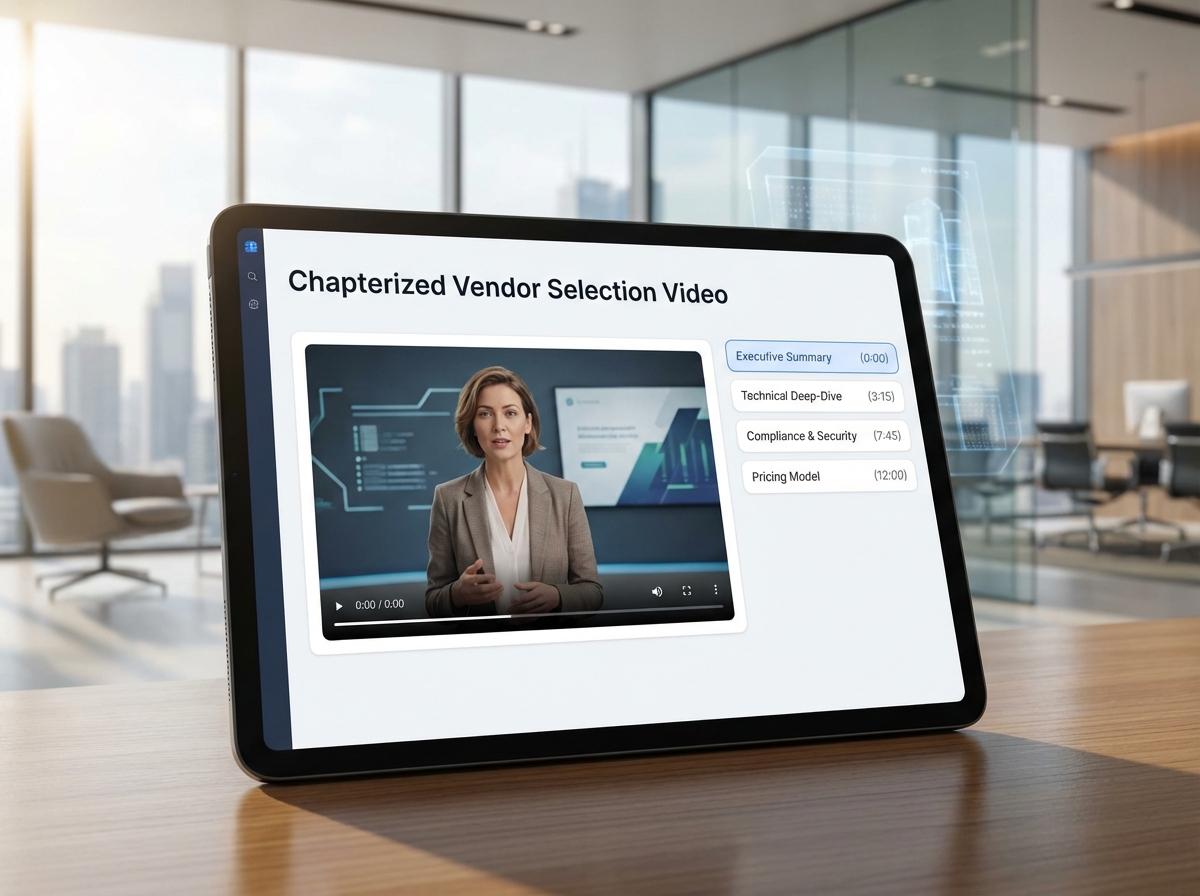
The middle of the procurement cycle is often where deals go to die due to "analysis paralysis." Enterprise vendor selection videos solve this by providing modular, chapterized explainers that allow different stakeholders to consume only the information relevant to their role. In 2026, these videos serve as the "digital twin" of your sales team, working 24/7 to educate the buying committee while your AEs focus on high-level negotiation.
These videos must go beyond simple product demos. They should incorporate competitive differentiation presentations that offer crisp, data-backed contrasts between your solution and the status quo. By using timestamped Q&A and chapterized navigation, you enable procurement officers to quickly find the "Security & Compliance" or "ROI Model" sections, which significantly reduces the time spent in the evaluation phase. Platforms like TrueFan AI enable the creation of these hyper-personalized assets at scale, ensuring each stakeholder feels the content was built specifically for their enterprise environment.
Leveraging Vendor Evaluation Automation
To further drive B2B procurement acceleration 2026, leading organizations are integrating their video content with vendor evaluation automation tools. This involves pairing personalized videos with standardized digital scorecards that procurement teams use to grade vendors. When a procurement officer opens your video, they are greeted with a summary that maps directly to their internal evaluation criteria.
This automation extends to the "virtual reshoot" capability. If a prospect raises a specific concern about a feature or a pricing tier, AI-driven video platforms can update the specific lines in the video without requiring a full production cycle. This agility—turning around a revised, personalized video in under 24 hours—demonstrates a level of responsiveness that 2026 buyers now expect as a baseline.
Sources:
RFP Response Video Personalization and Evaluation Automation
The RFP process is traditionally the most friction-heavy stage of the enterprise buying journey. RFP response video personalization transforms this static, document-heavy phase into a dynamic, engaging experience. Instead of forcing evaluators to wade through 100-page PDFs, savvy vendors are now submitting "Video RFP Indexes"—short, chapterized videos where each chapter corresponds to a specific section of the RFP (e.g., Chapter 4: Data Privacy, Chapter 7: Implementation Timeline).
This approach directly addresses the "hidden truths" of tender evaluation, where evaluators often skim documents due to time constraints. By providing a personalized video intro from the account executive or a subject matter expert, you humanize the bid and ensure your key value propositions are actually heard. This level of personalization is particularly effective in Q1, when procurement teams are often overwhelmed by a high volume of year-opening RFPs.
Workflow for Automated RFP Personalization
- Ingestion: Use AI to ingest the RFP requirements and map them to your existing library of modular video chapters.
- Persona-Specific Intros: Auto-generate role-specific introductions for the procurement lead, the IT director, and the business owner.
- Evidence Attachment: Link each video chapter to supporting documentation (SOC 2 reports, case studies) within a digital sales room.
- Rapid Revision: Utilize AI editing to adjust the script based on specific RFP amendments, ensuring the video remains 100% accurate throughout the bidding cycle.
By implementing this workflow, enterprises can achieve a 30-50% faster RFP response iteration cycle. This speed is a critical component of B2B procurement cycle acceleration 2026, as it allows your team to stay ahead of competitors who are still mired in manual document preparation.
Sources:
Procurement Compliance Videos and Contract Negotiation Support
The final hurdle in any enterprise deal is the "legal black hole." Procurement compliance videos and contract negotiation support assets are designed to shine a light on this phase and reduce redline cycles. These are micro-videos—often 60 seconds or less—where your legal or infosec team explains the rationale behind specific clauses, such as data residency, liability limits, or SLA tiers.
In 2026, "touchless procurement" is becoming the goal for many Indian and global enterprises. Research from IBM highlights that some organizations are achieving up to 85% touchless procurement through AI agents. To fit into this automated ecosystem, your compliance data must be easily digestible. A video walkthrough of your DPA (Data Processing Agreement) can preempt dozens of back-and-forth emails, as it allows the prospect's legal team to see the "why" behind your terms in a transparent, human format.
De-risking the Final Approval
Contract negotiation support videos should be stored in a centralized Digital Sales Room (DSR) where engagement can be tracked. If the prospect's legal counsel watches the "Indemnification Clause" video three times, it’s a clear signal to your sales team to proactively schedule a legal-to-legal call. This data-driven approach to B2B sales enablement ensures that you are focusing your human resources on the specific friction points that are delaying the contract signature.
TrueFan AI's 175+ language support and Personalised Celebrity Videos can even be utilized here to create high-impact, localized compliance messages for global stakeholders, ensuring that language barriers do not slow down the legal review process in different regions.
Sources:
Enterprise Buying Journey Optimization with B2B Sales Enablement
True B2B procurement acceleration 2026 is achieved when video content is not just a one-off asset but a triggered component of enterprise buying journey optimization. This involves orchestrating persona-aligned content based on real-time CRM and ABM signals. For example, if a CTO views a security-focused video but drops off before the 50% mark, the system should automatically trigger a follow-up email with a more detailed technical whitepaper or an invitation to a 1:1 session with a Solution Engineer.
This level of B2B sales enablement relies on a "trigger map" that connects stakeholder engagement to specific sales actions. By 2026, 85% of enterprises are expected to blend human and AI capabilities to boost productivity by at least 25%. In the context of sales, this means AI handles the content delivery and tracking, while humans intervene only when the data suggests a high-intent "buying signal" or a significant "consensus gap."
The Trigger Map for Q1 Acceleration
- Signal: CFO completes the "ROI & Payback" video chapter.
- Action: Deliver a personalized sensitivity analysis video; propose a budget approval calendar.
- Signal: Multiple stakeholders from the same account watch the "Competitive Differentiation" video.
- Action: Alert the AE to initiate a "Consensus Workshop" to align the different departments.
- Signal: RFP submission is confirmed.
- Action: Send a personalized "Thank You" video from the CEO, including a chapterized index of the bid's key highlights.
By measuring "consensus velocity"—the speed at which different stakeholders within an account move through the content—sales leaders can more accurately forecast Q1 revenue and identify "at-risk" deals before they stall.
Sources:
30/60/90-Day Q1 Action Plan for Procurement Acceleration
To implement this strategy effectively, organizations need a structured rollout that prioritizes high-impact accounts while building the necessary content infrastructure. Solutions like TrueFan AI demonstrate ROI through their ability to rapidly scale these personalized video plays across hundreds of accounts simultaneously.
0–30 Days: Foundation and Pilot
- Decision Mapping: Build a multi-stakeholder decision map for your top 10 Q1 target accounts.
- Core Asset Creation: Script and produce the "Big Three" videos: CFO ROI, CTO Security, and CMO Outcomes.
- RFP Pilot: Select one in-flight RFP and apply the "Video Index" approach with a 48-hour turnaround SLA.
31–60 Days: Scaling and Personalization
- Persona Variants: Use AI to create regional and industry-specific variants of your core videos.
- Competitive Differentiation: Introduce "Battlecard Videos" that provide 3 crisp contrasts against your top two competitors.
- Enablement Training: Train your AE and Bid teams on how to use video engagement analytics to drive their follow-up cadences.
61–90 Days: Optimization and Governance
- Negotiation Support: Expand your library to include micro-videos for common legal and procurement redlines.
- Advanced Analytics: Integrate video engagement data into your CRM to create a "Consensus Score" for every active deal.
- Governance Playbook: Formalize the approval workflows to ensure all personalized videos remain on-brand and compliant.
By the end of the 90-day cycle, your organization will have a repeatable engine for B2B procurement cycle acceleration 2026, characterized by shorter evaluation dwells and higher win rates in complex committee-led deals.
Conclusion: Securing the Q1 Advantage
The path to B2B procurement acceleration 2026 is paved with role-aligned, hyper-personalized content that respects the time and specific risks of the modern buying committee. By moving away from static communication and toward a modular, video-first strategy, enterprise sales teams can navigate the complexities of Q1 budget cycles with unprecedented speed and precision.
From multi-stakeholder decision mapping to automated RFP responses and contract negotiation support, the tools are now available to transform procurement from a bottleneck into a competitive advantage. As you execute your fiscal year procurement strategies, remember that the goal is not just to provide information, but to build the consensus necessary for a confident "Yes." Launch your Q1 pilot today and redefine what is possible in enterprise sales enablement.
Recommended Internal Links
- B2B procurement cycle acceleration 2026: video strategies
- B2B Procurement Cycle Acceleration 2026: Video Playbook
- Vendor Selection Video Presentations that Win 2026 RFPs
- B2B procurement cycle acceleration: video plays that win
- Q4 Deal Acceleration Strategies for B2B Procurement 2026
- Technology Spend Optimization for CFOs: ROI in 2026
- Digital India compliance marketing 2026: privacy-first video
- A CTO's Guide to 2026 Digital Transformation Budget Planning
Frequently Asked Questions
How do we ensure these personalized videos stay on-brand and compliant?
Governance is maintained through centralized templates and strict approval workflows. By using "brand locks" on visual elements and AI-driven script moderation, organizations can ensure that every video—even those generated at scale—adheres to corporate identity and legal standards.
Is stakeholder data protected when using these video platforms?
Security is paramount in 2026. Leading platforms, including TrueFan AI, adhere to ISO 27001 and SOC 2 standards. Data processing agreements (DPAs) and consent-first usage policies ensure that stakeholder information is handled with the same level of rigor as your core product data.
How can we maintain accuracy in 175+ languages for global deals?
Modern AI video technology uses "retained voice" and advanced lip-syncing to ensure that localized videos feel authentic. Human-in-the-loop QA sampling and engagement analytics help detect any linguistic anomalies, ensuring that your message is clear whether the stakeholder is in Mumbai, London, or New York.
Are procurement compliance videos actually allowable in formal tenders?
Yes, provided they are used as "supplementary evidence." Most modern RFPs allow for digital attachments or links to external portals. By hosting these in a secure Digital Sales Room with access controls, you provide a professional, governance-friendly way for evaluators to consume complex information.
What is the typical ROI of implementing a video-led procurement strategy?
Organizations typically see a 20-40% reduction in evaluation dwell time and a 15-25% faster legal cycle. By preempting common objections and building consensus faster, the primary ROI is found in the increased "win rate" of high-value Q1 deals that would otherwise stall due to stakeholder misalignment.