
Enterprise AI Video API: The CTO’s 2026 Guide to Secure, Real-Time CRM and WhatsApp Integration
Estimated reading time: ~9 minutes
Key Takeaways
- API-first, real-time generation: Trigger personalized videos from CRM and WhatsApp events with P50 latency under 30 seconds.
- Enterprise-grade security: ISO 27001, SOC 2, DPDP compliance, and regional data residency with robust auditability.
- Seamless integrations: Native patterns for Salesforce, HubSpot, and WhatsApp using webhooks and idempotency.
- Cloud-agnostic GPU infrastructure: Autoscaling, MIG partitioning, and deep observability for SRE-grade reliability.
- Proven rollout model: A structured checklist and 90-day plan to move from POC to production at scale.
In the rapidly evolving landscape of 2026, the shift from manual video production to automated, event-driven content has become a strategic imperative for global enterprises. An enterprise AI video API is no longer a luxury but a core component of the modern tech stack, enabling organizations to programmatically generate personalized media at a scale previously unimaginable. For CTOs and Engineering VPs, the challenge lies in selecting an AI video API for business that balances high-performance rendering with the stringent security requirements of a post-DPDP regulatory environment.
Platforms like TrueFan AI enable engineering teams to move beyond “studio-only” tools, providing a robust, API-first infrastructure that integrates directly into existing CRM and Marketing Automation Platform (MAP) workflows. By exposing RESTful endpoints for template management, real-time rendering, and analytics write-back, these systems allow for the creation of hyper-personalized customer journeys triggered by real-time business events. Whether it is a lead status change in Salesforce or an abandoned cart event on a headless commerce platform, the ability to trigger a personalized video in sub-30 seconds is the new benchmark for digital excellence.
As agentic AI workflows and autonomous orchestration dominate enterprise adoption in 2026, the focus has shifted toward low-latency GPU backends and cloud-agnostic architectures. This guide provides a technical deep dive into the architecture, security posture, and integration patterns required to deploy a B2B video personalization platform that scales to millions of renders while maintaining ISO 27001 and SOC 2 compliance.
Sources:
1. Architecture Overview: API Surface and Real-Time Generation
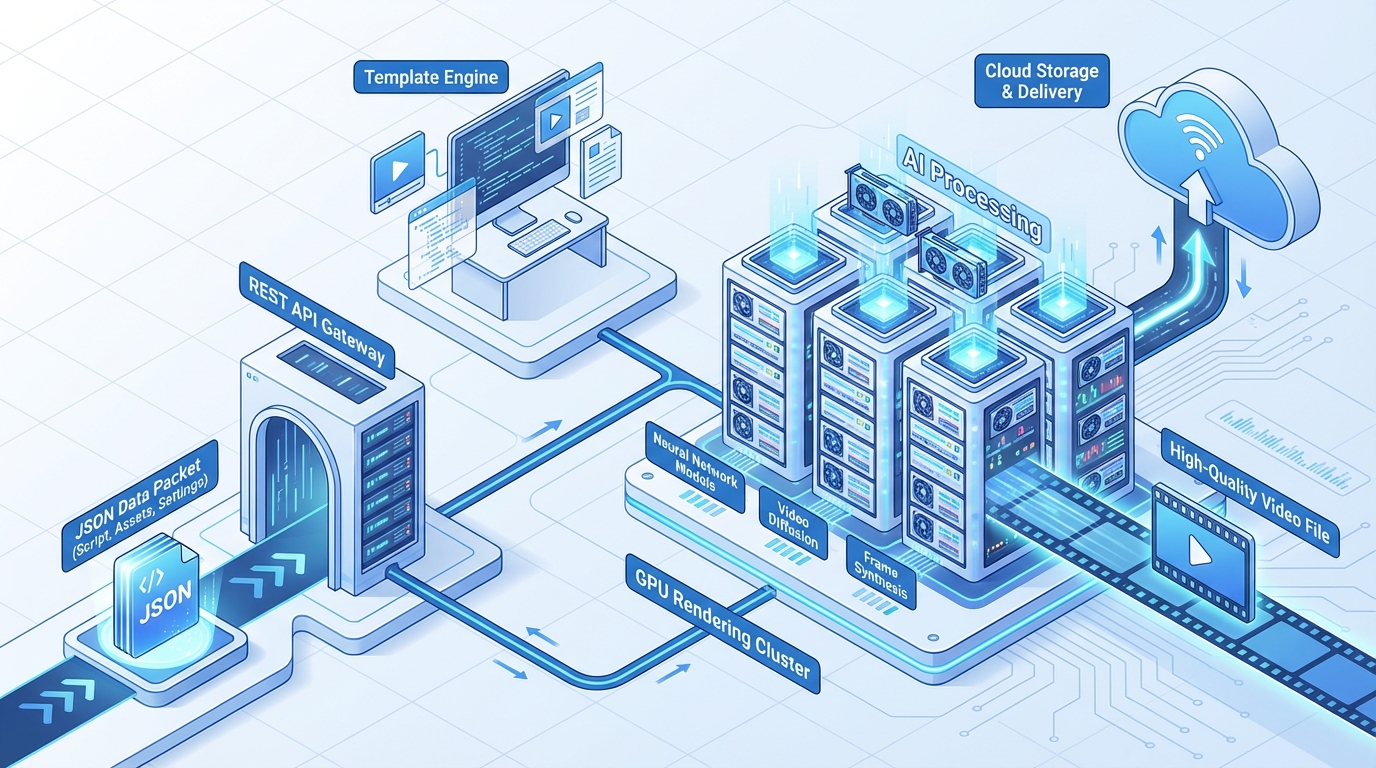
The core of a modern enterprise AI video API is built on a modular REST architecture designed for high concurrency and developer ergonomics. Unlike legacy video tools, an API-first approach treats video as dynamic data rather than a static asset, allowing for granular control over every frame through code. The API surface typically comprises four primary resources: Templates, Render, Assets, and Analytics.
The Templates API serves as the blueprint for all generation, allowing developers to define variable schemas such as first_name, product_image_url, and preferred_locale. The Render API is the engine's workhorse; a POST /render request initiates a job that combines these variables with pre-trained AI models to produce a unique MP4 or HLS stream. To ensure reliability in distributed systems, these endpoints must support idempotency keys, preventing duplicate renders and billing errors during network retries or CRM webhook loops.
To achieve the “real-time” promise, the underlying infrastructure relies on a cloud-agnostic GPU infrastructure. By utilizing Kubernetes-based autoscaling and pre-warmed GPU nodes, the system can target a P50 render latency of under 30 seconds. This low-latency pipeline is essential for “hot” triggers, such as in-session nudges or immediate WhatsApp responses, where any delay significantly degrades the user experience.
Key Architectural Components:
- REST API Video Personalization: Programmatic control over lip-sync, voice cloning, and scene transitions via JSON payloads.
- Real-Time Video Generation API: Optimized encoders and model-partitioning (MIG) to ensure rapid throughput during peak traffic.
- Scalable Personalized Video SaaS: Regionalized clusters that support data residency requirements while providing global CDN-backed delivery.
Sources:
2. Security, Compliance, and India-First Data Governance
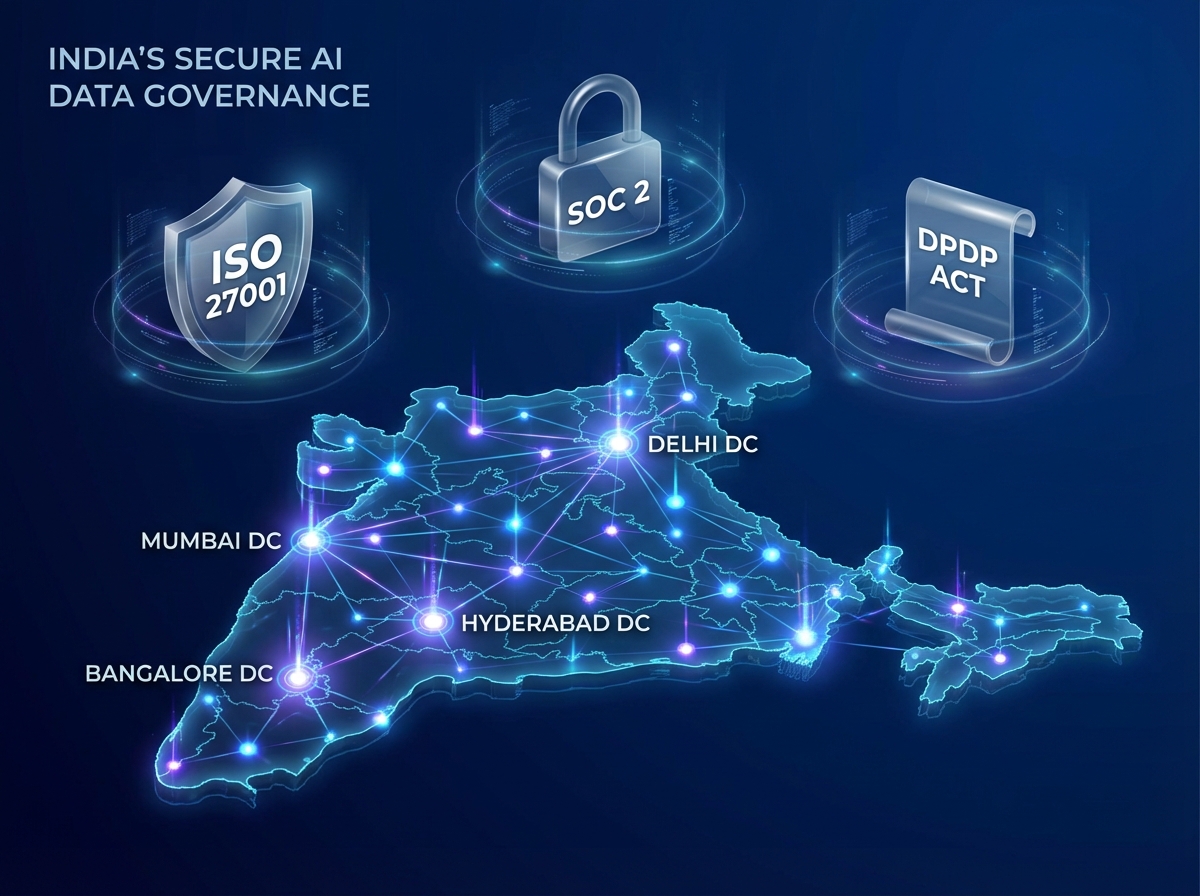
For the enterprise CTO, security is the non-negotiable foundation of any AI implementation. An ISO 27001 certified platform ensures that the Information Security Management System (ISMS) covers everything from infrastructure and application code to internal employee processes. Furthermore, a SOC 2 compliant video solution provides the necessary assurance regarding the security, availability, and confidentiality of customer data, backed by rigorous third-party audits.
In the context of the Indian market, compliance with the Digital Personal Data Protection (DPDP) Act 2023 DPDP-compliant personalization strategies is paramount. This requires strict adherence to principles of lawfulness, purpose limitation, and data minimization. Enterprise APIs must offer configurable data retention policies, allowing PII (Personally Identifiable Information) to be purged or tokenized immediately after a video is rendered and delivered.
Additionally, the 2026 regulatory landscape demands operational readiness for CERT-In advisories, which mandate the reporting of cyber incidents within a six-hour window. This necessitates robust audit logging, real-time monitoring, and automated incident response playbooks. By deploying on a cloud-agnostic GPU infrastructure with regional clusters in India, enterprises can ensure that sensitive data never leaves the jurisdiction, satisfying both legal requirements and internal risk mandates.
Compliance Checklist for 2026:
- DPDP Readiness: Consent management integration and automated Data Subject Request (DSR) workflows.
- Encryption: TLS 1.3 for data in transit and AES-256 for data at rest with KMS-backed key rotation.
- Access Control: RBAC with least-privilege enforcement and SAML/OIDC-based Single Sign-On (SSO).
Sources:
- NASSCOM: DPDP implications for enterprises
- DSCI: India Cybersecurity Domestic Market 2023 Report
- Ardent Privacy: Complying with CERT-In 6-hour reporting
- Ikigai Law: AI developer data protection handbook
3. Integration Patterns: Salesforce, HubSpot, and WhatsApp
The true value of an enterprise AI video API is realized through its integration into the existing GTM (Go-To-Market) stack. A Salesforce video integration typically utilizes Record-Triggered Flows or Apex Triggers to invoke the Render API. For instance, when a Lead's status changes to “Qualified,” an Apex Queueable class can POST a request to the API, passing the lead's name and interest area as variables. Once the video is rendered, a webhook writes the final URL back to a custom field on the Lead object, triggering a personalized email or task.
Similarly, a HubSpot AI video workflow can be orchestrated using HubSpot Workflows and Webhooks. By enrolling contacts based on lifecycle stages or lead score thresholds, the system can automatically generate personalized “Thank You” or “Product Demo” videos. The integration ensures that engagement metrics—such as video plays and completion rates—are synced back to the HubSpot timeline, providing sales teams with actionable intelligence.
For high-engagement delivery, the WhatsApp Business API video integration is the gold standard in 2026. The workflow involves the CRM triggering a render, followed by a completion webhook that sends a media message via the WhatsApp Cloud API. In the Indian market, this has shown a significant impact; for example, brands have reported up to 17% higher read rates on WhatsApp compared to traditional SMS or email outreach.
Example: Salesforce Apex Integration Snippet
// Outline for triggering a render via Apex
public class TrueFanVideoService {
    @future(callout=true)
    public static void triggerRender(String contactId, String firstName, String locale) {
        HttpRequest req = new HttpRequest();
        req.setEndpoint('https://api.truefan.ai/v1/render');
        req.setMethod('POST');
        req.setHeader('Authorization', 'Bearer ' + Label.TrueFan_API_Key);
        req.setHeader('Content-Type', 'application/json');
        req.setHeader('Idempotency-Key', contactId + '_' + System.now().getTime());

        Map<String, Object> body = new Map<String, Object>{
            'template_id' => 'tmpl_enterprise_001',
            'variables' => new Map<String, String>{ 'first_name' => firstName, 'locale' => locale },
            'webhook_url' => 'https://your-domain.com/hooks/video-complete',
            'metadata' => new Map<String, String>{ 'crm_id' => contactId }
        };
        req.setBody(JSON.serialize(body));
        Http h = new Http();
        HttpResponse res = h.send(req);
    }
}
Sources:
4. Personalization at Scale and Content Operations
Scaling interactive video data capture requires more than just raw compute; it requires a sophisticated marketing automation video API capable of handling complex content operations. TrueFan AI's 175+ language support and Personalised Celebrity Videos allow enterprises to localize content at a granular level, ensuring that a customer in Mumbai receives a video in Marathi while a customer in Madrid receives the same message in Spanish, all from a single API call.
Managing these operations at scale involves a “Template Variable Taxonomy.” This ensures that PII is handled safely and that assets like product images or brand logos are dynamically injected into the video without manual intervention. For high-volume users, such as Zomato (which has processed 354k videos/day) or Hero MotoCorp (2.4M greetings), the ability to partition queues by campaign priority is critical. This ensures that a time-sensitive “Flash Sale” video doesn't get stuck behind a massive, lower-priority brand awareness batch.
Furthermore, the B2B video personalization platform must provide an Analytics API that captures more than just “views.” CTOs need visibility into playthrough percentages, CTA clicks, and conversion attribution. By writing this data back to the CRM, organizations can create a closed-loop system where the performance of different video variants automatically informs future campaign strategies through A/B testing and variant scoring.
Content Operations Best Practices:
- Multilingual Support: Utilize 175+ locales regional language video SEO with native-sounding AI voice synthesis.
- Conditional Logic: Use the API to swap scenes based on customer segments (e.g., VIP vs. Standard).
- Asset Management: Use signed URLs for brand media to ensure security and CDN edge-caching for speed.
Sources:
5. Performance, SRE, and Observability
From a Site Reliability Engineering (SRE) perspective, an enterprise AI video API must be treated as a Tier-1 service. This means establishing clear Service Level Objectives (SLOs) for render latency and API availability. A robust system utilizes cloud-agnostic GPU infrastructure to avoid vendor lock-in and to leverage the best-performing hardware across AWS, Azure, or GCP. By using CUDA/NVENC pipelines and MIG (Multi-Instance GPU) partitioning, the platform can maximize hardware utilization while maintaining strict isolation between tenant workloads.
Observability is equally critical. Every request should carry a Correlation-Id or traceparent header, allowing for distributed tracing across the CRM, the Video API, and the delivery gateway (like WhatsApp). SRE teams should monitor metrics such as renders_inflight, render_latency_ms, and webhook_delivery_success_rate. If a webhook fails, the system must employ exponential backoff retries with jitter to ensure eventual consistency without overwhelming the receiving CRM endpoint.
Solutions like TrueFan AI demonstrate ROI through their ability to handle massive bursts in traffic without degrading performance. Whether it is a T20 sponsorship activation or a national holiday greeting campaign, the infrastructure must autoscale dynamically. This involves pre-warming GPU nodes based on historical traffic patterns and using edge-computing for pre-processing tasks to shave off critical milliseconds from the total time-to-delivery.
SRE and Performance Metrics:
- Render P95: Target < 60 seconds for complex templates; < 30 seconds for standard personalization.
- Idempotency: Mandatory for all POST operations to ensure “exactly-once” processing semantics.
- Webhook Security: HMAC-SHA256 signatures on all outgoing events to verify authenticity.
Sources:
6. Evaluation Checklist and 90-Day Rollout Plan
Choosing the right AI video API for business requires a structured evaluation process. CTOs should move beyond the “demo” and focus on the “RFP-ready” technical specifications. This includes verifying the provider's security certifications, testing API throughput under load, and reviewing the depth of their TrueFan API documentation. A successful implementation follows a phased approach to minimize risk and maximize time-to-value.
The CTO’s Evaluation Checklist
- API Coverage: Does the API support the full lifecycle (Templates, Render, Assets, Analytics)?
- Security & Privacy: Is it an ISO 27001 certified platform? Does it support DPDP interactive video data capture guide and regional data residency in India?
- Integration Readiness: Are there pre-built patterns for Salesforce video integration and HubSpot AI video?
- Scalability: Can the cloud-agnostic GPU infrastructure handle your peak volume (e.g., 1M+ renders/day)?
- Observability: Does it provide signed webhooks, distributed tracing, and detailed error codes?
90-Day Enterprise Rollout Plan
- Days 0–30 (POC): Select a high-impact use case (e.g., WhatsApp lead nurture). Integrate the Render API with a single CRM trigger. Target 10,000 renders and measure latency and conversion uplift.
- Days 31–60 (Pilot): Expand to multiple channels (Email + WhatsApp). Implement A/B testing for video templates. Harden security with SSO/RBAC and finalize the data retention policy.
- Days 61–90 (Production): Full-scale rollout across business units. Enable multi-region data residency. Establish a 24/7 monitoring dashboard and finalize the SLA credit structure.
Sources:
Conclusion
The transition to an API-driven video strategy is a fundamental shift in how enterprises communicate. By integrating a secure, high-performance enterprise AI video API into the CRM and WhatsApp ecosystem, CTOs can unlock unprecedented levels of customer engagement while maintaining the highest standards of data governance. As we move through 2026, the ability to deliver personalized, real-time content at scale will be the defining characteristic of market leaders.
For technical teams ready to build the future of video, the next step is to explore the TrueFan API documentation and initiate a pilot program. By focusing on security, scalability, and seamless integration, your organization can turn every customer touchpoint into a cinematic, personalized experience.
Sources:
- TrueFan AI: Enterprise Home
- TrueFan AI: Powering the Full BFSI Journey
- TrueFan AI: Powering the Full Pharma Journey
Recommended Internal Links
- DPDP-compliant personalization strategies
- Interactive video data capture
- Interactive video data capture guide
- AI sales outreach videos
- AI Impact Summit 2026: TrueFan
- Regional language video SEO
Frequently Asked Questions
How does an enterprise AI video API ensure data privacy under the DPDP Act?
The API should support regional data residency, ensuring that PII and rendered videos are stored within India. It must also provide automated tools for data minimization, such as configurable retention periods where data is purged immediately after the delivery webhook is acknowledged.
What is the typical latency for a real-time video generation API?
In 2026, the industry standard for an enterprise AI video API is a P50 latency of under 30 seconds for a 15-second personalized video. This is achieved through GPU pre-warming and optimized model inference pipelines.
Can we integrate the API with our existing WhatsApp Business Service Provider (BSP)?
Yes. The API is platform-agnostic. Once the video is rendered, the API sends a webhook to your system with the video URL. Your middleware or CRM then forwards this URL to your chosen WhatsApp BSP (e.g., Gupshup, Infobip, or Meta Cloud API).
How does TrueFan AI handle high-concurrency events like national festivals?
TrueFan AI utilizes a cloud-agnostic GPU infrastructure with Kubernetes-based autoscaling. This allows the system to spin up hundreds of GPU nodes in minutes to handle millions of renders, as seen in campaigns for Hero MotoCorp and Zomato.
What security certifications should I look for in a B2B video personalization platform?
At a minimum, the platform should be an ISO 27001 certified platform and provide a SOC 2 Type II report. For enterprises in India, alignment with CERT-In reporting guidelines and DPDP compliance is also essential.



