Customer health scoring AI: Operationalize predictive churn prevention videos across the SaaS lifecycle
Estimated reading time: ~10 minutes
Key Takeaways
- Customer health scoring AI detects subtle churn signals and triggers predictive video interventions that scale Customer Success.
- A robust orchestration layer connects data inputs → models → triggers to automate timely, personalized outreach.
- Monitoring behavioral churn signals like usage decay and onboarding stalls enables proactive rescue at the right moment.
- Lifecycle video marketing automation maps health thresholds to playbooks across onboarding, adoption, renewal, and win-back.
- An AI retention analytics platform ties video engagement to NRR lift and ROI with per-playbook attribution and testing.
In the hyper-competitive SaaS landscape of 2026, the difference between a market leader and a declining platform often comes down to a single metric: Net Revenue Retention (NRR). Traditional reactive support models are no longer sufficient to combat “silent churn,” where users gradually disengage long before they hit the cancel button.
Customer health scoring AI has emerged as the definitive solution to this problem, moving beyond static dashboards to trigger real-time, automated interventions. By leveraging customer health scoring automation, enterprises can now detect subtle behavioral churn signals and respond with predictive churn prevention videos that feel personal, timely, and relevant.
This strategic shift allows Customer Success (CS) teams to scale their impact without increasing headcount. Instead of manually reviewing thousands of accounts, AI systems compute dynamic health scores and launch lifecycle video marketing automation playbooks that guide users back to value.
Research indicates that AI-driven engagement and behavior-based automation are critical for reducing churn in the current market. For instance, Indian SaaS giants are increasingly embedding AI features directly into customer workflows to drive higher retention and expansion (Inc42). Furthermore, enterprise AI agents are now unifying product and support data to surface risk signals earlier than ever before (Analytics India Magazine).
Sources:
1. What is customer health scoring AI and why it matters for churn prevention
Customer health scoring AI is a machine-learning-driven system that computes dynamic account-level and user-level health scores, typically on a scale of 0–100. Unlike traditional scoring, which relies on manual weights, AI models analyze multi-source signals—product usage, onboarding progression, feature adoption, support sentiment, and billing hygiene—to predict churn risk.
By 2026, the median gross revenue retention across B2B SaaS has stabilized at approximately 90%, but top-quartile performers are reaching 95%+ by using predictive analytics (Zylo). These leaders understand that a health score is only as good as any action it triggers.
The core components of a modern health scoring system include:
- The Data Graph: Consolidating DAU/WAU/MAU, feature depth, session length, support ticket volume, and NPS sentiment into a single source of truth.
- Predictive Models: Using supervised churn propensity models and anomaly detection to identify usage deltas that deviate from a customer's historical baseline.
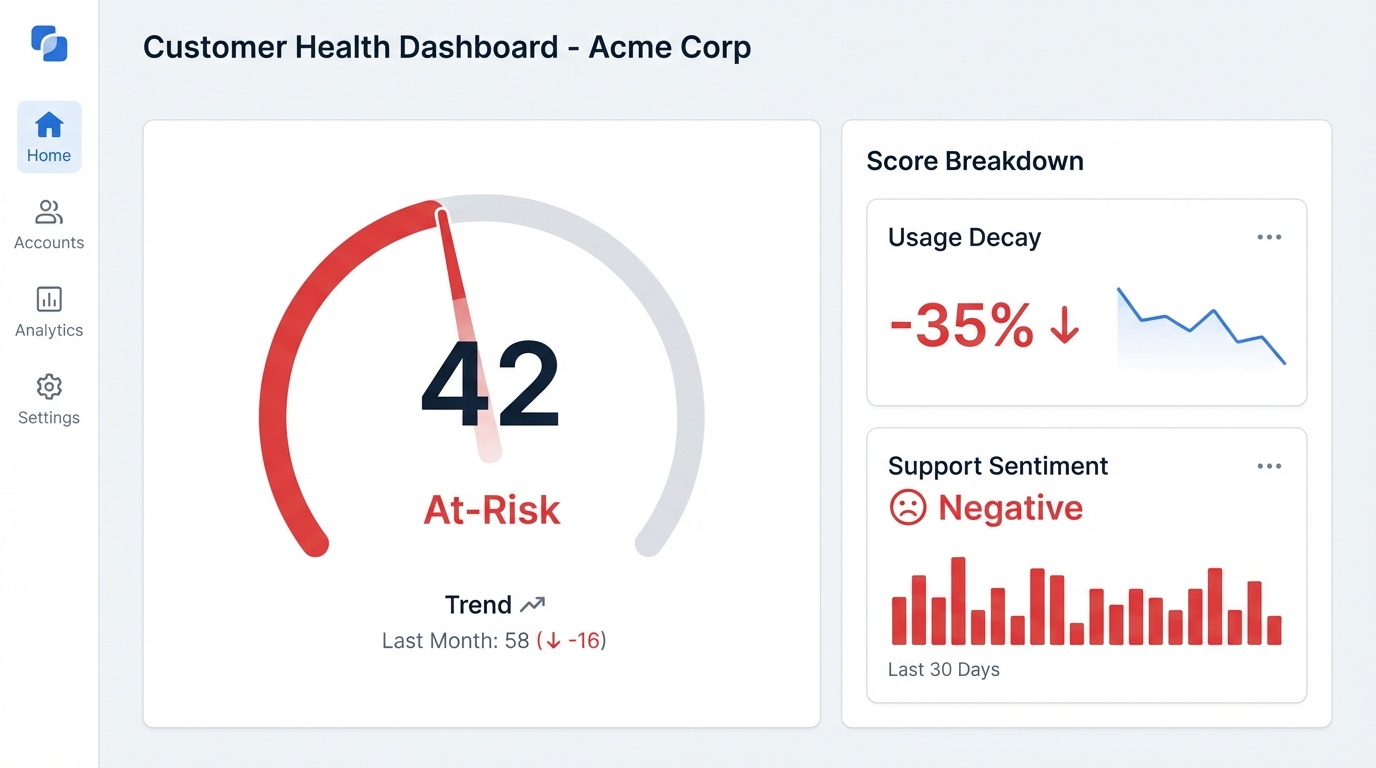
- Threshold Management: Categorizing accounts into “Healthy” (80–100), “Watch” (60–79), “At-Risk” (40–59), and “High Risk” (<40).
One critical coverage gap many competitors miss is the concept of Hysteresis. This prevents “notification thrash” by requiring a score to improve by a certain margin before changing status, ensuring that automated videos aren't triggered by minor, temporary fluctuations in usage.
Platforms like TrueFan AI enable enterprises to take these scores and immediately generate personalized video content that addresses the specific reason for a score drop. Whether it is a personalized walkthrough for a stalled onboarding process or a value recap for a high-risk renewal, video drives higher attention in crowded inboxes compared to standard text emails.
Sources:
- Zylo: SaaS statistics and retention benchmarks
- MoEngage: Customer journey automation and orchestration
2. Customer health scoring automation: Inputs, models, and orchestration
To effectively operationalize customer health scoring automation, organizations must build a robust orchestration layer that connects data inputs to automated triggers. This process begins with ingesting high-fidelity data from across the SaaS stack.
Key inputs for a 2026-ready scoring model include:
- Product Analytics: Frequency of core actions, feature adoption funnels, and time-to-first-value (TTFV).
- Support & Sentiment: Unresolved tickets older than 7 days, repeat issues, and negative sentiment detected in chat transcripts via NLP.
- Billing Hygiene: Failed payments, dunning attempts, and seat reductions which often precede a total cancellation.
The modeling phase requires continuous calibration. While many teams start with expert-weighted indices (e.g., 40% adoption, 25% sentiment), AI-driven systems retrain monthly to monitor AUC (Area Under the Curve) and precision-recall drift. This ensures the model remains accurate as the product evolves.
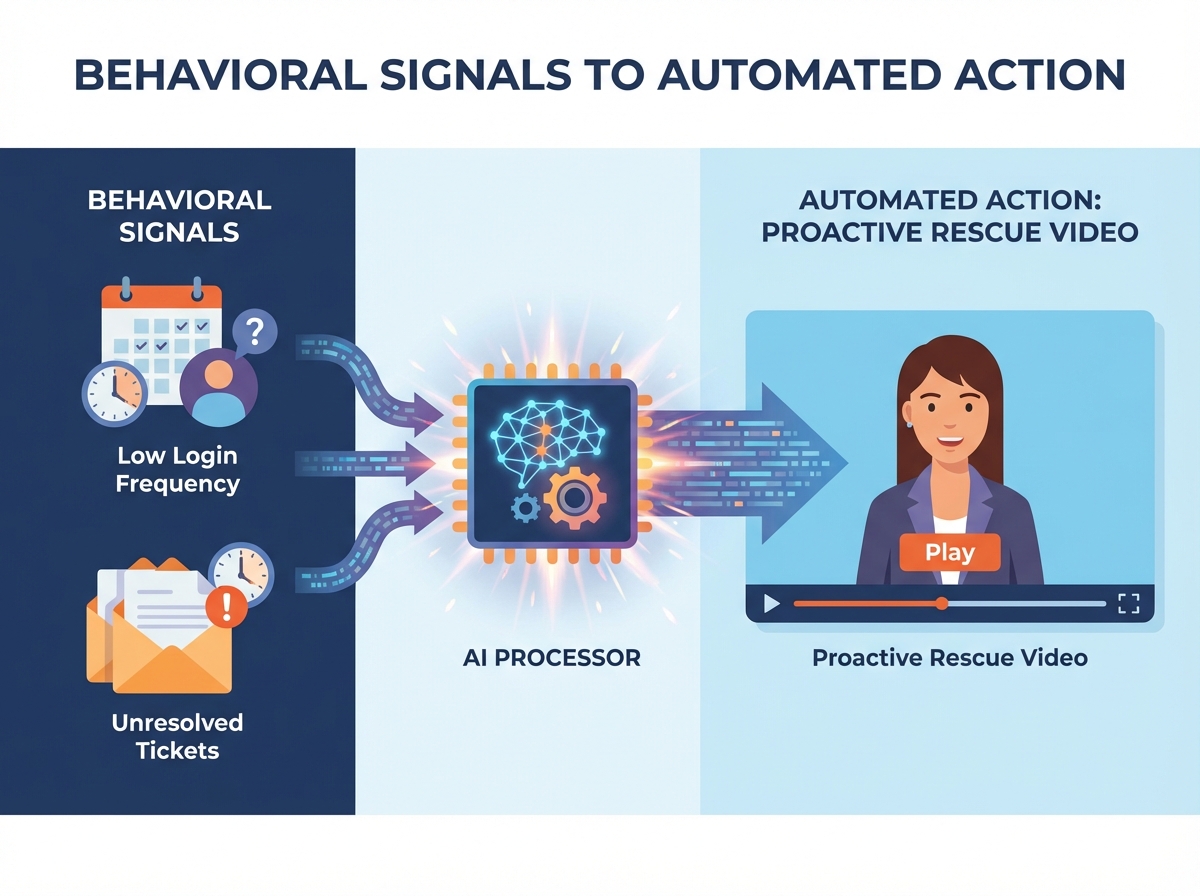
Once a score is calculated, the event bus emits changes to a trigger engine. This engine maps specific thresholds to video playbooks. For example, if a “Power User” suddenly shows a 30% drop in weekly key actions, the system doesn't just alert a CSM; it triggers a proactive customer rescue video.
In the Indian market, acting on these signals quickly along the customer journey is cited as a primary driver for reducing churn (MoEngage). By automating the intervention, SaaS companies ensure that no “At-Risk” account is left waiting for a manual review that might come too late.
Sources:
- MoEngage: AI in customer engagement and signal speed
- Gainsight: Predicting and preventing churn with AI
3. Behavioral churn signals to monitor and quantify
Identifying behavioral churn signals is the prerequisite for any successful retention strategy. In 2026, simply tracking “last login” is insufficient; teams must quantify the quality and velocity of engagement.
The most critical signals to monitor include:
- Usage Decay: A decline of ≥30% in weekly key actions over a 14-day rolling window. This is often the first sign of a “silent churner.”
- Onboarding Stalls: No progress on critical setup tasks for more than 7 days. This signal indicates a high probability of early-life churn.
- Feature Under-Adoption: Less than 20% of the licensed team using “sticky” features (those correlated with long-term retention) after 30 days.
- Sentiment Erosion: A downward trend in ticket sentiment over the last three interactions, even if the tickets were technically “resolved.”
Another coverage gap in traditional strategies is Role-Specific Branching. A drop in usage from an Executive Sponsor is far more dangerous than a drop from an individual contributor. Customer health scoring AI should weight these signals differently based on the user's persona and influence within the account.
By enriching these signals with ICP (Ideal Customer Profile) fit and seasonality controls, enterprises can estimate the “risk lift.” For instance, accounts in the bottom decile of engagement often carry 4–6x the churn risk of the median account. Quantifying this risk allows for the prioritization of high-value predictive churn prevention videos.
Sources:
- MoEngage: Journey and funnel analytics for churn signals
- Pylon: Essential Customer Success tools for 2026
4. Lifecycle video marketing automation: The 6 core playbooks
Transitioning from scores to action requires a structured approach to lifecycle video marketing automation. By mapping health score thresholds to specific video playbooks, SaaS companies can deliver “proactive rescue” at scale.
4.1 Automated customer onboarding videos
Trigger: New account creation or an onboarding stall >3 days.
Content: A 60–90 second welcome video that highlights the “time-to-first-value” steps.
Script Example: “Hi {{first_name}}, I noticed you haven't connected {{integration}} yet. Here is a 30-second walkthrough to unlock {{key_outcome}} today.”
KPIs: Setup completion rate, TTFV, and week-2 activation.
4.2 Milestone celebration videos
Trigger: First value achieved, team activation >70%, or a 1-year anniversary.
Content: Congratulatory message that reinforces the next best habit or invites the user to an advanced feature.
Script Example: “Congrats {{team_name}} on crossing {{milestone}}! Most {{industry}} teams now unlock {{advanced_feature}} to 2x their efficiency.”
KPIs: Subsequent feature adoption and NPS.
4.3 Renewal reminder automation
Trigger: T-120 to T-60 days before renewal, with messaging branched by risk tier.
Content: A value recap video featuring the customer's own ROI metrics and tailored renewal offers.
Script Example: “{{first_name}}, your team saved {{hours_saved}} hours this quarter. Let's review what's next before {{renewal_date}}.”
KPIs: Gross Revenue Retention (GRR) and time-to-close.
4.4 NPS improvement videos
Trigger: A detractor score (0–6) with a specific theme mapped (e.g., “performance”).
Content: An acknowledgment of the issue, a brief roadmap update, and an invitation for a direct feedback loop.
Script Example: “We heard your feedback on {{theme}}. Here is what changed—and how to get the updated experience in 60 seconds.”
KPIs: Detractor-to-promoter movement and ticket deflection.
4.5 Win-back campaign automation
Trigger: Churned or lapsed status for 30–90 days with “resurrection” signals like site visits.
Content: A personalized “we've improved” video highlighting new features the user previously requested.
Script Example: “Since you left, we launched {{new_feature}} that many {{role_plural}} asked for. Here is how it solves {{pain_point}} now.”
KPIs: Reactivation percentage and reactivated ARR.
4.6 Proactive customer rescue
Trigger: Sudden usage drop or multiple unresolved high-priority tickets.
Content: Executive empathy video providing a fast path to a solution and a bookable calendar slot.
Script Example: “I'm {{exec_name}}. I saw your team hit {{issue}}. Here is a 2-minute fix—and my calendar if you want support today.”
KPIs: Save rate and ARR at risk saved.
Sources:
5. AI retention analytics platform: Attribution, optimization, and ROI
An AI retention analytics platform serves as the measurement and experimentation layer for your video interventions. In 2026, it is no longer enough to track “views”; you must attribute retention and NRR lift directly to specific video playbooks.
Core features of a high-performing analytics platform include:
- Per-Playbook Attribution: Measuring the exact churn reduction and NRR lift for each automated sequence.
- Multivariate Creative Testing: A/B testing thumbnails, opening lines, and call-to-actions (CTAs). For example, does a thumbnail featuring the account's own product UI outperform a thumbnail of a spokesperson?
- Path Analysis: Tracking the journey from “video view” to “habit formation” to “renewal outcome.”
- Channel Benchmarking: Comparing engagement across Email, In-app, and WhatsApp. In the Indian market, WhatsApp often shows significantly higher read rates for personalized nudges (Goibibo case study).
Solutions like TrueFan AI demonstrate ROI through their ability to handle massive scale—such as generating 354,000 personalized videos in a single day for Zomato or 2.4 million greetings for Hero MotoCorp. This level of scale allows for statistically significant A/B testing that smaller, manual campaigns simply cannot achieve.
By 2026, top SaaS firms will use uplift modeling to determine which customers only renewed because of the video intervention, allowing for precise ROI calculations that justify the investment in subscription retention AI.
Sources:
6. Subscription retention AI: Governance, architecture, and TrueFan Enterprise
Implementing subscription retention AI at an enterprise level requires more than just a creative tool; it requires a secure, scalable architecture. This involves integrating your CRM, CDP, and billing systems into a unified trigger engine.
Enterprise Architecture Blueprint:
- Data Ingestion: CRM (Salesforce/HubSpot) and Product Analytics (Amplitude/Mixpanel) feed into the customer health scoring AI.
- Trigger Engine: When a score crosses a threshold, a webhook is sent to the video generation API.
- Video Generation: TrueFan AI's 175+ language support and Personalised Celebrity Videos allow for the creation of hyper-localized content that retains the original voice and lip-sync of the spokesperson.
- Omnichannel Delivery: Videos are delivered via Email, WhatsApp Business API, or In-app notifications.
- Analytics: Engagement data flows back into the AI retention analytics platform for ROI calculation.
Governance and Security:
In 2026, compliance with the Indian Digital Personal Data Protection (DPDP) Act and global standards like ISO 27001 and SOC 2 is non-negotiable. Enterprise-grade solutions must offer:
- PII Minimization: Using tokenization to ensure that sensitive customer data is never exposed during the video rendering process.
- Virtual Reshoots: The ability to iterate on messaging and offers without needing new celebrity shoots, saving thousands of creative production hours.
- Low-Latency Rendering: A target of sub-30 second render-to-delivery time ensures that an “onboarding rescue” video arrives while the user is still in the product.
A third coverage gap often overlooked is Multilingual Lip-Sync for Global Expansion. For SaaS companies expanding from India to EMEA or SE Asia, the ability to automatically localize a retention video into 175+ languages while maintaining perfect lip-sync is a massive competitive advantage.
Internal Source:
- TrueFan AI Product Offerings Executive Document (Enterprise)
7. Implementation roadmap and FAQs
Phase 1: Data Readiness (Weeks 1-4)
Define the key product events that correlate with retention. Backfill 90 days of data to establish a baseline for your customer health scoring AI.
Phase 2: Playbook Development (Weeks 5-8)
Select your first two playbooks (typically Onboarding and Renewal). Draft scripts with variables like {{first_name}}, {{usage_drop_%}}, and {{renewal_date}}.
Phase 3: Pilot and Scale (Weeks 9-12)
Launch the playbooks to a subset of your customer base. Use your AI retention analytics platform to monitor the “save rate” and refine the triggers before a full global rollout.
Conclusion
Operationalizing customer health scoring AI is no longer a luxury for SaaS companies; it is a survival requirement in 2026. By turning silent behavioral churn signals into automated, predictive churn prevention videos, enterprises can rescue at-risk accounts and celebrate milestones with a level of personalization that drives genuine loyalty.
The shift from reactive dashboards to lifecycle video marketing automation allows your Customer Success team to focus on high-value strategic work while the AI handles the heavy lifting of retention at scale. With the right architecture and a focus on data-driven attribution, you can turn your retention process into a measurable growth engine.
Book an Enterprise demo of Studio by TrueFan AI to activate predictive churn prevention videos across onboarding, adoption, renewal, and win-back.
Frequently Asked Questions
What is customer health scoring AI?
It is a machine-learning system that predicts churn and expansion risk by analyzing multi-source data (usage, support, billing). It goes beyond static scores to trigger automated next-best actions, such as personalized videos, to improve retention.
How do predictive churn prevention videos work?
When the customer health scoring automation detects a risk signal (like a 30% usage drop), it triggers an API call to generate a personalized video. This video is then sent to the user via their preferred channel (WhatsApp/Email) to address the specific friction point.
Which behavioral churn signals matter most in SaaS?
The most critical signals are usage decay, onboarding stalls, low feature depth, and negative support sentiment. Quantifying these signals within specific time windows (e.g., 14 days) allows for timely interventions.
How can TrueFan AI help with SaaS retention?
TrueFan AI's 175+ language support and Personalised Celebrity Videos allow SaaS companies to scale human-like outreach. By automating the creation of millions of personalized videos, it helps in proactive customer rescue and milestone celebrations at a scale impossible for manual teams.
How do you measure NPS improvement from personalized videos?
You track the movement of users from “Detractor” to “Passive” or “Promoter” status following a video intervention. By correlating these shifts with renewal rates, you can calculate the direct NRR impact of your NPS improvement videos.