Voice search optimization video content in 2026: Enterprise playbook for AI Overviews, featured snippets, and YouTube voice queries in India
Key Takeaways
- AI-driven, video-first SERPs and AI Overviews now cite YouTube heavily; capturing position-zero drives voice-assistant visibility.
- Win voice results by scripting videos for conversational queries: give a direct answer in the first 30 seconds and use question-led chapters.
- AEO requires precise schema (VideoObject, Clip, HowTo) and 40–55 word answers to land featured snippets.
- Scale multilingual, voice-optimized video with Studio by TrueFan AI for governance, safety, and API automation.
- Prioritize technical factors: Core Web Vitals, accurate SRT captions, clean audio, and YouTube Hinglish metadata to boost discovery.
In the rapidly evolving digital landscape of 2026, voice search optimization video content has transitioned from a niche tactic to the cornerstone of enterprise visibility. As AI-driven, multimodal Search Engine Results Pages (SERPs) prioritize quick, answer-first, video-forward results, the traditional “blue link” strategy has become obsolete. Today, success is defined by how effectively your video assets are selected by voice assistants, cited in AI Overviews, and positioned within video featured snippets for complex, question-based queries (zero-click video SEO India 2026).
The 2026 shift is undeniable: Google’s AI Overviews now frequently cite YouTube videos as primary sources, and “position-zero” snippets fuel the majority of voice-assistant answers. For enterprises operating in India, this requires a specialized approach—one that balances global SEO standards with the nuances of local languages and Hinglish conversational patterns. By mastering voice search optimization video content 2026, brands can secure a dominant share of voice in a market where multimodal search journeys combine voice input, visual video panels, and AI-generated summaries (multimodal AI video creation 2026).
1. The 2026 Multimodal Shift: AI Overviews and Video-First SERPs in India
The search environment in 2026 is no longer a linear list of text results. We have entered the era of multimodal search, where users interact with devices through a combination of voice, images, and video (multimodal AI video creation 2026). According to recent 2026 market data, over 65% of search queries in India are now initiated via voice, with a significant portion of these occurring on mobile devices and smart TVs.
The Rise of AI Overviews (AIO)
AI Overviews have become the primary interface for informational queries. Instead of clicking through to a website, users receive a synthesized answer at the top of the SERP. Crucially, these overviews are heavily reliant on video content. Research indicates that AI Overviews cite YouTube videos in approximately 42% of all “how-to” and “what is” queries. For enterprises, this means that AI overview video citations are now more valuable than a standard #1 organic ranking (featured snippet video strategy).
India-Specific Search Trends
In India, the shift is even more pronounced. Digital marketing trends for 2026 highlight a massive adoption of voice-friendly website structures and local-language content. Indian agencies are now prioritizing “Hinglish” (a blend of Hindi and English) to capture the natural speaking patterns of the urban and semi-urban population. As noted by DeepSense, SERP success in 2026 is about occupying multiple features simultaneously—videos, AI summaries, and featured snippets.
Multimodal Discovery Surfaces
- Voice Assistants: Google Assistant, Alexa, and Siri fetching video-based answers.
- Android/Google TV: Where voice queries lead directly to YouTube “Key Moments.”
- Automotive Interfaces: Where audio-visual summaries of video content provide hands-free information.
Source: Savit Interactive - AI SEO Playbook; CIIM - Digital Marketing Trends 2026
2. Conversational SEO for AI Videos: Scripting for Natural Language
To rank in a voice-first world, your video content must speak the language of the user. Conversational SEO for AI videos is the practice of optimizing video scripts, metadata, and transcripts to mirror the long-tail, question-based queries that users actually speak aloud (Conversational SEO for AI videos).
The Scripting Blueprint
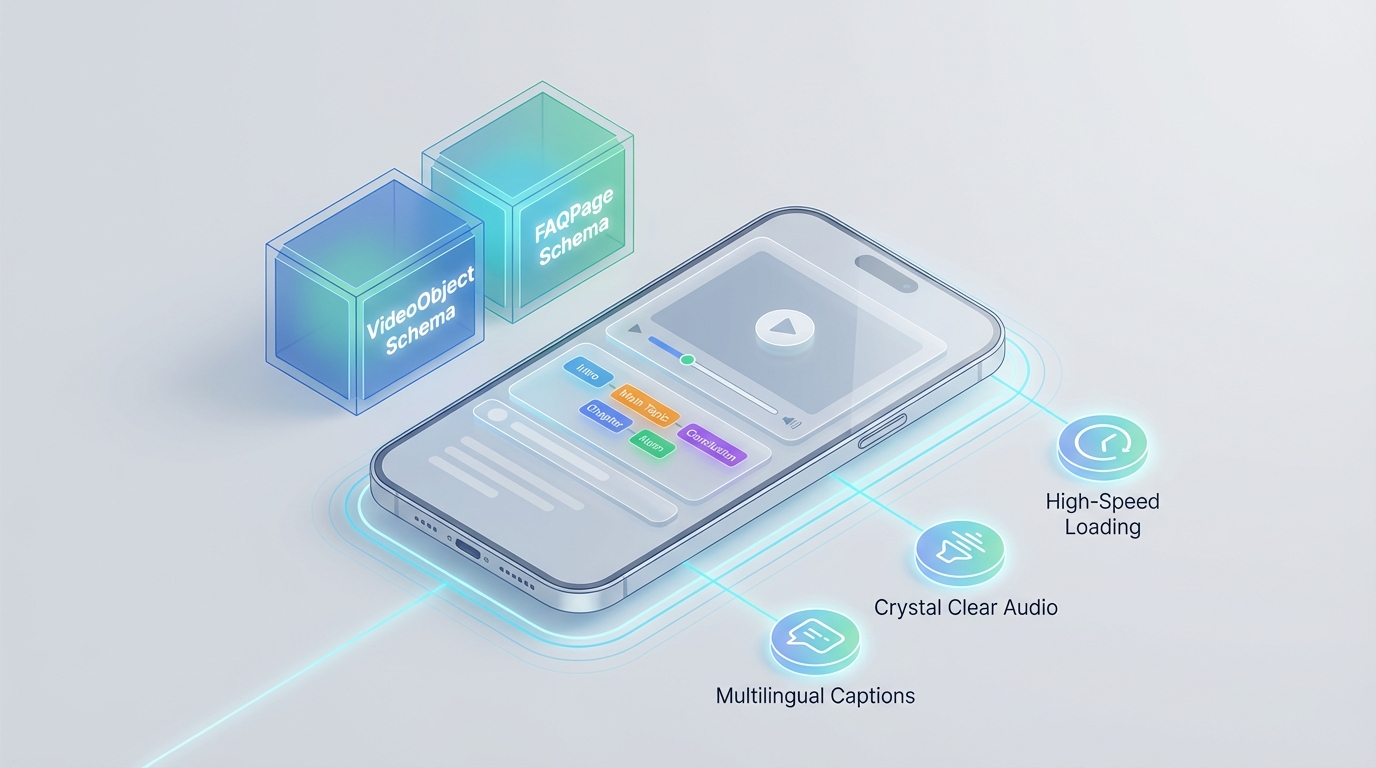
In 2026, the “inverted pyramid” of video content has been refined for AI. Your script must follow this structure:
- The Direct Answer (0–30s): Open with a concise, plain-language answer to the core question. This “micro-content” is what voice assistants extract for their verbal responses.
- Question-Led Chapters: Divide the video into 3–5 sections, each titled as a specific question (e.g., “How do I apply for a GST refund?”).
- Semantic Recap: End with a summary that repeats the core answer using different phrasing to provide broader semantic coverage for AI models.
Targeting Indian Query Patterns
For the Indian market, natural language video SEO must account for regional nuances. Users rarely ask, “What are the best investment strategies?” Instead, they ask, “Best investment options kya hain?” or “Mutual funds mein invest kaise karein?” (Conversational SEO for AI videos (2026))
Key query modifiers to target include:
- “Kaise karein” (How to)
- “Sabse accha” (Best)
- “Kahan milega” (Where to find)
- “Hindi mein” (In Hindi)
Metadata for Natural Language
Your metadata should act as a bridge between the video and the search engine’s “Answer Engine.”
- Titles: Start with the question. For example, “YouTube voice search optimization: Kaise karein? (2026 Guide).”
- Descriptions: The first 160 characters must be an answer-first summary. Follow this with a bulleted FAQ section containing 3–5 related questions.
- Tags: Use a mix of English, Hindi transliterations, and city-specific modifiers if the content is localized.
Source: First Launch - Voice Search YouTube India; Shopify India - High-Quality Traffic Trends
3. Answer Engine Optimization (AEO) and Featured Snippets
Answer engine optimization video marketing is the strategic structuring of content specifically for AI summarizers (featured snippet video strategy). Unlike traditional SEO, which focuses on keywords, AEO focuses on providing the most authoritative, verifiable, and “extractable” answer (zero-click video SEO India 2026).
Winning AI Overview Citations
To earn a spot in an AI Overview, your video needs to be technically “readable” by Google’s Multimodal Universal Model (MUM). This involves:
- Precise Chaptering: Use question-labeled chapters. Each chapter should represent a distinct sub-topic that an AI might want to cite.
- On-Page VideoObject Schema: Implement advanced schema markup including
hasPartandClipproperties. This tells the search engine exactly where a specific answer starts and ends. - Visual Clarity: AI now “watches” videos. Ensure that key information is presented clearly on-screen via headings and text overlays, which AI can parse via OCR (Optical Character Recognition).
Featured Snippets: The “Position Zero” for Video
Featured snippets video content India often appears as “Suggested Clips.” When a user asks a “how-to” question via voice, the assistant often says, “According to [Brand Name] on YouTube...” and then plays a specific 40-second segment.
To win these snippets:
- The 50-Word Rule: Ensure your spoken answer within a specific chapter is between 40–55 words. This is the “sweet spot” for featured snippet extraction.
- Step-by-Step Clarity: For “How-To” content, use clear verbal cues like “Step one,” “Step two,” etc. This maps perfectly to the
HowToschema and list-based featured snippets.
The Role of Authority (E-E-A-T)
In 2026, AI Overviews prioritize videos from authoritative channels. This means consistent publishing within a specific topical cluster is essential. If your channel is the “go-to” for Indian tax laws, your videos are far more likely to be cited for voice queries related to “income tax filing.” Build topical clusters to strengthen entity authority (topic-cluster video marketing).
Source: InGold Solutions - 20 SEO Trends for 2026; Digital Market Academy - Video Optimization 2025-26
4. Scaling Voice-Optimized Content with Studio by TrueFan AI
For enterprises, the challenge isn't just creating one voice-optimized video; it's creating hundreds of them across multiple languages and regions. This is where AI-driven production platforms become indispensable.
Platforms like Studio by TrueFan AI enable enterprises to bridge the gap between static text and dynamic, voice-optimized video at scale. By automating the production process, brands can ensure that every FAQ on their website has a corresponding video asset that is optimized for voice discovery.
Multilingual Localization at Scale
India is a land of many languages. To truly capture the voice search market, you cannot rely on English alone. Studio by TrueFan AI's 175+ language support and AI avatars allow brands to localize content for India’s diverse linguistic landscape instantly. This means a single enterprise “How-To” guide can be converted into 10 different regional language videos, each with its own question-based video optimization strategy (Translate YouTube video with AI; AI voice cloning for Indian accents).
Enterprise Governance and Safety
When using AI to generate video content, brand safety is paramount. Studio by TrueFan AI provides:
- Licensed Avatars: Use real influencers or custom brand spokespeople as AI avatars to maintain trust and E-E-A-T.
- Content Moderation: Real-time profanity filters and blocks for sensitive content ensure that generated videos align with corporate standards.
- Compliance: ISO 27001 and SOC 2 compliance ensure that enterprise data is handled with the highest security standards.
Technical Integration
Enterprises can use APIs and webhooks to automate the generation of video variants. For example, when a new product is launched, the system can automatically generate 50 micro-videos answering common customer questions, each optimized for voice search optimization video content 2026. Distribute short, direct-answer variants via Shorts for SERP coverage on mobile (YouTube Shorts automation with AI).
5. Technical Voice Search Ranking Factors for Video (2026 Checklist)
To ensure your videos are discoverable by voice assistants and AI engines, you must adhere to a strict technical framework. In 2026, voice search ranking factors video are a combination of traditional performance metrics and advanced semantic markers (voice search ranking factors for video).
The Technical Checklist
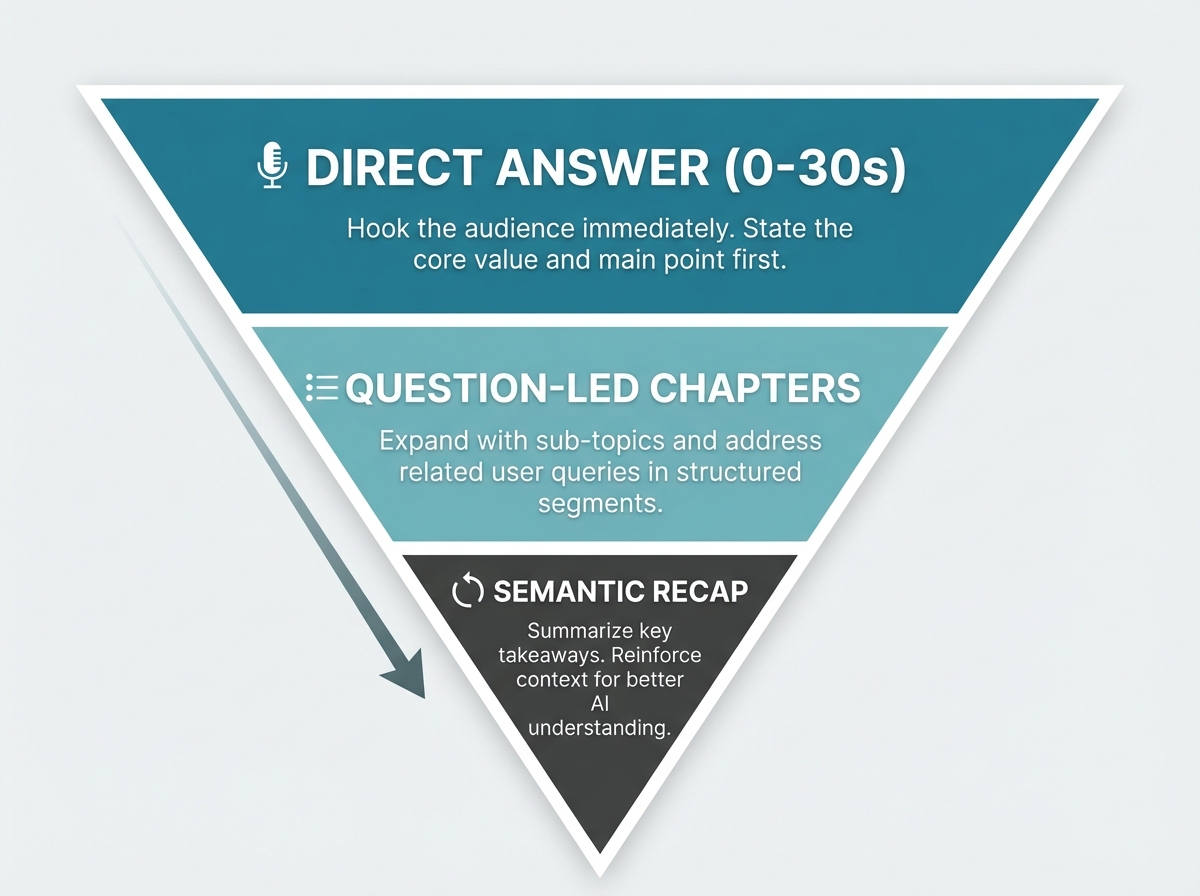
- Page Speed & Core Web Vitals: Video landing pages must have an LCP (Largest Contentful Paint) of < 2.5s. Use lazy-loading for video embeds and optimize thumbnail sizes (<150KB).
- Structured Data (The “Must-Haves”):
VideoObject: Include name, description, uploadDate, duration, and thumbnailUrl.hasPart/Clip: Define chapters with precisestartOffsetandendOffset.FAQPage: Mirror the video’s Q&A in on-page schema to reinforce the answer's authority.HowTo: For stepwise content, map steps to video timestamps.
- Multilingual SRTs: Do not rely on auto-generated captions. Upload accurate, time-aligned SRT files in English, Hindi, and other regional languages. This provides the “textual proof” AI needs to parse your video (Translate YouTube video with AI; AI voice cloning for Indian accents).
- Mobile-First Layout: Since most voice searches happen on mobile, ensure the video player is responsive and the surrounding text is easy to read on small screens.
- Audio Quality: Voice assistants favor videos with high-quality, clear audio. Minimize background noise and ensure the primary speaker's voice is prominent.
Question-Based Optimization at Scale
Your question-based video optimization should extend to your internal linking strategy. Link your voice-optimized videos to related blog posts and product pages using descriptive, question-based anchor text. This creates a “topical cluster” that signals to Google that you are an authority on the subject (topic-cluster video marketing).
Source: Prabhat Soft - Digital Marketing Trends in India 2026; Amigo Creatz - SEO Statistics 2026
6. Voice Query Optimization for YouTube India: The Metadata Playbook
YouTube is the second largest search engine and the primary source for video-based voice answers. Voice query optimization YouTube India requires a deep understanding of how Indian users interact with the platform.
The “Hinglish” Advantage
In 2026, “Hinglish” is the dominant language of search in urban India. Your YouTube strategy must reflect this:
- Titles: Combine English keywords with Hindi transliterations. Example: “How to link Aadhaar with PAN: Aadhaar Card link kaise karein?”
- Descriptions: Use the first two lines to provide a direct answer in English, followed by a Hindi translation.
- Pinned Comments: Use the pinned comment as a “TL;DR” (Too Long; Didn’t Read) section with timestamps. This is often where AI crawlers look for quick summaries.
Format Diversification
- YouTube Shorts: Use Shorts for micro-answers (20–40 seconds). These are highly effective for “quick-fire” voice queries like “What is the price of iPhone 17 in India?” (YouTube Shorts automation with AI)
- Long-Form with Chapters: Use long-form videos for comprehensive “How-To” guides. Ensure every chapter is a question that a user might ask their voice assistant.
Measurement and Analytics
Track your success by monitoring “Search Terms” in YouTube Analytics. Look for queries that start with “Who,” “What,” “How,” or “Kaise.” An increase in these queries indicates that your conversational keywords video content strategy is working (Conversational SEO for AI videos).
Source: First Launch - Voice Search YouTube; DeepSense - SERP Feature Focus
7. Measurement, ROI, and Enterprise FAQ
Measuring the success of voice search optimization requires a shift in KPIs. Traditional metrics like “click-through rate” are still relevant, but they don't tell the whole story in an era of “zero-click” AI Overviews.
Key Performance Indicators (KPIs) for 2026
- AIO Citation Count: How many times is your video cited in Google’s AI Overviews for target keywords?
- Voice Share of Voice: What percentage of voice-assistant answers for your industry are sourced from your content?
- Key Moment Wins: How many of your videos show “Key Moments” in the SERPs?
- Hinglish Query Growth: Are you seeing an increase in traffic from natural language, regional, and Hinglish queries?
Solutions like Studio by TrueFan AI demonstrate ROI through reduced production costs and significantly higher engagement in voice-driven search results. By automating the creation of high-quality, voice-optimized video, enterprises can achieve a scale that was previously impossible, leading to a lower “Cost Per Answer” and higher brand authority.
Enterprise FAQ: Voice Search & AI Video
Q1: How does Google’s AI Overview decide which video to cite for a voice query?
Google prioritizes videos that provide a direct, concise answer within the first 30 seconds, have clear question-based chapters, and are supported by accurate VideoObject schema. Authority (E-E-A-T) of the YouTube channel also plays a significant role (featured snippet video strategy).
Q2: Is “Hinglish” really necessary for enterprise SEO in India?
Yes. In 2026, over 50% of urban Indian voice queries use a mix of Hindi and English. Ignoring Hinglish means missing out on a massive segment of the natural language search market (Conversational SEO for AI videos).
Q3: How do I scale video for 175+ languages without a massive production budget?
By using Studio by TrueFan AI, you can automate the translation and dubbing process. The platform allows you to take a single master video and generate localized versions with AI avatars and cloned voices, ensuring your voice search optimization video content reaches every corner of the market (Translate YouTube video with AI; AI voice cloning for Indian accents).
Q4: Can voice assistants discover videos that are not on YouTube?
While YouTube is the primary source, voice assistants can also discover videos hosted on your website if they are properly marked up with VideoObject schema and are accessible to search crawlers. However, YouTube remains the most “voice-friendly” platform.
Q5: What is the most common mistake brands make in voice search optimization?
The most common mistake is failing to provide a “direct answer” early in the video. Many brands use long intros or “fluff” content, which prevents voice assistants from extracting the necessary information for a quick verbal response.
Q6: How does ISO 27001 compliance affect AI video production?
For enterprises, data security is critical. ISO 27001 compliance ensures that the AI platform you use to generate video content follows international standards for information security, protecting your brand's intellectual property and customer data.
Q7: Will AI-generated videos rank as well as human-shot videos?
In 2026, search engines prioritize the quality and relevance of the answer over the method of production. High-quality AI-generated videos that provide accurate, helpful information and follow technical SEO guidelines rank just as well, if not better, than traditional videos due to their optimized structure.
Conclusion
Voice-led, video-first search is now the default discovery experience in India’s 2026 landscape. Enterprises that script for conversational queries, structure content for extractability, and reinforce authority with schema and topical clusters will dominate AI Overviews, featured snippets, and voice assistants.
Scaling this advantage requires operational excellence. Platforms like Studio by TrueFan AI enable multilingual production, governance, and automation—ensuring every high-intent question gets a precise, voice-ready video answer.
Frequently Asked Questions
How do I make my videos eligible for AI Overview citations?
Lead with a 30-second direct answer, add question-led chapters, overlay key text on-screen, and implement VideoObject with Clip schema. Maintain topical authority with consistent publishing.
What role does Hinglish play in YouTube voice search?
Hinglish mirrors natural speech patterns in Indian metros. Use mixed-language titles, bilingual descriptions, and pinned TL;DR comments with timestamps to match real queries and boost discovery.
Which technical signals most impact voice-first rankings?
Core Web Vitals, clean audio, accurate multilingual SRTs, responsive players, and rich schema (HowTo, FAQPage, VideoObject) are foundational for voice visibility.
How can enterprises scale multilingual “how-to” videos?
Use AI production platforms like Studio by TrueFan AI to translate, dub, and auto-generate regional variants with governance, safety, and API automation.
What’s the ideal answer length for featured snippets?
Keep the spoken answer to 40–55 words within a clearly labeled chapter. This maximizes extractability for “Suggested Clips” and voice-assistant playback.



