Voice search optimization video content in 2026: How enterprise brands in India win featured snippets, AI Overview citations, and voice assistant discovery
Key Takeaways
- Shift from traditional SEO to Answer Engine Optimization (AEO) with answer-first video structures to win AI citations.
- Use timestamped chapters, structured metadata, and VideoObject schema to unlock Featured Snippets and Key Moments.
- Adopt a multilingual strategy (Hinglish + regional languages) and localize scripts, captions, and metadata for Indian voice queries.
- Scale production with AI tools like Studio by TrueFan AI under robust governance and compliance.
- Measure success via AI Overview Share of Voice, voice assistant referral traffic, and chapter-level CTR.
The 2026 Inflection Point: Why Voice Search Optimization Video Content is Non-Negotiable
In 2026, the digital landscape in India has undergone a seismic shift, where voice search optimization video content is no longer a luxury but the primary driver of enterprise visibility. As AI Overviews now reach over 1.5 billion users across 100+ countries, including a massive, mobile-first Indian demographic, the way consumers interact with search engines has evolved from typing keywords to having full-blown conversations. For Indian brands, this means that “ranking #1” is being replaced by “being the cited answer.”
Source: India Today.
The year 2026 marks a definitive inflection point for search in India. According to recent data, approximately 35% of all mobile searches in India are now voice-based, driven by the ubiquity of affordable 5G and the rise of conversational AI assistants. Furthermore, Google’s AI Overviews have fundamentally changed the Click-Through Rate (CTR) landscape; research from Campaign India indicates that while traditional organic links are seeing a decline, YouTube and video assets are thriving, capturing 15–17% of all citations within AI-generated answer blocks.
Source: Amigo CREATZ.
Source: Campaign India.
For enterprise brands, this shift necessitates a transition from traditional SEO to Answer Engine Optimization (AEO). In this new era, your video content must function as a discrete “answer unit.” It is no longer enough to produce high-quality video; that video must be scripted, structured, and marked up to be instantly extractable by AI agents. Platforms like Studio by TrueFan AI enable enterprises to produce these high-volume, answer-first videos at a scale that traditional production houses simply cannot match.
The India-First Context
India’s search behavior is unique. With a mix of English, Hindi, and regional languages, the “Hinglish” phenomenon has dominated voice queries. Users are asking questions like “GST return kaise file kare?” or “Best health insurance for senior citizens matlab kya hai?” To win in 2026, brands must optimize for these natural language patterns.
Key 2026 Statistics for India:
- Voice Search Volume: Over 35% of mobile queries are now voice-led.
Source: Amigo CREATZ.
- AI Overview Reach: 1.5 billion global users, with India being one of the largest active markets.
Source: India Today.
- Video Citation Rate: 15-17% of AI Overview links point to YouTube/Video content.
Source: Campaign India.
- Visual Search Growth: 43% increase in visual and video-based search optimization.
Source: Amigo CREATZ.
- Video ROI: 93% of marketers report positive ROI from video, specifically when integrated with AI discovery.
Source: HubSpot.
1. The Mechanics of Voice Search and AI Overview Citations for Video
To master voice search optimization video content 2026, one must understand how AI agents “consume” video. Unlike traditional crawlers that look at titles and tags, 2026-era AI models use multimodal processing to “watch” and “listen” to your content.
The “Answer-First” Packaging
The most critical ranking factor for voice and AI search is the “Answer-First” framework. AI assistants like Google Assistant, Alexa, and Siri are designed to provide immediate gratification. If a user asks a question, the assistant looks for a video that provides a concise, 15-30 second answer right at the beginning.
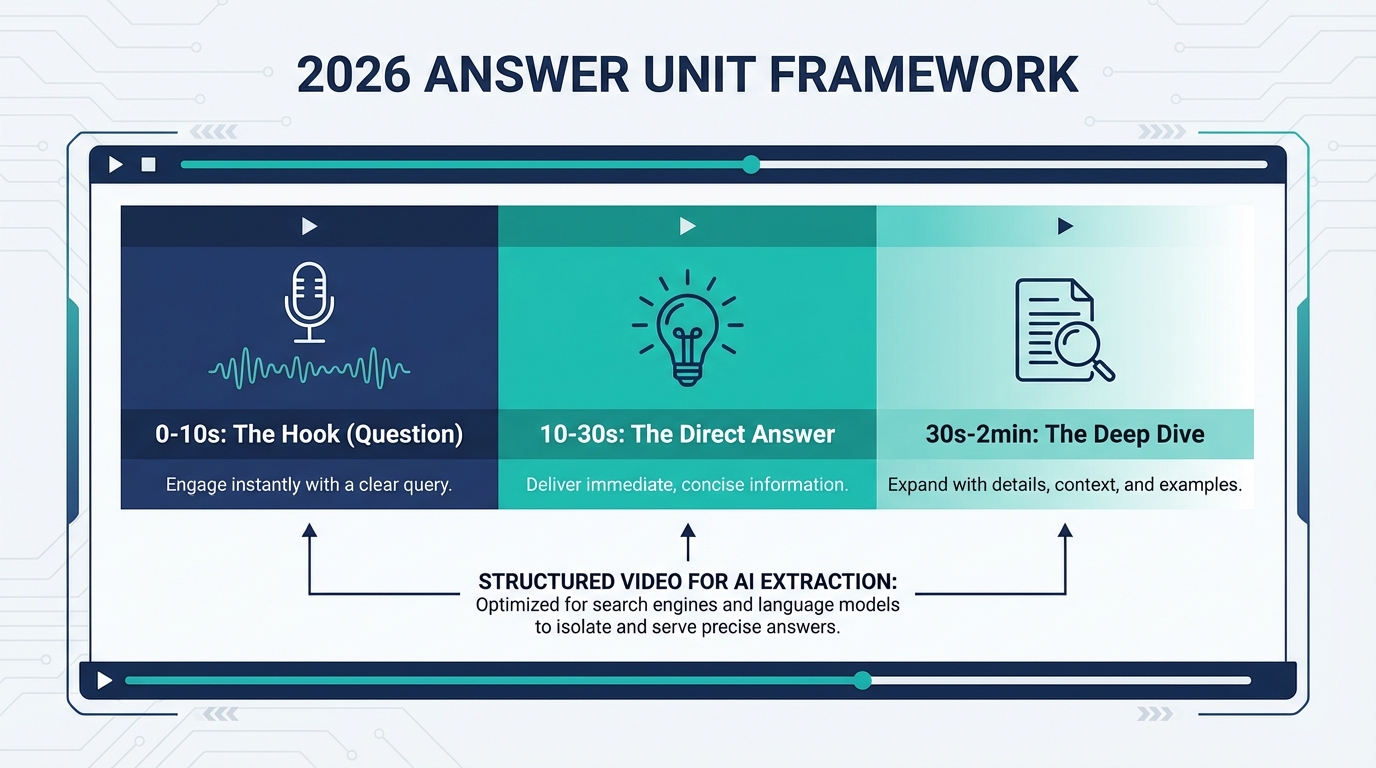
The 2026 Answer Unit Framework:
- The Hook (0-10s): Restate the user’s question clearly.
- The Direct Answer (10-30s): Provide a one-sentence, authoritative answer.
- The Deep Dive (30s-2min): Break down the “how” or “why” using structured steps.
- The Citation Signal: Use on-screen text that mirrors the spoken answer to reinforce multimodal comprehension.
AI Overview Video Citations
AI Overviews (formerly SGE) prioritize videos that are “chaptered” correctly. When Google generates an AI Overview for a query like “How to set up a digital rupee wallet in India,” it doesn’t just link to a video; it often cites a specific “Key Moment.” To qualify for these citations, your video must have timestamped chapters that correspond to common “People Also Ask” (PAA) questions. See: Voice Search Ranking Factors and YouTube Shorts Automation AI.
2. Conversational SEO: Scripting and Metadata for Natural Language Queries
Traditional SEO focused on “head terms” (e.g., “Digital Marketing India”). Conversational SEO for AI videos focuses on the long-tail, question-led phrases that people actually speak.
Natural Language Video SEO
In 2026, your scripts must be written for the ear, not just the eye. This involves using “Conversational Keywords”—phrases that include pronouns (I, you, we) and question starters (Who, What, Where, When, Why, How).
Scripting for Voice Discovery:
- Avoid Jargon: AI assistants struggle to read aloud complex industry jargon. Use simple, clear language in the first 30 seconds.
- Hinglish Integration: For the Indian market, scripts should naturally blend English and Hindi where appropriate. For example: “If you’re wondering ‘SIP investment kaise shuru kare,’ here are the three steps.”
- Entity Association: Mention your brand and key entities (locations, products, regulations like DPDP) clearly so the AI can link your video to the Knowledge Graph.
Metadata Mirroring
Your metadata should act as a transcript of your conversational intent.
- Titles: Start with the question. Instead of “2026 SEO Trends,” use “What are the top SEO trends for 2026 in India?”
- Descriptions: The first two lines should provide the direct answer. This is what AI agents often scrape for voice snippets.
- Tags: Include regional spellings and common transliterations (e.g., “kaise kare,” “kya hai”). Explore the Voice Search Ranking Factors guide.
3. Answer Engine Optimization (AEO): Winning Featured Snippets in India
Answer engine optimization video marketing is the strategic practice of making your video the “canonical” answer for a specific query. In India, where featured snippets often appear in both English and Hindi, AEO is the key to dominating the SERP.
The Featured Snippets Video Content India Playbook
To win a featured video snippet, your content must be supported by a robust technical ecosystem on your landing page.
- The Companion Article: Never publish a video in isolation. Embed it on a page with a high-quality article that uses
HowToorFAQSchema. - Heading Alignment: The H2 or H3 immediately preceding the video embed should be the exact question the video answers.
- Bullet Point Summaries: Provide a bulleted summary of the video’s key points next to the player. AI Overviews love to pair these bullets with your video as a citation.
Key Moments and Seek-to-Action
Google’s “Key Moments” feature is the holy grail of featured snippets video content India. By using VideoObject schema with Clip or SeekToAction properties, you tell the search engine exactly where the answer to a specific sub-query starts. This allows a voice assistant to say, “In this video from [Brand Name], they explain the process at the 1-minute mark,” and then play that specific segment. See: Voice Search Ranking Factors and YouTube Shorts Automation AI.
4. Multilingual Mastery: Optimizing for Hinglish and Regional Voice Discovery
India is a land of many languages, and in 2026, voice query optimization YouTube India requires a multilingual strategy. Voice search in regional languages (Tamil, Telugu, Bengali, Marathi) is growing faster than English search.
The Language-Specific Upload Strategy
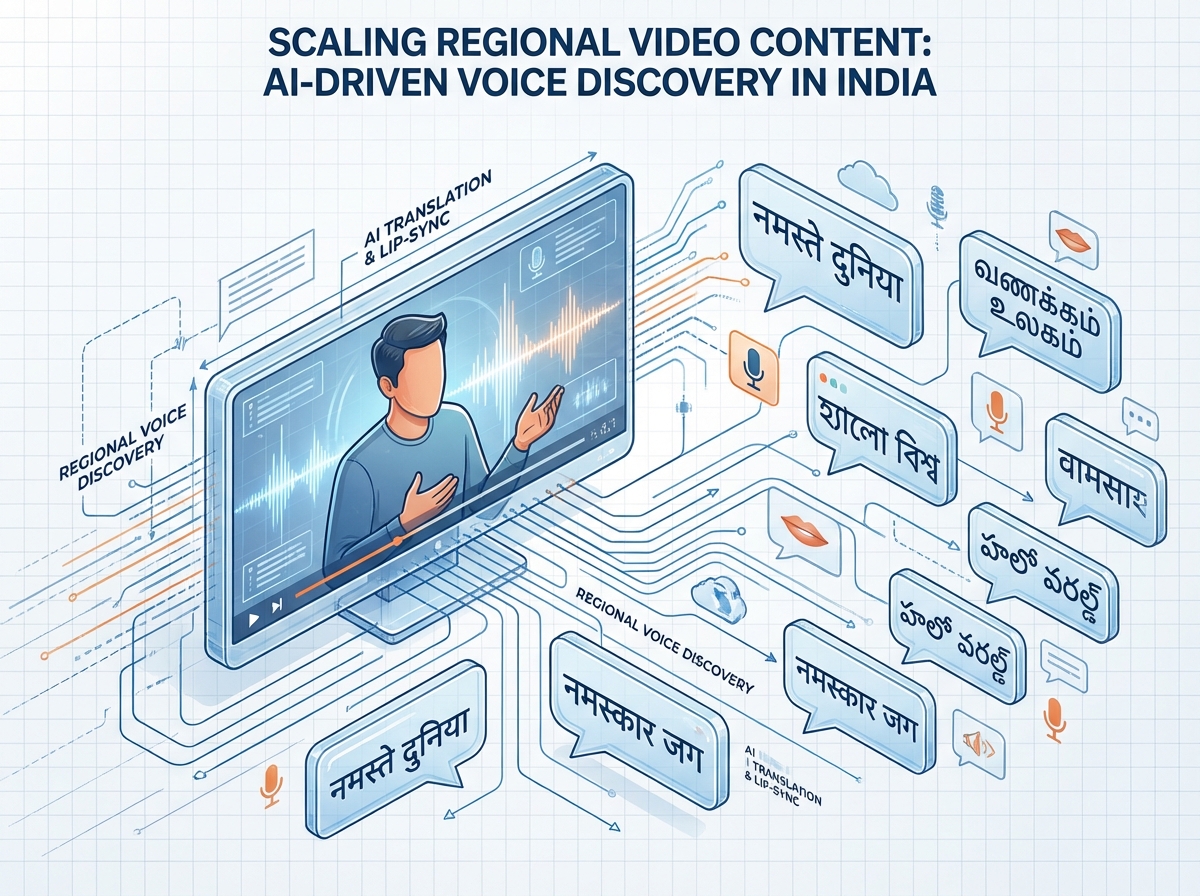
Rather than just adding subtitles, enterprise brands are now finding success by uploading separate video variants for different languages. This allows for localized metadata, which is crucial for voice assistant video discovery.
Studio by TrueFan AI’s 175+ language support and AI avatars allow brands to take a single English master script and instantly generate perfectly lip-synced versions in Hindi, Tamil, or Kannada. This ensures that when a user in Chennai asks a voice query in Tamil, your brand has a native-language video ready to be served as the answer. Learn more about Multimodal AI Video Creation 2026.
Regional Nuances in Voice Search
- Phonetic Optimization: Voice assistants often misinterpret regional accents. Using clear, AI-generated voices ensures that the transcription (and thus the indexing) is 100% accurate. See AI Voice Cloning Indian Accents.
- Transliterated Keywords: Many Indian users type or speak in “Romanized” regional languages. Your tags and descriptions must include these variants (e.g., “paisa kaise kamaye”). Refer to this guide on voice cloning and accents.
5. Technical Blueprint: Schema, Metadata, and Multilingual Implementation
To achieve top-tier voice search ranking factors video, you must satisfy the technical requirements of 2026 search engines.
The Technical Checklist
- Schema Markup: Use
VideoObjectschema for every video. Ensure you populate thetranscript,potentialAction(SeekToAction), andhasPart(for chapters) fields. See the Voice Search Ranking Factors. - Core Web Vitals: For videos embedded on your site, page speed is a ranking factor for voice search. Use lazy loading for videos and ensure your CDN is optimized for the Indian subcontinent.
- Mobile-First Delivery: Since most voice searches happen on mobile, ensure your video player is responsive and that captions are legible on small screens.
Question-Based Video Optimization
Every video should be treated as a response to a specific set of questions.
- Pinned Comments: Pin a comment on YouTube that lists all the questions answered in the video with timestamps. This provides an additional text layer for AI to crawl.
- Closed Captions (CC): Never rely on auto-generated captions. Upload a clean, SRT file that includes the conversational keywords you are targeting. See: Translating YouTube Videos with AI (2025).
6. Scaling Enterprise Video SEO with AI Governance
For large enterprises, the challenge isn’t just making one video—it’s making thousands of “answer units” for every product, service, and FAQ. Solutions like Studio by TrueFan AI demonstrate ROI through their ability to automate the production of SEO-optimized video assets at a fraction of the traditional cost. Explore Topic Cluster Video Marketing for scaling strategy.
Governance and Compliance
In the era of the DPDP (Digital Personal Data Protection) Act in India, enterprises must be cautious about how they use AI.
- Consent-First Models: Ensure all AI avatars used in your videos are fully licensed and ethical.
- Watermarking: All AI-generated content should be watermarked for transparency, which is increasingly becoming a signal for “Responsible AI” that search engines value.
- Moderation: Use real-time filters to ensure that your “answer units” remain brand-safe and compliant with local regulations. See Brand Guideline Enforcement AI.
Measurement and Iteration
You cannot optimize what you do not measure. In 2026, tracking “Rank #1” is less important than tracking:
- AI Overview Share of Voice: How often is your video cited in the AI answer block?
- Voice Assistant Trigger Rate: How many views are coming from “Google Assistant” or “Alexa” referrals?
- Chapter CTR: Which specific “Key Moments” are users clicking on most?
Conclusion
Mastering voice search optimization video content in 2026 requires a fundamental shift in how we perceive video. It is no longer a passive medium but a structured, conversational data source that feeds the world’s most advanced AI answer engines. By focusing on “answer-first” scripting, robust schema markup, and a multilingual approach tailored for the Indian market, enterprise brands can secure their place at the top of the conversational SERP.
Frequently Asked Questions
How does voice search optimization differ from traditional video SEO?
Traditional video SEO focuses on keywords in titles and descriptions to rank in a list of results. Voice search optimization focuses on providing a direct, spoken answer that an AI assistant can read aloud or a search engine can cite as a “Key Moment.” It requires a more conversational script and much more granular metadata (like timestamped chapters).
Will AI Overviews reduce the traffic to my brand’s website?
While AI Overviews provide answers directly on the SERP, they also provide citations. If your video is the cited source, you gain high-authority visibility and “zero-click” brand awareness. Furthermore, users seeking a “Deep Dive” will still click through to your full video or companion article.
How do I optimize for Hinglish voice queries specifically?
Include Romanized Hindi phrases in your tags and the first 200 characters of your description. Your video script should also naturally use common Hinglish terms (e.g., “GST portal par login kaise kare”) to ensure the AI recognizes the conversational intent. For detailed steps, see Translating YouTube Videos with AI.
Can I use AI-generated videos for enterprise SEO?
Yes, provided they are high-quality and compliant. Solutions like Studio by TrueFan AI enable enterprises to generate thousands of localized, answer-first videos that are perfectly structured for AI discovery while maintaining strict brand governance and ethical standards.
What is the most important technical factor for winning featured snippets in 2026?
The most important factor is the alignment between your video chapters and the VideoObject Schema on your landing page. If your chapters exactly match the questions users are asking, Google is significantly more likely to feature your video as a “Key Moment” snippet. Review the Voice Search Ranking Factors guide.
How many languages should I support for the Indian market?
While English and Hindi are the big two, optimizing for the “Big 5” (English, Hindi, Tamil, Telugu, and Bengali) covers over 80% of the digital population in India. Using AI tools to create these variants is the most cost-effective way to scale.