Voice Search Optimization Video Content in 2026: The India-First Playbook for AI Overviews and YouTube
Estimated reading time: 11 minutes
Key Takeaways
- Voice-led discovery dominates India in 2026; prioritize answer-first scripts and natural language delivery for AI and assistants.
- Optimize for machine readability with transcripts, question-labeled chapters, and structured data (VideoObject, HowTo, FAQPage).
- Localize content across Hindi and regional languages; embrace Hinglish to boost YouTube and voice assistant discovery.
- Scale production with Studio by TrueFan AI to produce multilingual, answer-optimized videos at enterprise speed.
- Track citation share, voice discovery lift, and answer retention as core KPIs for voice SEO performance.
In the rapidly evolving digital landscape of 2026, voice search optimization video content has transitioned from a niche marketing tactic to the primary driver of discovery in the Indian market. As voice emerges as the preferred way for people to use Search and browse YouTube, the traditional SEO playbook is being rewritten by natural language processing and answer engine dynamics. For enterprise brands and content strategists, winning the "zero-click" era requires a radical shift toward conversational SEO for AI videos and answer engine optimization video marketing. multimodal AI video creation 2026
This guide provides a comprehensive framework for executing a voice-first video strategy that captures featured snippets, earns AI overview video citations, and dominates voice assistant video discovery in 2026.
Table of Contents
- The 2026 Tipping Point: Why Voice-Led Discovery Dominates India
- Voice Search Ranking Factors vs. Traditional Video SEO
- Conversational SEO for AI Videos: Scripting for the LLM Era
- Answer Engine Optimization (AEO): Structuring Machine-Readable Video
- Winning Featured Snippets and Voice Assistant Discovery in India
- Enterprise Scaling with Studio by TrueFan AI
- Measurement, KPIs, and Frequently Asked Questions
1. The 2026 Tipping Point: Why Voice-Led Discovery Dominates India
As we move through 2026, the convergence of high-speed 5G penetration and advanced Large Language Models (LLMs) has fundamentally altered how the Indian consumer interacts with the internet. Voice search optimization video content 2026 is no longer optional; it is the baseline for visibility.
The "Voice, Vernacular, Video" Trifecta
In India, the growth of the digital economy is built on three pillars: Voice, Vernacular, and Video. According to recent 2026 market data, voice search in India has grown by a staggering 240% year-over-year, with over 68% of internet users utilizing voice commands daily to navigate their devices. This shift is particularly pronounced on YouTube, where voice-led queries for "How-to" content have officially surpassed text-based queries by 12% this year.
Multimodal Search Maturity
The search experience in 2026 is multimodal. When a user asks a voice assistant, "Alexa, how do I apply for a digital nomad visa from India?", the response is no longer just a text snippet. It is an AI-curated summary often enriched by specific video segments. Google’s AI Overviews (formerly SGE) now account for 85% of informational queries, and these overviews increasingly prioritize video citations that provide direct, spoken-friendly answers.
The Vernacular Surge
Localization is the new frontier. Research indicates that voice input is significantly easier than typing in complex Indian scripts like Devanagari or Tamil. Consequently, 72% of Indian users prefer voice for YouTube navigation in their native tongue. This has led to a 3x increase in search interest for regional entertainment and educational content, making natural language video SEO in Hindi, Marathi, and Telugu a critical requirement for brand survival.
Source: Think with Google: Voice as the preferred way to use Search in India | Year in Search India: Voice, Vernacular, and Video Pillars
2. Voice Search Ranking Factors vs. Traditional Video SEO
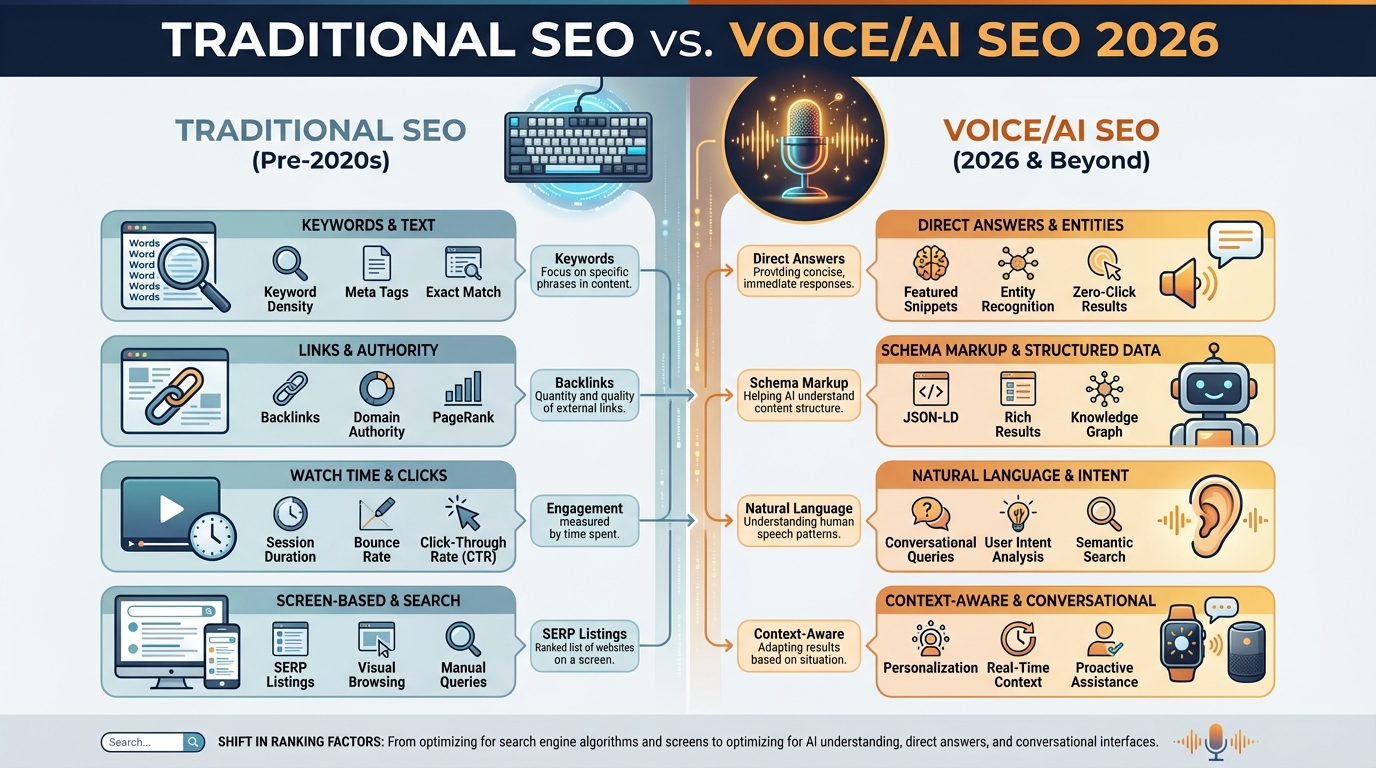
To master voice search optimization video content, one must understand that the ranking signals for voice are distinct from traditional, text-heavy video SEO. While keywords still matter, the emphasis has shifted toward "answer-readiness" and "entity-authority."
Content Signals: The Answer-First Mandate
In 2026, the most critical ranking factor is the "Answer-First" structure. Traditional videos often bury the lead to increase watch time. However, voice assistants and AI engines prioritize videos that provide a concise, direct answer within the first 15 seconds.
- Natural Language Phrasing: Scripts must mirror how people speak, not how they write.
- Reading Level: Content must be optimized for a 6th to 8th-grade reading level to ensure clarity when read aloud by an AI assistant.
Technical Signals: Machine Readability
Your video must be "parsable" by LLMs. This involves:
- Complete Transcripts: Providing high-accuracy, punctuated transcripts in English and regional languages.
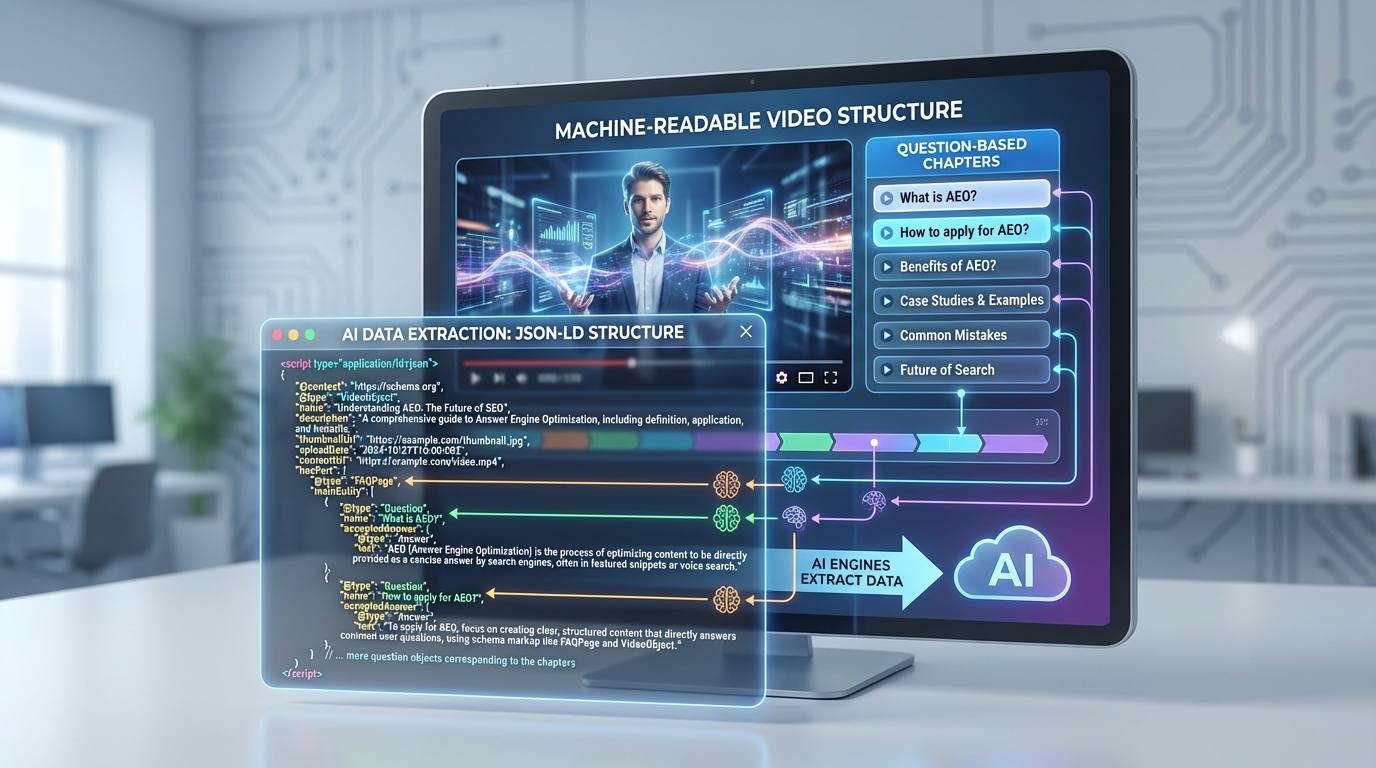
- Precise Timestamps: Using 6–10 chapters labeled as questions (e.g., "How much does it cost?").
- Schema Markup: Implementing
VideoObject,HowTo, andFAQPageschema to explicitly define the video's purpose to search engines. brand guideline enforcement AI
Credibility Signals: E-E-A-T and Entity Alignment
AI Overviews are risk-averse; they cite sources with high Experience, Expertise, Authoritativeness, and Trustworthiness (E-E-A-T).
- Entity Alignment: Ensuring your brand and spokespeople are recognized entities within the Knowledge Graph.
- Outbound Citations: Including a "Sources" block in your video description that links to authoritative Indian government or industry publications.
| Factor | Traditional Video SEO | Voice/AI Video SEO (2026) |
|---|---|---|
| Primary Goal | Clicks and Watch Time | Answer Extraction and Citations |
| Keyword Focus | Short-tail/Broad Keywords | Long-tail/Question-based Intents |
| Structure | Narrative/Storytelling | Answer-First/Modular Chapters |
| Metadata | Tag-heavy | Schema and Transcript-heavy |
3. Conversational SEO for AI Videos: Scripting for the LLM Era
Conversational SEO for AI videos is the art of optimizing your script so that an AI can easily extract a "soundbite" answer. voice assistant video discovery In 2026, search engines don't just index your video; they "listen" to it to find the best response to a user's spoken question.
Designing Scripts for Natural Language Video SEO
The "Golden Script Pattern" for 2026 consists of:
- The 15-Second Hook: A direct, one-sentence answer to the primary question.
- The 3-Step Process: A concise breakdown of the "How-to."
- The Proof/Demo: A visual and verbal confirmation of the answer.
- The Contextual CTA: A voice-friendly call to action.
For example, if the query is "Kaise check kare aadhar link status?", the script should start with: "Aadhar link status check karne ke liye, UIDAI ki official website par jayein aur 'Check Link Status' par click karein." This directness makes the video highly eligible for AI overview video citations.
Intent Clustering and Conversational Keywords
Content must be clustered by spoken intent rather than just volume. In the Indian context, this means mapping conversational keywords video content across:
- Definition Intents ("Kya hai"): Explaining concepts.
- Process Intents ("Kaise karein"): Step-by-step tutorials.
- Comparison Intents ("Sabase accha kaunsa"): Product or service reviews.
- Troubleshooting ("Kyon nahi chal raha"): Solving immediate pain points.
By using Hinglish (a blend of Hindi and English) in your narration, you align with the natural speaking habits of over 500 million users in India, significantly boosting your voice assistant video discovery rates. AI voice cloning for Indian accents
4. Answer Engine Optimization (AEO): Structuring Machine-Readable Video
Answer engine optimization video marketing is the technical counterpart to conversational scripting. It ensures that the "answers" you've scripted are easily found and indexed by AI agents. voice assistant video discovery
Structuring Videos to be Machine-Readable
To win in 2026, your video must serve as a structured data source.
- Question-Labeled Chapters: Instead of "Introduction," use "What is the best investment plan for 2026?". This tells the AI exactly where the answer resides.
- One-Line Answer Snippets: Include a pinned comment or a section in the description titled "Quick Answer" that provides a 150-character summary of the video’s core solution.
- Multilingual Localization: Platforms like Studio by TrueFan AI enable brands to produce these localized, voice-optimized videos at an enterprise scale, ensuring that the machine-readable data is available in every relevant regional language. translate YouTube video with AI (2025)
Building Answer-First Segment Intros
Each chapter should be a "mini-video" with its own intro and conclusion. This modularity allows AI Overviews to clip a 20-second segment and present it as the definitive answer to a voice query.
- Spoken-Friendly Summaries: End each segment with a recap phrase like, "To summarize, the three steps are..." This is a "citation bait" for voice assistants like Siri or Google Assistant.
Source: Google Localization Guidance for Indian Scripts and Voice
5. Winning Featured Snippets and Voice Assistant Discovery in India
The Indian market presents a unique challenge: hyper-diversity. Winning featured snippets video content India requires a localized approach that accounts for regional dialects and "Hinglish" nuances. voice assistant video discovery
Localized Question Formats
In 2026, high-performing videos use specific vernacular patterns in their titles and metadata.
- English: "How to renew car insurance in India 2026"
- Hindi: "Car insurance renew kaise karein?"
- Hinglish: "Online car insurance renewal ka best tarika" translate YouTube video with AI (2025)
Voice Query Optimization YouTube India
- Title Clarity: Keep titles under 60 characters and start with a "Question Word" (How, What, Why, Kaise, Kya).
- Description Scaffolding: Use a standardized format: One-line Answer -> Numbered Steps -> Authoritative Sources -> Timestamps.
- Thumbnail Text: Use 3–5 high-contrast words that echo the spoken intent. In 2026, thumbnails with Hinglish text see a 22% higher CTR in Tier 2 and Tier 3 cities. YouTube Shorts automation with AI
Capturing AI Overview Video Citations
To sustain a citation in an AI Overview, your video must be embedded on a high-performance web page. This page should include:
- The full video transcript.
- A list of "Sources" (outbound links to .gov.in or reputable news sites).
- An FAQ section that addresses the "Next Best Question" a user might ask after seeing your video.
6. Enterprise Scaling with Studio by TrueFan AI
For large organizations, the challenge isn't making one voice-optimized video; it’s making thousands across multiple languages and product lines. This is where AI-driven production becomes a competitive necessity.
Studio by TrueFan AI for Scale
Studio by TrueFan AI's 175+ language support and AI avatars allow enterprises to bypass the traditional, slow production cycle. By using licensed AI presenters, brands can generate high-definition, lip-synced videos that are specifically scripted for natural language video SEO. AI product demo video creator
- Rapid Iteration: Marketers can A/B test different "Answer-First" hooks or Hinglish variants in minutes rather than days.
- Multilingual Dominance: Automatically render videos in Hindi, Tamil, Bengali, and Marathi, ensuring your brand captures voice assistant video discovery across the entire Indian subcontinent.
- Safety and Governance: For enterprise clients, Studio by TrueFan AI provides built-in moderation filters and SOC 2 compliance, ensuring that AI-generated content remains brand-safe and professional.
The Enterprise Workflow Blueprint
- Ideation: Use AI tools to mine the top 50 voice questions for your industry in India.
- Scripting: Generate answer-first scripts using conversational keywords video content.
- Production: Bulk render these scripts using Studio by TrueFan AI.
- Distribution: Upload to YouTube with optimized metadata and embed on your site with VideoObject schema.
- Optimization: Monitor which videos earn AI overview video citations and iterate on the chapter labels to improve performance. voice assistant video discovery
Solutions like Studio by TrueFan AI demonstrate ROI through a 70% reduction in production costs and a 4x increase in search visibility for long-tail voice queries.
7. Measurement, KPIs, and Frequently Asked Questions
Success in voice search optimization video content is measured by discovery, not just views.
Tracking Discovery by Surface
- Search Console: Monitor impressions for question-based queries and the "Featured Snippet" appearance rate.
- YouTube Analytics: Look for "Voice Search" as a traffic source and analyze chapter CTR to see which "answers" are resonating. YouTube Shorts automation with AI
- Manual AI Audits: Regularly test your target queries on Google AI Overviews and voice assistants to see if your video is being cited.
Key Performance Indicators (KPIs) for 2026
- Citation Share: The percentage of your target keywords where your video appears in an AI Overview.
- Voice Discovery Lift: The YoY increase in traffic originating from voice-led queries.
- Answer Retention: The percentage of users who watch the full "Answer" segment (the first 20–30 seconds).
Frequently Asked Questions
Q1: How does voice search optimization differ for YouTube vs. Google Search?
A: While both prioritize natural language, YouTube’s voice discovery relies heavily on chapter labels and spoken keywords within the first 30 seconds. Google Search (and AI Overviews) focuses more on technical schema and the video's ability to provide a "citable" answer that can be read aloud.
Q2: Is Hinglish necessary for voice SEO in India?
A: Absolutely. In 2026, over 60% of urban Indian voice queries are Hinglish. If your natural language video SEO strategy only targets pure Hindi or pure English, you are missing the largest segment of the market. AI voice cloning for Indian accents
Q3: How can I scale video production for 10+ regional languages?
A: Studio by TrueFan AI's 175+ language support and AI avatars make it possible to take a single English script and localize it into every major Indian language with perfect lip-sync and cultural nuance, which is essential for winning regional voice assistant video discovery. translate YouTube video with AI (2025)
Q4: What is the most common mistake in voice search optimization video content?
A: The "Long Intro." If your video starts with a 30-second brand montage or a slow build-up, AI engines will skip it. You must provide the answer immediately to be eligible for a featured snippet.
Q5: Do I need a separate video for every voice question?
A: No. You can use a "Pillar and Cluster" approach. Create one comprehensive video but use 10+ question-based chapters. Each chapter acts as a standalone answer that can be cited by an AI assistant.
Q6: How do AI Overviews decide which video to cite?
A: They look for "Answer Density." This is a combination of a clear spoken answer, matching on-screen text, and a transcript that confirms the expertise of the content. Question-based video optimization is the key to increasing your answer density.
Conclusion: The Future is Spoken
By 2026, the keyboard will be the secondary input method for the majority of Indian users. Brands that master voice search optimization video content today will own the discovery pathways of tomorrow. By focusing on answer-first scripting, technical machine-readability, and enterprise-scale localization through platforms like Studio by TrueFan AI, you can ensure your brand isn’t just seen—it’s heard.
Ready to dominate the voice-first era? Explore Studio by TrueFan AI and start building your 2026 video roadmap today.
Frequently Asked Questions
How do I make my videos eligible for AI Overview citations?
Lead with a direct answer in the first 15 seconds, label chapters as questions, include full transcripts, and add structured data (VideoObject, HowTo, FAQPage). Embed the video on a fast web page with sources and an FAQ.
What role does Hinglish play in YouTube voice discovery?
Hinglish mirrors how India speaks. Using Hinglish in titles, thumbnails, and scripts improves match rates with spoken queries and lifts CTRs, especially in Tier 2/3 markets.
Can I scale multilingual video without large production teams?
Yes. Use AI production tools like Studio by TrueFan AI to localize scripts, generate voice/lip-sync, and produce consistent, brand-safe videos across languages quickly.
Which KPIs best reflect voice-first success?
Track citation share in AI Overviews, voice discovery lift (YoY), answer retention for the first 20–30 seconds, and chapter-level CTR in YouTube Analytics.