Voice commerce vernacular India 2026: An enterprise blueprint for Hindi, Tamil, and Bengali
Estimated reading time: ~11 minutes
Key Takeaways
- Vernacular voice will power India’s next wave of digital commerce, especially across Tier-2+ cities by 2026.
- A robust ASR–NLU–TTS stack optimized for code-mixing and dialects is essential for enterprise-grade CX.
- Blending voice with personalized video increases trust and conversions across Hindi, Tamil, and Bengali users.
- Voice SEO and localized FAQs improve discoverability for long-tail, conversational queries.
- Deploy a 90-day roadmap to move from POC to multilingual scale while tracking ROI with clear KPIs.
In the rapidly evolving digital landscape of the subcontinent, voice commerce vernacular India 2026 represents the definitive frontier for enterprise growth. This paradigm defines the end-to-end shopping journey—from discovery and consideration to purchase and post-sales support—conducted entirely via speech in regional languages. As we approach 2026, the convergence of high-speed connectivity and advanced linguistic models has made voice commerce vernacular India the primary interface for over 650 million vernacular-first users.
With India’s internet user base projected to reach between 900 million and 950 million by 2026, the "speak, not type" shift is no longer a niche preference but a strategic necessity. For the next billion users, traditional text-based interfaces present significant friction, whereas vernacular voice assistant adoption offers a natural, intuitive path to digital consumption. This blueprint provides CTOs and marketing leaders with a comprehensive framework for building scalable, compliant, and high-ROI voice-activated shopping experiences tailored for Hindi, Tamil, and Bengali markets.
1. The Vernacular Opportunity: Adoption and Tier-2+ Penetration in the Bharat Market
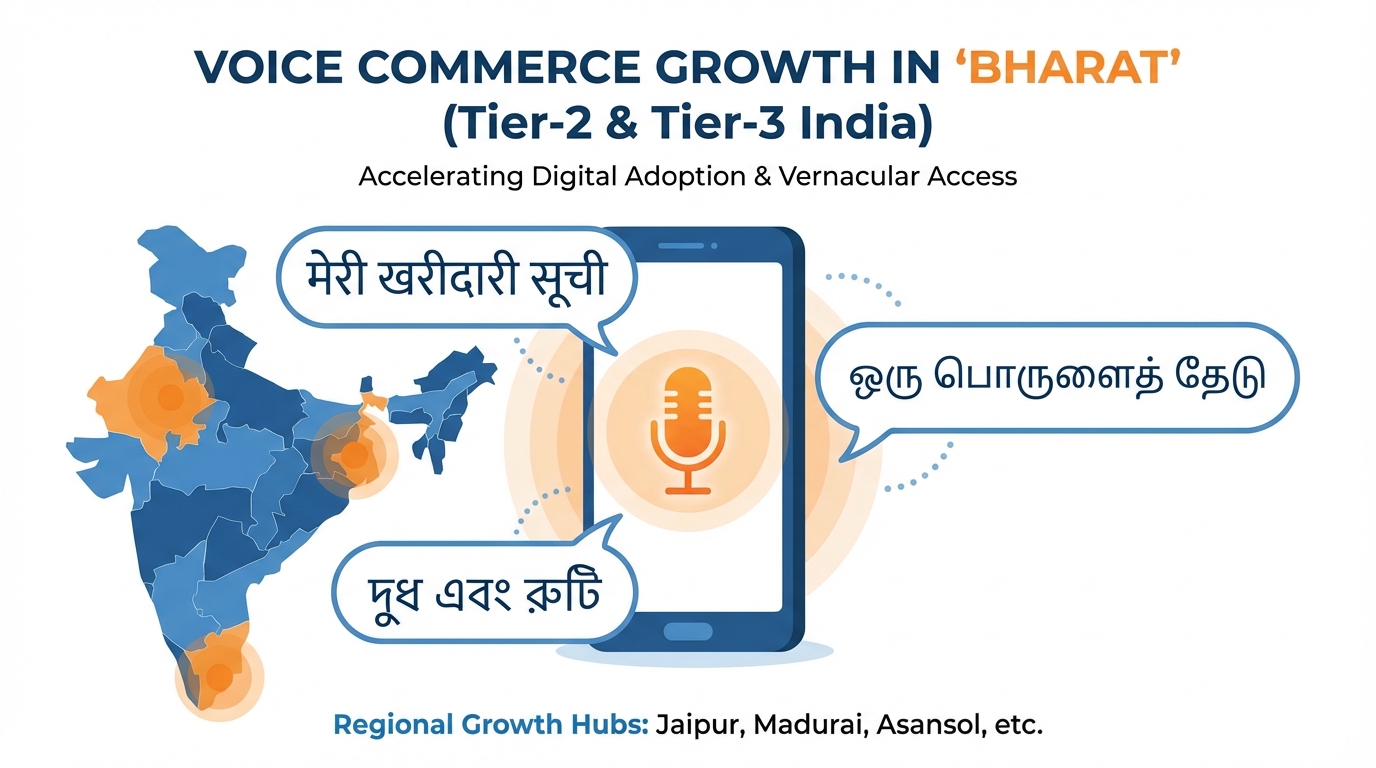
The demographic shift toward "Bharat"—the non-metro, regional-language-speaking heart of India—is reshaping the e-commerce hierarchy. Current data indicates that 98% of India’s internet users now consume content in local languages, with even 57% of urban users expressing a preference for vernacular interfaces. This trend is driving a massive surge in tier-2 voice commerce penetration, as users in these regions find typing in Indic scripts cumbersome compared to the fluidity of speech.
By 2026, Tier-2 and Tier-3 cities are expected to contribute over 67% of all e-commerce orders in India. These users exhibit a unique regional shopping behavior analysis profile, often utilizing code-mixed speech—such as Hinglish, Tanglish, or Benglish—to navigate digital storefronts. Enterprises that fail to accommodate these linguistic nuances risk alienating the most significant growth segment of the decade.
The opportunity extends across multiple categories, from grocery and quick-commerce to high-consideration electronics. In the grocery sector, voice-activated replenishment in Hindi or Bengali allows users to manage households with simple verbal commands. Similarly, in beauty and personal care, voice-activated shopping Hindi Tamil interfaces enable guided discovery, where users can ask for product recommendations based on specific skin types or concerns in their native tongue.
Sources:
2. The Enterprise Tech Stack: Conversational AI and NLP for Regional Languages
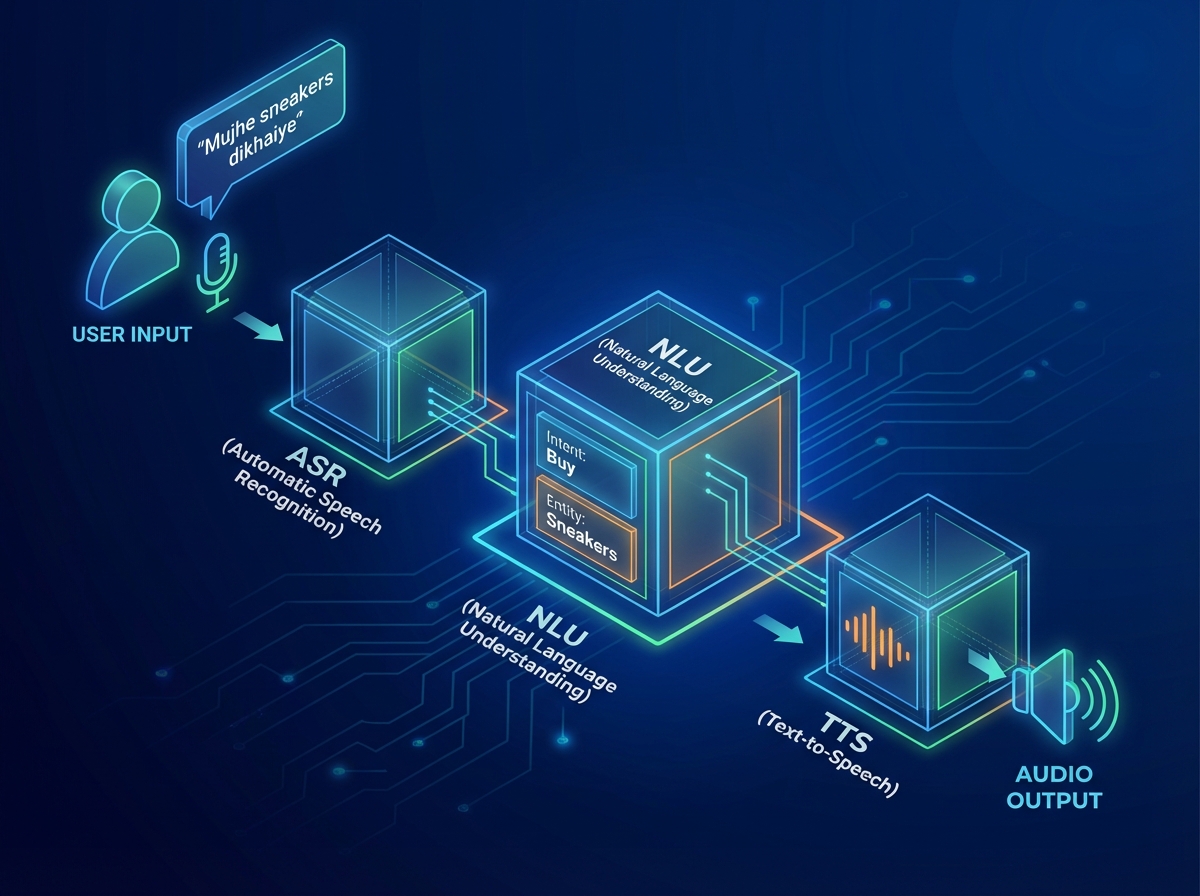
Building a robust infrastructure for conversational AI regional languages requires a sophisticated pipeline optimized for the linguistic diversity of the Indian market. At the core of this stack is natural language processing commerce, a specialized NLP framework designed to handle retail-specific intents and entities across multiple dialects. The architecture must seamlessly integrate Automatic Speech Recognition (ASR), Natural Language Understanding (NLU), and Text-to-Speech (TTS) modules.
The ASR layer must be engineered for noise robustness, particularly for users in Tier-2 environments where background noise is prevalent. It must also excel at "code-mixing," the practice of blending English technical terms with regional grammar. For instance, a Hindi user might say, "Mujhe 40 size ke safed sneakers dikhaiye," requiring the NLU to extract "sneakers" as the category, "white" as the color, and "40" as the size entity while maintaining the conversational context.
Furthermore, smart speaker commerce integration India is becoming a critical component of the enterprise stack. As smart home adoption grows, integrating with platforms like Alexa and Google Assistant allows brands to facilitate "Add to Cart" and "Buy Now" intents through voice. This requires secure account linking and the implementation of voice-to-UPI payment flows, where users can authorize transactions via secure audio prompts or linked WhatsApp confirmation messages.
Dialect-specific shopping experiences are the final piece of the technical puzzle. The system must recognize phonetic variations and colloquialisms unique to different regions. A Tamil query like "₹150 kku keezh saadam order pannu" (Order rice under ₹150) requires the NLU to understand the price cap and the specific food item, while a Bengali query for a "Samsung 55 inchi smart TV" must trigger an availability check against real-time inventory APIs.
Sources:
3. Personalization and Multilingual Voice Marketing Automation Strategies
In 2026, generic marketing is obsolete. Conversational shopping personalization leverages CRM and Customer Data Platform (CDP) insights to tailor every voice interaction based on the user’s language, location, and past purchase history. By integrating multilingual voice marketing automation, enterprises can trigger personalized voice prompts for cart abandonment, price drops, or subscription renewals in the user’s preferred dialect.
Platforms like TrueFan AI enable enterprises to bridge the gap between voice-only interactions and rich visual engagement. When a user expresses uncertainty during a voice dialogue—perhaps by asking "How does this work?" in Tamil—the system can automatically trigger a personalized video offer. This video, delivered via WhatsApp or a mobile landing page, can feature a brand ambassador or celebrity explaining the product in the user's native language, significantly increasing trust and conversion rates.
These voice-triggered video offers serve as a powerful tool for reducing cognitive load. Instead of listening to a long list of technical specifications, the user receives a 30-second visual demonstration that is dynamically rendered to include their name and a custom discount code. This level of hyper-personalization is proven to drive higher engagement, with Indian marketers using AI reporting up to 3.5x higher ROI compared to traditional methods.
The integration of voice and video creates a cohesive journey that mirrors a real-world retail experience. For example, a beauty brand could use voice to identify a user's skin concerns and then immediately follow up with a personalized video tutorial featuring a celebrity influencer. This approach not only solves the user's problem but also builds an emotional connection that purely text-based or English-only interfaces cannot achieve.
Sources:
4. Voice SEO Optimization for Regional Discoverability and Search Phrases
To capture the growing volume of voice queries, enterprises must implement a rigorous voice SEO optimization regional strategy. Unlike traditional search, which focuses on short-tail keywords, voice search is inherently conversational and long-tail. Users are more likely to ask, "Which is the best budget smartphone under 15,000 in Bengali?" rather than typing "budget smartphone Bengali."
Optimizing for voice-activated shopping Hindi Tamil involves creating extensive FAQ sections in regional languages that mirror these natural speech patterns. This content should be marked up with Speakable and FAQ schema to ensure that voice assistants can easily parse and read the information aloud. Additionally, brand and product names must have SSML (Speech Synthesis Markup Language) hints to ensure correct pronunciation across different linguistic models.
Local SEO also plays a vital role in the voice commerce ecosystem. Many voice queries are location-intent driven, such as "Where is the nearest grocery store that has organic rice?" in Hindi. Ensuring that Google My Business (GMB) listings and local inventory pages are optimized in regional languages allows brands to capture this high-intent traffic. Voice-call CTAs with IVR routing by language can further streamline the path from discovery to purchase.
Furthermore, enterprises should focus on creating language-specific sitemaps and App Actions. By mapping voice intents directly to store SKUs and local inventory, brands can ensure that their products are the first ones surfaced when a user makes a verbal request. This proactive approach to SEO ensures that the brand remains visible in an increasingly crowded and voice-first marketplace.
Sources:
5. A 90-Day Enterprise Roadmap for Bharat Market Voice Automation
Implementing Bharat market voice automation requires a phased approach that prioritizes data readiness and user trust. A 90-day roadmap allows enterprises to move from a Proof of Concept (POC) to a full-scale multilingual rollout without compromising on quality or compliance. This journey begins with assembling a cross-functional squad comprising product, engineering, marketing, and legal experts.
Weeks 1–4: Foundations and POC
The initial phase focuses on tagging product catalogs and defining the linguistic taxonomy for NLU entities. Brands should start with a Hindi MVP, focusing on the top 20 most frequent customer utterances. It is critical to establish guardrails during this phase, including audio-logging with PII redaction to ensure compliance with the Digital Personal Data Protection (DPDP) Act. Fallback mechanisms to human agents must also be established to handle out-of-scope queries.
Weeks 5–8: Integrations and Pilots
In the second month, the project expands to include Tamil and integrates WhatsApp voice capture. This is the ideal time to launch voice-triggered video offers for high-impact journeys, such as electronics demonstrations or beauty tutorials. By wiring CRM triggers to these voice interactions, brands can begin to see the impact of personalized video on cart abandonment rates. Analytics dashboards should be stood up to track intent success and ASR accuracy.
Weeks 9–12: Scale and ROI
The final phase involves adding Bengali and fine-tuning the models for specific dialects, such as Bhojpuri or Haryanvi, within the Hindi cluster. A/B testing between voice-only and voice+video flows will provide the data needed to optimize offer depth and prompt variants. By the end of day 90, the enterprise should have a fully operational, DPDP-compliant voice commerce engine that is ready for wide-scale promotion and ROI tracking.
Sources:
6. Measuring Voice Commerce ROI and Performance in India
To justify continued investment, enterprises must adopt a rigorous framework for voice commerce ROI measurement India. This involves tracking both technical performance metrics and business outcomes across different languages and regions. Key Performance Indicators (KPIs) should include Word Error Rate (WER) and Character Error Rate (CER) for ASR, as well as precision and recall for NLU intent classification.
From a business perspective, the focus should be on conversion rates, Average Order Value (AOV), and revenue per 1,000 utterances. Regional shopping behavior analysis can reveal which linguistic segments are most profitable and where the highest drop-off points occur in the voice dialogue. For instance, if users in West Bengal show a high intent success rate but low conversion, it may indicate a friction point in the payment or delivery phase that needs to be addressed.
Attribution is another critical component. Multi-touch attribution (MTA) models should be updated to include voice touchpoints, allowing marketers to understand how a voice interaction on a smart speaker might influence a final purchase on a mobile app. Matched-market tests, comparing regions with voice features enabled against those without, can provide a clear picture of the incremental revenue generated by voice commerce.
Solutions like TrueFan AI demonstrate ROI through increased engagement and lower return rates, especially when video proof is used to clarify product features during the voice journey. By reducing the "uncertainty gap" through personalized, multilingual video, brands can see a significant uplift in customer lifetime value (LTV) and a reduction in customer acquisition costs (CAC) in the competitive Bharat market.
Sources:
7. TrueFan AI: The Strategic Acceleration Layer for Voice and Video Commerce
As enterprises scale their voice initiatives, TrueFan AI serves as a critical acceleration layer, providing the tools necessary to deliver high-impact, personalized content at the speed of conversation. TrueFan AI's 175+ language support and Personalised Celebrity Videos allow brands to create a sense of familiarity and trust that is essential for winning over vernacular-first users in Tier-2 and Tier-3 cities.
The platform’s API-first architecture enables real-time video rendering in under 30 seconds, making it possible to deliver a personalized video offer the moment a user finishes a voice query. Whether it’s a festive greeting in Bengali or a product explainer in Tamil, TrueFan AI ensures that the content is perfectly localized, featuring accurate lip-sync and voice retention for brand avatars. This level of technical sophistication ensures that the brand’s message is consistent and professional across all linguistic variants.
Moreover, TrueFan AI provides deep analytics on video views and conversions, allowing enterprises to refine their multilingual voice marketing automation strategies. By understanding which celebrity endorsements or video styles resonate best with specific dialect groups, brands can optimize their creative spend and maximize ROI. In a market as diverse as India, this data-driven approach to personalization is the key to long-term success.
In conclusion, the blueprint for voice commerce vernacular India 2026 is built on a foundation of linguistic empathy and technical excellence. By combining advanced conversational AI with personalized video engagement, enterprises can unlock the massive potential of the Bharat market. The transition to voice is not just a technological upgrade; it is a fundamental shift in how brands communicate with the next billion users.
Frequently Asked Questions
What is the primary driver for voice commerce in India by 2026?
The primary driver is the "speak, not type" shift among 650 million+ vernacular-first users. As internet penetration reaches 950 million, voice provides a friction-free interface for users in Tier-2 and Tier-3 cities who prefer Hindi, Tamil, or Bengali over English-centric text interfaces.
How does code-mixing affect conversational AI in regional languages?
Code-mixing, such as Hinglish or Tanglish, is a standard communication pattern in India. To be effective, conversational AI regional languages must be trained on datasets that include these blends of English and vernacular terms to accurately identify intents and entities during a shopping journey.
What role does personalized video play in voice-activated shopping?
Personalized video acts as a visual bridge for voice interactions. When a user is hesitant or needs more information, a voice-triggered video offer can provide a localized, celebrity-led demonstration that builds trust and clarifies product details, leading to higher conversion rates.
How can TrueFan AI help enterprises scale voice commerce?
TrueFan AI provides the infrastructure for real-time, multilingual video personalization. By integrating TrueFan AI's 175+ language support and Personalised Celebrity Videos into your voice stack, you can deliver hyper-personalized content that resonates with regional audiences and drives measurable ROI.
Is voice commerce in India compliant with the DPDP Act?
Yes, but it requires strict adherence to data protection principles. Enterprises must implement clear consent flows (both audio and UI), practice data minimization, and ensure that all PII in voice logs is redacted. Audio data must be stored and processed in accordance with the latest Indian regulations.