B2B Procurement Cycle Acceleration 2026: The Enterprise Playbook for Multi-Stakeholder Success
Estimated reading time: 10 minutes
Key Takeaways
- Accelerate enterprise buying by prioritizing asynchronous, role-based engagement over meeting-heavy cycles.
- Use personalized vendor selection videos and automated scorecards to standardize evaluation and close the consensus gap.
- Adopt a 90-day execution blueprint aligned to discovery, pilot engagement, and late-stage optimization.
- Localize for India with regional-language content, WhatsApp distribution, and DPDP-ready compliance assets.
- Quantified ROI and verifiable proof points are essential for CFO-led committees in 2026.
B2B procurement cycle acceleration 2026 has emerged as the primary differentiator for enterprise sales organizations aiming to dominate the Q4 budget finalization and Q1 vendor selection windows. As global economic shifts demand higher fiscal accountability, the traditional “wait-and-see” approach to procurement has been replaced by a mandate for rapid, data-driven decision-making.
In this landscape, enterprise buying journey optimization requires more than just a standard sales deck; it demands a strategic orchestration of role-based content, automated evaluations, and verifiable ROI proof. This guide outlines a comprehensive 90-day, India-ready plan to compress evaluation timelines and de-risk approvals across complex buying committees.
The New Landscape of Enterprise Buying Journey Optimization in 2026
The enterprise buying environment in 2026 is characterized by unprecedented complexity and a significant expansion in the size of buying groups. Recent data indicates that the average enterprise buying committee now consists of 11 to 15 stakeholders, each possessing veto power over different aspects of the procurement process.
To achieve B2B procurement cycle acceleration 2026, organizations must pivot from synchronous meeting-heavy cycles to asynchronous, high-impact engagement models. The shift toward AI-assisted evaluation and automated sourcing has reduced manual friction, but it has also raised the bar for vendor transparency and governance.
Winning teams are now designing journeys that prioritize “time-to-shortlist” by providing stakeholders with personalized, role-specific evidence before the first formal RFP meeting occurs. This proactive approach addresses the primary bottleneck in modern procurement: the “consensus gap” where stakeholders fail to align on technical or financial requirements.
By standardizing evaluation criteria early through automated scorecards and leveraging interactive microsites, vendors can move from longlist to shortlist 40% faster than traditional methods. Platforms like TrueFan AI enable these teams to deliver this level of personalization at a scale previously thought impossible.
Source: WNS Procurement: Trends shaping procurement into 2026
Source: Kensium: AI personalization transforms B2B sales journeys
Mastering Multi-Stakeholder Procurement Mapping for Complex Committees
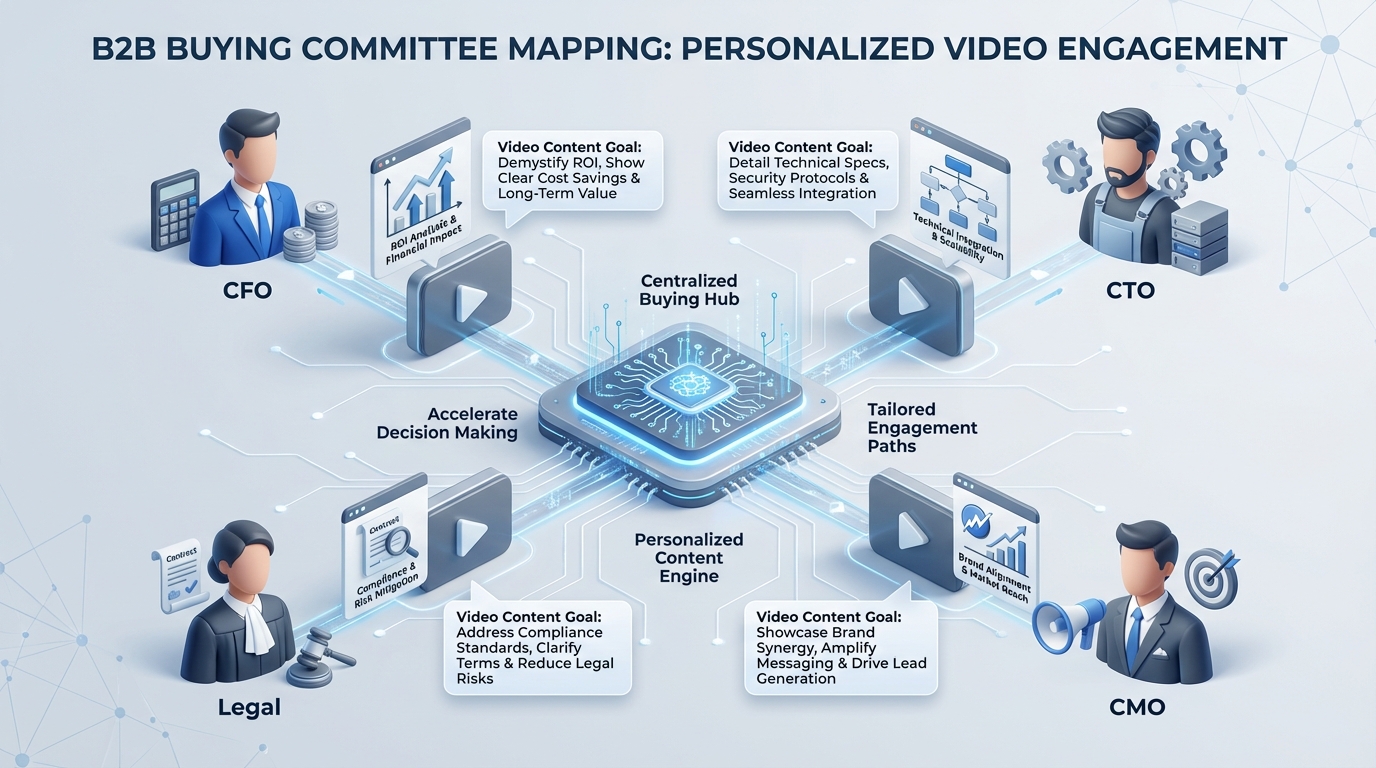
Effective B2B procurement cycle acceleration 2026 begins with a rigorous multi-stakeholder procurement mapping exercise. This process involves creating a structured inventory of every decision-maker, influencer, and veto-holder within the target account, mapping their specific goals and objections to tailored content assets.
In 2026, the “CFO-led” procurement model has become the standard, meaning even mid-ticket deals require rigorous financial justification. However, the technical and operational stakeholders remain the gatekeepers of feasibility. Understanding the nuanced requirements of each persona is critical for maintaining momentum.
| Persona | Primary Goals | Key Risks & Objections | Must-See Proof Points | Preferred Format |
|---|---|---|---|---|
| CFO / Finance | Quantified ROI, Payback Period | Capex vs. Opex volatility, Long-term TCO | 3-Statement Model Highlights, Sensitivity Analysis | ROI Demonstration Video |
| CTO / CIO | Architecture Fit, Scalability | Security breaches, Integration friction | SOC 2/ISO 27001 Certs, API Documentation | Tech Overview Video |
| CMO / BU Lead | Revenue Impact, Time-to-Value | Low user adoption, Implementation lag | Case Benchmarks, Adoption Roadmap | Outcome-Focused Video |
| CPO / Procurement | Compliance, Benchmarking | Commercial non-compliance, Vendor risk | Competitive Comparables, Legal Attestations | Scorecard-Ready Evidence |
| Legal / InfoSec | Regulatory Fit (DPDP Act) | Data privacy violations, Liability caps | Data Flow Diagrams, Compliance Videos | Chaptered Explainer Video |
TrueFan AI's 175+ language support and Personalised Celebrity Videos allow sales teams to address these diverse stakeholders in their native languages and preferred contexts, ensuring that the value proposition is never lost in translation. This level of localization is particularly vital for Indian enterprises operating across multiple regional hubs.
Source: Shopify India: B2B conversion rate optimization and proof-driven journeys
Scaling Impact with Enterprise Vendor Selection Videos and RFP Personalization
The transition from a longlist of potential vendors to a final shortlist is often where deals stall. To overcome this, enterprise vendor selection videos have become a mandatory component of the modern sales toolkit. These are not generic marketing clips; they are short, role-targeted modules that address specific comparison criteria.
A successful “Core Three” video set includes a “Why Us” outcomes video for business leads, a “How It Works” technical deep-dive for IT, and a “What’s the ROI” snapshot for finance. These videos should be distributed via ABM landing pages and, in the Indian context, through professional WhatsApp Business channels to ensure high visibility.
Furthermore, RFP response video personalization is the “secret weapon” for winning high-stakes bids in 2026. Instead of submitting a 100-page static document, leading firms embed personalized video sections that address requirement clusters directly. This reduces the need for multiple clarification meetings and allows the procurement committee to digest complex information at their own pace.
By using dynamic variables such as the prospect's company name and specific industry metrics, these videos create a sense of bespoke partnership. Solutions like TrueFan AI demonstrate ROI through these personalized touchpoints, which have been shown to increase RFP win rates by up to 35% in competitive sectors like BFSI and Manufacturing.
Source: Kensium: AI-driven personalization reduces friction in B2B decisions
Driving Efficiency via Vendor Evaluation Scorecard Automation
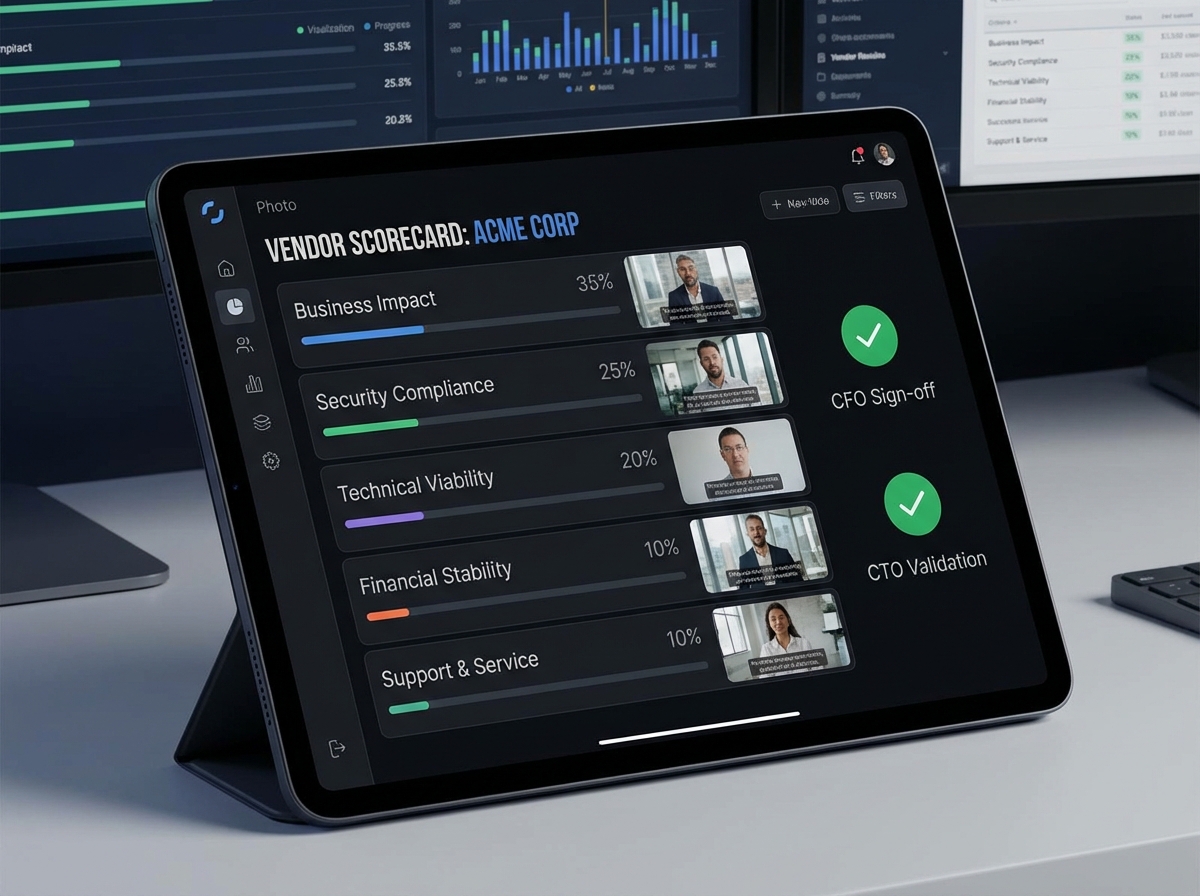
One of the most significant barriers to B2B procurement cycle acceleration 2026 is the manual, often subjective, nature of vendor scoring. Vendor evaluation scorecard automation solves this by providing a standardized, weighted framework for comparison, integrated with embedded video evidence.
An automated scorecard ensures that all stakeholders are evaluating the vendor against the same criteria, reducing the risk of “internal misalignment” late in the cycle. This transparency builds trust with the procurement office and speeds up the final vote.
The 2026 Standardized Evaluation Template
| Criteria Bucket | Weight | Evidence Required | Automation Trigger |
|---|---|---|---|
| Business Impact | 25% | Case Study Video, ROI Calculator | Link to ROI Dashboard |
| Security & Privacy | 20% | SOC 2 Report, DPDP Compliance Video | InfoSec Approval Signal |
| Integration & IT Fit | 15% | API Documentation, Tech Demo Video | CTO Validation |
| TCO & Commercials | 20% | Pricing Model, Payback Analysis | CFO Sign-off |
| Implementation | 10% | Project Roadmap, Training Plan | BU Lead Consensus |
| Compliance & Legal | 10% | DPA, Indemnity Clause Explainer | Legal Review Completion |
By linking enterprise vendor selection videos directly within these scorecard rows, you provide the “proof” exactly where the “rating” happens. This eliminates the need for stakeholders to hunt through emails for relevant documents. Additionally, adding QR codes to physical scorecard printouts used in boardroom meetings ensures that even offline discussions are supported by digital evidence.
Source: WNS Procurement: Regional emphasis on governance and resilience
Localizing Success: B2B Sales Cycle Acceleration India
For organizations targeting the Indian market, B2B sales cycle acceleration India requires a nuanced understanding of local communication preferences and regulatory requirements. India’s enterprise landscape is unique, with a heavy reliance on mobile-first communication and a growing emphasis on data sovereignty.
WhatsApp Business has surpassed email as the primary channel for stakeholder “nudges” and quick updates in India. Delivering decision-maker consensus building videos via WhatsApp ensures nearly 100% open rates and allows for rapid feedback loops. However, this must be balanced with strict adherence to the India Digital Personal Data Protection (DPDP) Act.
Localization is another critical lever. While English remains the language of business, providing procurement compliance documentation videos in regional languages like Hindi, Tamil, or Bengali can significantly speed up approvals in manufacturing hubs or regional BFSI branches. This demonstrates a level of commitment to the local market that generic global competitors often miss.
Furthermore, the Indian procurement cycle is often influenced by “relationship-based” trust. Using exact-voice localization for stakeholder videos helps maintain the personal touch of the account executive while scaling the message across a 15-person committee. This blend of high-tech automation and high-touch localization is the hallmark of a successful 2026 India strategy.
Source: Shopify India: CRO and proof-driven journeys in complex B2B cycles
The 90-Day Roadmap for Procurement Committee Engagement
Achieving B2B procurement cycle acceleration 2026 requires a disciplined execution timeline. This 90-day blueprint is designed to move a deal from initial discovery to final signature by orchestrating a relentless cadence of value-driven engagement.
Days 0–15: Discovery and Mapping
The focus here is on foundational intelligence. Sales teams must build their multi-stakeholder procurement mapping and draft a content matrix that aligns every persona with a specific proof point. This is also the time to stand up the vendor evaluation scorecard automation template and produce the first cut of enterprise vendor selection videos.
Days 16–45: Pilot Accounts and Committee Engagement
During this phase, the selection videos are launched and embedded into ABM hubs. The procurement committee engagement cadence begins in earnest, with role-specific videos sent to the CFO, CTO, and CMO. Tracking watch-time analytics during this period is crucial; if a CFO hasn't watched the ROI demonstration video by Day 30, it signals a potential budget bottleneck that needs immediate intervention.
Days 46–90: Scale and Optimize
The final stretch focuses on removing late-stage friction. This involves rolling out procurement compliance documentation videos and contract negotiation support content to the legal and InfoSec teams. ROI demonstration videos should be iterated with scenario-specific variants (e.g., “What if adoption is 70% vs 90%?”) to satisfy the CFO's sensitivity analysis requirements.
Key KPIs to Track:
- Time-to-Shortlist: Reduction in days from initial contact to formal RFP inclusion.
- Stage Velocity: Average duration of the “Evaluation” and “Negotiation” stages.
- Committee Watch-Through: Percentage of the 11-15 stakeholders who have engaged with their specific video modules.
- Scorecard Completion: The speed at which the automated scorecard is finalized by the buying group.
Conclusion
The era of the “linear” sales funnel is over. In 2026, success belongs to those who can navigate the non-linear, multi-stakeholder reality of modern procurement. By integrating enterprise vendor selection videos, vendor evaluation scorecard automation, and role-specific ROI demonstrations, organizations can significantly compress their sales cycles and secure Q4/Q1 wins. The key is to provide the right evidence, to the right person, in the right format, at the exact moment they need it to make a decision.
Frequently Asked Questions
How does B2B procurement cycle acceleration 2026 differ from traditional sales acceleration?
Traditional sales acceleration focuses on the seller's activities (more calls, more emails). B2B procurement cycle acceleration 2026 focuses on the buyer's internal hurdles—consensus building, financial justification, and compliance—and provides the tools (like automated scorecards and role-based videos) to clear those hurdles faster.
Why is multi-stakeholder mapping more critical now than in previous years?
In 2026, the average buying committee has grown to 11-15 people. Without a map, it is impossible to ensure that every stakeholder—from the CFO to the InfoSec lead—has the specific evidence they need to say “yes.” One missing approval can stall a multi-million dollar deal for months.
Can personalized videos really replace live meetings in the procurement process?
They don't replace meetings; they make them more efficient. By using decision-maker consensus building videos for asynchronous alignment, you ensure that when a live meeting does happen, everyone is already informed. This shifts the meeting from “information gathering” to “decision making.”
How does TrueFan AI integrate with existing CRM systems to track stakeholder engagement?
TrueFan AI provides API-driven integration with major CRM and ABM platforms. This allows sales teams to see exactly which stakeholder watched which video and for how long, triggering automated follow-ups or alerts in the CRM when a key decision-maker engages with the content.
What is the role of the India DPDP Act in B2B procurement for 2026?
The DPDP Act mandates strict controls on how personal data is processed. For B2B vendors, this means providing clear, video-based documentation of data flows and security measures to satisfy the “Legal and Compliance” stakeholder, who now holds significant veto power in the Indian enterprise sector.