

AI Product Photography Replacement India 2026: The Merchant’s Guide to Scaling Visuals Without Shoots
Estimated reading time: ~10 minutes
Key Takeaways
- AI replaces studio shoots for most e-commerce use cases, cutting time-to-market by up to 85% and costs by 70–90%.
- Catalog-scale automation generates videos, 360s, and lifestyle images for Amazon, Shopify, and Meesho from photos or 3D models.
- Localization at scale enables on-brand Indian scenes, seasonality, and 175+ language support for regional reach.
- Compliance-first workflows align with India’s DPDP Act via disclosure, consent, and data minimization guardrails.
- Enterprise-grade platforms like Studio by TrueFan AI provide speed, APIs, and security for large catalogs.
The landscape of Indian e-commerce has undergone a seismic shift, making AI product photography replacement India 2026 the definitive standard for high-growth D2C brands and marketplace sellers. In an era where speed-to-market and visual depth determine winner-take-all outcomes, the traditional model of physical studio shoots—fraught with logistics delays, high costs, and inventory handling—has become a relic of the past. Platforms like Studio by TrueFan AI enable merchants to transform basic supplier images into studio-quality, high-conversion assets in minutes, effectively democratizing professional-grade visual storytelling for every seller from Surat to Siliguri. See how the approach powers Shopify product video generation without photography.
1. The Great Shift: Why India’s Merchants are Replacing Traditional Shoots in 2026
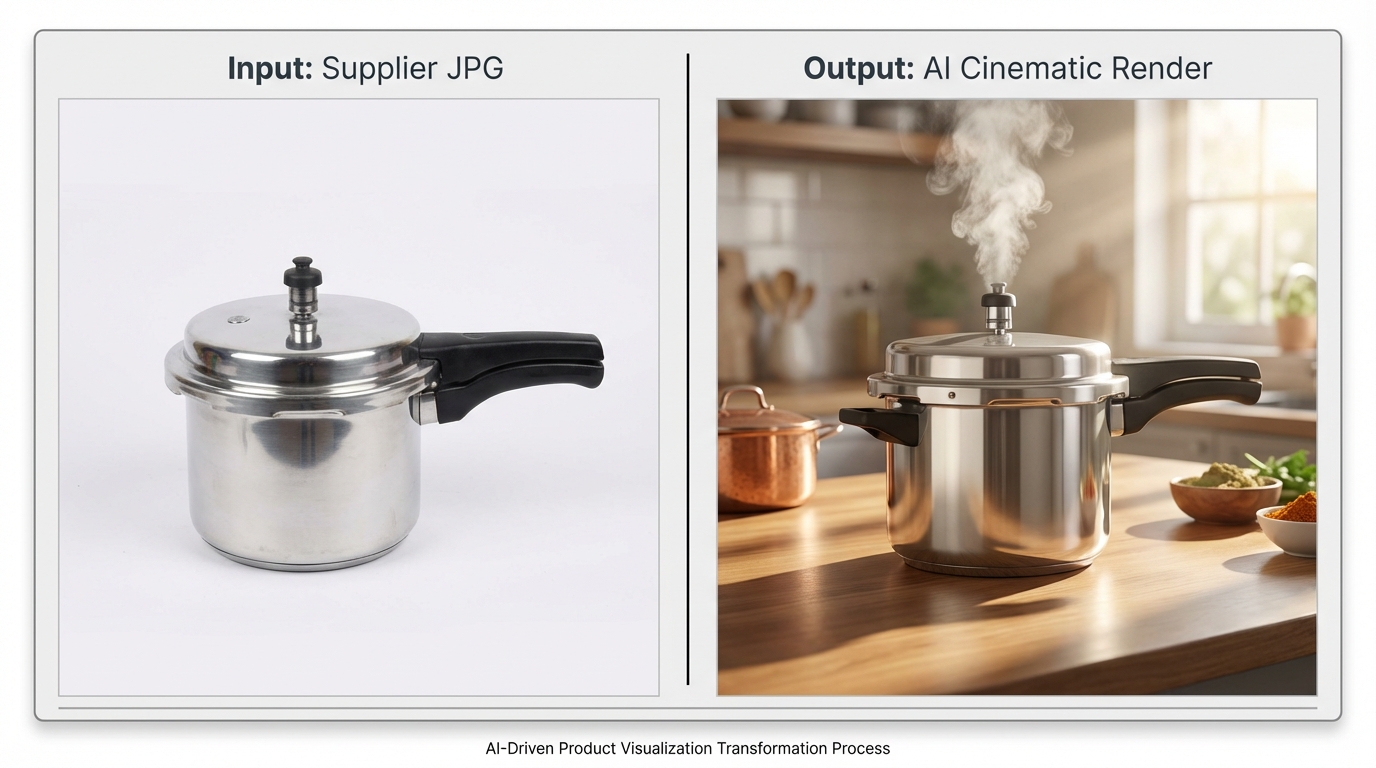
By the first quarter of 2026, the Indian e-commerce ecosystem reached a tipping point. Recent data indicates that 72% of Indian D2C brands have replaced physical shoots with AI-generated content to meet the insatiable demand for fresh visual media. This transition isn't merely about cost-cutting; it’s about "AI product photography replacement"—a category of e-commerce visual content AI that transforms supplier JPG/PNG images or 3D model files (GLTF/OBJ/USDZ) into PDP-ready videos, lifestyle stills, and 360-degree spins at catalog scale.
The macro-trends of 2026 emphasize three core pillars: AI Autonomy, Sustainability, and Immersive Storytelling. According to the Economic Times 2026 Trends Report, sustainability has moved from a "nice-to-have" to a default consumer expectation. AI content factories support this by eliminating the carbon footprint associated with shipping physical samples to studios and the waste of single-use set builds.
Furthermore, the rise of "hybrid human+AI workflows" means that while AI does the heavy lifting of rendering and background generation, brand managers retain creative control over the "vibe" and cultural nuance. For Indian merchants, this means being able to replace product photography AI India workflows with systems that understand the difference between a Diwali-themed living room in Delhi and a monsoon-ready balcony in Mumbai.
Key 2026 Market Metrics:
- Time-to-Market: AI-driven visual content reduces time-to-listing by 85% compared to traditional studio workflows.
- Market Valuation: The Indian AI visual commerce market is projected to reach $1.2 billion by the end of 2026.
- Sustainability ROI: Sustainability-focused AI workflows reduce the carbon footprint of e-commerce logistics by an average of 30%.
Source: Samaro.ai Photography Trends 2026
2. The Technical Pipeline: Transforming Stills and 3D Models into High-Conversion Motion
The core of an AI product photography replacement India 2026 strategy lies in the ability to generate "motion from nothing." In 2026, the most successful sellers are no longer asking for more photos; they are demanding product video from photos AI pipelines that can ingest a single supplier shot and output a 15-second cinematic feature.
From Supplier JPGs to Cinematic Video
The "product video from photos AI" workflow typically follows a five-step automated sequence:
- Prep & Segmentation: The AI identifies the product, removes busy backgrounds, and ensures a clean alpha channel or neutral gray/white base.
- Shadow Grounding: To avoid the "floating product" look, the system generates physically accurate contact shadows on a virtual plane.
- Template Selection: Merchants choose from marketplace-optimized templates (e.g., "Amazon Explainer," "Instagram Reel," or "Shopify Hero").
- Scene Synthesis: The AI "hallucinates" a realistic environment around the product—such as an Indian kitchen for cookware or a festive backdrop for apparel.
- Motion Injection: Parallax effects, pans, and zooms are added to create the illusion of a multi-camera studio shoot.
The 3D Advantage: Product Video from 3D Model AI
For high-ticket items like electronics, furniture, and jewelry, the product video from 3D model AI approach is superior. By using GLTF, OBJ, or USDZ files—often provided by manufacturers or generated via photogrammetry—AI can render:
- 360° Turntables: Smooth 10–20 second spins that allow customers to inspect every angle.
- Exploded Views: Showing the internal components of a gadget or the layers of a mattress.
- Material Swaps: Instantly changing the color or texture of a sofa without needing a new render from scratch.
To ensure realism, these models must utilize PBR (Physically Based Rendering) maps, including albedo, roughness, and metalness. In 2026, AI systems automatically calibrate these maps to match the lighting of the chosen virtual environment, ensuring that a gold necklace sparkles correctly under "Indian Golden Hour" lighting.
3. Building the AI Content Factory: Catalog Automation for Amazon, Shopify, and Meesho
Scaling visual content for 1,000+ SKUs requires more than just a good AI tool; it requires e-commerce catalog video automation. This is the process of using APIs and templates to generate content for an entire inventory without manual intervention for each item.
Marketplace-Specific Optimization
Each platform has unique requirements that your AI content factory must respect:
- Amazon India: The Amazon Product Image Guide recommends at least six images and one video. AI-generated 360-degree renders have been shown to increase conversion rates on Amazon India by 41% in 2026. Your automation should ensure videos are brand-safe, focus on benefits, and include captions for sound-off viewing.
- Shopify: Shopify’s product media guidance emphasizes that 3D models and videos significantly boost buyer confidence. The Shopify product video no photography trend allows brands to use 1:1 aspect ratios for galleries and 9:16 for the Shop app, all generated from a single master asset.
- Meesho: As a video-first commerce leader, Meesho’s 2024-2025 reports highlight the growth of creator-led selling. AI catalog video generators for Meesho must prioritize small-screen legibility and regional language overlays to reach Tier 2 and Tier 3 markets effectively.
D2C Product Content Automation
For D2C brands, the goal is "Create Once, Distribute Everywhere." By binding data from your PIM (Product Information Management) system to an AI catalog video generator India, you can auto-fill prices, titles, and specs into your videos. This ensures that when a price changes in your database, your entire video ad library updates automatically.
4. The Strategic Advantage: Localization, Lifestyle Context, and No-Inventory Pre-Launches
One of the biggest content gaps in traditional photography is the inability to localize at scale. A single photo shoot in a studio in Bangalore cannot represent the diverse cultural fabric of India. This is where AI lifestyle product images and localized video content provide a massive competitive edge.

Regional Nuance and Seasonality
In 2026, AI allows you to place your product in contextually relevant Indian scenes:
- Festive Context: Instantly swap a neutral background for a Diwali set with marigolds and diyas, or an Eid set with crescent motifs.
- Geographic Relevance: Show a raincoat against a backdrop of a rain-soaked Mumbai street or a tea set in a Munnar plantation setting.
- Language Localization: Generating voiceovers and subtitles in 175+ languages ensures your product speaks the customer's tongue, whether it's Marathi, Tamil, or Bengali.
No-Inventory Product Video Creation
Perhaps the most revolutionary use case is no-inventory product video creation. Brands can now launch pre-order campaigns, waitlists, and distributor onboarding before the physical stock even arrives in India. By using 3D CAD models or supplier samples, you can create high-fidelity PDPs and ads, reducing the "dead time" between manufacturing and the first sale. This "sell-then-build" or "sell-while-shipping" model is a cornerstone of the 2026 lean D2C playbook.
5. Governance and Compliance: Navigating India’s DPDP Act in the Age of Synthetic Media
As AI-generated content becomes the norm, governance is no longer optional. The Digital Personal Data Protection (DPDP) Act in India has strict implications for synthetic media, especially when using AI avatars or human likenesses.
Key Compliance Pillars for 2026:
- Consent-First Models: Any AI-generated human must be based on fully licensed digital twins or fictional personas. Unauthorized celebrity deepfakes are a high-risk liability.
- Synthetic Media Disclosure: To maintain trust and comply with evolving marketplace rules, synthetic visuals should be watermarked or labeled in the metadata.
- Data Minimization: Ensure your AI partner processes only the necessary product assets and maintains SOC 2 or ISO 27001 certifications to protect your intellectual property.
- Content Moderation: Automated filters must prevent the generation of misleading claims or culturally insensitive imagery, which could lead to account suspensions on Amazon or Meesho.
By integrating these "quality guardrails" into your e-commerce visual content AI pipeline, you protect your brand from the legal and reputational risks associated with unregulated AI use.
6. The Enterprise Choice: Why Studio by TrueFan AI is the Standard for 2026 Visual Commerce
When choosing a product photography alternative AI tool, enterprise-grade features are non-negotiable. The market has moved beyond simple "filter" apps to robust platforms that handle thousands of renders with consistent quality.
Studio by TrueFan AI’s 175+ language support and AI avatars provide a comprehensive solution for brands looking to dominate the Indian market. Unlike generic global tools, it is built with the nuance of Indian commerce in mind—offering the right aspect ratios for local apps and the cultural context needed for regional lifestyle generation.
Why Enterprise Brands Choose This Path:
- Scale & Speed: With 30-second render times and batch processing capabilities, brands can refresh their entire catalog for a seasonal sale in a single afternoon.
- Localization: The ability to convert a single English script into 175+ languages with perfect lip-syncing allows for a truly pan-India reach.
- Integration: Webhooks and APIs allow the platform to sit directly within your existing marketing automation and PIM pipelines.
- Compliance: Solutions like Studio by TrueFan AI demonstrate ROI through a "walled garden" approach, ensuring 100% content compliance and data security.
By moving away from the "one-off shoot" mentality and toward a continuous AI content factory, brands can achieve a level of visual agility that was impossible just two years ago.
7. FAQs: Mastering AI Product Photography Replacement in India
Explore answers to the most common questions in the FAQ section at the end of this article.
Conclusion: The 2026 Roadmap to Visual Dominance
The transition to AI product photography replacement India 2026 is no longer a futuristic concept—it is a competitive necessity. By leveraging product video from photos AI and e-commerce catalog video automation, Indian merchants can scale their visual presence at a fraction of the traditional cost and time.
Whether you are a D2C brand on Shopify or a high-volume seller on Amazon and Meesho, the ability to generate localized, high-fidelity, and compliant visual content is the key to winning the 2026 e-commerce landscape. The future of product photography isn't a camera; it's a cloud-based AI factory.
Sources:
Frequently Asked Questions
Can AI really replace the quality of a professional DSLR product shoot?
By 2026, AI rendering engines have reached a point where they are indistinguishable from photography for 95% of e-commerce use cases. For PDPs, social media ads, and marketplace listings, AI provides better lighting control, perfect shadows, and the ability to generate motion—something a static photo cannot do.
How much can I save by switching to an AI product photography replacement?
Most brands report a 70–90% reduction in costs. You eliminate studio rentals, photographer fees, model hiring, shipping of samples, and post-production editing. Speed-to-market further boosts ROI by allowing you to go live weeks earlier than with a traditional shoot.
Is AI-generated content allowed on Amazon India and Shopify?
Yes—provided it meets each platform’s technical specifications (resolution, aspect ratio, and file size). Amazon encourages high-quality video and 360-degree content. Ensure the product’s appearance remains accurate to the physical item to prevent elevated return rates.
Do I need 3D models to create these videos?
Not necessarily. While 3D models offer maximum flexibility, an AI product image to video converter can produce cinematic videos from just 1–5 high-quality static photos.
How does Studio by TrueFan AI handle regional Indian languages for product explainers?
Studio by TrueFan AI offers 175+ language support and AI avatars. You can input a script in one language and instantly generate a video where the avatar speaks the target regional language with natural inflection and precise lip-sync—ideal for Meesho and regional Facebook ads.
What is the Digital Personal Data Protection (DPDP) Act’s impact on AI visuals?
The DPDP Act requires clear rights to any personal data used. In AI contexts, use licensed digital humans or fictional personas rather than scraped images. Choose compliant platforms and label synthetic media appropriately to remain aligned with evolving marketplace and legal standards.



