AI Overviews optimization 2026: An India Festival SEO Playbook for Zero-Click and Answer Engines
Estimated reading time: ~12 minutes
Key Takeaways
- Shift from classic SEO to Answer Engine Optimization (AEO), prioritizing citation-worthiness in AI Overviews and Copilot.
- Win India’s festival SERPs with video-first micro-tutorials, multilingual transcripts, and Clip/HowTo/FAQ schema.
- Optimize for vernacular voice search using direct answers, local entities, and conversational phrasing.
- Build E-E-A-T with expert reviews, bylines, timestamps, and citations to Indian authorities like FSSAI.
- Scale with AI-driven video production to ship localized, schema-rich content rapidly during festivals.
AI Overviews optimization 2026 is no longer a luxury for digital leaders; it is the primary battlefield for enterprise marketing heads and SEO leaders aiming to capture 50%+ of festival-related searches. AI Overviews optimization 2026 As we navigate the 2026 landscape, the goal has shifted from driving clicks to shipping India-first, schema-rich, video-first, and citable answers that dominate AI Overviews (SGE), Bing Chat/Copilot, and voice assistants.
The urgency is backed by staggering data: AI search traffic has surged by 527% YoY, and recent projections indicate that by late 2026, over 50% of organic traffic will have shifted to AI-driven answer engines. In India, this shift is even more pronounced as marketing strategies pivot toward AI-led conversational journeys, vernacular voice search, and WhatsApp-based engagement during peak festival seasons.
Sources:
What Changed in 2026: From SEO to Answer Engine Optimization India
The transition from traditional Search Engine Optimization (SEO) to Answer Engine Optimization India (AEO) and Generative Engine Optimization (GEO) represents a fundamental change in how Indian festivals are discovered online. In 2026, the focus has moved from ranking for keywords to becoming the “canonical source” that Large Language Models (LLMs) synthesize into a single, authoritative answer. Answer Engine Optimization video 2026
Answer Engine Optimization (AEO) is the strategic process of optimizing content for AI-generated answers. It involves assembling concise, source-backed, and semantically structured content “chunks” designed specifically for LLMs to cite. Unlike classic SEO, which prioritizes click acquisition, AEO prioritizes citation-worthiness. If your brand is the cited source in a Google AI Overview or a Bing Copilot summary, you win the trust of the user, even if they never visit your website.
Generative Engine Optimization (GEO) takes this further by tuning content structure so generative systems select and synthesize your brand’s unique insights. This requires alignment with Natural Language Processing (NLP) and complex entity graphs rather than just matching keywords. In the Indian context, this shift is driven by a massive rise in vernacular voice queries and short-form video answers. Platforms like TrueFan AI enable enterprises to bridge this gap by creating localized, high-authority video content that feeds these generative engines. Featured snippet video content
The 2026 Google Cloud “AI Agent Trends” report highlights that “workflows matter more than models.” For SEO leaders, this means your content workflow must produce structured, unambiguous data that AI agents can easily parse and present to users during the high-intent windows of Holi, Diwali, and Navratri.
Sources:
India’s Zero-Click SEO Festival Content Reality: Capturing the 2026 SERP
In 2026, the “zero-click” phenomenon has reached its peak during Indian festivals. Users no longer want to browse through ten blue links to find the “muhurat” timings for Diwali or an eco-friendly “thandai” recipe for Holi. They expect instant, accurate answers directly within the AI Overview or Bing Chat interface.
Zero-click SEO festival content is about being the “Featured Snippet” featured snippet video strategies on steroids. Success is measured by being the cited authority or the featured video clip that answers a user's immediate need. For enterprise brands, this means optimizing for specific festival-related clusters that trigger AI summaries:
- Holi: Focus on date/year accuracy, eco-friendly color DIYs, “how to remove gulal stains” (a high-intent query), and city-specific water restrictions.
- Diwali: Optimize for “puja steps,” “diyas vs LED” sustainability guides, and “safe crackers” advisories.
- Navratri: Target “fasting recipes,” “garba events near me,” and the specific “color-of-the-day” schedules that drive daily search spikes.
- Eid: Prioritize “prayer timings,” “Zakat FAQs,” and “seviyan recipes” in multiple languages.
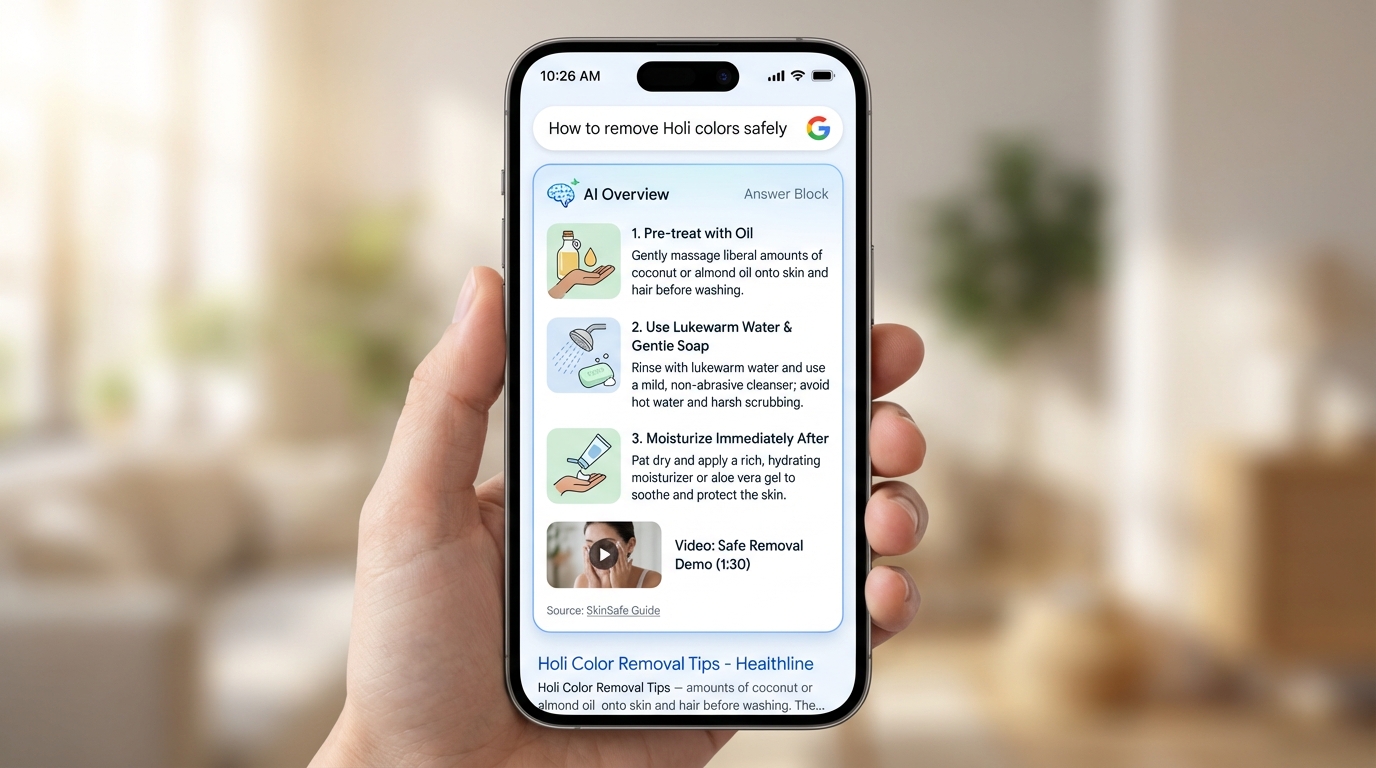
To dominate these clusters, your content must be modular. Instead of one long 3,000-word guide, you need 10-15 “answer blocks” that are 60-80 words each, followed by a clear “Source: [Brand Name]” line. This structure makes it incredibly easy for Google SGE festival content engines to pull your data into their summaries.
Sources:
Voice Search Holi Queries and the Rise of Conversational SEO Marketing
Voice search has become the primary mode of discovery for the “Next Billion Users” in India. By 2026, voice search Holi queries are predominantly in Hinglish or regional vernaculars. Users are asking their phones, “Holi ke baad color kaise nikale?” or “Kids ke liye safe gulal kahan milega?” Regional language video SEO
Conversational SEO marketing requires a deep understanding of these natural language patterns. Your content must mirror the way people actually speak. For example, instead of a heading like “Holi Skin Care Tips,” use “How can I protect my skin from Holi colors?” This aligns with the NLP models used by AI Overviews to match user intent with content blocks.
The Voice Playbook for 2026:
- Direct Answer Blocks: Provide a 60-80 word direct answer at the top of your page.
- Entity Density: Include local entities like city names (e.g., “Delhi Holi events”), specific measurements (e.g., “mix 200ml of coconut oil”), and current dates.
- Vernacular Transcripts: Every video or audio piece must have a text transcript that includes Hinglish and regional variants to feed the semantic search optimization engines.
For safety and food-related guidance, it is critical to cite Indian authorities. Referencing FSSAI for food safety or reputed institutions like Sir Ganga Ram Hospital for skin safety advisories adds a layer of E-E-A-T (Experience, Expertise, Authoritativeness, Trustworthiness) that AI systems are programmed to prioritize in 2026.
Sources:
Featured Snippet Video Strategies: Dominating Visual Answer Engines
In 2026, AI Overviews are increasingly video-first. A user searching for “how to tie a turban for Baisakhi” or “how to make eco-friendly rangoli” is more likely to be presented with a 30-second video clip than a text paragraph. This is where featured snippet video strategies become essential. Featured snippet video content
To win these “key moments” in search, your video content must be highly structured. Vertical micro-tutorials (30-60 seconds) that answer one specific query are the gold standard. These videos should feature strong on-screen steps, auto-captions in multiple languages, and an end card that summarizes the key points.
Video-First AEO Pillars:
- Clip-Level Timecodes: Provide JSON-LD markup with specific labels like “Step 1: Pre-soak with cold water – 00:05.” This allows Google to jump the user directly to the relevant part of your video.
- Multilingual Support: TrueFan AI's 175+ language support and Personalised Celebrity Videos allow brands to create these micro-tutorials at scale, ensuring that a user in Tamil Nadu sees a different, localized version of the “Holi Safety” video than a user in Punjab. AI celebrity video marketing in India
- Embedded Transcripts: Always include a full text transcript on the landing page where the video is hosted. This provides the “textual proof” that AI crawlers need to index the video content accurately.
By monitoring video carousels and featured clips in AI Overviews, enterprise brands can iterate on their hooks and CTA lines using virtual reshoots, ensuring the content remains fresh as the festival date approaches. For QA and delivery fidelity across languages, prioritize perfect lip-sync voice sync accuracy comparison guide.
Sources:
Schema Markup Implementation and E-E-A-T Festival Authority Building
Technical SEO in 2026 is synonymous with schema markup implementation. Schema is the language that allows AI systems to understand the context, relationships, and authority of your content without having to “guess.” For festival content, three types of schema are non-negotiable:
- HowTo Schema Festival Guides: This is essential for any procedural content (e.g., “How to perform Lakshmi Puja”). You must include properties like totalTime, supply, tool, and step. Ensure the steps in your schema match the on-page text verbatim.
- FAQPage Schema Video Content: Mark up your top 5-8 FAQs from your voice search clusters. Each answer should be under 80 words and clearly visible on the page. This increases your chances of appearing in the “People Also Ask” sections of AI Overviews.
- VideoObject + Clip Schema: This is the secret sauce for winning video snippets. By defining hasPart clips with specific startOffset and endOffset, you tell the search engine exactly which part of your video answers which question. Answer Engine Optimization video 2026
Beyond technical markup, E-E-A-T festival authority building is the ultimate differentiator. In a world of AI-generated fluff, Google and Bing prioritize content that shows “Experience.” This means including first-hand procedural steps, expert reviews (e.g., a dermatologist reviewing your “Holi skin care” post), and citations of Indian institutions like FSSAI.
Transparency is key. Ensure every festival guide has a clear author byline with credentials, a “Last Updated” timestamp, and links to authoritative sources. This builds the “Trust” component of E-E-A-T that AI engines use to rank sources in 2026.
Sources:
Scaling with TrueFan AI: Future-Proofing Google SGE Festival Content
Executing a high-velocity AEO strategy for a country as diverse as India requires scale that traditional production cannot match. This is where the intersection of generative AI and enterprise SEO becomes powerful. Solutions like TrueFan AI demonstrate ROI through their ability to mass-produce localized, schema-ready video content that dominates Google SGE festival content and Bing Chat results.
For an enterprise marketing head, the workflow for a festival like Diwali in 2026 looks like this:
- Scripting: Generate 50+ micro-scripts answering specific FAQ and HowTo queries.
- Production: Use TrueFan AI to generate these videos in 175+ languages with perfect lip-sync, featuring brand ambassadors or celebrities who resonate with specific regions. Voice sync accuracy comparison guide AI celebrity video marketing in India
- Automation: Deploy these videos via API to your brand site, YouTube, and WhatsApp Business channels, complete with JSON-LD markup and multilingual transcripts.
- Iteration: If a new safety regulation or a change in “muhurat” timing occurs 48 hours before the festival, use virtual reshoots to update the messaging across all 50+ videos without a new shoot.
This “Agentic” approach to content creation ensures that your brand is always the most current and authoritative source. While Google AIO/SGE prefers multi-source summaries and local entities, Bing Copilot emphasizes explicit citations and brand mentions across authoritative domains. A multi-platform strategy that leverages high-scale AI video ensures you are covered on both fronts.
Sources:
Action Checklist for the Next Quarter (India Festivals 2026)
To stay ahead of the AI Overviews optimization 2026 curve, enterprise teams should follow this tactical roadmap:
- Phase 1: The Festival Hub (8 Weeks Out)
- Build one pillar “Festival Hub” page per major event (Holi, Diwali, etc.).
- Create 6-10 micro-pages focusing on specific HowTo/FAQ queries.
- Generate 6-10 vertical videos (30-60s) per festival using AI-driven production. Featured snippet video content
- Phase 2: Technical & Semantic Layer (6 Weeks Out)
- Implement HowTo, FAQPage, and VideoObject schema on all pages. Answer Engine Optimization video 2026
- Ensure all videos have transcripts in Hindi, English, and at least 2 regional languages.
- Map your entity graph: link your content to specific dates, rituals, and local venues.
- Phase 3: Freshness & Distribution (1 Week Out)
- Refresh “Last Updated” timestamps and verify date/time accuracy for rituals.
- Submit video and news sitemaps to Search Console for rapid indexing.
- Distribute video links via WhatsApp Business to your loyalty segments. Voice commerce in vernacular India
- Phase 4: Monitoring & Iteration (Festival Day + 48 Hours)
- Track your AI Overview citation rate and brand mention frequency.
- Use virtual reshoots to swap out CTA lines if conversion rates dip.
- Record which “answer blocks” were cited by Bing and Google to inform the next festival's strategy.
FAQ: Navigating AI Search in 2026
Explore the full Q&A in the Frequently Asked Questions section at the end of this article.
Sources:
Conclusion: Dominating the 2026 Festival Season
The era of passive SEO is over. To win the 2026 festival season in India, enterprise brands must embrace the “Answer Engine” reality. This means moving beyond keywords to master semantic search, natural language processing, and high-scale video production. By prioritizing AI Overviews optimization 2026, implementing robust schema, and leveraging the power of localized generative video, you can ensure your brand remains the most cited, trusted, and visible authority in the new AI-driven search landscape.
The shift to zero-click and voice-first discovery is an opportunity for those who can provide the fastest, most accurate, and most engaging answers. Start building your citable answer blocks today and secure your place at the top of the 2026 SERP.
Frequently Asked Questions
How does AI Overviews optimization 2026 differ from traditional SEO?
Traditional SEO focuses on ranking for keywords to drive clicks. AI Overviews optimization focuses on Answer Engine Optimization, where the goal is to provide structured, citable content chunks that AI engines synthesize into direct answers. The primary KPI shifts from “Clicks” to “Citation Share.” AI Overviews optimization 2026
Why is video so important for Google SGE festival content?
In 2026, AI engines prioritize multi-modal answers. For “How-To” festival queries, a video clip is often more helpful than text. By using VideoObject schema and key moments, you allow Google to feature your brand as the visual authority in the AI summary. Featured snippet video content
Can I use AI to generate my festival content at scale?
Yes, but it must be governed. Platforms like TrueFan AI enable the creation of high-quality, celebrity-led video content that is brand-safe and ethically sourced. This allows localization and personalization required to win in a diverse market like India.
What is the best way to improve Bing Chat optimization in India?
Bing Copilot relies heavily on authoritative citations and index freshness. Ensure your site has a strong E-E-A-T profile, cite reputable Indian institutions (like FSSAI), and maintain an updated sitemap so Bing sees festival updates in real time.
How do I measure success in a zero-click environment?
Track AI visibility metrics: citation rate in AI Overviews, frequency of brand mentions in generative summaries, and Assisted Conversions where users view your brand in an AI answer and later convert via direct search or app visits. Measuring AI Overview impact