AI crisis communication tools: Your enterprise playbook for rapid response, brand recovery, and stakeholder trust (India 2026)
Estimated reading time: ~10 minutes
Key Takeaways
- Speed is trust: Real-time sentiment monitoring and rapid response automation compress time-to-respond from hours to minutes.
- Personalization at scale: Crisis response video personalization delivers human, 1:1 updates across India’s multilingual audiences.
- End-to-end workflow: From detection to amplification, AI coordinates cross-functional updates and legal approvals.
- Measured recovery: Brand reputation management AI tracks sentiment delta, misinformation decay, and NPS recovery.
- Playbooks win: Scenario-based, API-triggered templates ensure consistency across WhatsApp, SMS, email, IVR, and owned media.
Imagine a scenario where a product safety rumor surfaces on a niche forum at 3:00 AM, and by 7:00 AM, it has triggered a 400% surge in negative social mentions across Tier-1 and Tier-2 Indian cities. In this high-velocity environment, AI crisis communication tools combined with real-time sentiment monitoring enable the fastest path to accurate detection, rapid response marketing automation, and stakeholder trust rebuilding.
The traditional PR “wait and see” approach is obsolete in 2026. Indian enterprises now operate in an ecosystem where AI-driven search engines and social algorithms prioritize speed, structured data, and verified authority. To maintain market share and brand equity, Crisis Management Teams (CMTs) must transition from reactive damage control to a proactive, automated readiness posture.
1. The 2026 landscape: Why Indian enterprises prioritize real-time sentiment monitoring
The Indian corporate landscape in 2026 is defined by hyper-connectivity and a multi-lingual digital citizenry. AI-driven search and discovery are redefining the PR and corporate communications landscape, requiring brands to optimize for structured data and credibility to avoid invisibility during a crisis. According to industry insights, the rise of AI-driven search will define the next era of PR communications, making speed the ultimate currency of trust.
Indian communication leaders now emphasize faster issue-spotting and social listening at scale. The shift from reputation management to “readiness” is the hallmark of 2026 best practices. Enterprises are moving away from static crisis manuals toward codified playbooks and simulation drills designed to compress the time-to-respond from hours to minutes.
Furthermore, real-time sentiment monitoring in India’s diverse market is no longer optional. With the proliferation of regional content, AI must surface risks and opportunities across dozens of languages and platforms simultaneously. AI has become the indispensable PR copilot, spotting crisis red flags earlier and demanding strong governance to avoid the pitfalls of automated missteps.
Sources:
- Exchange4Media: The rise of AI-driven search in PR
- Exchange4Media: Crisis communications in the AI era
- Exchange4Media: From reputation to readiness
- Reputation Today: The role of AI in media monitoring
2. Defining the modern stack: What are AI crisis communication tools?
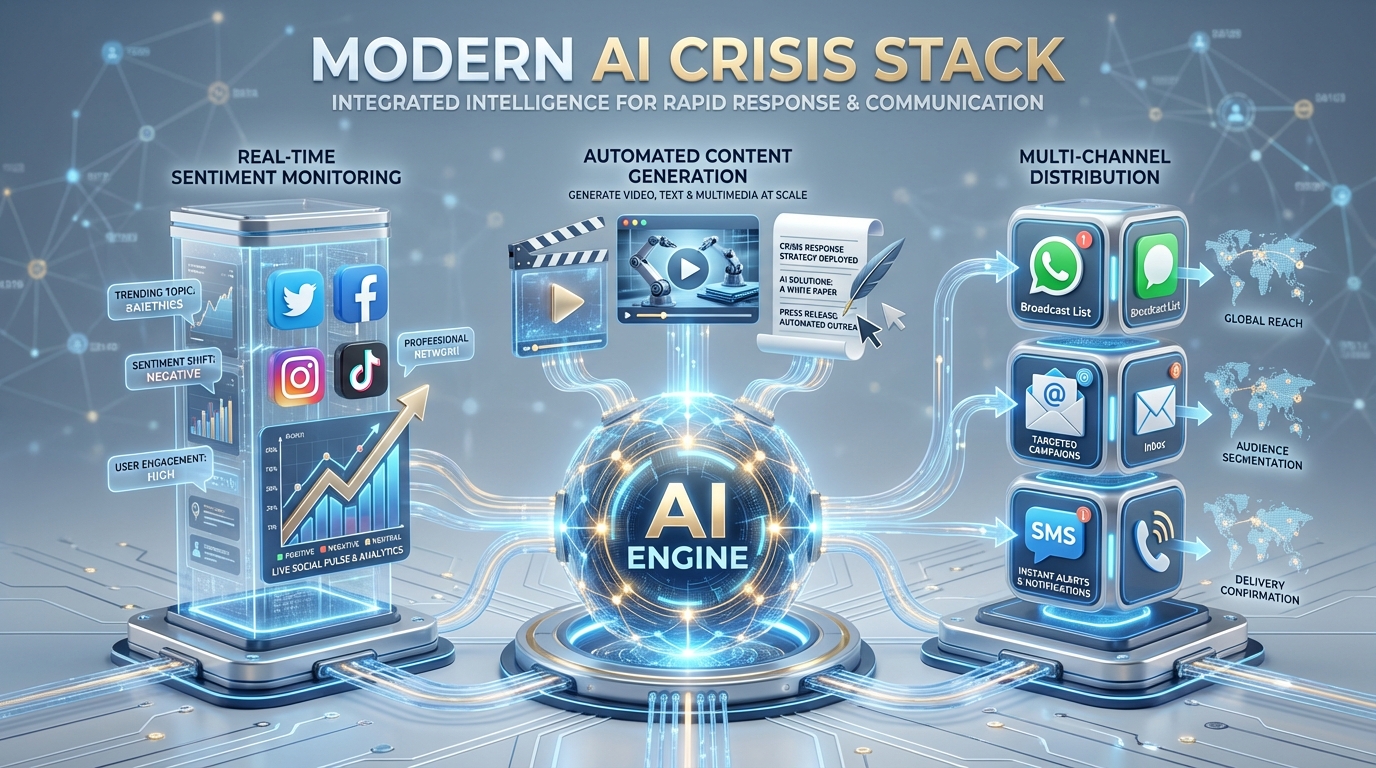
AI crisis communication tools are enterprise-grade software systems that integrate real-time sentiment monitoring, automated alerts, and predictive analytics with content generation and multi-channel distribution. These systems are designed to detect crises in their infancy, deliver personalized updates, and coordinate cross-functional responses across external and internal stakeholders.
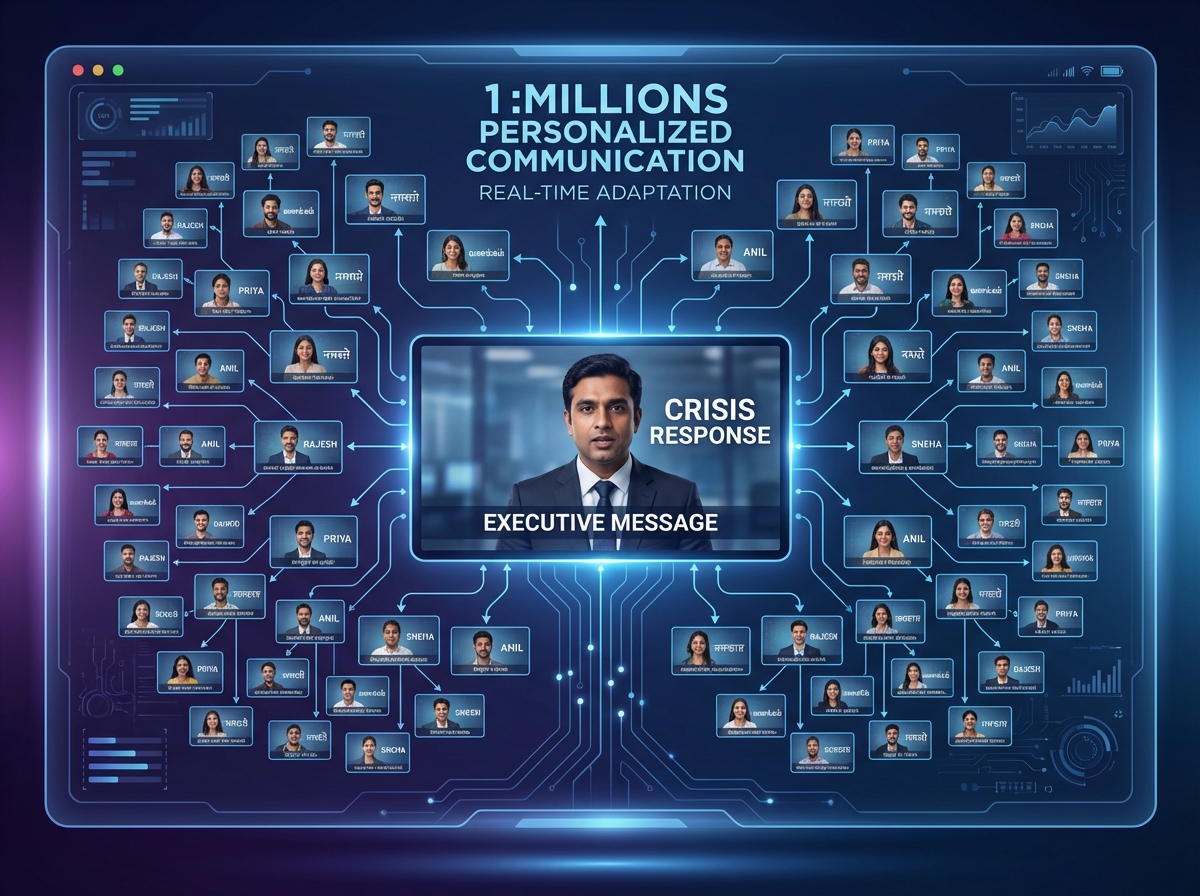
The primary objective of these tools is to achieve empathy at scale. Through crisis response video personalization, brands can deliver 1:1 messages from leadership to millions of customers simultaneously. This human-centric approach, powered by high-speed AI rendering, reduces the spread of misinformation and provides a measurable improvement in stakeholder confidence.
In 2026, a robust AI-powered damage control strategy involves more than just sending a press release. It requires a system that can verify claims in real-time, draft rebuttals with verified citations, and sequence counter-messaging to neutralize falsehoods before they go viral. The result is a significant reduction in the “misinformation decay curve,” ensuring that the brand's version of the truth remains the dominant narrative.
Sources:
3. Capabilities checklist: Building an emergency marketing response system
A sophisticated emergency marketing response system must act as a central command center for the modern enterprise. It should integrate roles, approvals, and legal review queues to ensure that every piece of communication is compliant and accurate. In the Indian context, this system must be “channel-ready,” capable of deploying updates across WhatsApp, SMS, email, and IVR prompts within seconds.
Key capabilities of a 2026-ready system include:
- Rapid response marketing automation: This involves API-triggered deployment across owned and paid channels. When a crisis threshold is met, the system automatically activates pre-approved templates, localized for specific geographies and languages.
- Crisis communication personalization: Generic statements no longer suffice. AI allows for audience-specific variants for customers, employees, partners, and regulators. Each group receives information tailored to their specific concerns and required actions.
- Crisis engagement automation: Smart routing ensures that high-severity queries are escalated to human experts immediately, while routine inquiries are handled by AI agents. This maintains a strict time-to-first-response SLA, which is critical for stakeholder trust rebuilding.
- Automated brand recovery campaigns: Once the immediate threat is contained, the system transitions to recovery. This involves a series of updates—often using brand recovery video campaigns—that showcase proof-of-fix milestones and independent audit results over a 30, 60, and 90-day cadence.
By leveraging brand reputation management AI, organizations can track the effectiveness of these interventions in real-time, adjusting the tone and frequency of messages based on the evolving sentiment of the target audience.
Sources:
- Reputation Today: AI in media monitoring and brand reputation
- Reputation Today: PR’s evolution in the AI era
4. The end-to-end workflow: From detection to rapid response marketing automation
Effective crisis management follows a rigorous, AI-enhanced workflow that ensures no stakeholder is left uninformed. The process begins with detection, where real-time sentiment monitoring aggregates signals from social media, news outlets, and even internal support tickets to calculate a risk score based on reach and velocity.
Once a crisis is identified, the “Decide” phase kicks in. The emergency marketing response system auto-routes the incident to the designated Incident Commander. Legal and compliance teams review the situation through a pre-configured queue, selecting the appropriate playbook—whether it’s for a data breach, a product recall, or a financial rumor.
The “Communicate” and “Amplify” phases utilize rapid response marketing automation to synchronize messaging across all platforms. Platforms like TrueFan AI enable enterprises to generate crisis response video personalization assets where executives address impacted cohorts by name and region. This level of personalization is particularly effective in India, where trust is often built through direct, localized communication.
The final stages involve “Countering” and “Recovering.” AI-powered damage control tools monitor the decay of misinformation, while automated brand recovery campaigns provide continuous evidence of remediation. Success is measured through brand reputation management AI dashboards that track sentiment delta, NPS recovery, and employee confidence levels.
Sources:
- Exchange4Media: Insights from industry leaders on crisis comms
- TrueFan AI: Enterprise capabilities and case studies
5. Strategic integration: Leveraging crisis response video personalization with TrueFan AI
For large-scale Indian enterprises, the ability to communicate with millions of stakeholders individually is a competitive necessity. TrueFan AI’s 175+ language support and Personalised Celebrity Videos (or executive avatars) allow brands to deliver high-impact messages that resonate emotionally while maintaining factual accuracy.
In a crisis, speed is paramount. TrueFan AI provides low-latency renders, often producing personalized video assets in under 30 seconds. This allows a CEO to “personally” apologize to every affected customer by name, explaining the specific steps being taken to resolve their issue. This level of crisis communication personalization transforms a potential PR disaster into an opportunity for stakeholder trust rebuilding.
The effectiveness of this technology is proven through massive Indian campaigns. For instance, Zomato successfully delivered 354,000 personalized videos in a single day, while Hero MotoCorp localized 2.4 million greetings across various dealerships and languages. These same high-throughput capabilities are now being applied to brand recovery video campaigns, ensuring that remediation updates reach the right people at the right time.
Solutions like TrueFan AI demonstrate ROI through increased engagement and faster sentiment recovery. By integrating these tools into an emergency marketing response system, enterprises ensure that their crisis response is not only fast but also deeply human and localized.
Sources:
6. Scenario playbooks: Deploying AI-powered damage control in India
To be effective, AI crisis communication tools must be mapped to specific, high-probability scenarios. Each playbook requires a unique combination of messaging, channels, and KPIs.
Data Breach Response
In the event of a data breach, the priority is transparency and protection. The playbook involves:
- Messaging: Acknowledging the incident, stating known facts, and providing clear steps for customer protection (e.g., password resets).
- Channels: Direct WhatsApp and email alerts, a dedicated FAQ microsite, and internal town hall videos.
- AI Integration: Using crisis response video personalization to have the Chief Security Officer address impacted users, explaining the breach's scope and the remediation steps.
- KPIs: Time-to-notify, percentage of password resets completed, and regulator inquiry resolution speed.
Product Recall or Service Outage
For physical products or digital service failures, the focus shifts to safety and remediation:
- Messaging: Safety-first instructions and step-by-step replacement or workaround guides.
- Channels: In-app banners, localized IVR prompts, and retail signage with QR codes leading to personalized videos.
- AI Integration: Brand recovery video campaigns that demonstrate how to check for affected batch numbers or how to apply a software patch.
- KPIs: Recall completion percentage and reduction in support ticket volume.
Executive Controversy or Market Rumors
When a brand's reputation is threatened by rumors or executive actions, AI-powered damage control is essential:
- Messaging: Values-based responses and a commitment to independent reviews.
- Channels: LinkedIn updates, investor relations notes, and employee memos.
- AI Integration: Personalized addresses from the Board of Directors to key investors and employees to maintain internal stability.
- KPIs: Employee confidence scores and the accuracy rate of media coverage following the response.
Sources:
- The Gutenberg: Crisis comms strategies for misinformation
- Exchange4Media: Readiness and simulation drills for 2026
7. Implementation guide: Rolling out brand reputation management AI in 30 days
Implementing a comprehensive crisis stack requires a disciplined, four-week approach to ensure technical integration and organizational alignment.
Week 1: Stack Alignment and Integrations
The first step is connecting real-time sentiment monitoring sources—including social media, news APIs, and WhatsApp signals—to your CRM and CDP. CMTs must configure the emergency marketing response system with clear roles, permissions, and legal review queues. This week also involves inventorying likely scenarios and aligning on spokesperson policies.
Week 2: Templates and Localization
Focus shifts to content. Teams should build message templates and crisis response video personalization scripts for various leaders (CEO, HR, Comms). These must be configured for India’s multi-lingual landscape, ensuring variants are ready in Hindi, Tamil, Bengali, Marathi, and English, with pre-defined tone guides for each.
Week 3: Automation and Drills
This week involves wiring rapid response marketing automation triggers. For example, if a sentiment score drops below a certain threshold in a specific city, the system should automatically prepare a localized response. CMTs must also establish crisis engagement automation rules for routing and escalation, followed by a full-scale simulation drill to refine thresholds.
Week 4: Launch and Reporting
The final week is dedicated to standing up dashboards for brand reputation management AI. These views should integrate listening data with campaign performance, providing executive-ready reports. Crisis hubs should be enabled with FAQPage and HowTo schema to ensure high discoverability on AI-driven search engines during an actual event.
Sources:
- Reputation Today: The role of AI in media monitoring
- Exchange4Media: PR learnings for 2026 readiness
Conclusion: The future of enterprise resilience
In 2026, the difference between a managed incident and a corporate catastrophe lies in the technology stack. By integrating AI crisis communication tools into the core of the enterprise, Indian brands can ensure they are not just reacting to disruptions but actively shaping the narrative. The transition to rapid response marketing automation and personalized video communication allows for a level of transparency and empathy that was previously impossible at scale.
As the digital landscape continues to evolve, the focus must remain on stakeholder trust rebuilding. Whether through real-time sentiment monitoring or brand recovery video campaigns, the goal is to provide a consistent, factual, and human response to every challenge. Enterprises that embrace these tools today will be the ones that thrive in the volatile market of tomorrow.
Sources:
Frequently Asked Questions
How do AI crisis communication tools integrate with our current PR/IR stack?
Modern AI crisis communication tools are designed to be “API-first.” They integrate directly with your Customer Data Platform (CDP) and CRM to trigger responses based on real-world events. Governance is maintained through centralized approval workflows, ensuring that AI-generated content meets legal and brand standards before deployment.
Can we personalize updates without re-shooting spokesperson videos?
Yes. Through crisis response video personalization technology, you can use pre-approved templates and AI-powered virtual reshoots. This allows you to change the name, location, and specific remediation details in a video without requiring the executive to return to a studio, enabling a 1:1 response at a 1:Millions scale.
How do we prevent the amplification of misinformation?
Prevention requires a combination of AI-powered damage control and authoritative content hubs. AI tools detect falsehoods early, allowing you to deploy “myth vs. fact” sequences. By using schema-enabled crisis hubs, you ensure that search engines prioritize your verified updates over speculative social media posts.
What about multilingual accuracy and speed in the Indian market?
Speed and accuracy are achieved through localized AI models and pre-approved language libraries. TrueFan AI, for example, supports over 175 languages, allowing for near-instant localization. Human-in-the-loop QA processes are typically reserved for the initial template creation, while the AI handles the high-speed distribution of localized variants.
How do we measure stakeholder trust rebuilding post-crisis?
Measurement is handled by brand reputation management AI dashboards. These track KPIs such as sentiment delta (the shift from negative to neutral/positive), the decay rate of misinformation, and remediation completion rates. Linking these metrics to NPS and customer retention data provides a clear picture of trust recovery.