
AI Video Generator for Jewelry India 2026: Virtual Try-On, Bridal Showcases, and Multilingual AI Spokespersons at Enterprise Scale
Estimated reading time: ~12 minutes
Key Takeaways
- High-fidelity AI product videos capture metal tone, gemstone scintillation, and real-life wearability—driving conversion and engagement.
- Catalog-to-cinema automation generates 360° spins and lifestyle shots from still images, processing 500+ SKUs in under 48 hours.
- Virtual try-on to shareable video turns AR fit data into cinematic reels; Studio by TrueFan AI powers multilingual spokespeople.
- Bridal season at scale with regional localization across 7+ Indian languages, ritual-specific clips, and set walkthroughs.
- Enterprise blueprint integrates PIM/DAM, social and WhatsApp distribution, and ASCI-compliant governance with watermarking.
The landscape of Indian retail is undergoing a seismic shift, and the AI video generator for jewelry India 2026 has emerged as the definitive tool for brands looking to capture a share of the projected ₹6 lakh crore market. As consumer attention migrates from static storefronts to immersive, video-first discovery on Instagram Reels and WhatsApp, the traditional reliance on expensive, slow-moving physical photoshoots has become a bottleneck for growth. In 2026, luxury jewelry AI video showcase India 2026 is no longer a futuristic concept; it is an operational necessity for national chains and D2C disruptors alike.
By 2026, data indicates that over 45% of leading Indian jewelry brands have integrated AI-driven video workflows into their core marketing stacks. These systems allow retailers to transform flat catalog images into cinematic 360° videos, orchestrate virtual try-on AI video jewelry experiences for social commerce, and launch massive bridal collections with multilingual AI spokespersons—all at an enterprise scale that maintains strict brand governance. Platforms like Studio by TrueFan AI enable these brands to automate the generation, localization, and omnichannel distribution of high-fidelity assets as outlined in this AI product showcase guide that were previously impossible to produce at such velocity.
1. Why India’s Jewelry Market Demands a Luxury Jewelry AI Video Showcase in 2026
The core problem facing Indian jewelry retailers in 2026 is the “fidelity gap.” While India’s jewelry market is one of the largest globally, it has historically been underserved by digital video technology. Most Product Detail Pages (PDPs) and Instagram catalogs still rely on flat imagery that fails to communicate the three essential elements of high-ticket jewelry: metal fidelity, gemstone scintillation (the “sparkle”), and real-life wearability on diverse Indian skin tones.
A luxury jewelry AI video showcase India 2026 solves this by providing platform-ready 6–45 second videos that feature macro gemstone shots, realistic light reflections, and color-accurate metal rendering. In a market where a single bridal set can cost upwards of ₹10 lakhs, static images simply do not provide the psychological assurance required for a digital-first purchase.
The ROI of Motion in 2026:
- Conversion Uplift: PDPs featuring AI-generated product videos see a 32% higher conversion rate compared to those with static images alone.
- Engagement Metrics: High-retention jewelry video formats, focusing on cinematic close-ups and metal brilliance, outperform static posts by 4.5x on platforms like Instagram and WhatsApp.
- Cost Efficiency: Enterprise brands report a 70% reduction in content production costs by moving from physical shoots to an AI video creator for gold diamond brands.
Recent market signals, such as Tanishq’s early adoption of AR and DAIMANTÉ’s AI-led sustainable diamond designs, prove that the Indian consumer is ready for high-tech, immersive shopping. The 2026 playbook requires brands to move beyond simple “slideshows” and embrace generative video that understands the physics of light on gold and diamonds.
Sources:
2. From Catalog to Cinema: Jewelry Product Video Without Photography India
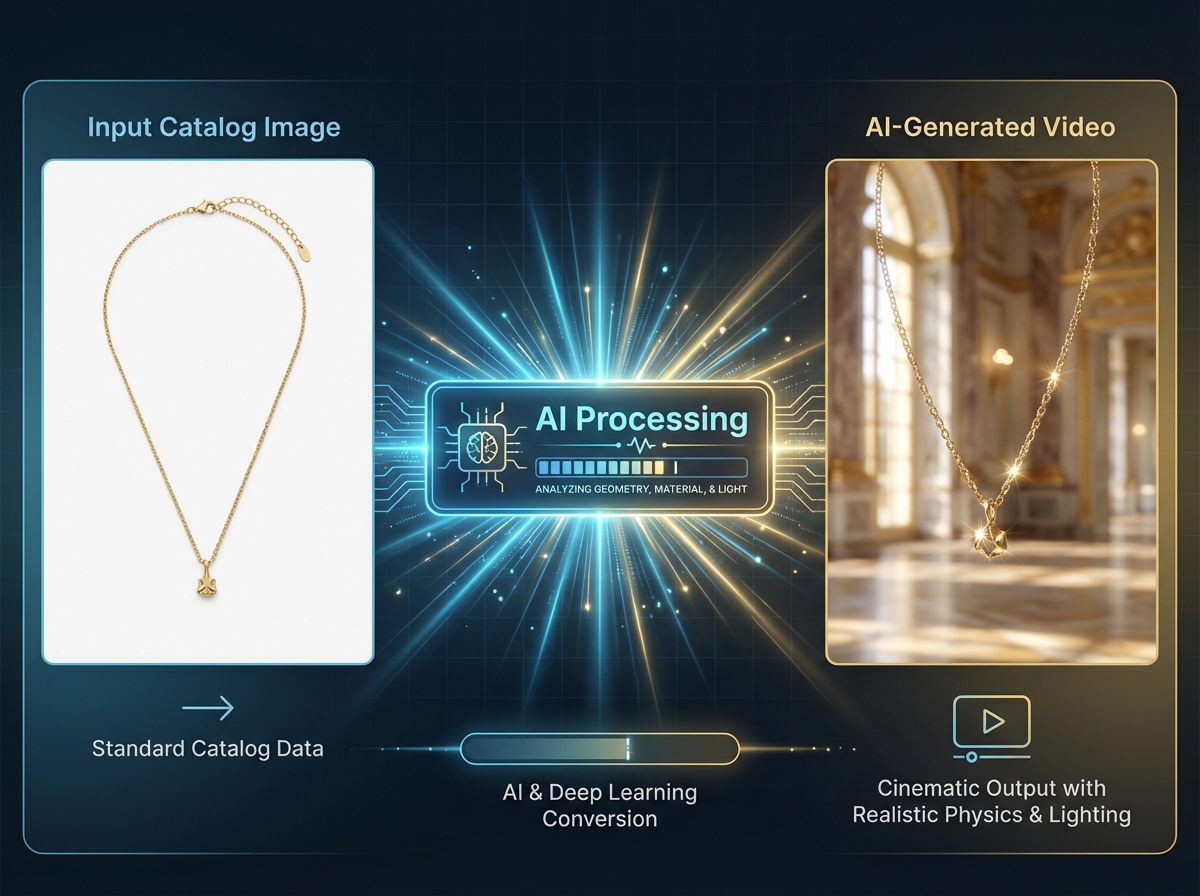
One of the most significant breakthroughs in 2026 is the ability to generate jewelry product video without photography India. For decades, the industry was tethered to the “shoot cycle”—sending physical samples to studios, hiring specialized macro photographers, and waiting weeks for post-production. Today, enterprise AI systems ingest existing catalog stills or basic white-background shots and use neural rendering to infer 3D cues and material properties.
The Technical Workflow for 2026
To create a high-end video from a single image, the AI pipeline follows a sophisticated sequence:
- Input Ingestion: The system takes product images (front, side, and 45-degree angles) along with material specs (e.g., 22k Gold, VS1 Clarity Diamonds).
- Background Synthesis: The AI removes the sterile white background and replaces it with lifestyle environments—ranging from a royal palace setting for a Polki set to a minimalist modern aesthetic for daily-wear diamonds.
- Scintillation Simulation: This is the “secret sauce.” The AI calculates how light should hit specific diamond cuts (Round, Princess, Marquise) to create realistic “fire” and “brilliance” as the virtual camera moves.
- 360° Spin Synthesis: Using depth-estimation models, the AI creates a seamless rotation of the piece, allowing the customer to see the thickness of a Kada or the intricate work on the back of a Maang Tikka.
This workflow allows a Kalyan Malabar jewelry video AI creator to process an entire seasonal catalog of 500+ SKUs in less than 48 hours, a task that would previously take three months of studio time. Furthermore, these assets are automatically formatted into 9:16 Reels for Instagram, 1:1 squares for feed posts, and 16:9 banners for hero sections on e-commerce sites.
Sources:
3. Virtual Try-On AI Video Jewelry: The New Social Commerce Standard
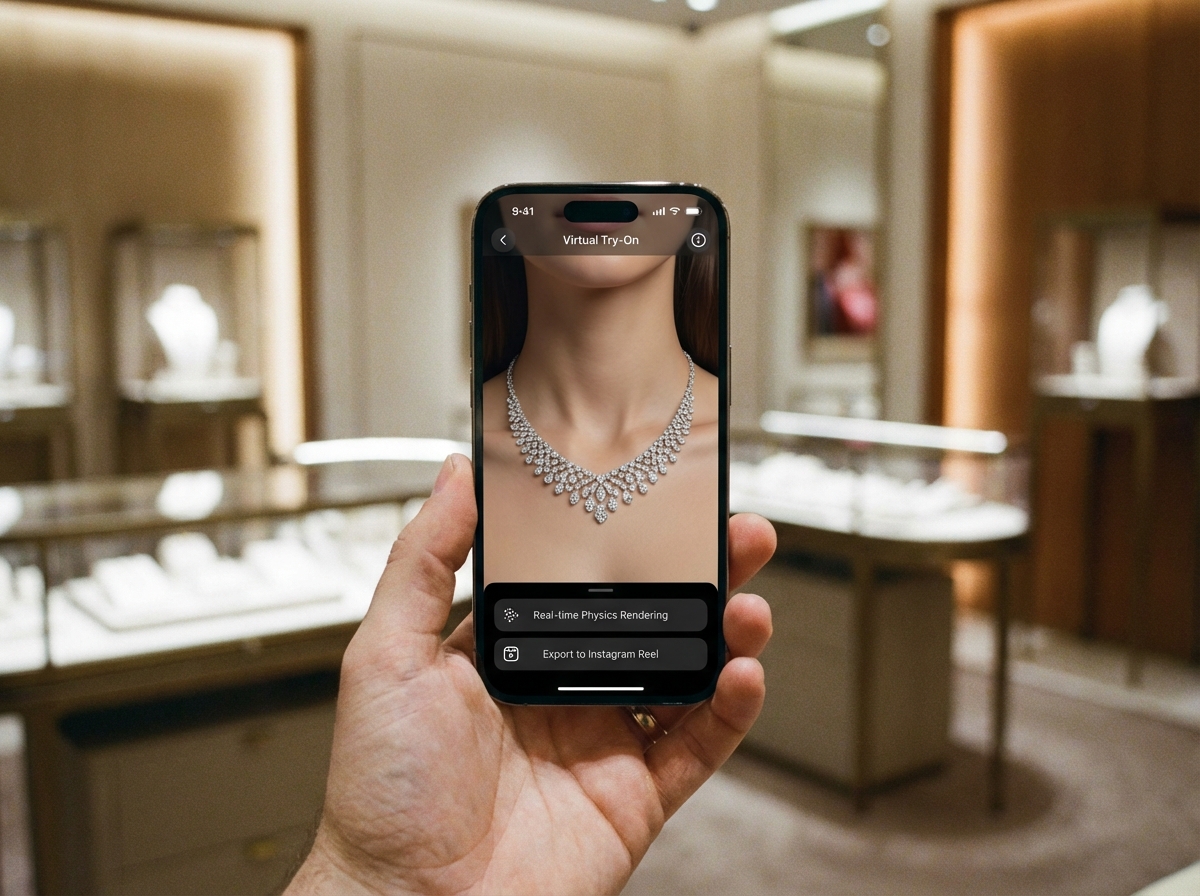
In 2026, the bridge between “browsing” and “buying” is virtual try-on AI video jewelry. While Augmented Reality (AR) has existed for years, it often lacked the cinematic quality needed for high-end marketing. The current trend involves an AR-to-Video workflow where real-time fit data from partners like mirrAR or Camweara is used as a foundation for AI-generated video content.
Bridging AR and AI Video
Brands like Candere by Kalyan have demonstrated that Indian consumers are highly receptive to virtual try-on. However, the next step in the evolution is converting those interactive moments into shareable, high-definition video content.
- The Workflow: A user interacts with an AR try-on tool. The system captures the fit and positioning. The AI then “up-renders” this into a cinematic 15-second Reel where the jewelry sits naturally on the skin, featuring realistic subsurface scattering (how light penetrates and glows on human skin).
- Distribution: These videos are then pushed via the jewelry Instagram Reels AI video India pipeline directly to the brand's social handles or sent as personalized WhatsApp messages using this WhatsApp video commerce integration setup to high-intent leads.
This “try-on to video” conversion has become a cornerstone of jewelry e-commerce product video AI strategies. It moves the needle from a “gimmick” to a high-converting sales tool by showing the product in motion, reacting to the wearer's movements with perfect physics.
Sources:
4. Bridal Season at Scale: AI Video Generator for Bridal Collection
The Indian wedding industry is a behemoth, and the AI video generator for bridal collection has revolutionized how brands handle the intense seasonal demand. Bridal jewelry requires a different storytelling approach—one that emphasizes heritage, emotion, and the “complete look.”
Wedding Jewelry Video Automation AI
In 2026, enterprise retailers use wedding jewelry video automation AI to manage regional wedding calendars. India does not have one wedding season; it has dozens. From the Aashirwad ceremonies in Bengal to the grand weddings of Punjab and the traditional ceremonies in Tamil Nadu, the jewelry and the “vibe” change significantly.
Automation Blocks for Bridal Campaigns:
- Set Walkthroughs: Automatically generating videos that show how a heavy Haar, Maang Tikka, and Jhumkas look as a coordinated set.
- Regional Localization: A single bridal campaign can be instantly localized into 7+ languages (Hindi, Tamil, Telugu, Kannada, Malayalam, Bengali, Marathi). The AI adjusts the voiceover, the background music (e.g., Nadaswaram for South Indian collections vs. Shehnai for North Indian), and even the color grading to match regional aesthetic preferences.
- Ritual-Specific Content: Generating specific 10-second clips for Haldi, Mehendi, and Sangeet, showcasing lighter vs. heavier pieces appropriate for each event.
By using a bridal jewelry showcase video AI, a brand can launch a 50-piece collection across 10 different states with localized messaging in a single day, ensuring they capture the “Muhurtham” or “Muhurat” dates effectively across the country.
5. AI Spokespersons and Text-to-Video AI for Tanishq Style Ads
The most visible shift in 2026 is the rise of the AI spokesperson for jewelry brand launch explained in this use-cases guide. High-end jewelry has always relied on celebrity endorsements with insights on endorsement costs, but the cost and logistical hurdles of celebrity shoots make them impossible for every minor collection or regional store opening.
Studio by TrueFan AI's 175+ language support and AI avatars make AI spokespersons affordable in India allow brands to create a “Brand Face” that can speak to every customer in their mother tongue. Whether it’s a photorealistic avatar of a store manager announcing a new gold scheme in Telugu or a virtual influencer showcasing a diamond collection in Marathi, the level of personalization is unprecedented.
Creating “Tanishq-Style” Ads with Text-to-Video
The industry benchmark for Indian jewelry advertising has long been the “Tanishq aesthetic”—warm lighting, emotional storytelling, and exquisite macro shots. In 2026, text-to-video AI for Tanishq style ads allows smaller retailers to achieve this high-production look through prompt-driven scripts.
- The Prompt: “Cinematic macro shot of a 22k gold necklace with intricate filigree work, warm sunset lighting, soft focus bridal background, 4K resolution, slow-motion pan.”
- The Result: A production-grade video that captures the “soul” of the piece without a ₹50 lakh production budget.
This democratization of high-end aesthetics means that a local jeweler in Coimbatore can now compete visually with a national giant, provided they have the right custom AI avatars for jewelry marketing and video generation tools.
6. Enterprise Implementation: The 6-Week Blueprint for Jewelry Brands
Implementing an AI video generator for jewelry India 2026 at an enterprise level requires more than just a “plug-and-play” app. It requires a structured integration into the brand's existing PIM (Product Information Management) and DAM (Digital Asset Management) systems.
The 6-Week Roadmap
- Week 1: Data Mapping: Ingesting the top 200–500 SKUs. Mapping material metadata to the AI’s rendering engine to ensure that “Rose Gold” looks like Rose Gold and not “Copper.”
- Week 2-3: Pipeline Setup: Connecting the brand's catalog feed to the generation engine. Setting up templates for 360° spins, on-skin mocks, and spokesperson-led announcements.
- Week 4: Localization & QA: Generating variants in 7+ Indian languages. This includes a “Human-in-the-loop” QA process where native speakers verify the pronunciation of traditional jewelry terms (e.g., “Vanki,” “Oddiyanam,” “Nath”).
- Week 5: Channel Integration: Automating the flow to the PDP CMS, Instagram Graph API, and WhatsApp Business API with this 2026 integration guide. Ensuring every video has the correct VideoObject schema for SEO.
- Week 6: Governance & Safety: Finalizing the “walled garden” approach. Ensuring all AI-generated content is ASCI-compliant, features necessary disclosures, and is protected by digital watermarks.
For the AI video for online gold shopping India segment, this speed-to-market is critical. Gold prices fluctuate daily; being able to generate a video ad featuring today’s live price and pushing it to WhatsApp in minutes is a massive competitive advantage.
7. Strategic Comparison & FAQs
When evaluating the landscape of AI video creator for gold diamond brands, it is essential to distinguish between generic video tools and specialized jewelry-first platforms.
| Feature | Traditional Video Production | Generic AI Video Tools | Studio by TrueFan AI |
|---|---|---|---|
| Turnaround Time | 4-8 Weeks | 1-2 Days | < 1 Hour (Batch) |
| Cost per Asset | ₹50,000 - ₹5,00,000 | ₹500 - ₹2,000 | ₹50 - ₹200 (Scale) |
| Material Fidelity | Perfect (Physical) | Poor (Plastic-looking) | High (Neural Rendering) |
| Regional Languages | Manual Dubbing | Limited | 175+ with Lip-Sync |
| Scalability | Low | Medium | High (API-First) |
Frequently Asked Questions (FAQs)
Q1: How does an AI video generator handle the complex reflections of diamonds?
A: Modern 2026 engines use specialized “scintillation passes.” Unlike generic video tools, a dedicated AI video creator for gold diamond brands calculates light refraction based on the specific cut and clarity of the stone, ensuring the “sparkle” looks authentic and not like a digital filter.
Q2: Is AI-generated jewelry content compliant with ASCI guidelines in India?
A: Yes, provided the brand follows transparency protocols. Enterprise solutions like Studio by TrueFan AI include automated watermarking and disclosure layers that inform the consumer the content is AI-enhanced, ensuring full compliance with the latest ASCI and consumer protection laws.
Q3: Can we use our own brand ambassadors as AI spokespersons?
A: Absolutely. Through custom avatar training, you can create a digital twin of your brand ambassador. This allows you to generate thousands of personalized videos for different regional markets without requiring the celebrity to be present for every shoot.
Q4: How does AI video improve the “Online Gold Shopping” experience?
A: AI video for online gold shopping India focuses on transparency. By showing the weight, the BIS Hallmark, and the scale of the piece (e.g., on a virtual neck or wrist), the video reduces the “fear of the unknown” that often prevents high-value gold purchases online.
Q5: What is the difference between AR try-on and AI video?
A: AR is interactive and happens in real-time on the user's camera. AI video is a pre-rendered, high-fidelity cinematic asset. Solutions like Studio by TrueFan AI demonstrate ROI through their ability to take the “data” from an AR try-on and turn it into a beautiful, high-definition Reel that can be used for broad marketing and social sharing.
Conclusion: The 2026 Mandate
The future of Indian jewelry retail is moving, breathing, and speaking. The AI video generator for jewelry India 2026 is no longer a luxury for the few—it is the infrastructure for the many. Brands that master the art of the luxury jewelry AI video showcase India 2026 today will be the ones defining the heritage of tomorrow. By combining the emotional depth of traditional Indian craftsmanship with the infinite scale of generative AI, jewelry retailers can finally provide a shopping experience that is as brilliant as the pieces they sell.
Sources:
Frequently Asked Questions
How does virtual try-on convert into high-performing Reels?
AR fit data (placement, scale, occlusion) is captured and “up-rendered” by AI into a 10–20s cinematic asset with realistic skin interaction and gemstone scintillation, ready for Instagram and WhatsApp distribution.
Can we scale bridal campaigns across languages in days?
Yes. Localization pipelines generate voiceovers, captions, and culturally tuned grades in Hindi, Tamil, Telugu, Kannada, Malayalam, Bengali, and Marathi, allowing same-day multi-state launches.
What makes AI jewelry videos look real in 2026?
Neural material models simulate metal tone, micro-scratches, and diamond scintillation per cut and clarity, while depth-aware cameras produce natural parallax and 360° spins from still images.
How do enterprise teams integrate and govern these workflows?
Connect PIM/DAM to generation APIs, automate channel pushes, add watermarking and disclosures, and run human-in-the-loop QA for terminology and pronunciation to stay ASCI-compliant.



