URL to Video AI Generator: Turn Product Pages into E-commerce Product Videos in 30 Seconds
Estimated reading time: ~15 minutes
Key Takeaways
- Paste a URL to instantly generate on-brand, channel-ready product videos in ~30 seconds.
- AI extracts images, copy, reviews, and pricing to map into brand-safe templates with platform compliance.
- Optimize for Shopify PDPs and Amazon SBV with format, safe zones, and first-3-second hooks.
- API-driven workflows connect feeds and triggers to auto-refresh variants and scale testing.
- Fast rendering accelerates experimentation, lowering CPA and stabilizing ROAS.
A URL to video AI generator converts any product or landing page into on-brand e-commerce product videos—without filming—so performance teams can launch and iterate creatives daily. By simply pasting a URL, marketers can auto-generate high-fidelity variants and ship channel-ready videos for Shopify PDPs and Amazon Sponsored Brands in under 30 seconds. This technology represents a fundamental shift in creative velocity, allowing brands to move from static imagery to dynamic, high-converting video assets at the speed of digital commerce.
In the hyper-competitive landscape of 2026, where consumer attention is the primary currency, the ability to produce e-commerce product videos at scale is no longer a luxury but a baseline requirement for survival. Platforms like TrueFan AI enable brands to bridge the gap between static product listings and the immersive, video-first experiences that modern shoppers demand. As we look toward the future of performance marketing, the integration of automated video creation from URL workflows is set to become the standard for growth-stage and enterprise brands alike.
1. The Evolution of E-commerce Creative: What is a URL to Video AI Generator?
A URL to video AI generator is a sophisticated system that ingests a web URL—such as a product detail page (PDP) or a custom landing page—and autonomously extracts the essential DNA of that page to build a professional video. Unlike traditional video editing software that requires manual input of every asset, this technology uses web content video automation tips to scrape product imagery, hero videos, headlines, feature bullets, customer reviews, and metadata like price and star ratings. It then maps these elements into a pre-approved brand template, complete with synchronized music, synthetic voiceovers, and platform-specific safe zones.
The core components of this system involve three distinct layers: content extraction, scene templating, and compliance presets. During extraction, the AI identifies the most high-impact visuals and copy points, ensuring that the "Hook, Body, and CTA" structure of the video is grounded in the actual data of the product page. Scene templating then takes these assets and organizes them into a narrative flow—starting with a problem-solution hook, moving through unique selling propositions (USPs), and concluding with a strong call to action. Finally, compliance presets ensure the output matches the technical requirements of the destination, whether it is a 9:16 vertical video for TikTok or a 16:9 landscape video for Amazon.
For performance marketing teams, this technology solves the "creative bottleneck" that has historically limited testing capacity. Instead of waiting weeks for a production house to deliver a handful of assets, teams can now generate dozens of variants for different audience segments in minutes. This shift allows for a "test-and-learn" culture where creative is treated as a variable to be optimized, much like bidding strategies or audience targeting. By 2026, it is projected that 91% of businesses will utilize AI-driven video as a core marketing tool, with the AI video generator market expected to reach over $2 billion globally.
Sources:
- Video Marketing Statistics 2026: Key Data and Trends
- Artificial Intelligence (AI) Video Generator Market Report 2026
2. From Product Page to Ad-Ready: The Product Page Video Converter Workflow
The transition from a static URL to a high-performing video asset is governed by a streamlined product page video converter workflow designed for maximum efficiency. The process begins with the ingestion of the URL, where the system parses the HTML and structured data (Schema.org) to identify the product's core identity. This includes high-resolution images from the gallery, the primary H1 title, pricing information, and even social proof elements like "4.8/5 stars based on 2,000 reviews." This automated video creation from URL guide approach ensures that the video is always an accurate reflection of the current live page.
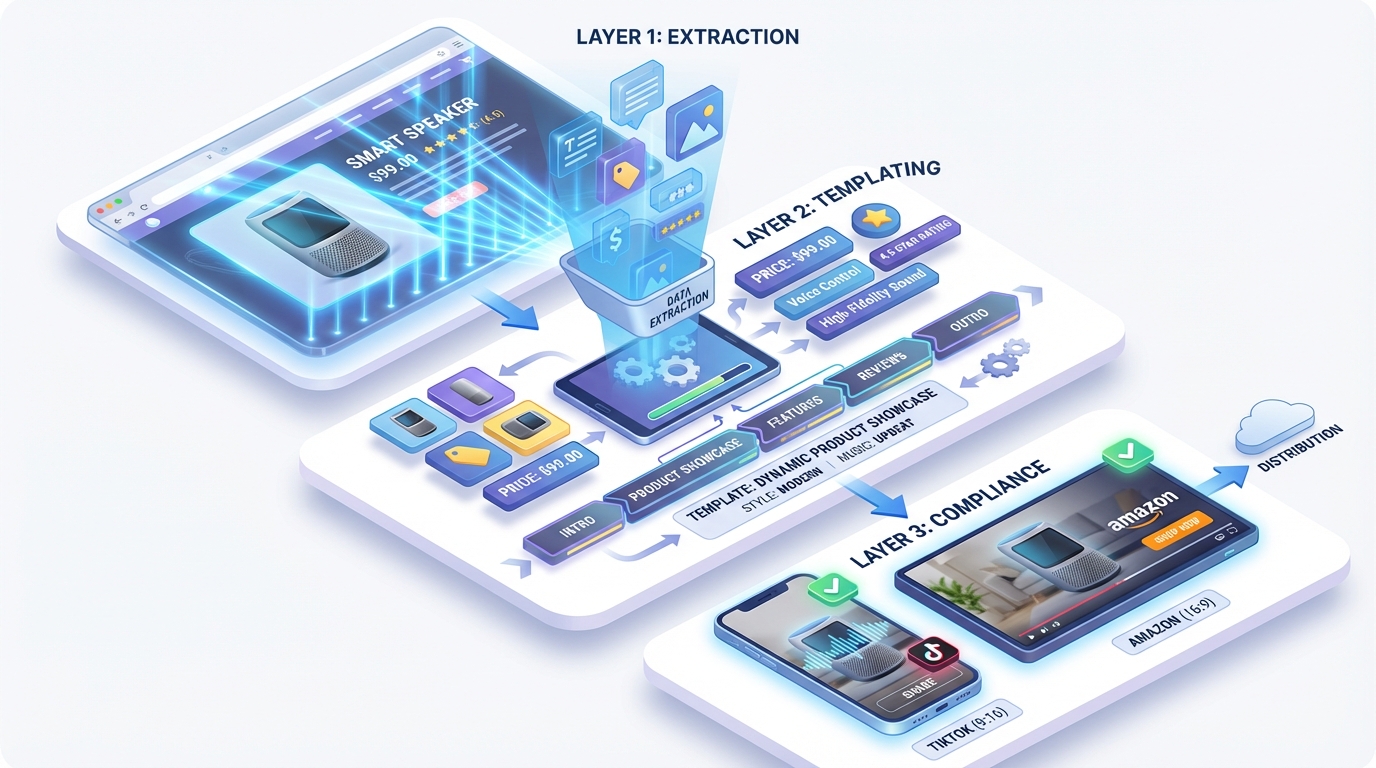
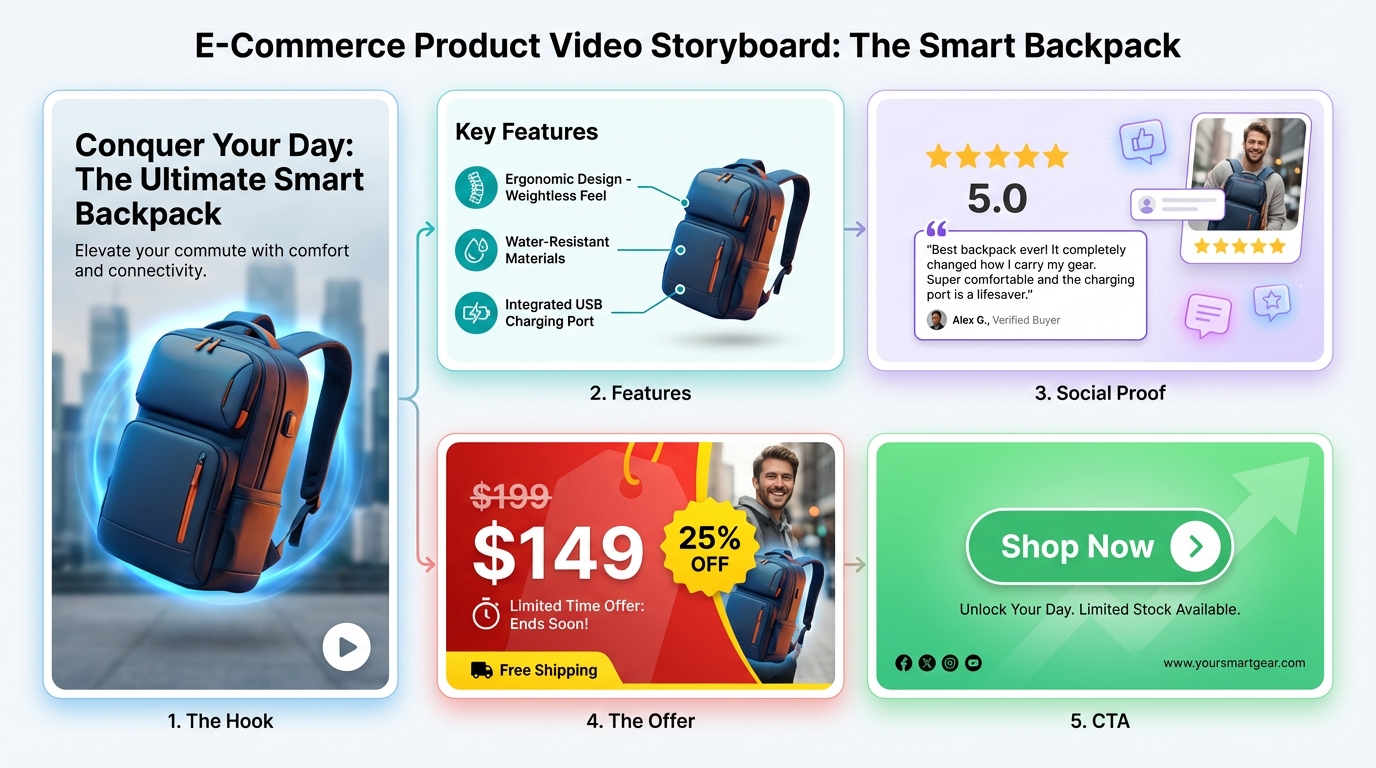
Once the content is ingested, the system enters the auto-storyboarding phase. Here, the AI assembles a sequence of scenes based on proven e-commerce frameworks. A typical storyboard might look like this:
- The Hook (0-3s): A high-impact product shot paired with the main benefit headline.
- The Features (3-12s): A carousel of the top three USPs extracted from the product bullets.
- The Social Proof (12-18s): A dedicated frame showing the star rating and a snippet of a top-rated review.
- The Offer (18-25s): A dynamic frame showing the current price, any active discounts, and "Free Shipping" badges.
- The CTA (25-30s): A clear "Shop Now" end card with the brand logo.
Dynamic content generation plays a critical role in keeping these videos fresh. By tying the video generation process to live data feeds or APIs, brands can ensure that the price shown in the video matches the price on the site in real-time. If a product goes on a "Flash Sale" for 24 hours, the video can automatically update its "Offer" frame to reflect the new discount without any manual intervention. This level of web content video automation is particularly valuable for large-scale retailers managing thousands of SKUs, where manual updates would be impossible.
Furthermore, the workflow includes rigorous brand control and governance. Marketers can lock in brand kits—specifying exact hex codes, font families, and logo placements—ensuring that every AI-generated video remains strictly on-brand. Before the final export, a preview stage allows for minor adjustments to the synthetic voiceover or caption timing, providing a "human-in-the-loop" safety net that maintains high quality while benefiting from machine speed.
3. Platform Dominance: Shopify Video Integration and Amazon Listing Videos
To maximize the ROI of e-commerce product videos, they must be deployed where the purchase intent is highest: the product detail pages and marketplace listings. Shopify video integration has become a cornerstone of modern PDP optimization. Research indicates that adding video to a Shopify product gallery can increase conversion rates by up to 80% in some categories. When integrating these videos, it is essential to follow technical best practices, such as using compressed MP4 formats and ensuring that videos are lazy-loaded to protect the page's Largest Contentful Paint (LCP) score.
On the marketplace side, Amazon listing videos—specifically Sponsored Brands Video (SBV)—offer a massive opportunity for brands in the Indian market. Amazon India has recently expanded its own AI Video Generator (Open Beta) to help sellers create content, but third-party URL to video AI generators often provide more creative flexibility and brand control. For SBV in India, compliance is non-negotiable: videos must be in a 16:9 aspect ratio, avoid any letterboxing or pillarboxing, and keep all critical text within the "safe zones" to prevent it from being obscured by the platform's UI elements.
Strategic use of these videos involves more than just "showing the product." For Shopify, the focus should be on "shoppable overlays" and interactive elements that reduce the friction between watching and buying. For Amazon, the focus is on the first three seconds; because SBV ads autoplay on mute in the search results, the visual hook must be strong enough to stop the scroll. Performance marketers should create specific variants for each platform: a detailed, feature-rich version for the Shopify PDP and a punchy, benefit-first version for Amazon Sponsored Brands.
Sources:
- Shopify: Add product media (video) to products
- Amazon Ads India: Sponsored Brands video ad format overview
- Amazon Ads India: Sponsored Brands video moderation rules
4. Scaling with API-Driven Video Creation and Web Content Video Automation
For enterprise-level brands and high-growth startups, manual URL pasting is only the beginning. The true power of this technology lies in API-driven video creation, which allows for the programmatic generation of thousands of video assets based on external triggers. By connecting a product feed (such as a Google Merchant Center or Shopify feed) to the video generation engine, marketers can create a "living" creative library that updates itself. For example, a price drop in the inventory system can trigger an API call to regenerate the video ad with the new price and push it directly to the Meta or Google Ads asset library.
This level of web content video automation enables sophisticated "growth stacks" where video creation is integrated into the broader marketing automation ecosystem. A common developer pattern involves a POST request that sends the product URL, a template ID, and specific dynamic overlays (like a "Limited Stock" badge) to the generator. Once the render is complete, a webhook notifies the CMS or DAM (Digital Asset Management) system to update the product media across all sales channels. This eliminates the "creative lag" that often occurs between a business change and a marketing update.
Beyond inventory triggers, API-driven workflows support advanced experimentation. A growth engineer can set up an automated A/B test where 50 different versions of a video are generated—each with a different hook or background music—and deployed across social channels to find the winning combination. This "creative-as-code" approach allows brands to treat their video assets as dynamic software rather than static files. By 2026, the shift toward API-first creative stacks will be the primary differentiator for brands that can scale their ROAS while maintaining a lean creative team.
5. The Speed of Growth: Why 30-Second Rendering Time Changes Media Performance
In the world of performance marketing, "velocity" is often the most underrated KPI. A 30-second rendering time is not just a technical achievement; it is a strategic advantage that fundamentally changes how campaigns are managed. When the time between a creative idea and a production-ready asset is reduced to under a minute, the cost of experimentation drops to near zero. This allows teams to recover from "creative fatigue"—the phenomenon where ad performance decays over time as the audience becomes overexposed to the same visual—almost instantly.
With sub-minute SLAs, brands can align their creative output with real-world events in real-time. If a particular product goes viral on social media or is mentioned by an influencer, a performance marketer can generate and launch a dedicated video ad for that product within minutes, capturing the peak of the trend. This agility is particularly crucial during high-stakes shopping events like Black Friday, Cyber Monday, or India’s Great Indian Festival, where market conditions and competitor offers change by the hour.
The impact on media performance is measurable. Brands utilizing rapid variant generation often see a 40% reduction in Cost Per Acquisition (CPA) and a significant stabilization of Return on Ad Spend (ROAS). By constantly feeding the algorithm fresh, relevant content, the ad platforms' machine learning models can more effectively find the right audience for each specific creative angle. In 2026, the industry standard for agile teams will be the ability to refresh their entire creative suite weekly, a feat only possible through a high-speed GPU-accelerated rendering pipeline.
6. 2026 Market Trends and Enterprise-Grade Governance
As we move through 2026, several key trends are shaping the future of e-commerce video. First, the move from experimental AI to "AI-by-default" workflows is complete. Brands are no longer asking if they should use AI, but how to integrate it into their existing governance structures. Enterprise-grade security, including ISO 27001 and SOC 2 compliance, has become a mandatory requirement for any AI video partner. Large brands require the assurance that their data is protected and that the AI models used are trained on ethically sourced, consented content.
TrueFan AI's 175+ language support and vernacular video automation in India and Personalised Celebrity Videos represent the cutting edge of this trend, allowing brands to combine the efficiency of URL-to-video automation with the high-impact pull of celebrity endorsements. This "hyper-localization" ensures that a single product URL can be turned into dozens of videos tailored to different regional dialects and cultural nuances, all while maintaining perfect lip-sync and voice fidelity. This is particularly relevant in diverse markets like India, where "speaking the customer's language" is a key driver of trust and conversion.
Another significant trend is the rise of "virtual reshoots." Instead of organizing a new production for a minor script change, AI allows brands to update the dialogue or product details in existing footage seamlessly. This reduces creative waste and allows for continuous improvement of top-performing assets. As Indian advertising experts have noted, the shift is moving toward "direction and data hooks" over manual editing, where the marketer's role is to provide the strategic input while the AI handles the heavy lifting of production.
Sources:
7. Implementation Strategy: Measurement, Optimization, and Getting Started
To successfully implement a URL to video AI generator strategy, brands must move beyond "one-off" creations and adopt a systematic measurement and optimization framework. The primary KPIs for these videos should include Click-Through Rate (CTR), Conversion Rate (CVR), and the "Add-to-Cart" rate on the PDP. However, more advanced teams also track "creative fatigue curves"—measuring the point at which impressions begin to yield diminishing returns—to trigger the automated generation of new variants.
A robust testing plan should include the following variables:
- Scripting: Benefit-first (e.g., "Get glowing skin in 7 days") vs. Feature-first (e.g., "Contains 20% Vitamin C").
- Offers: Percentage discounts vs. flat currency off vs. "Buy One Get One" bundles.
- Social Proof: Using a star-rating badge vs. a scrolling carousel of customer review quotes.
- Duration: Testing 15-second "snackable" clips against 30-second "deep dive" product demos.
Solutions like TrueFan AI demonstrate ROI through their ability to handle these complex testing cycles at scale, providing the infrastructure needed for millions of renders and real-time delivery. To get started, marketers should identify their top 10 high-traffic, low-conversion product pages. By converting these URLs into videos and deploying them as both PDP hero assets and retargeting ads, brands can quickly validate the performance lift and build a business case for full-scale automation.
The journey from a static product page to a dynamic, video-driven e-commerce powerhouse begins with a single URL. As the digital landscape continues to evolve toward immersive, personalized experiences, the brands that embrace automated video creation will be the ones that capture the hearts—and wallets—of the 2026 consumer.
Recommended Internal Links
- URL to Video AI Generator
- Automated Video Creation from URL: Guide
- URL to Video AI Generator 2024
- API-Driven Video Creation: Ultimate Guide
- Web Content Video Automation Tips
- Web Content Video Automation Guide
- Web Content Video Automation 2024
- Vernacular Video Automation in India
- Interactive Video Data Capture
- Interactive Video Data Capture Guide
Frequently Asked Questions
What content can a URL to video AI generator pull from my page?
The system typically extracts high-resolution product images, hero videos, titles, feature bullet points, USPs, current pricing, active promotions, and social proof elements like star ratings and customer reviews. For higher fidelity, you can also connect a direct product feed.
How do I keep offers and price accurate in the videos?
By using dynamic content generation tied to your pricing or promotion feeds, the videos can automatically update their text overlays to reflect the current live data. This ensures your ads are always compliant and accurate without manual re-editing.
Can I export directly for Amazon Sponsored Brands Video in India?
Yes. Most advanced generators, including TrueFan AI, offer specific presets for Amazon SBV that adhere to the 16:9 aspect ratio and 15-30 second duration requirements while ensuring all text remains within the platform's safe zones.
Will adding video to my Shopify store affect site speed?
If implemented correctly using Shopify video integration best practices—such as using compressed MP4 files, lazy-loading, and providing poster images—the impact on site speed is minimal, while the impact on conversion is typically very high.
How fast can I render videos at scale for an enterprise campaign?
Enterprise-grade pipelines support a 30-second rendering time per variant. This allows for the generation of thousands of personalized or localized videos in a single day, making it ideal for large-scale daily testing and real-time campaign triggers.
Can developers automate the creation of video variants?
Absolutely. Through API-driven video creation, developers can set up automated workflows where new videos are triggered by inventory changes, new product launches, or specific experimental parameters in a growth stack.