

The Enterprise URL to Video AI Generator: 10x Content Velocity for D2C with API-Driven, 30-Second Renders
Estimated reading time: ~9 minutes
Key Takeaways
- Enterprise URL to video AI generators convert product or landing page URLs into on-brand videos in ~30 seconds.
- API-driven workflows power Shopify, Amazon, and lifecycle marketing with localization and personalization at scale.
- Teams achieve 10x content velocity through CSV bulk generation and automated template mapping.
- Short-form e-commerce product videos reduce CPA and boost CTR, ROAS, and marketplace conversion.
- Enterprise-grade governance includes RBAC, uptime SLAs, and compliance (ISO 27001, SOC 2, GDPR/CCPA).
In the hyper-competitive landscape of 2026, the ability to transform static web assets into high-converting motion content is no longer a luxury; it is a core operational requirement. For D2C brands and global marketplaces, the URL to video AI generator has emerged as the definitive solution for overcoming creative bottlenecks and ad fatigue. By leveraging web content video automation, enterprise growth teams are now achieving 10x content velocity, rendering professional-grade assets in under 30 seconds.
Automating e-commerce product videos directly from product or landing page URLs allows brands to maintain a consistent presence across Meta, TikTok, and Amazon without the overhead of traditional production. This tactical playbook explores how to integrate a product page video converter into your existing stack, utilizing Shopify video integration, Amazon listing videos optimization, and CSV to video bulk generation. Platforms like TrueFan AI enable these sophisticated workflows, ensuring that every SKU in your catalog is backed by high-performance video assets.
What is a URL to Video AI Generator?
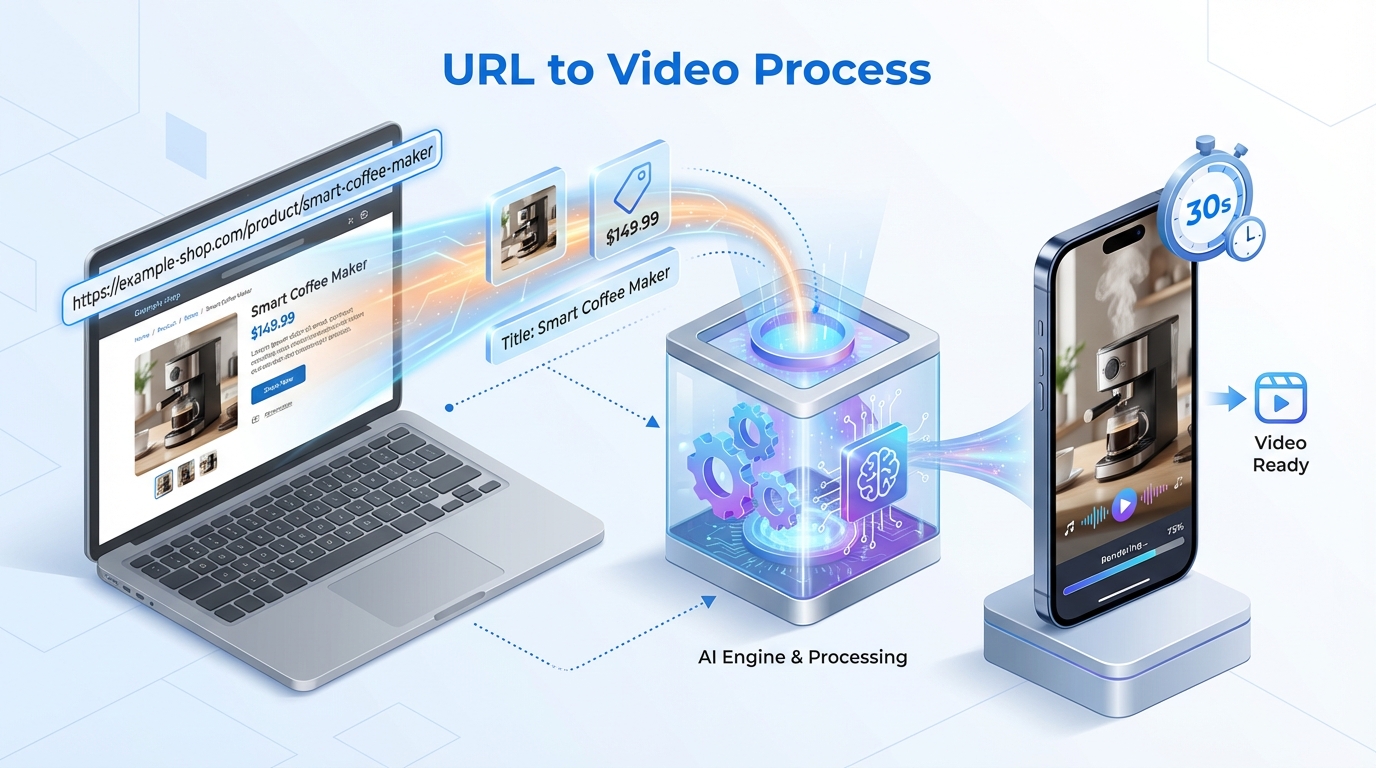
A URL to video AI generator is an enterprise-grade system designed to ingest a public product or landing page URL and programmatically extract critical metadata. This includes page titles, descriptions, high-resolution images, pricing, technical specifications, and even customer reviews. The system then maps this data to predefined, brand-compliant video templates, facilitating automated video creation from URL without manual intervention.
The process of web content video automation involves a sophisticated pipeline: ingestion, extraction via Open Graph or JSON-LD, template slotting, and voiceover synthesis. Unlike basic consumer editors, an enterprise URL to video AI generator focuses on API-driven video creation, offering the scalability required for thousands of SKUs. It ensures that every output is optimized for specific channel ratios, such as 9:16 for Reels or 1:1 for feed posts, while maintaining strict brand governance.
The distinction between a simple editor and an enterprise stack lies in the infrastructure. Enterprise solutions prioritize 30-second rendering SLAs, role-based access control (RBAC), and PII-safe token handling. By automating the transition from a web page to a video asset, brands can ensure their e-commerce product videos are always synchronized with their latest website updates, pricing changes, and inventory levels.
Sources:
- Tagshop AI Blog: URL-to-video generators overview
- LTX Studio Trends: Creative direction as a differentiator
Why Growth Teams Use Product Page Video Converters to 10x Velocity
Performance marketing in 2026 is defined by the rapid decay of creative effectiveness, necessitating a constant stream of fresh assets to combat ad fatigue. A product page video converter solves this by enabling dynamic content generation, where PDP data is transformed into hundreds of video variations based on region, language, or specific promotional offers. This agility is essential for D2C brands managing expansive catalogs where manual video production is physically and financially impossible.
The shift toward vertical video has been accelerated by the omnichannel retail boom, particularly in markets like India, where short-form content drives the majority of mobile commerce. Utilizing automated video creation from URL allows brands to meet this demand instantly. Furthermore, the impact of 30-second rendering cannot be overstated; it allows growth hackers to iterate on creative angles within the same hour a trend surfaces, rather than waiting days for a design queue to clear.
Beyond speed, the use of e-commerce product videos significantly improves key performance indicators across the funnel. Data from 2026 indicates that Indian D2C brands prioritizing short-form video have seen a 40% reduction in CPA compared to those relying on static imagery. By automating the production of these assets, teams can focus on high-level strategy and media buying rather than the minutiae of frame-by-frame editing.
Sources:
- ET BrandEquity: AI creators and India’s omnichannel retail boom
- ViVideo 2026 Report: State of AI video creation
Enterprise Workflows That Actually Scale
Shopify Video Integration for PDP and Lifecycle
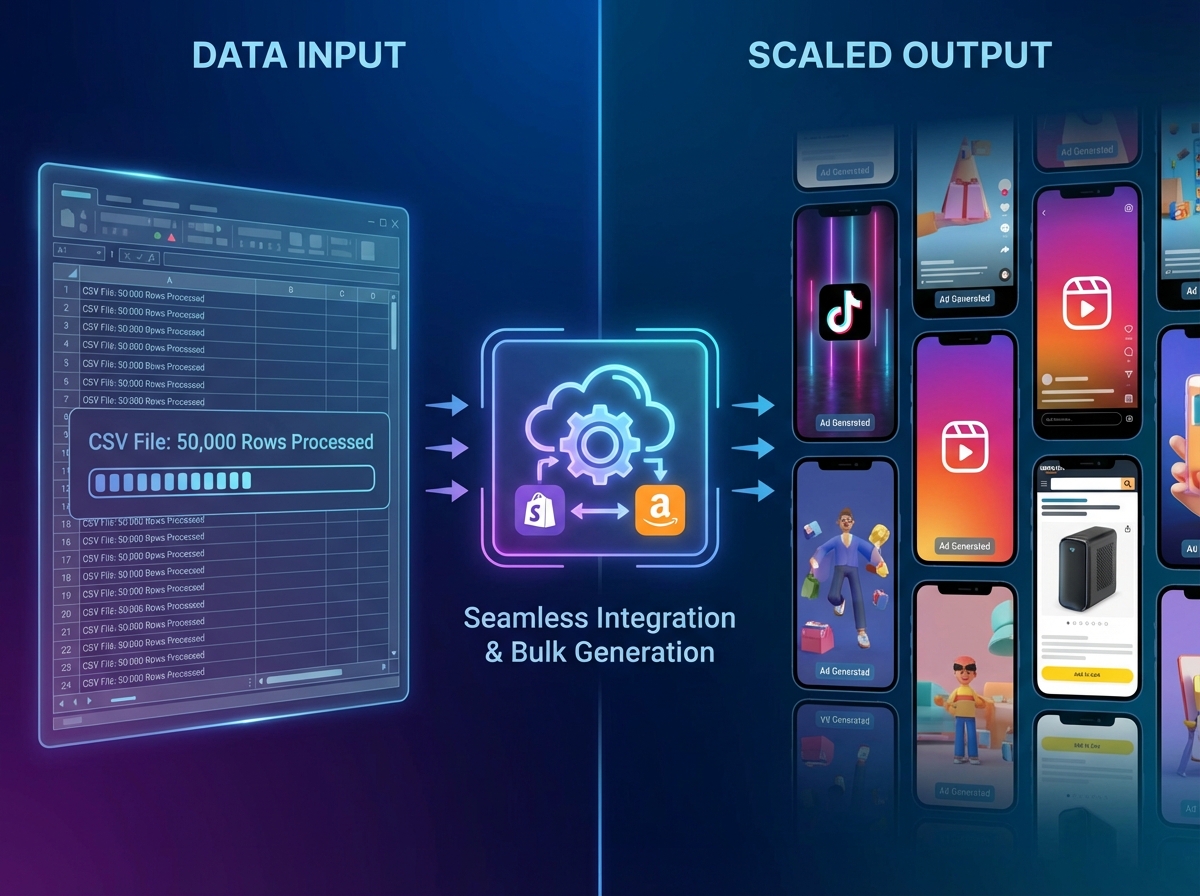
For Shopify-based brands, the integration of a URL to video AI generator creates a seamless loop between product management and marketing. When a new product is added to the Shopify admin, a webhook triggers the automated video creation from URL process. The resulting e-commerce product videos are then automatically attached to the PDP media gallery and pushed to Meta or TikTok ad catalogs. This ensures that your paid social ads always feature the most current product visuals and pricing, with 30-second rendering keeping the pipeline moving in real-time.
Amazon Listing Videos and Marketplace Syndication
Amazon India now recommends at least one product video per listing to maintain competitive search rankings and conversion rates. An enterprise product page video converter maps PDP data to strict Amazon specifications, including duration limits, safe zones, and mandatory captioning. By automating Amazon listing videos, brands can ensure that every ASIN—including variants for size or color—has a high-quality video asset. This systematic approach eliminates the “content gap” often found in large marketplace catalogs.
CSV to Video Bulk Generation
When dealing with seasonal sales or massive catalog refreshes, CSV to video bulk generation is the most efficient workflow. Marketers can upload a CSV containing SKU IDs, custom benefit statements, and discount codes, which the system then uses to batch-render thousands of unique video variants. This method is particularly effective for localized campaigns, where API-driven video creation allows for the simultaneous production of assets in multiple languages and currencies, all while maintaining a unified brand voice.
REST API Video Personalization in Lifecycle Marketing
The frontier of 2026 marketing is hyper-personalization. By utilizing REST API video personalization, brands can inject customer-specific data—such as names, loyalty points, or recently viewed products—into video templates. TrueFan AI’s 175+ language support and Personalised Celebrity Videos exemplify how this technology can be used to deliver bespoke messages via WhatsApp or email. This dynamic content generation at the individual level drives significantly higher engagement than generic video content, especially in replenishment and abandoned cart journeys.
Sources:
- Amazon Seller Central: Product video media guidance
- ET BrandEquity: India’s omnichannel growth and velocity needs
Under the Hood: How Automated Video Creation from URL Works
The technical architecture of a modern URL to video AI generator is designed for high-throughput and precision. It begins with URL ingestion, where the system uses DOM scraping and schema.org extraction to identify the “hero” elements of a page. This web content video automation engine must handle complex edge cases, such as dynamic pricing scripts or lazy-loaded images, to ensure the data captured is accurate and high-resolution.
Once the data is extracted, it enters the template mapping phase. Here, logic-based rules determine which assets fit into specific slots—for example, mapping the “Product Title” to a headline overlay and “Customer Rating” to a social proof badge. The API-driven video creation engine then assembles these components, applying motion presets, synthesizing voiceovers, and generating captions. The final render occurs on a cloud-agnostic GPU farm, where 30-second rendering is achieved through parallel processing and optimized encoding paths.
Enterprise systems also incorporate critical quality assurance gates. These include automated contrast checkers to ensure text legibility, safe-zone validators for different social platforms, and profanity filters for any scraped user-generated content (UGC). Furthermore, the architecture supports hash-based cache-busting; if a product’s price changes on the URL, the system detects the delta and triggers a re-render, ensuring your e-commerce product videos never display outdated information.
Sources:
- LTX Studio Blog: Decision speed and creative advantage
- Tagshop AI: Category explainer for URL-to-video workflows
Implementation Playbooks for Performance Marketers
Launch in 7 Days: The Pilot Phase
To prove the value of a product page video converter, start with your top 20 high-volume SKUs. Generate 15-second and 30-second variants in 9:16 and 1:1 formats and deploy them as A/B tests against your existing static or manual video assets. The primary KPI for this phase is the “time-to-first-render,” which should ideally be under 30 seconds. Success is measured by a target CTR lift of 15-30% and a noticeable reduction in the creative production cycle for e-commerce product videos.
Scale in 30 Days: The Catalog Phase
Once the pilot is successful, transition to CSV to video bulk generation to cover your entire product catalog. This phase involves setting up Shopify video integration to automate the flow for all new arrivals and seasonal updates. Focus on localizing voiceovers and subtitles to reach diverse regional markets. Key metrics include catalog coverage percentage and maintaining a bulk render error rate of less than 1%, ensuring that dynamic content generation remains reliable at scale.
Personalize in 60 Days: The Lifecycle Phase
The final stage of implementation involves integrating REST API video personalization into your CRM and lifecycle flows. Set up triggers for abandoned carts or post-purchase cross-sells that send a personalized video via WhatsApp or email. By using API-driven video creation, you can inject the customer’s name and their specific purchase history into the video in real-time. Monitor the ROAS of these retargeting efforts and ensure your 30-second rendering SLA is consistently met to provide a frictionless customer experience.
KPIs and Procurement Checklist for Enterprise URL to Video Platforms
Measuring the success of a URL to video AI generator requires a dual focus on marketing performance and operational efficiency. Acquisition KPIs should include CTR, CPC, and ROAS lift, specifically comparing e-commerce product videos to static benchmarks. For marketplaces, track the view-through conversion rates for Amazon listing videos. Solutions like TrueFan AI demonstrate ROI through these metrics while simultaneously reducing the “cost per video” by up to 90% compared to traditional agencies.
From an operational perspective, content velocity—defined as the number of unique videos produced per marketer per week—is the gold standard. You must also track technical SLAs, such as 30-second rendering adherence and system uptime. In the Indian market, where AI and measurement priorities are top of mind for 2026, having a transparent dashboard that links video production to actual revenue outcomes is essential for executive buy-in.
Procurement Checklist
When evaluating a URL to video AI generator, ensure the platform meets these enterprise requirements:
- API-Driven Video Creation: Robust REST APIs for seamless stack integration.
- REST API Video Personalization: Ability to handle PII-safe tokens for 1:1 messaging.
- Platform Integrations: Native Shopify video integration and Amazon-compliant outputs.
- Scalability: Support for CSV to video bulk generation and high-concurrency rendering.
- Performance: Guaranteed 30-second rendering at scale.
- Compliance: ISO 27001 and SOC 2 certifications, with GDPR/CCPA-compliant data handling.
- Governance: Role-based access control (RBAC), SSO (SAML/OIDC), and comprehensive audit logs.
Sources:
By adopting a URL to video AI generator, D2C brands can finally bridge the gap between their expansive product catalogs and the high demand for video content. Whether through Shopify video integration, Amazon listing videos, or REST API video personalization, the path to 10x content velocity is paved with automation. Start your pilot today to experience the power of 30-second rendering and transform your web content into a high-performance video engine.
Recommended Internal Links
Frequently Asked Questions
How does a URL to video AI generator handle dynamic pricing?
The system uses scheduled crawls or webhooks to monitor the source URL for changes. When a price update is detected, the web content video automation engine automatically triggers a re-render of the video asset, ensuring that your e-commerce product videos always reflect the current offer.
Can I use these videos for Amazon Sponsored Brands?
Yes. An enterprise product page video converter is designed to output videos that meet Amazon’s specific technical requirements, including aspect ratios, file sizes, and “safe zone” constraints for text overlays. This makes it easy to generate Amazon listing videos and ad creative from a single URL.
What is the difference between bulk generation and API personalization?
CSV to video bulk generation is used for creating large batches of videos for different products or segments simultaneously. REST API video personalization is used for real-time, 1:1 video creation triggered by a specific user action, such as a cart abandonment event.
Does TrueFan AI support multiple languages for global campaigns?
Yes, TrueFan AI’s 175+ language support and Personalised Celebrity Videos allow brands to localize their content for any market. This is integrated into the API-driven video creation workflow, enabling automated translation of captions and voiceovers.
Is the data extracted from my URL secure?
Enterprise-grade URL to video AI generators prioritize security by using PII-safe tokens and encrypted data pipelines. They commonly maintain certifications like ISO 27001 and SOC 2, ensuring your brand’s data and your customers’ information are handled to the highest standards.



