
Summer appliance urgency marketing 2026: Turn temperature anxiety into instant commerce in India
Estimated reading time: ~9 minutes
Key Takeaways
- Heatwaves compress the purchase cycle into a 48-hour panic-buy window, making real-time triggers essential.
- Temperature-based marketing automation aligns spend with local heat intensity to maximize ROAS.
- Weather-responsive commerce videos on WhatsApp drive 3.2x higher conversions on Red Alert days.
- Hyperlocal reach plus inventory-sync guardrails prevent wasted spend and out-of-stock frustration.
- Governance matters: adhere to BEE labeling and privacy standards while scaling nationally.
The Indian summer of 2026 is projected to be one of the most volatile on record. As the India Meteorological Department (IMD) issues red-alert warnings for above-normal maximum temperatures across Central and Northwest India, consumer behavior is shifting from "research" to "rescue." For consumer durable brands, this creates a fleeting window where summer appliance urgency marketing 2026 becomes the difference between a record-breaking quarter and missed seasonal targets.
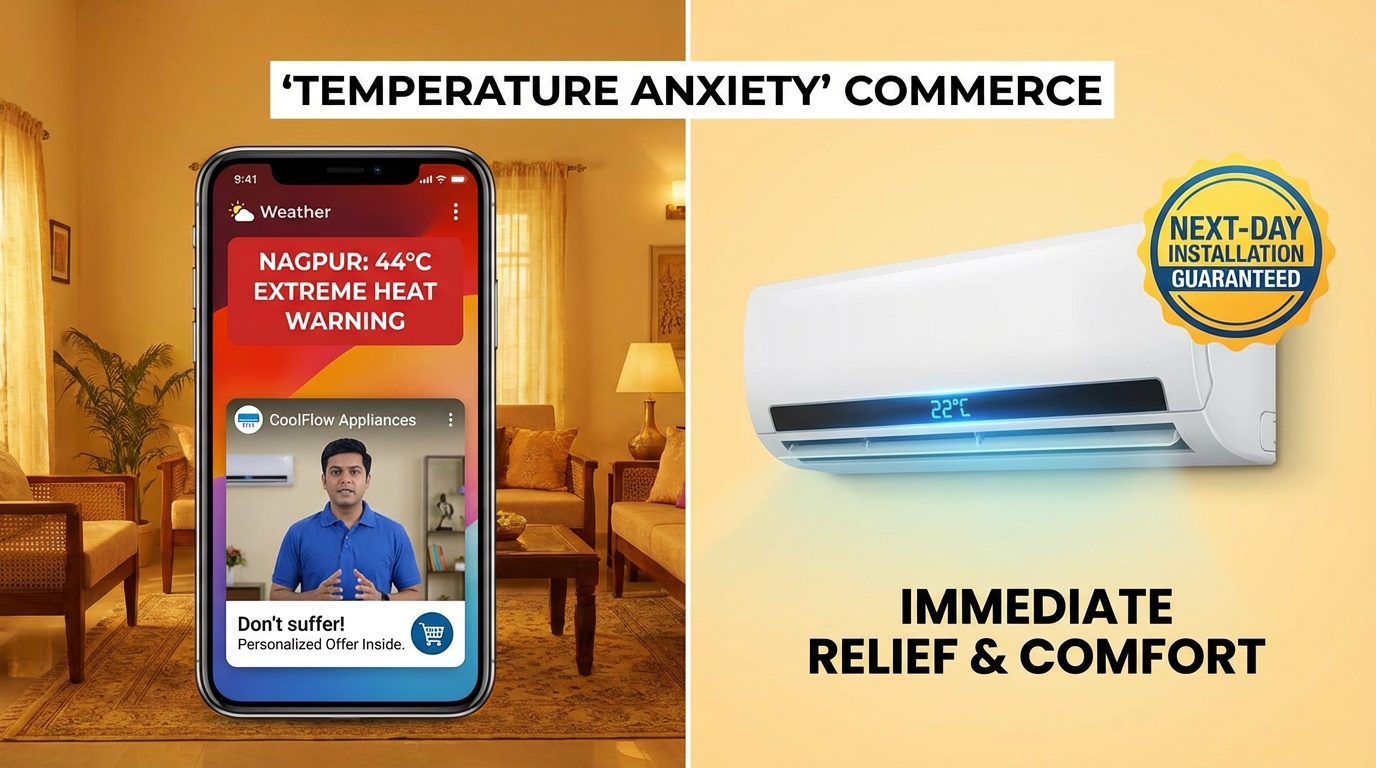
"Temperature anxiety"—the acute psychological discomfort felt when the "feels-like" temperature crosses the 37°C threshold—is no longer just a weather phenomenon; it is a potent commercial trigger. When the mercury spikes, intent becomes instantaneous. Brands that can operationalize temperature-based marketing automation to deliver weather-responsive commerce videos within minutes of a heatwave alert are capturing demand that competitors lose to out-of-stock messages and delivery delays.
Why heat wave triggered offers India convert during 2026’s harsh summer
The 2026 summer season is defined by early-onset heatwaves and a strong El Niño influence, accelerating the demand for cooling solutions. According to recent IMD seasonal forecasts, the number of heatwave days is expected to be significantly higher than the decadal average. This environmental pressure compresses the traditional 30-day purchase cycle for ACs and coolers into a 48-hour "panic buy" window.
Heat wave triggered offers India are uniquely effective because they align with the customer's immediate physical need. When a customer receives a personalized video showing their local city temperature hitting 42°C, paired with a "Next-Day Installation" guarantee, the friction of price comparison vanishes. Data from early 2026 campaigns suggests that conversion rates on "Red Alert" days are 3.2x higher than baseline seasonal averages when the creative is contextually relevant.
Furthermore, the rise of digital-first shopping—with e-commerce now accounting for over 15% of appliance sales—means that instant cooling solution offers must be delivered where the consumer is: on WhatsApp and mobile apps. Platforms like TrueFan AI enable brands to bridge this gap by generating hyper-personalized video content for quick commerce in India that reflects real-time local weather conditions, ensuring the marketing message feels like a timely service rather than an intrusive advertisement.
Sources:
Building temperature-based marketing automation with enterprise APIs
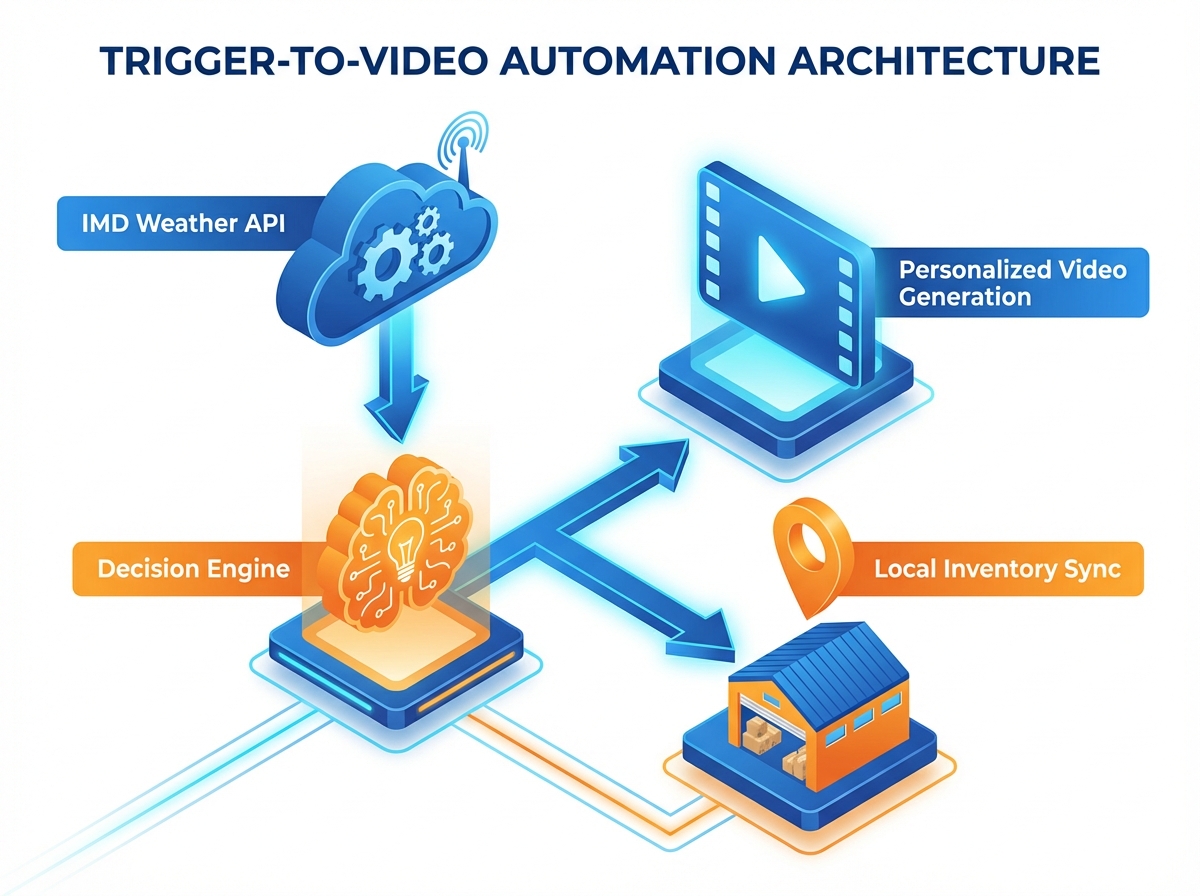
To capitalize on weather volatility, CMOs are moving away from static "Summer Sale" banners toward a dynamic architecture. Temperature-based marketing automation is a rules-based engine that synchronizes environmental data with commerce operations. This system ensures that marketing spend is only deployed when and where the heat is most intense, maximizing ROAS.
The reference architecture for a 2026-ready system includes:
- Data Ingestion: Real-time IMD heatwave alerts and 72-hour forecasts integrated via API.
- Decision Logic: Threshold-based triggers (e.g., 35°C for "Early Bird" offers, 40°C for "Emergency Install" messaging).
- Creative Orchestration: An automated pipeline that injects local temperature, user name, and nearest store inventory into video templates.
- Inventory Sync: A critical guardrail that suppresses ads in pin codes where SKUs are out of stock or installation slots are full.
TrueFan AI's 175+ language support and Personalised Celebrity Videos allow enterprises to scale this architecture across India's diverse linguistic landscape. By automating the "Trigger-to-Video" flow, brands can render and dispatch a personalized WhatsApp video in under 30 seconds. This speed is vital; a delay of even four hours during a heat spike can result in a customer switching to a competitor who promises faster relief.
Sources:
Creative blueprints: From AC upgrades to beverage cooling
Effective weather-responsive commerce videos must balance urgency with utility. In 2026, consumers are increasingly sensitive to "bill shock" due to rising electricity tariffs and new BEE energy-efficiency norms. Creative strategies must therefore pivot from "Cooling Power" to "Smart Savings."
AC cooler personalization campaigns that drive upgrades
For the air conditioning segment, the focus is on the "Exchange and Upgrade" narrative. AC cooler personalization campaigns should highlight the 10% price hike in 2026 models due to stricter BEE ratings, framing the purchase as a "buy now to save later" investment. Dynamic overlays should show the user's specific city temperature and the exact EMI starting point, such as: "Arjun, Mumbai feels like 39°C. Upgrade your old 3-star AC to a 2026 5-star Inverter for just ₹1,999/month."
Energy-efficient cooling videos that reduce “bill shock”
With the Bureau of Energy Efficiency (BEE) revising star ratings in January 2026, energy-efficient cooling videos are essential for managing price objections. These videos should visually demonstrate the ISEER (Indian Seasonal Energy Efficiency Ratio) benefits, using thermograph animations to show how inverter technology maintains comfort while consuming 30-40% less power than older models.
Beverage cooling and summer fashion triggers
The urgency isn't limited to heavy appliances. Beverage cooling solution campaigns for mini-fridges and chillers should trigger at the 36°C mark, emphasizing "Chilled in 15 Minutes" promises. Similarly, summer fashion video marketing can use UV index callouts to promote linen collections or SPF-rated apparel. This climate-adaptive product marketing ensures that the brand remains relevant across every degree of the thermometer.
Sources:
Targeting and reach: Hyperlocal and Tier-2 strategies
The 2026 heatwave is not uniform; while Delhi might be under a "Red Alert," Bengaluru may remain temperate. Regional heat wave targeting allows brands to shift budgets dynamically to the "hottest" pin codes. This hyperlocal approach prevents wasted ad spend in regions where the cooling need hasn't yet peaked.
In Tier-2 and Tier-3 cities, the strategy must account for different purchase drivers. Tier-2 city summer appliance offers often perform best when they lead with "Zero-Downpayment EMI" and "Installation within 24 Hours." Vernacular content is non-negotiable here. A personalized video in Marathi for a customer in Nagpur, mentioning their specific neighborhood dealer, creates a level of trust that a generic English ad cannot match.
By integrating with ONDC (Open Network for Digital Commerce), brands can further localize their reach, showing real-time stock availability in the customer's immediate vicinity. This ensures that the instant cooling solution offers are not just attractive but fulfillable, closing the loop between a weather trigger and a physical delivery.
Sources:
Operations and merchandising: The "Predict and Convert" playbook
The most sophisticated marketing engine will fail if the supply chain isn't synchronized. Seasonal inventory optimization is the backbone of urgency marketing. In 2026, leading retailers are using weather prediction commerce automation to look 48-72 hours ahead. If a heatwave is predicted for Jaipur on Thursday, inventory is pre-positioned in local hubs by Tuesday, and "Pre-Heatwave" nurture campaigns are triggered on Wednesday.
Pre-summer sale automation India starts as early as mid-February, focusing on AMC (Annual Maintenance Contract) reminders and "Filter Cleaning" services. This "warms the funnel," ensuring that when the first 40°C day hits, the brand is already top-of-mind. Solutions like TrueFan AI demonstrate ROI through these multi-stage journeys, moving a customer from a service reminder to a high-value upgrade video as the temperature rises.
Key operational guardrails for 2026 include:
- OOS Suppression: Automatically pausing video ads when local stock drops below 5 units.
- SLA Badging: Dynamically updating "Install by Tomorrow" to "Install in 2 Days" based on technician availability.
- Surge Pricing Control: Balancing "Heat Shield" discounts with the reality of increased logistics costs during peak demand.
Sources:
Measurement, governance, and the road to scale
Success in summer appliance urgency marketing 2026 is measured by "Time-to-Value." Key Performance Indicators (KPIs) should include the delta in Add-to-Cart rates on hot days versus baseline days, and the click-to-install-slot conversion rate. Brands should also track the "Video Play Rate" of personalized content, which typically sees a 40% lift over generic video assets.
Governance is equally critical. All energy-efficient cooling videos must strictly adhere to BEE labeling guidelines to avoid regulatory penalties. Furthermore, data privacy and consent-based marketing are paramount. Using enterprise-grade platforms ensures that every personalized video sent via WhatsApp is compliant with ISO 27001 standards and respects user opt-out preferences.
For enterprises looking to start, a 4-week Proof of Concept (POC) focusing on the top 10 heat-sensitive cities is the recommended path. By defining temperature thresholds and syncing them with a personalized video API, brands can prove the incrementality of weather-responsive commerce before scaling nationwide for the peak months of May and June.
Conclusion: From forecast to cart in under 60 seconds
The 2026 summer season presents a high-stakes challenge for Indian consumer durable brands. With "temperature anxiety" driving urgent, high-intent searches, the ability to respond in real-time is no longer a luxury—it is a survival requirement. By operationalizing weather prediction commerce automation and deploying weather-responsive commerce videos, brands can transform a weather alert into a confirmed order.
The future of seasonal marketing lies in this intersection of environmental data and generative AI. Don't wait for the first 45°C day to test your strategy. Move from forecast to cart in under 60 seconds and ensure your brand is the first choice for relief this summer.
Sources:
Frequently Asked Questions
What is temperature-based marketing automation?
It is an automated system that uses real-time weather data and IMD alerts to trigger specific marketing campaigns, such as instant cooling solution offers, only when local temperatures cross a predefined threshold (e.g., 38°C).
How do weather-responsive commerce videos improve ROI?
By showing the user their current local temperature and a relevant product (like a 5-star AC) with a "Next-Day" delivery promise, these videos significantly reduce the time spent in the consideration phase, leading to higher conversion rates and lower cost-per-acquisition.
Can TrueFan AI handle the scale of a national heatwave campaign?
Yes, TrueFan AI is designed for enterprise scale, capable of rendering hundreds of thousands of personalized videos in under 30 seconds, supporting 175+ languages to ensure every region in India is reached with a localized message.
How does seasonal inventory optimization prevent wasted ad spend?
The system uses real-time stock feeds to ensure that ads are only shown for products that are currently in stock in the user's specific pin code, automatically suppressing promotions for out-of-stock items.
What are the BEE star rating changes for 2026?
As of January 1, 2026, BEE has implemented stricter energy-efficiency norms, which have led to a price increase of approximately 10% for ACs and 5% for refrigerators. Marketing should focus on the long-term electricity savings of these new models to offset the higher upfront cost.



