
Voice Commerce India: Building Vernacular, Voice-Activated Shopping for Tier-2/3 Growth
Estimated reading time: ~12 minutes
Key Takeaways
- Vernacular voice commerce removes literacy and UX barriers for India’s next 200M shoppers.
- A robust stack blends ASR/TTS, NLU, personalization, commerce backends, and secure payments.
- Multichannel automation across WhatsApp, IVR, apps, and smart speakers drives conversion.
- Regional voice SEO and discovery videos boost traffic and trust in Tier-2/3 India.
- A disciplined 90-day rollout with clear KPIs ensures technical stability and ROI.
The digital landscape of the subcontinent is undergoing a seismic shift as the next 200 million shoppers enter the ecosystem. Implementing a robust strategy for voice commerce India is no longer a futuristic luxury but a core requirement for brands targeting growth in Bharat. By enabling customers to discover, decide, and buy products using speech in their preferred regional language, enterprises can effectively bypass the literacy and technical barriers that often stall traditional e-commerce adoption.
This evolution is powered by sophisticated AI that understands complex intents, diverse dialects, and the nuanced context of Indian consumers. Whether through WhatsApp voice notes, IVR systems, or in-app assistants, natural language commerce India provides a frictionless path to purchase. However, the journey to scaling these interfaces requires overcoming significant hurdles, including dialect variance, connectivity constraints, and fragmented technology stacks.
The promise of this technology lies in its ability to deliver a proven playbook for reaching buyers via voice commerce vernacular India. By leveraging conversational shopping AI personalization, brands can provide a humanized experience that mirrors the familiarity of a local shopkeeper. This guide provides a comprehensive blueprint for digital innovation and growth teams to launch and scale voice-activated shopping across the diverse Indian landscape.
Why Vernacular Voice is India’s Next Growth Lever
The momentum behind voice-activated interfaces is supported by compelling market signals and evolving user behaviors across the country. According to recent industry analysis, India’s e-retail GMV reached approximately $60 billion in 2024, with continued penetration into Tier-2 and Tier-3 cohorts. These shoppers increasingly prioritize vernacular, ease-of-use experiences as primary differentiators when choosing where to spend their disposable income.
Research indicates that Rest-of-India shoppers across Tiers 1 through 4 exhibit distinct discovery and user experience preferences compared to metro-based consumers. For these users, traditional text-based search often represents a high cognitive load, whereas voice reduces friction in product discovery and trust-building. Voice interfaces naturally support "code-switching," where users blend English with regional languages, such as Hinglish or Tamglish, to express their needs.
The adoption of smart speakers is also picking up pace in non-metro cities, indicating a growing readiness for home-based voice interfaces. Major players have already validated this trend; for instance, Flipkart’s launch of a Hindi and English voice assistant for grocery shopping served as an early indicator of mainstream acceptance. As we move into 2026, the high adoption of Generative AI by Indian businesses further reinforces the infrastructure readiness for sophisticated conversational commerce.
Sources:
- Bain & Company: How India Shops Online 2025
- PwC India: How India Shops Online 2024
- ET Telecom: Smart Speaker Adoption in Non-Metros
- Voicebot.ai: Flipkart Voice Assistant Launch
- iThink Logistics: AI Statistics & Top Ecommerce Trends 2026
The End-to-End Stack for Natural Language Commerce India
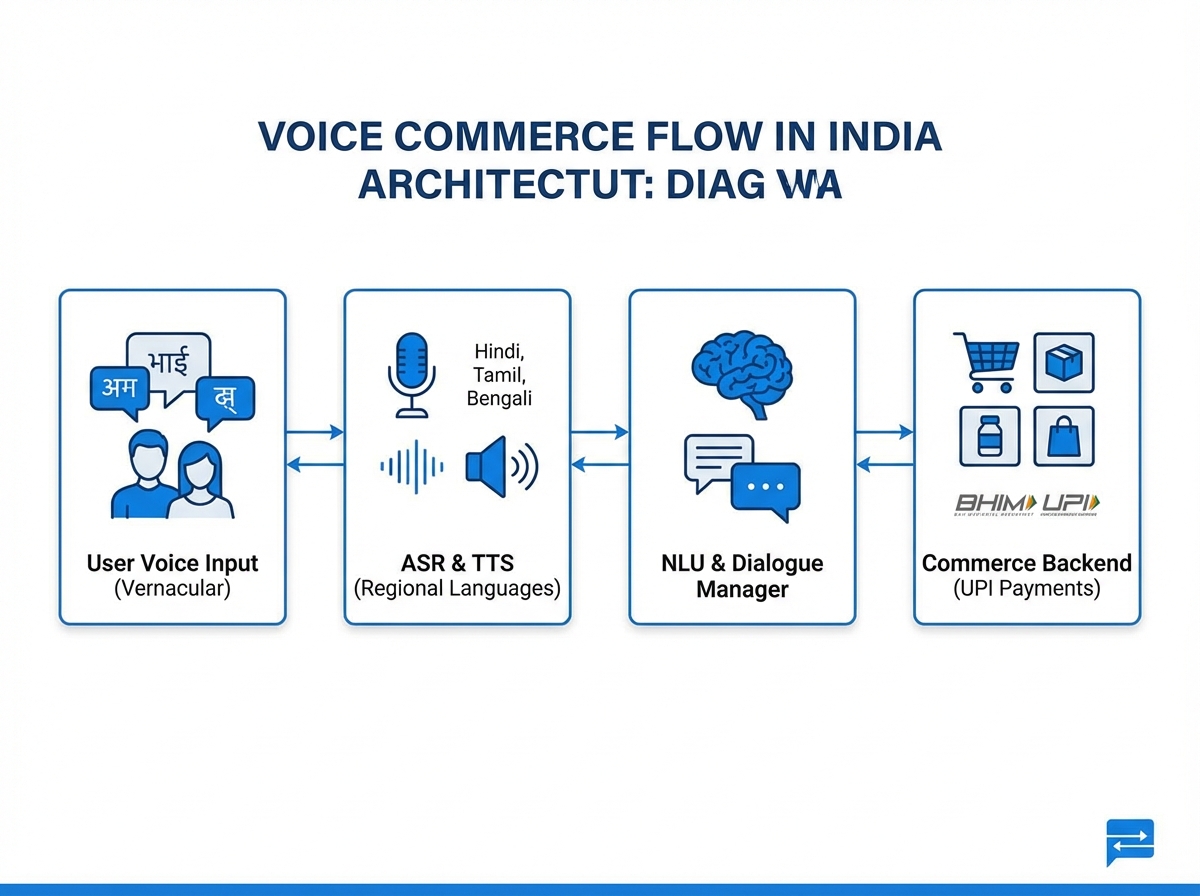
Building a resilient architecture for natural language commerce India requires a multi-layered approach that accounts for the country's unique linguistic and technical challenges. The foundation of this stack is the ASR (Automatic Speech Recognition) and TTS (Text-to-Speech) layer. This layer must support Hindi alongside major regional languages like Marathi, Bengali, Tamil, Telugu, Kannada, and Malayalam, incorporating dialect modeling and phonetic variants.
The NLU (Natural Language Understanding) and Dialogue Manager component serves as the brain of the system, extracting intents and entities for commerce-specific actions. It must handle complex tasks such as browsing catalogs, comparing products, adding items to carts, and applying promotional offers. Effective recovery strategies, including intelligent reprompts and short-turn clarifications, are essential for maintaining the flow of conversation when the AI encounters ambiguity.
A sophisticated personalization engine is the next critical component, utilizing CRM and CDP history to power conversational shopping AI personalization. This engine analyzes location, inventory levels, and seasonal trends to generate voice-triggered personalized offers in real-time. By integrating directly with the commerce backend—including catalog search, pricing engines, and UPI-based payment gateways—the system ensures a seamless transition from voice intent to successful transaction.
Security and user trust must be baked into the implementation through explicit consent capture for voice data and secure account linking tokens. Purchase confirmation guardrails, such as bilingual confirmations and multiple-choice verification, prevent accidental orders and build consumer confidence. Platforms like TrueFan AI enable brands to augment this stack by delivering hyper-personalized video content that responds to voice triggers, further enhancing the user experience.
Multilingual Voice Marketing Automation Playbook
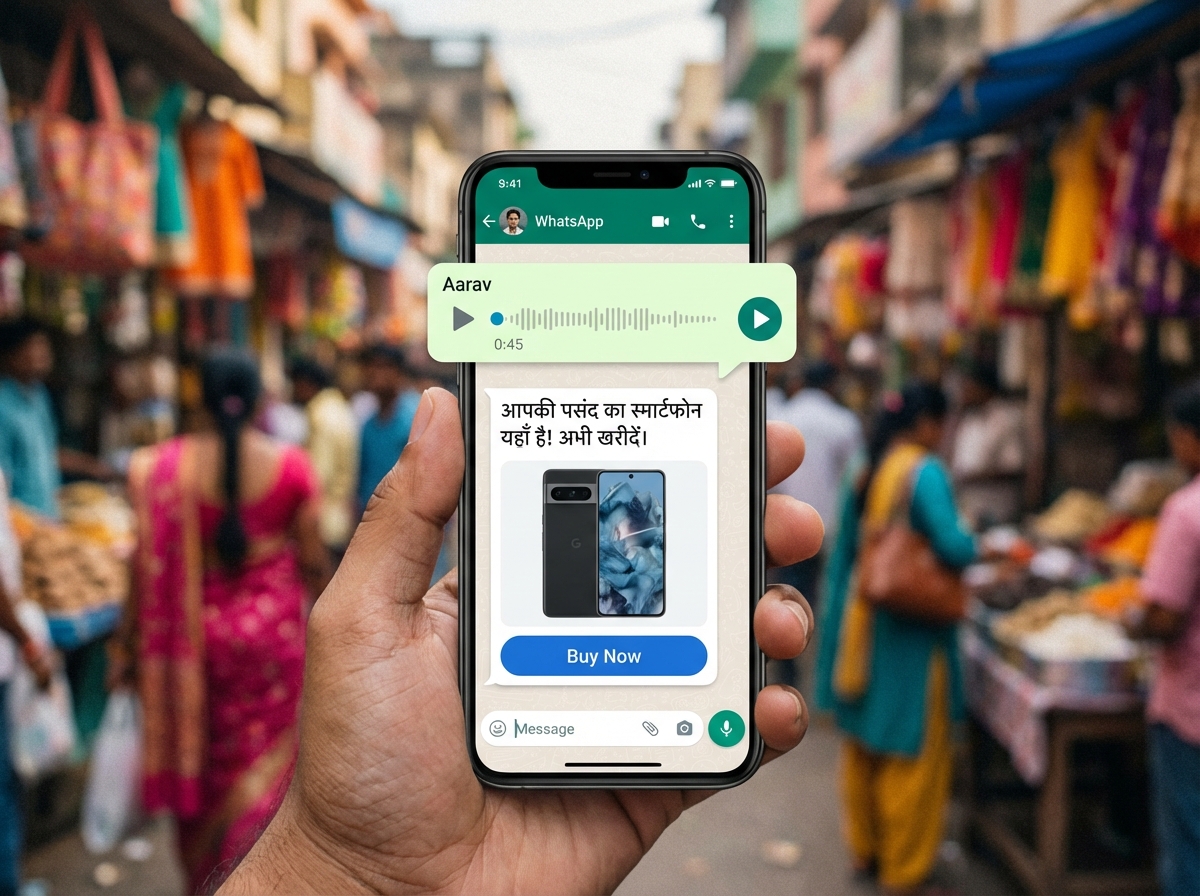
Effective multilingual voice marketing automation involves the strategic orchestration of automated, regional-language journeys across WhatsApp, IVR, and in-app channels. These journeys are designed to trigger relevant content and offers based on specific user actions or lifecycle stages. A well-designed playbook begins with a vernacular onboarding experience, perhaps a 30-45 second voice-guided tour on WhatsApp.
Discovery journeys can be significantly enhanced by allowing users to speak their queries, such as "Find products under ₹499 for school." The system should respond with the top three picks, potentially accompanied by voice search product discovery videos that showcase the items in the user's native tongue. For recovery and win-back scenarios, an abandoned cart voice nudge can be paired with voice-triggered personalized offers to incentivize completion.
Service-oriented journeys, such as order tracking or return requests, should utilize a mix of IVR and WhatsApp handoffs to minimize friction. Governance of these journeys requires intelligent language selection based on device locale and previous session history to ensure consistency. To optimize performance in low-bandwidth areas, TTS snippets should be cached, and duplicate journeys should be suppressed when a user is interacting via a smart speaker.
The "Say-to-save" flow is a particularly effective tactic for driving engagement through voice-activated offer redemption. In this model, a customer hears an offer in their vernacular and simply speaks a phrase like "Code bolo: FEST10" or "Mujhe ₹50 ka cashback chahiye" to claim it. This interaction is backed by real-time identity verification and CRM logging to ensure the offer is applied correctly and securely to the user's account.
Smart Speaker Commerce Integration in India
The integration of commerce capabilities into smart speakers like Alexa and Google Assistant represents a significant opportunity for reaching households in non-metro areas. Smart speaker commerce integration involves creating custom skills or actions that enable users to browse catalogs, reorder essentials, and check order statuses. This requires a robust account linking process, typically utilizing OAuth and mobile OTPs to ensure security.
Catalog synchronization is a vital technical requirement, necessitating nightly feeds and real-time inventory checks to prevent the promotion of out-of-stock items. When a user decides to purchase, the system can initiate a payment handoff by sending a deep link to a UPI-enabled app on the user's smartphone. This hybrid approach balances the convenience of voice discovery with the security of established mobile payment frameworks.
Localization for smart speakers goes beyond simple translation; it requires tuning utterances for specific acoustic environments and regional variants. Short, concise prompts are preferred to maintain user engagement and reduce the likelihood of misinterpretation. As smart speaker usage continues to grow in Tier-2 and Tier-3 cities, these devices will become central hubs for natural language commerce India, facilitating routine purchases through simple voice commands.
Sources:
Voice SEO Regional Languages: Traffic Strategy for Vernacular Queries
To capture the growing volume of voice-based searches, brands must implement a dedicated strategy for voice SEO regional languages. This involves optimizing content and metadata for long-tail, question-based queries that reflect how people actually speak in different parts of India. For example, a user in North India might ask, "Dukan ke liye sasta printer kaunsa?" while a user in the South might use a mix of Tamil and English.
Developing query libraries for each target region is a fundamental step in this process, accounting for code-switching and local slang. Structured data, such as FAQPage and HowTo schemas, should be used to provide clear, concise answers that voice assistants can easily parse and read aloud. It is also important to include phonetic variants and common transliterations in alt text and captions to account for the diverse ways users might pronounce brand or product names.
Voice search product discovery videos play a dual role here, providing both a rich user experience and valuable SEO signals. By publishing transcripts for these videos and using regional language keywords in the metadata, brands can improve their visibility in search results. This holistic approach to SEO ensures that the brand remains relevant as voice commerce vernacular India becomes the primary mode of digital interaction for millions.
Tier-2 Voice Adoption Strategies that Actually Work
Successfully scaling voice commerce in Tier-2 and Tier-3 markets requires a deep understanding of local constraints and preferences. Tier-2 voice adoption strategies must prioritize connectivity-aware user experiences, such as offline IVR fallbacks and compressed audio files. Pre-caching TTS snippets can also help maintain a responsive interface even when the user's internet connection is unstable.
Building trust is perhaps the most critical factor in these markets, where users may be skeptical of new digital checkout flows. Providing order confirmations via personalized regional-language videos can go a long way in reassuring customers that their transaction was successful. Offering a mix of Cash on Delivery (COD) and UPI options further lowers the barrier to entry for users who are still acclimating to online shopping.
Assisted commerce models, where retail staff or kiosks trigger voice journeys for customers, can also drive adoption by providing a human touchpoint. WhatsApp click-to-voice handoffs allow users to start a conversation with a text and switch to voice when they need more detailed assistance. By leaning into smart speaker commerce integration where households are already comfortable using voice for utilities, brands can naturally transition users toward commerce activities.
Execution Blueprint and KPIs: A 90-Day Rollout
Launching a voice commerce India initiative requires a disciplined, phased approach to ensure technical stability and user acceptance. During the first 30 days, teams should prioritize languages based on current order share and launch a Proof of Concept (POC) for Hindi and one South Indian language. This phase focuses on establishing baseline metrics for voice query volume and initial conversion rates.
In the second month, the focus shifts to building out multilingual voice marketing automation and integrating voice-activated offer redemption flows. This is also the ideal time to pilot smart speaker commerce integration with a limited set of high-frequency products. By day 60, the core infrastructure should be robust enough to support more complex interactions and a wider range of regional dialects.
The final 30 days of the rollout involve scaling voice search product discovery videos across the catalog and expanding support to 5-7 languages. Teams should implement comprehensive voice SEO regional languages tactics and iterate on offer logic based on the data gathered during the pilot. Success is measured through a combination of top-funnel engagement metrics, mid-funnel conversion signals, and bottom-funnel ROI indicators.
Key performance indicators (KPIs) should include voice query count, assistant engagement rates, and discovery video watch-through rates. Mid-funnel metrics like add-to-cart via voice and offer redemption rates provide insight into the effectiveness of the conversational flow. Finally, monitoring the conversion rate and AOV after voice-triggered personalized offers will demonstrate the tangible business impact of the initiative.
How TrueFan AI Accelerates Vernacular Voice Commerce
For enterprises looking to scale these experiences, TrueFan AI's 175+ language support and Personalised Celebrity Videos provide a powerful tool for engagement. The platform’s ability to render hyper-personalized videos with under 30-second latency ensures that the user experience remains fluid and responsive. By integrating with CRM systems like Salesforce or HubSpot, brands can trigger these videos automatically based on voice-activated events.
This technology is particularly effective for creating voice search product discovery videos that are mapped to specific category intents. For instance, after a user expresses interest in a product via voice, the system can immediately generate a video featuring their name and city, explaining the product's benefits in their local language. Solutions like TrueFan AI demonstrate ROI through significantly higher watch-through rates and increased add-to-cart actions compared to static content.
The platform also supports multilingual voice marketing automation by automatically swapping video variants based on the user's region. This ensures that a customer in Maharashtra receives a Marathi video while a customer in West Bengal receives one in Bengali, all without manual intervention. High-profile brands like Zomato and Hero MotoCorp have already utilized this scale to deliver hundreds of thousands of personalized messages in a single day.
Smart Architecture and Compliance Checklist
An enterprise-grade architecture for natural language commerce India must be both scalable and compliant with data protection regulations. The flow typically begins with voice input being processed through ASR and NLU layers, which then interact with the product catalog and personalization engine. This data is then passed to a video generation component to create a tailored response, which is delivered back to the user via their preferred channel.
Compliance requirements include rigorous consent logging for all voice captures and explicit opt-ins for any purchase or offer redemption. PII (Personally Identifiable Information) must be minimized and encrypted, with data residency maintained according to local policies. Guardrails against accidental purchases, such as "confirm to buy" voice prompts and easy revocation flows, are essential for maintaining a secure and user-friendly environment.
Checklist for Enterprise Deployment:
- Implement ISO 27001/SOC 2 compliant data pipelines.
- Establish automated content moderation for all generated assets.
- Ensure sub-second latency for NLU and dialogue management.
- Integrate UPI deep linking for seamless voice-to-payment transitions.
- Set up real-time analytics for monitoring ASR error rates by dialect.
FAQ: Operational Depth and India Specifics
How does the system handle the wide variety of Indian accents and dialects?
The system is trained on diverse datasets including Hinglish, Marathi-English, and Tamil-English mixes. It utilizes short-turn prompts to clarify intent and confirms high-risk actions to ensure accuracy across different linguistic patterns.
What measures are in place to prevent fraud during voice-activated offer redemption?
Security is maintained through velocity checks, device binding, and the use of OTPs for high-value claims. This ensures that voice-activated offer redemption remains a secure channel for both the brand and the consumer.
Can voice commerce work for users who are currently offline?
Yes, brands can implement offline-to-voice flows, such as scanning a QR code in-store to trigger a WhatsApp voice conversation in the local language. IVR short codes also provide a reliable way to engage users without a continuous data connection.
How are payments handled in a voice-first environment?
Payments are typically facilitated through UPI collect requests or deep links sent to the user's mobile device. The transaction is then confirmed via a voice message and a digital receipt to complete the natural language commerce India loop.
How does TrueFan AI ensure the videos feel authentic to the user?
TrueFan AI's 175+ language support and Personalised Celebrity Videos use advanced lip-sync technology and regional voice synthesis to create a natural and engaging experience. This level of personalization is key to driving the tier-2 voice adoption strategies that lead to long-term loyalty.
Conclusion: The Future of Shopping is Vocal
The transition toward voice commerce India represents a fundamental change in how brands interact with the next generation of Indian consumers. By moving beyond text and embracing the natural linguistic diversity of the subcontinent, enterprises can unlock unprecedented growth in Tier-2 and Tier-3 markets. The combination of natural language commerce India and hyper-personalized video content creates a powerful synergy that drives both engagement and conversion.
As we look toward 2026, the brands that succeed will be those that view voice not just as a feature, but as a comprehensive strategy for inclusion and accessibility. By following this blueprint—from technical stack selection to multilingual voice marketing automation—your organization can lead the way in the vernacular commerce revolution. The tools are ready, the infrastructure is in place, and the audience is waiting to be heard.
Recommended Internal Links
- Vernacular Voice SEO Strategies for India’s 2026 Commerce
- Master voice SEO regional languages for commerce success
- Master voice SEO regional festivals for 2026 campaigns
- Voice SEO Regional Optimization for India’s 2026 Commerce
- Tier-2 Festival Commerce Automation: Local Growth Playbook
- ONDC Personalized Video Onboarding: 2026 Playbook Guide
Frequently Asked Questions
What is voice commerce and why is it critical for Tier-2/3 India?
Voice commerce enables shoppers to discover and buy using natural speech in their preferred language, reducing literacy and UX barriers. It accelerates adoption in Tier-2/3 markets where vernacular and ease-of-use are decisive factors.
How do brands handle multilingual and dialect variations in ASR/NLU?
Deploy ASR/TTS with regional models, phonetic variants, and code-switching support. Combine with NLU that uses short-turn clarifications, confidence thresholds, and fallbacks to maintain accuracy across dialects.
Which channels work best for vernacular voice journeys in India?
WhatsApp, IVR, in-app assistants, and smart speakers work well in combination. Coordinate them via multilingual automation so users can switch channels seamlessly based on context and bandwidth.
How are payments and security managed in voice-first flows?
Use UPI deep links or collect requests with device binding, OTP for high-value actions, and explicit consent. Add bilingual confirmations and verification prompts to prevent accidental purchases.
What KPIs should teams track in the first 90 days?
Track voice query volume, engagement rate, add-to-cart via voice, offer redemptions, watch-through on discovery videos, conversion rate, and AOV uplift from personalized offers.



