AR Try-On Video Marketing 2026: Enterprise Blueprint to Lift Conversion and Reduce Returns
Estimated reading time: 9 minutes
Key Takeaways
- Enterprises are accelerating AR try-on video marketing to lift conversion by 25%–150% and reduce returns by 15%–40%.
- Vertical playbooks in beauty, eyewear, jewelry, and fashion rely on precision fit, shade, and scale visualization.
- Personalization and automation at scale use first-party data to deliver dynamic, shoppable AR videos in real time.
- India-first execution requires Android optimization, adaptive bitrates, and WhatsApp distribution with robust governance.
- Focus on data privacy, disclosures, and model training on return data to continuously improve AR outcomes.
The digital commerce landscape is undergoing a seismic shift as we approach 2026. Enterprise leaders are no longer satisfied with static imagery or passive video content; the demand for AR try-on video marketing 2026 has reached a fever pitch. This strategy fuses high-performance augmented reality (AR) engines with personalized, shoppable short-form videos across product detail pages (PDP) and social channels (live commerce personalization in India 2026).
By integrating virtual product experience videos, brands are effectively bridging the gap between digital browsing and physical trial. In markets like India, where immersive shopping experiences India are becoming the standard, this technology is essential for building consumer confidence. The fusion of AR and video allows customers to visualize products in real-time, significantly reducing the “imagination gap” that often leads to cart abandonment (quick commerce video personalization in India).
Enterprise-level adoption of these tools is driven by the need for precision. Whether it is a specific shade of lipstick or the exact fit of a luxury watch, AR-powered video provides a level of detail that traditional media cannot match. As we look toward the 2026 fiscal year, the integration of these immersive layers into the standard marketing stack is the primary differentiator for top-tier retail brands.
Source: India beauty VTO trend (Nykaa Trends report)
Source: Global context (2026 video trends)
1. The ROI Case: AR Conversion Optimization and Return Reduction
The financial justification for AR-integrated video marketing is rooted in two critical metrics: conversion lift and return reduction. Data from 2026 indicates that AR conversion optimization is no longer a luxury but a fundamental requirement for high-growth e-commerce. By providing a “try-before-you-buy” experience within a video format, brands are seeing conversion rates climb by 25% to 150% on key product pages.
Equally important is the implementation of AR return reduction strategies. In the fashion and beauty sectors, returns are often driven by a mismatch between consumer expectations and the actual product. High-fidelity AR overlays show scale, finish, and fit with surgical precision, allowing customers to make informed decisions. This transparency has been shown to reduce return rates by 15% to 40% for SKUs that utilize accurate visualization.
Beyond immediate sales, these virtual product experience videos drive significant improvements in engagement. PDP dwell time often increases by over 60% when interactive AR elements are present. This increased time on page correlates directly with brand recall and long-term customer loyalty, as users feel more empowered and less “sold to” during their journey (live commerce personalization India 2026: real-time guide).
Source: AR marketing effects (confidence, returns)
Source: AR adoption and usage trends
Source: Digital marketing trends 2026
2. Vertical Playbooks: Beauty and Eyewear Innovation
In the beauty sector, AR beauty try-on videos have revolutionized how consumers discover their perfect match. These videos utilize advanced face mesh technology and lighting normalization to render shades onto a user's face in real-time. By offering “Try your shade” calls-to-action (CTAs) within a shoppable video, brands like Nykaa have set a new benchmark for experiential retail in India.
The technical execution of virtual makeup application videos requires a deep library of SKU-mapped shades. These systems must account for skin tone detection and hairline masking to ensure the overlay looks natural. When executed correctly, the result is a seamless transition from viewing a tutorial to seeing the product on one's own skin, which drastically shortens the decision cycle.
Similarly, eyewear virtual try-on automation has become a cornerstone of the optical industry. Modern systems utilize pupillary distance (PD) estimation and temple-fit simulation to ensure the frames not only look good but fit correctly. Platforms like Lenskart have popularized this in the Indian market, using AR to avoid the “goof-ups” associated with traditional online frame shopping.
Source: Nykaa VTO trend signaling
Source: Lenskart AR campaign coverage
Source: NARS 3x CVR via AR VTO
3. Jewelry Visualization and 3D Product Interaction Marketing
The jewelry industry presents unique challenges for digital marketing, specifically regarding the “sparkle” and scale of precious metals and stones. Jewelry visualization marketing solves this by using physically based rendering (PBR) to capture the way light interacts with gemstones. Scale-accurate rings, bangles, and necklaces are rendered on the user’s hands or neck, providing a realistic sense of how the piece will wear.
Execution in this vertical requires sophisticated hand and neck tracking. Surface occlusion is vital; the AR must understand when a finger is behind a ring or when a necklace is tucked under a collar. This level of 3D product interaction marketing allows users to spin, zoom, and swap variants within the video, transforming a passive viewing experience into a tactile exploration of luxury.
In India, Tanishq was an early mover in this space, launching AR experiences to bring the showroom to the customer's home. By integrating these 3D moments into short-form videos, brands can drive a 20% to 50% increase in add-to-cart rates. The ability to “measure ring size” through a quick AR tool within the video further removes friction from the high-value purchase process.
Source: Tanishq AR launch
Source: mirrAR (StyleDotMe) India AR provider
4. Fashion AR Video Campaigns and Virtual Fitting Rooms
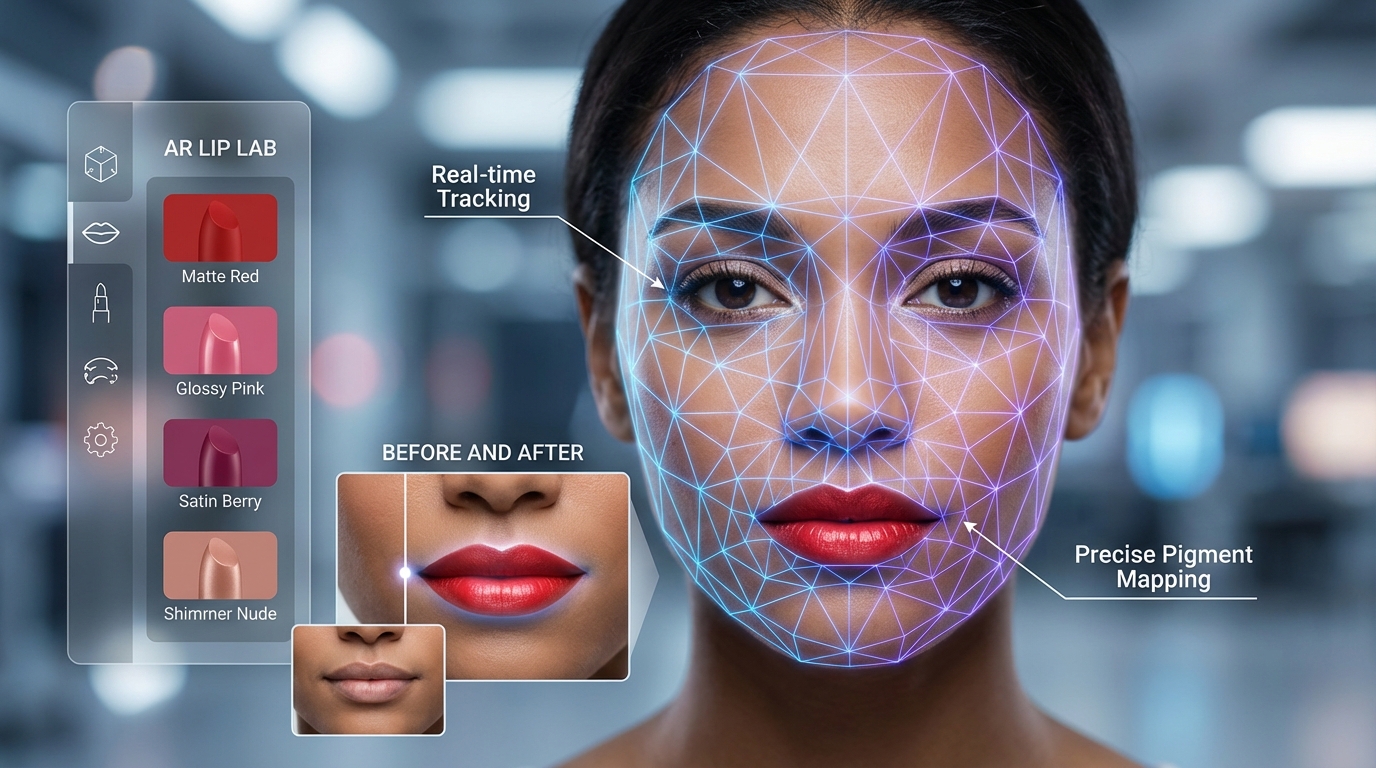
The fashion industry is leveraging fashion AR video campaigns to tackle the industry's biggest pain point: fit. By using body-proxy-based visualization, brands can simulate how a garment drapes on different body types. These virtual fitting room campaigns provide users with a “size confidence meter,” which uses past return data and current body measurements to suggest the perfect fit.
For enterprise brands, virtual sizing recommendation videos are essential for reducing the high costs associated with size exchanges. In COD-heavy markets like India, providing this pre-purchase fit guidance is a critical component of AR return reduction strategies. When a customer sees how a silhouette matches their specific body shape in a video, the likelihood of a return due to “poor fit” drops significantly.
Technical execution involves silhouette matching and garment physics approximations. The video content often features a celebrity or influencer introduction, followed by a personalized AR overlay that allows the user to “step into” the outfit. This hybrid approach combines the aspirational nature of traditional fashion marketing with the practical utility of modern AR technology.
Source: Eyewear VTO ROI (Fittingbox)
Source: Experiential retail examples (Rubick.ai)
5. Personalization and Automation: The Enterprise Engine
To achieve success at scale, brands must move beyond manual video creation. Augmented reality personalization involves using first-party data—such as size profiles, shade preferences, and past purchase history—to dynamically render AR overlays. This ensures that every user receives a video tailored specifically to their needs, featuring the most relevant SKUs and personalized CTAs (quick commerce video personalization in India).
Platforms like TrueFan AI enable this level of hyper-personalization by serving as the orchestration layer between AR SDKs and delivery channels. By automating the creation of thousands of personalized videos, enterprises can maintain a consistent brand voice while speaking directly to the individual. This virtual product demonstration automation is what allows a brand to scale from a single pilot to a global rollout across 175+ languages (live commerce personalization India 2026).
TrueFan AI's 175+ language support and Personalised Celebrity Videos allow brands to localize their AR campaigns for diverse regions instantly. The system can take a single master template and generate thousands of variants, each with localized voiceovers, regional shade charts, and specific currency symbols. This automation stack is essential for maintaining the speed and agility required in the 2026 digital marketplace. By automating the creation of thousands of personalized videos, enterprises can ensure real-time relevance at scale (rapid fulfillment personalization strategies).
Source: TrueFan AI Enterprise Intelligence (Internal Enterprise Documentation)
Source: Video marketing trends for 2026
6. India Execution, Governance, and the 2026 Roadmap
Executing immersive shopping experiences India requires a deep understanding of the local infrastructure. Content must be optimized for Android-first environments and adaptive bitrates to ensure smooth playback on low-bandwidth networks. Furthermore, the integration of WhatsApp Business flows allows for the instant delivery of personalized AR snippets, meeting the consumer where they are most active (WhatsApp catalog video marketing).
Governance and trust are paramount as we move into 2026. Brands must implement “Generated with AR” disclosures and maintain strict data privacy standards. Solutions like TrueFan AI demonstrate ROI through their secure, ISO 27001-compliant architectures, ensuring that user data is protected while delivering high-impact creative. This commitment to ethics and transparency is what builds long-term consumer trust in AR-driven commerce.
The 2026 roadmap for enterprise brands involves expanding VTO coverage to 95% of top-selling SKUs and unifying in-store AR mirrors with online journeys. By training fit and shade recommendation models on real-world return data, brands can continuously refine their AR conversion optimization efforts. The future of retail is not just digital; it is an interactive, personalized, and immersive experience that begins with a single video.
Source: Nykaa Trends report
Source: Tanishq AR precedence
Frequently Asked Questions
What is AR try-on video marketing 2026?
It is an enterprise strategy that combines augmented reality overlays with shoppable, short-form videos. This allows users to virtually “try on” products like makeup, eyewear, or clothing directly within a video player on a website or social media platform.
How does AR reduce e-commerce return rates?
By providing accurate visualizations of scale, fit, and color, AR helps eliminate the uncertainty that leads to returns. When customers can see exactly how a product looks on them before purchasing, they are much less likely to be disappointed upon delivery.
Can AR video marketing be personalized for individual users?
Yes, through augmented reality personalization, brands can use customer data to show specific shades or sizes that match the user's profile. TrueFan AI provides the infrastructure to automate this personalization at scale across thousands of unique video variants.
Which industries benefit most from AR try-on videos?
The beauty, eyewear, jewelry, and fashion industries see the highest ROI. These sectors rely heavily on visual and physical fit, making them perfect candidates for AR-driven “try-before-you-buy” experiences.
Is AR video marketing effective in the Indian market?
Absolutely. With the rise of immersive shopping experiences India, consumers are increasingly looking for interactive ways to shop. High-fidelity AR helps build trust, especially in high-value categories like jewelry and luxury fashion.
How do I measure the success of an AR video campaign?
Key metrics include conversion rate lift (CVR), reduction in return rates, average order value (AOV), and PDP dwell time. Advanced analytics can also track “tap-to-try” events and variant switches within the video to understand user intent.