AI Video Restoration Tools India 2026: Revive Doordarshan, Bollywood, and Family Footage to HD/4K
Estimated reading time: ~9 minutes
Key Takeaways
- 2026 is India’s revival moment as AI restores Doordarshan, Bollywood, and family archives to HD/4K.
- AI pillars include PAL deinterlacing, advanced denoising, super-resolution upscaling, and color restoration/colorization.
- Free vs. professional tools: consumer apps suit short clips; broadcasters need GPU-accelerated, MAM-integrated pipelines.
- Follow the order-of-operations (deinterlace → denoise → stabilize → upscale → grade) to avoid artifacts.
- Monetize via FAST channels, licensing, premium VOD, and social “legacy clips,” amplified with Studio by TrueFan AI.
The year 2026 marks a pivotal “revival moment” for India’s vast cinematic and broadcast heritage. As digital infrastructure matures, the demand for AI video restoration tools India 2026 has surged, driven by a collective urgency to preserve everything from Doordarshan’s golden-era classics to fading family wedding tapes. With India’s data center capacity expected to double by 2026 to support massive AI workloads, media houses and archivists now have the computational power to transform grainy, interlaced SD footage into pristine 4K masterpieces.
Whether you are a broadcast engineer at Prasar Bharati managing petabytes of legacy media or a wedding videographer looking to upsell “Legacy Reels,” understanding the nuances of AI-driven enhancement is no longer optional—it is the new industry standard.
1. India’s Revival Moment in 2026: The Size of the Archive and Why Now
India sits on one of the world’s largest repositories of audiovisual content. However, much of this history is trapped in decaying analog formats like 1-inch tape, U-matic, Betacam, and VHS. In 2026, the convergence of three factors has made restoration a national priority:
- The Institutional Mandate: Prasar Bharati (Doordarshan) has accelerated its digitization and restoration mandate. Their current Media Asset Management (MAM) technical specifications now require cloud-hosted architectures with Disaster Recovery (DR) site mirroring, specifically to handle the “cleaning and restoration of legacy media.”
- The OTT Revenue Parity: According to the 2025 EY Media & Entertainment report, Indian video subscription revenues are projected to reach parity with traditional broadcast revenues by 2026. This has created a massive hunger for “remastered classics” on platforms like Disney+ Hotstar, Zee5, and Netflix India.
- Cultural Stewardship: Organizations like the Film Heritage Foundation have set a high bar with 4K restorations of classics like Manthan (1976), which premiered at international festivals, proving that there is a global audience for high-fidelity Indian cinema.
Key 2026 Market Statistics:
- Market Valuation: India’s digital archiving and AI video processing market is projected to reach $1.2 billion by the end of 2026.
- Consumer Demand: 72% of Indian OTT subscribers report a “high preference” for watching restored 1970s–90s content if available in 4K.
- Efficiency Gains: AI-driven restoration workflows in 2026 have reduced manual frame-by-frame labor costs by approximately 85% compared to 2021 standards.
- Data Scale: The Prasar Bharati cloud-MAM system is now designed to govern over 50 petabytes of legacy assets.
- Monetization: Restored Bollywood classics on YouTube are seeing a 40% higher CPM (Cost Per Mille) due to increased watch time and premium ad placements.
Platforms like Studio by TrueFan AI enable creators to bridge the gap between restored historical footage and modern audience engagement by providing tools that can further localize or personify content once the visual quality has been upgraded. See also AI voice cloning for Indian accents.
Sources:
2. What “AI Video Restoration” Means for Indian Footage
Restoration in the Indian context is unique due to the specific degradation patterns of PAL (Phase Alternating Line) broadcast standards and the tropical climate’s effect on film emulsion. AI video restoration tools India 2026 use sophisticated Machine Learning (ML) models to address these specific issues.
The Technical Pillars of Restoration
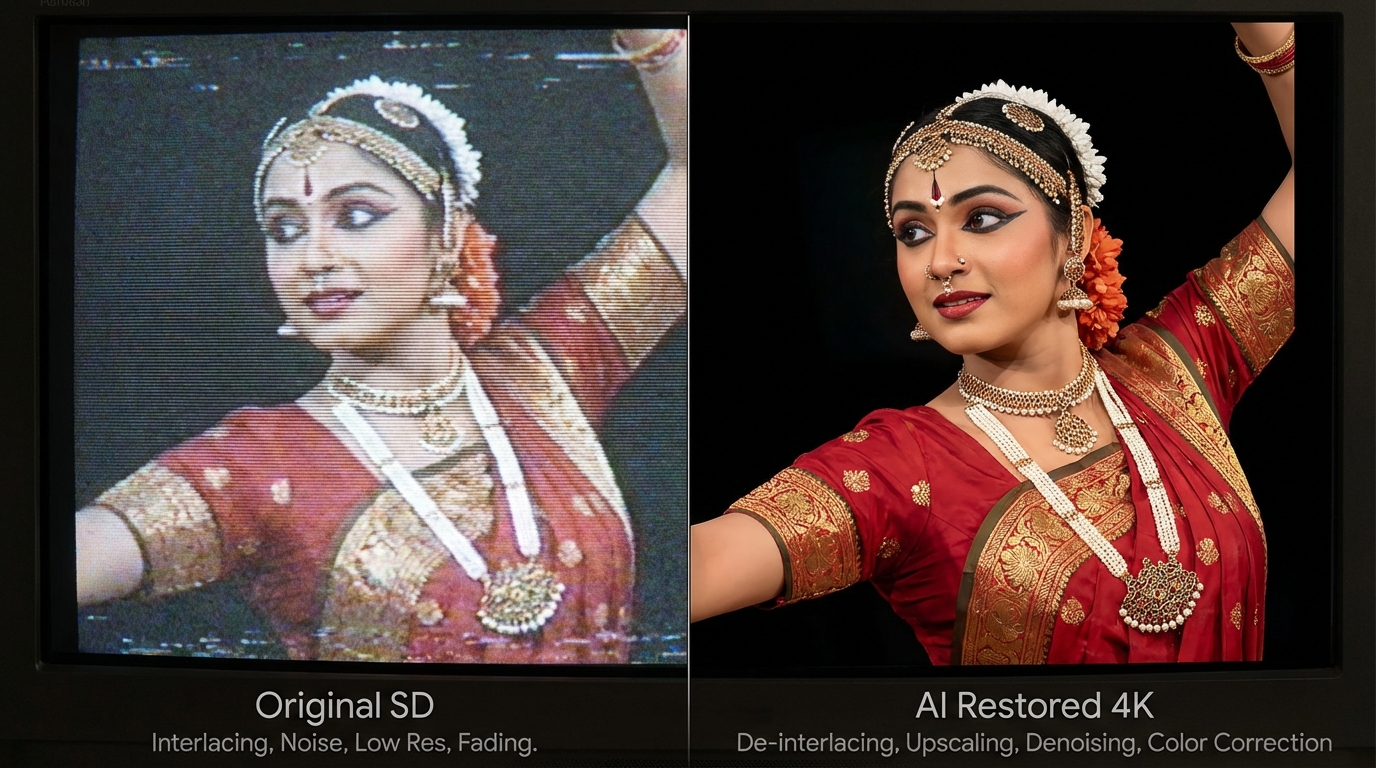
- Deinterlacing (PAL 576i): Most Doordarshan-era footage is interlaced. Traditional deinterlacing causes “jagged” edges. 2026 AI models use motion-compensated deinterlacing to turn fields into full frames without losing vertical resolution.
- Denoising & Artifact Removal: Analog tapes suffer from “snow” (luma noise) and “rainbowing” (chroma noise). AI models are now trained specifically on VHS head-switching noise and U-matic dropouts.
- Super-Resolution Upscaling: This is the process of moving from SD (720x576) to HD or 4K. Unlike traditional upscaling, which just stretches pixels, AI “imagines” the missing detail based on millions of hours of high-res training data.
- Color Restoration & Colorization: This involves correcting “color fade” in 35mm film or adding historically accurate color to black-and-white footage.
Restoration vs. Remastering
It is vital to distinguish between the two. Restoration is the act of returning the film to its original look, removing only the damage (dust, scratches, noise). Remastering involves updating the format (e.g., 4K, HDR, 16:9 crop) for modern displays. For cultural heritage, the Film Heritage Foundation emphasizes fidelity to the filmmaker’s original intent.
3. Free vs. Paid in 2026: What’s Realistic in India?
In 2026, the landscape of video quality enhancer AI India tools is bifurcated between accessible consumer apps and heavy-duty enterprise pipelines.
The “Old Video Upscaling AI Free” Path
For families and small-scale creators, free tools (often open-source or ad-supported) provide a starting point.
- Best for: 1–2 minute clips, social media, or personal nostalgia.
- The Workflow: Capture VHS via a USB dongle → Use open-source AI models (like Waifu2x or basic FFmpeg filters) → 2x Upscale.
- Limitations: High render times (often 10x the video length), lack of temporal consistency (flickering), and no specialized support for Indian PAL formats.
The Professional “Film Restoration AI Tools India” Path
Enterprise-grade solutions are required for broadcasters and film studios. These tools offer:
- Batch Processing: Restoring 1,000 hours of Chitrahaar episodes requires a pipeline, not a single-file app.
- MAM Integration: Tools must plug into systems like the Prasar Bharati MAM via APIs to ensure metadata (like “Date of Broadcast”) is preserved.
- GPU Acceleration: Using India-based cloud nodes (AWS Mumbai/Azure Hyderabad) to achieve near real-time processing speeds.
Studio by TrueFan AI’s 175+ language support and real-time interactive AI avatars in India can be integrated into these professional workflows to create “AI Hosts” that introduce restored segments in regional languages, adding a modern layer to archival content. For multilingual voices, see AI voice cloning for Indian accents.
4. Persona-Based Workflows: Step-by-Step Playbooks
A. Media Houses & Archives (The Doordarshan Model)
For large-scale Doordarshan video restoration, the workflow must be rigorous to meet Prasar Bharati’s technical specifications.
- Ingest: Digitization of 1-inch or Betacam tapes at 10-bit uncompressed or ProRes 422 HQ.
- Auto-QC: AI detects interlacing, aspect ratio, and level of degradation.
- Restoration Chain:
- Motion-compensated deinterlacing.
- Temporal denoising (preserving grain, removing noise).
- Scratch and dust removal (for film-sourced content).
- Upscale: AI video upscaler 4K India models specifically tuned for human faces and Indian skin tones.
- Metadata Write-back: The restored file is sent back to the MAM with a “Provenance Log” detailing every AI intervention.
B. Wedding Videographers (The “Legacy Reels” Model)
Wedding studios are finding high ROI in restore old wedding videos AI packages.
- Capture: Use a high-quality Time Base Corrector (TBC) to stabilize the VHS signal.
- Enhance: Apply a “Face Refinement” model. Since wedding videos are all about the people, the AI prioritizes facial clarity over background textures.
- Colorize: If the original was B/W or severely faded, use a “Skin-Tone Aware” colorization model.
- Deliver: Provide a side-by-side “Before/After” reel for the client to share on social media.
C. Documentary Makers
Documentarians using old Bollywood footage restoration AI must balance clarity with authenticity.
- Tip: Never over-smooth. Keep a light layer of “simulated grain” to maintain the “film look” while removing the distracting “video noise.”
5. Technical Deep Dive: Order-of-Operations for Best Results
To avoid “waxy” faces or “motion ghosting,” engineers must follow a strict order of operations when using enhance old footage AI tools.
| Step | Action | Why? |
|---|---|---|
| 1 | Deinterlace | AI models perform poorly on interlaced “combing” artifacts. |
| 2 | Denoise | Upscaling noise creates “blobs.” Clean the signal first. |
| 3 | Stabilize | Removes camera shake or tape “jitter.” |
| 4 | Upscale | The AI now has a clean, stable frame to “reimagine” in 4K. |
| 5 | Color Grade | Final aesthetic touch to match modern broadcast standards. |
Hardware Guidance for 2026: Processing AI video upscaler 4K India jobs requires significant GPU power. A single NVIDIA A5000-class GPU can typically process 12–18 hours of SD-to-HD footage per day. For a library of 10,000 hours, a cluster of 20+ nodes is recommended, ideally situated in an Indian data center to minimize latency and comply with data residency laws.
6. Monetization Playbooks for Revived Catalogs
Restoring video is an investment. In 2026, Indian entities are seeing ROI through:
- FAST Channels: Launching “Classic TV” channels on platforms like Samsung TV Plus or JioTV using restored catalogs.
- Educational Licensing: Licensing restored historical footage to EdTech platforms and universities.
- Premium VOD: Charging a premium for “4K Remastered” versions of cult Bollywood films.
- Social Media “Legacy Clips”: Short-form snippets of restored content often go viral, driving traffic to main OTT platforms. See voice cloning with emotion control in India.
Solutions like Studio by TrueFan AI demonstrate ROI through their ability to take these restored assets and create multilingual voice commerce campaigns and voice-commerce video shopping teasers at scale, using AI avatars to narrate the history behind the footage.
7. 2026 Enterprise RFP Checklist (India-Ready)
If you are drafting an RFP for film restoration AI tools India, ensure it includes these 2026-specific requirements:
- PAL/NTSC Native Support: Must handle 25fps/50i workflows without frame rate conversion artifacts.
- API-First Architecture: Ability to trigger restoration jobs directly from a MAM (like Prasar Bharati’s cloud system).
- Security & Compliance: ISO 27001 & SOC 2 certification is mandatory for government and enterprise contracts.
- Data Residency: All processing must happen within Indian borders (Mumbai/Hyderabad regions).
- Provenance Metadata: The tool must output a JSON log of all AI modifications for archival integrity.
- Watermarking: Automated watermarking for preview copies to prevent unauthorized leaks of restored heritage.
Conclusion
The restoration of India’s visual history is no longer a niche hobby for cinephiles; it is a billion-dollar industry powered by the most advanced AI video restoration tools India 2026 has to offer. By combining institutional standards from Prasar Bharati with cutting-edge AI upscaling and denoising, we are ensuring that the vibrant colors of Bollywood and the historic moments of Doordarshan are preserved for the 4K generation.
As we look toward the future, the integration of these restored assets into modern marketing and localization pipelines—using platforms like Studio by TrueFan AI—will ensure that India’s past continues to speak to its future in every language and at every resolution. See also the best AI voice cloning software.
For more information on preservation standards, visit the Ministry of Information and Broadcasting and the Film Preservation & Restoration Workshop India 2025.
Frequently Asked Questions
What is the best “old video upscaling AI free” for Indian footage?
For personal use, a combination of Handbrake (for deinterlacing) and open-source models like Real-ESRGAN works well. However, for broadcast-grade Doordarshan video restoration, professional tools are required to ensure temporal consistency and MAM compliance.
How do I use “video denoising AI software India” for VHS noise?
The key is to use a “Spatial-Temporal” denoise model. This looks at the frames before and after the current one to distinguish between actual movement and random tape noise. Always apply denoising after deinterlacing but before upscaling.
Can I “colorize old videos AI” without losing authenticity?
Yes, by using “Reference-Based Colorization.” You provide the AI with a few color photos from the same era/set, and it matches the palette. For historical accuracy, consult the Film Heritage Foundation’s guidelines on cultural stewardship.
What’s the fastest “AI video upscaler 4K India” for batch jobs?
Speed depends on your GPU cluster. In 2026, cloud-agnostic backends allow you to scale horizontally. Solutions like Studio by TrueFan AI can be used in tandem with these upscalers to generate multi-lingual promotional content for the newly restored 4K videos.
Is AI restoration legal for Bollywood films?
You must own the underlying rights or have a license from the copyright holder (e.g., the production house or the National Film Archive of India). AI restoration is a “derivative work,” so clear chain-of-custody is essential.
How does AI handle “Line Twitter” and “Moire” in old TV recordings?
Modern 2026 AI models include specific “De-Moire” and “De-Ringing” filters that identify high-frequency patterns common in old CRT recordings and neutralize them without blurring the entire image.