Vernacular video automation India: The CMO’s playbook for tier-2/3 growth with multilingual AI
Estimated reading time: ~8 minutes
Key Takeaways
- Adopt a vernacular-first strategy to win tier-2/3 users where Indic languages dominate growth.
- Deploy an integrated 175-language video platform with Indian AI avatars, voice cloning, and code-mix (Hinglish) support.
- Drive regional personalization using city/district data, local festivals, and channel-specific playbooks.
- Ensure enterprise-grade governance with consent-first talent use, ISO/SOC2, and a 30-60-90 rollout plan.
- Measure beyond vanity metrics: optimize VTR, CVR, CAC, and LTV with robust attribution.
Vernacular video automation India is the definitive frontier for Chief Marketing Officers aiming to capture the next 500 million consumers. In an era where India’s internet user base is projected to exceed 900 million by 2025, the ability to automate localized video content is no longer a luxury but a core operational necessity. Platforms like TrueFan AI enable enterprises to bridge the linguistic divide, ensuring that brand messaging resonates with cultural precision across the diverse landscape of Bharat.
The shift toward a “vernacular-first” strategy is driven by the reality that rural and tier-2/3 markets are leading digital adoption. By 2026, voice-first vernacular interactions are expected to become mainstream for over 650 million users, necessitating a sophisticated approach to video production that goes beyond simple translation. This playbook outlines the strategic framework for implementing high-scale, brand-safe, and culturally nuanced video automation to dominate the Indian market.
Why Bharat is a once-in-a-decade growth lever for tier-2 city video marketing
The demographic shift in India’s digital consumption is unprecedented. As of 2025, the majority of new internet users are emerging from rural areas and tier-2/3 cities, where preference for Indic languages over English is absolute. This evolution has transformed tier-2 city video marketing from a peripheral experimental budget item into the primary engine of customer acquisition and retention.
Data from the IAMAI–Kantar 2024 report indicates that the growth of the Indian internet is being fueled by vernacular, voice, and video. For CMOs, this means that the traditional “translate-later” approach—where English creative is dubbed as an afterthought—is fundamentally broken. Consumers in Bharat demand content that feels indigenous to their specific region, reflecting local idioms, cultural cues, and social contexts.
By 2026, voice-first commerce will be the standard for 650 million users, making code-mix aware ASR (Automatic Speech Recognition) and NLU (Natural Language Understanding) crucial for building brand trust. A “vernacular-first” approach involves ideating and producing content natively in languages like Hindi, Tamil, Bengali, and Marathi, including code-mixed variants like Hinglish. This strategy ensures higher View-Through Rates (VTR) and Click-Through Rates (CTR) by establishing an immediate emotional connection with the viewer.
The vernacular AI stack CMOs need in 2026 for a 175 language video platform
To operationalize Bharat-scale growth, enterprises must move away from fragmented point tools and adopt an integrated 175 language video platform. Such a platform provides a centralized system for generating, localizing, and rendering video assets while maintaining consistent brand identity and voice retention. TrueFan AI's 175+ language support and Personalised Celebrity Videos provide the technical foundation required for this level of sophisticated automation.
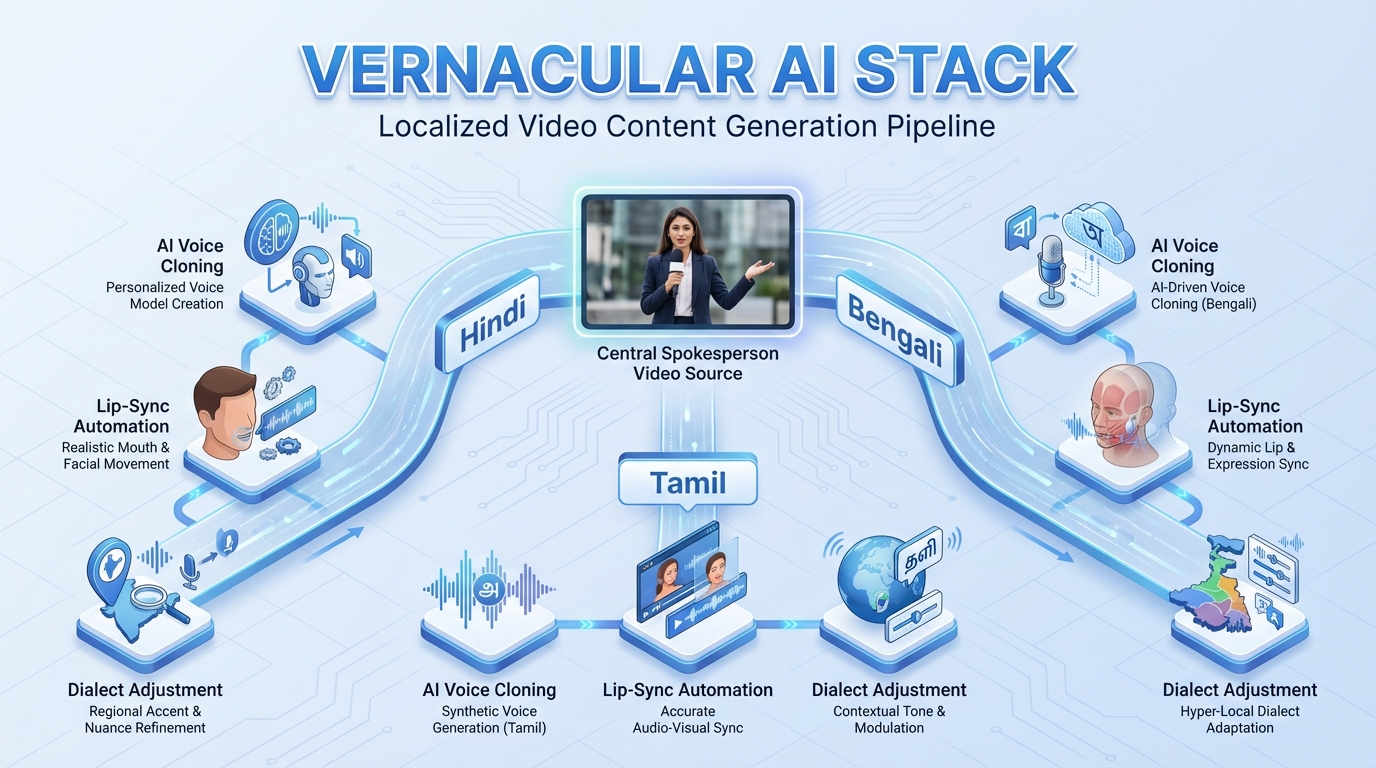
A robust vernacular AI stack consists of several critical components. First is the Indian AI avatar, a licensed and consented digital spokesperson—often a celebrity or a brand ambassador—capable of perfect lip-sync across multiple languages. This allows for brand-safe automation of performance ads and onboarding videos. For instance, a Bengali AI spokesperson can natively address audiences in West Bengal, utilizing dialect sensitivity to distinguish between Kolkata and Siliguri phrasing.
The second pillar is AI voice cloning Indian accents. This technology clones the unique prosody and phoneme patterns of regional languages, preserving the brand’s “voice” while ensuring high accuracy in pronouncing local names and places. This is coupled with AI dubbing Indian languages, which uses frame-accurate lip-sync to retain the original speaker’s timbre while generating localized speech. This eliminates the need for expensive re-shoots and significantly reduces the latency of campaign launches.
Hinglish AI video creation is equally vital for metro-adjacent and Gen Z cohorts. By utilizing code-mixed creative—such as a “Aaj hi order karo” Call to Action (CTA) combined with English product terminology—brands can achieve higher watch-time among urbanized tier-2 audiences. This stack enables “virtual reshoots,” where a single line or offer can be updated across thousands of videos without a new production cycle, facilitating rapid A/B testing and performance optimization.
Regional language personalization and channel playbooks for Bharat market AI videos
Effective regional language personalization requires a deep integration of data signals and creative execution. CMOs must move beyond simple name-tagging and incorporate city, district, and even taluka-level data into their video scripts. This includes localized price elasticity, festival calendars (such as Pongal or Pohela Boishakh), and specific retailer catchment areas.
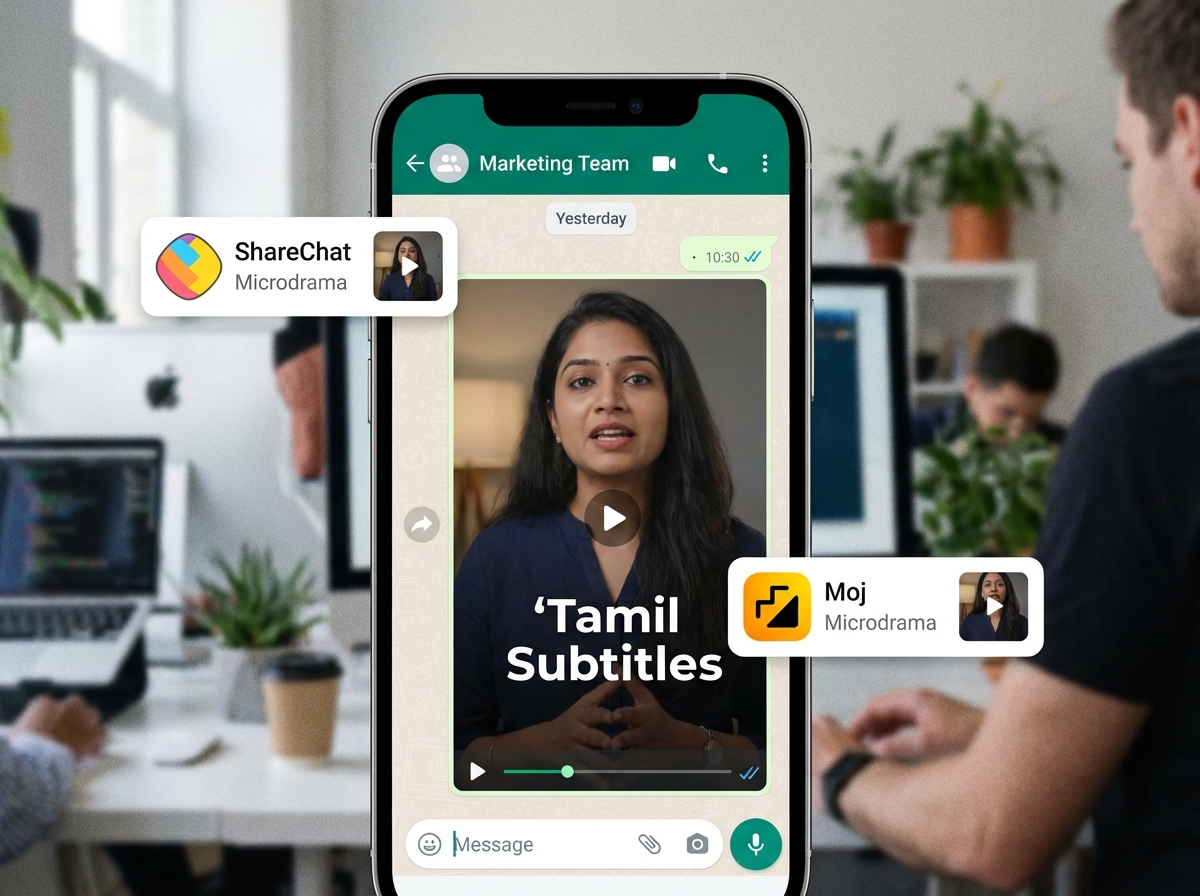
For Bharat market AI videos, channel-specific playbooks are essential. On WhatsApp, the strategy should focus on click-to-chat ads leading to personalized video demos. If a user doesn't interact within a specific window, an automated voice-note in the local language can serve as a powerful nudge. These videos should be lightweight (under 2MB) and feature burned-in subtitles to ensure accessibility in low-bandwidth areas.
On platforms like ShareChat and Moj, the “microdrama” format—short-form storytelling with high conflict and resolution—is the dominant trend for 2026. Brands can use vernacular video automation to remix these trends weekly, utilizing localized slang and creator whitelisting to drive engagement. YouTube Shorts requires a different approach, with Hinglish and Tamil remixes featuring 6-9 second high-impact hooks and end-card CTAs in the local script.
Telegram drip sequences also benefit from AI dubbing Indian languages. Fintech and Edtech brands can use these for KYC nudges or lesson introductions, scheduling a sequence that moves from a welcome message to a FOMO-driven offer over nine days. By using templates for Tamil video automation, brands can ensure that every variant—whether for Coimbatore or Chennai—maintains a high standard of vocabulary and formality appropriate to the specific cohort.
Enterprise-grade governance and implementation for a multilingual AI video generator
As brands scale their use of a multilingual AI video generator, governance and security become paramount. Enterprise-grade solutions must adhere to ISO 27001 and SOC 2 standards, ensuring that data residency remains within India or the APAC region. A “consent-first” model is non-negotiable; every Indian AI avatar or voice clone must be used under strict contractual agreements with the talent, including clearly defined usage windows and campaign pre-approvals.
Implementation should follow a structured 30-60-90 day roadmap. In the first 30 days, brands should launch a pilot in two languages (e.g., Hinglish and Tamil) using three core templates for performance, onboarding, and retention. The goal is to integrate CRM data and establish a QA rubric that ensures at least 95% accuracy in name and place pronunciation. Solutions like TrueFan AI demonstrate ROI through real-time API renders that deliver personalized videos in under 30 seconds.
Between days 31 and 60, the program should scale to include Bengali and Hindi, rolling out distribution across ShareChat, Moj, and YouTube Shorts. This phase introduces virtual reshoots for A/B testing and multi-armed bandit experimentation to optimize creative performance. By day 90, the operation should be hardened to support 8-12 languages, with automated bias audits, watermarking, and full analytics dashboards for cohort-level insights.
Budgeting for these programs requires a shift from traditional production costs to a “cost-per-render” or subscription model. Team roles must evolve to include Regional Subject Matter Experts (SMEs) who can perform dialect QA, and Data Engineers who can manage the real-time flow of personalization signals. Demanding high SLAs for render latency and uptime is critical for maintaining the integrity of real-time customer journeys.
Vendor checklist for vernacular video automation India and measurement models
Selecting the right partner for vernacular video automation India requires a rigorous evaluation of both technical capability and regional expertise. The ideal vendor must offer a 175 language video platform that guarantees consistent voice retention and lip-sync across all Indic dialects. They should provide a catalog of licensed Indian AI avatars and specific personas like a Bengali AI spokesperson to ensure brand safety and cultural relevance.
The measurement of these programs must go beyond vanity metrics. CMOs should track CPM and CPV for inventory efficiency, but the real value lies in VTR and CVR (Conversion Rate) improvements. In tier-2/3 markets, it is essential to account for assisted conversions and view-through attribution, as cross-device behavior is common. ROI should be measured by the reduction in Customer Acquisition Cost (CAC) and the increase in Long-Term Value (LTV) from retained vernacular cohorts.
Conclusion
The transition to vernacular video automation India is a strategic imperative for any brand serious about the Bharat opportunity. By leveraging a 175 language video platform and focusing on regional language personalization, CMOs can unlock unprecedented growth in tier-2 and tier-3 cities.
Ready to dominate Bharat? Book an enterprise demo of TrueFan AI to launch vernacular video automation India pilots in 30 days and transform your tier-2/3 growth strategy.
Frequently Asked Questions
What is the primary benefit of vernacular video automation India for large enterprises?
The primary benefit is the ability to scale hyper-personalized, culturally relevant video content to millions of users in their native dialects without the prohibitive costs and time constraints of traditional video production.
How does a 175 language video platform handle complex Indian dialects?
A sophisticated 175 language video platform uses advanced AI voice cloning and NLU models trained on regional prosody and phoneme patterns to reproduce specific nuances of dialects.
Is the use of an Indian AI avatar brand-safe?
Yes, provided the platform uses a consent-first model with strict contractual limits on usage and automated content moderation.