
URL to video AI generator: Turn any product URL into high‑performing videos in 30 seconds
Estimated reading time: ~12 minutes
Key Takeaways
- Transform any product or landing page into videos in ~30 seconds with a URL to video AI generator for 10x creative velocity.
- Enterprise-grade, API-first workflows enable programmatic template selection, secure rendering, and global scalability.
- Ecommerce integrations cover Shopify PDP embeds and Amazon listing videos that meet marketplace guidelines.
- Bulk production via CSV and feed-driven refreshes keep catalogs synced to pricing, inventory, and seasonal promotions.
- Performance and ROI improve through dynamic content generation, vertical-first formats, and rapid creative testing.
The modern performance marketing landscape demands an unprecedented level of creative velocity, making a high-performance URL to video AI generator an essential component of the enterprise tech stack. As digital storefronts expand across global marketplaces, growth leads and marketing operations teams face the daunting challenge of producing 10x more content for Product Detail Pages (PDPs), Amazon listings, and paid social channels without the prohibitive costs of traditional shoots. Platforms like TrueFan AI enable brands to bridge this gap by instantly transforming static web content into dynamic, high-converting video assets that beat creative fatigue and lower customer acquisition costs (CAC).
By leveraging a sophisticated URL to video AI generator, enterprises can ingest any ecommerce or landing page URL to auto-produce on-brand videos in approximately 30 seconds. This technology facilitates a seamless transition from web content to video automation, allowing for API-driven video creation and bulk generation via CSV. The result is a streamlined workflow that supports Shopify video integration and Amazon listing videos at scale, ensuring that every product in a massive catalog receives the high-quality video coverage necessary to thrive in a video-first retail environment.
1. Defining the Category: Web Content Video Automation and the Evolution of the Product Page Video Converter
The emergence of web content video automation represents a paradigm shift in how digital assets are conceived and deployed. At its core, a URL to video AI generator is an intelligent system designed to crawl a specific web address—such as a product page or a campaign landing page—and parse its foundational elements. This includes extracting titles, pricing, descriptions, high-resolution imagery, customer reviews, and structured data like JSON-LD. Once this data is harvested, the AI binds these fields to pre-approved, branded templates, rendering a fully edited video optimized for specific platforms.
This process effectively functions as a specialized product page video converter. Unlike generic video editors, these tools are purpose-built for the ecommerce lifecycle, focusing on the specific attributes that drive conversion. By converting PDP content—including hero images, unique selling propositions (USPs), and SKU attributes—into short, channel-ready clips, marketers can ensure their messaging remains consistent across the entire funnel. Whether it is a 6-second hook for social media or a 30-second deep dive for a PDP embed, the automation ensures that the creative output is always aligned with the source truth of the website.
Furthermore, automated video creation from URL removes the friction of manual editing and asset management. Marketers no longer need to download images or copy-paste text into a separate video tool; they simply provide the URL or use an API to trigger the generation. This level of automation is critical for enterprise brands managing thousands of SKUs, where manual video production is not only expensive but physically impossible at the required speed of modern retail.
2. Market Context: Why Web Content Video Automation is Essential in 2026
The adoption of AI in video production has reached a critical tipping point, with 2026 data indicating a massive surge in global usage. Recent industry reports show that over 120,000 AI-generated videos have been produced by more than 205,000 users across 220 countries, with ecommerce and short-form content being the primary drivers of this growth. This explosion in volume is accompanied by a shift in workflow dynamics, where text-to-video now accounts for approximately 65.7% of creations, while image-to-video sits at 32.6%. This suggests that marketers are increasingly using AI to seed multi-step creative pipelines that start with existing web assets.
A significant format shift is also underway, with vertical video (9:16) now capturing 43.7% of the market share. Projections suggest that vertical formats will surpass traditional landscape video by mid-2026, aligning perfectly with the consumption patterns of social platforms like TikTok, Instagram Reels, and YouTube Shorts. For performance marketers, this means that a URL to video AI generator must be capable of producing vertical-first content by default to meet the demands of mobile-centric shoppers.
In the APAC region, particularly within the Indian retail media landscape, the shift toward video-first placements is even more pronounced. Marketers are demanding feed-driven, dynamic creatives that can update in near-real time to reflect changes in pricing, promotions, or stock levels. As the quality of AI generation converges across different tools, the primary differentiator for brands has become creative direction and decisioning speed. The ability to render a video in under 30 seconds allows brands to react to market trends and competitor moves instantly, providing a significant competitive advantage.
Sources:
- Vivideo: State of AI Video Creation 2026
- LTX Studio: AI Video Trends and Predictions
- Think with Google: Retail Media Insights for APAC
- Tagshop: URL to Video Generator Roundup
3. Enterprise-Grade Capabilities: API-Driven Video Creation and Global Scalability
For large-scale organizations, a URL to video AI generator must offer more than just a simple interface; it requires a robust, API-first architecture. API-driven video creation allows developers to programmatically select templates, POST URLs, bind metadata, and trigger renders without manual intervention. This is supported by enterprise-grade infrastructure, including ISO 27001 and SOC2 compliance, ensuring that data security and brand integrity are maintained at all times. TrueFan AI's 175+ language support and Personalised Celebrity Videos demonstrate how these enterprise features can be leveraged to create hyper-localized content for a global audience.
The technical orchestration of these systems involves a cloud-agnostic GPU render farm capable of meeting a 30-second rendering time target. This low-latency environment is essential for real-time triggers, such as generating a personalized video the moment a customer abandons their cart or when a new product is listed on a marketplace. Enterprise solutions also provide sophisticated queue prioritization and throughput guarantees (SLOs), ensuring that high-priority campaigns are processed first during peak periods like Black Friday or Diwali.
Security and governance are equally paramount. Enterprise platforms implement consent-first operations, moderation filters to block offensive content, and comprehensive audit trails. These systems also offer regional storage options and data minimization practices to comply with global privacy regulations like GDPR and CCPA. By integrating with existing CRM, MA, and CDP platforms, brands can trigger video generation through channels like the WhatsApp Business API, delivering personalized content directly to the consumer's preferred communication platform within minutes of a web interaction.
4. Ecommerce Ecosystems: Shopify Video Integration and Amazon Listing Strategies
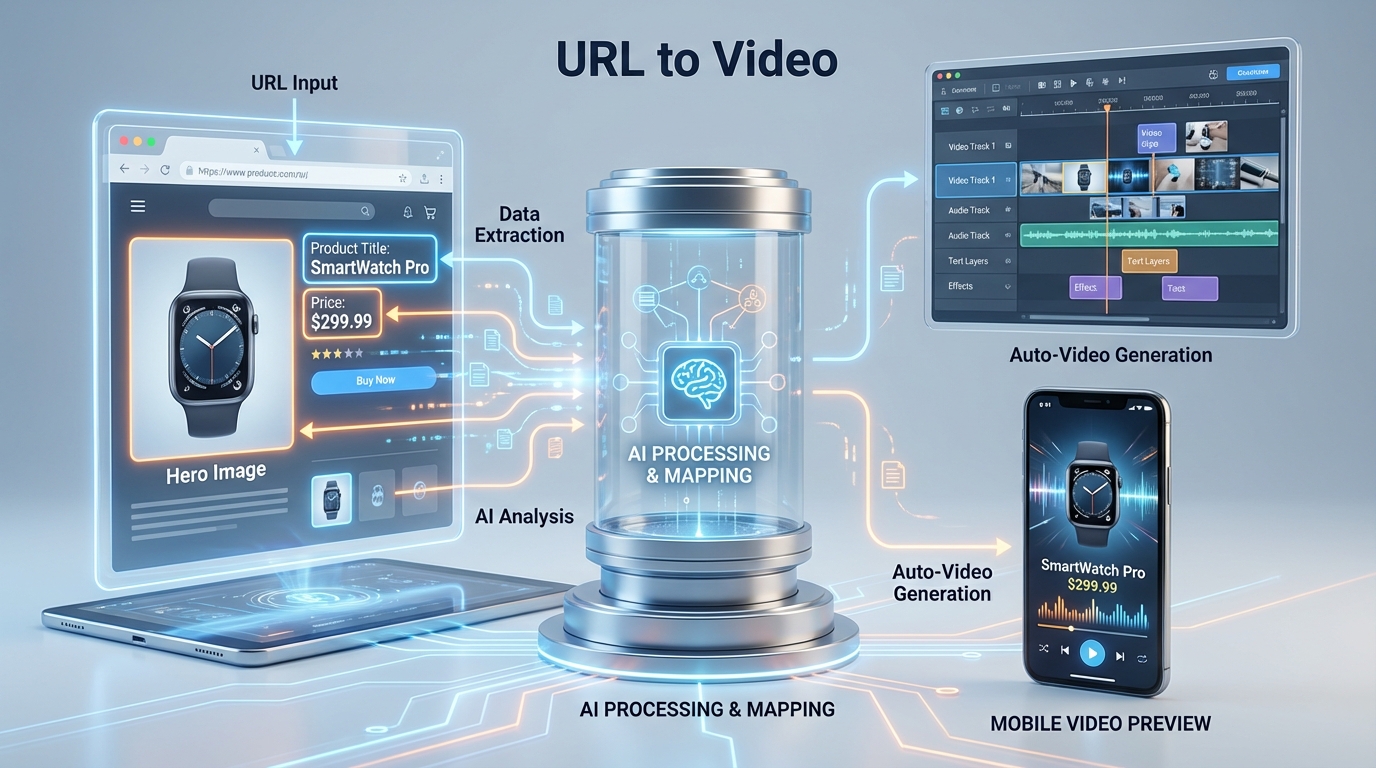
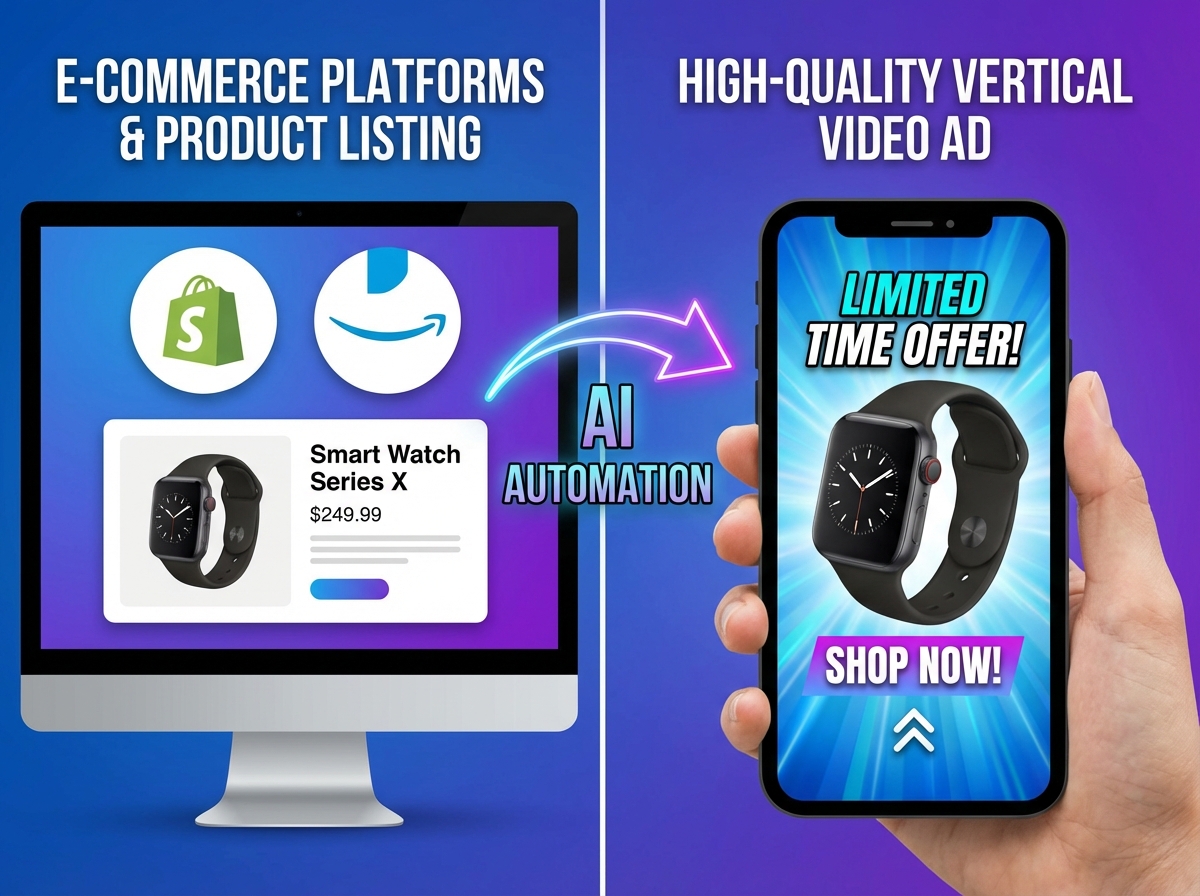
The most immediate application for a URL to video AI generator is within the major ecommerce ecosystems. Shopify video integration has become a streamlined process where merchants can simply paste a product URL into the generator to produce high-quality PDP videos. The system uses the Shopify Storefront API to extract critical data points such as the product title, price, compare-at price, media gallery, and even customer ratings. These elements are then automatically mapped to a 1:1 or 9:16 template, which can be embedded directly back into the Shopify theme as an app block or syndicated to Meta and TikTok ad accounts.
For brands operating on Amazon, the focus shifts to Amazon listing videos. By ingesting an ASIN or product URL, the AI parses the title, bulleted features, and images to create compliant videos that adhere to Amazon's strict text-density and safe-area guidelines. These videos are typically 15–30 seconds long and are designed to be "silent-first," utilizing captions and bold overlays to convey value even when the user has their sound turned off. This bulk mapping of an ASIN feed to auto-generated video allows brands to cover their entire Amazon catalog in a fraction of the time it would take a traditional agency.
Beyond standard product pages, the technology also excels at converting landing pages into video ads. By extracting hero headlines, social proof, and benefit statements from a high-performing landing page, the URL to video AI generator can produce a variety of ad hooks and CTA cards. This ensures that the video ad seen by the consumer is perfectly mirrored by the landing page they arrive at, creating a cohesive user journey that significantly improves conversion rates and ROAS. Best-practice guidance: web content video automation tips
5. Scaling Through Automation: CSV to Video Bulk Generation and Technical Workflows
When dealing with thousands of products, manual URL entry is no longer feasible. This is where CSV to video bulk generation becomes the primary workflow for enterprise marketers. By uploading a CSV file containing product URLs, SKUs, and specific attributes like discount percentages or seasonal CTA text, brands can trigger the simultaneous creation of thousands of unique video assets. The system maps each CSV column to a corresponding variable in the video template, ensuring that every SKU receives a tailored creative that reflects its unique selling points.
The technical workflow behind this scale involves several sophisticated steps:
- URL Ingestion and Parsing: The system crawls the page, rendering JavaScript if necessary to extract HTML and JSON-LD data. It prioritizes high-resolution assets and uses heuristic extraction if structured data is missing.
- Template Binding: Variables like {product_title}, {hero_image}, and {price} are bound to the brand kit, which includes specific fonts, colors, and motion styles.
- Rendering Pipeline: The GPU scheduler assigns the task to a render node. The goal is a 30-second rendering time per video, even under heavy load.
- Webhooks and QA: Once the render is complete, a webhook notifies the brand's system. Automated visual checks ensure that logos are visible and text contrast meets accessibility standards.
This level of web content video automation allows for "diff-only" rendering. For example, if a brand changes the price of 500 items in their catalog, the system can be configured to only re-render the videos for those specific SKUs, saving time and compute resources. This ensures that the video content displayed on PDPs and in ads is always synchronized with the live site data, preventing the common issue of displaying outdated pricing or out-of-stock items.
6. Performance and ROI: Maximizing Impact with Dynamic Content Generation
The ultimate goal of implementing a URL to video AI generator is to drive measurable business outcomes. Dynamic content generation allows marketers to move beyond static, one-size-fits-all videos and instead produce variants tailored to specific audiences, geographies, and languages. By testing different hooks—such as benefit-led vs. price-led messaging—brands can identify which creative elements resonate most with different segments. Solutions like TrueFan AI demonstrate ROI through increased engagement rates and a significant reduction in the time-to-market for new creative tests.
To accurately measure the success of these automated workflows, performance marketers should track several key KPIs:
- Velocity KPIs: The number of videos produced per marketer per day and the time-to-first-render.
- Engagement KPIs: PDP dwell time, Add-to-Cart (ATC) lift, and video completion rates.
- Financial KPIs: CTR vs. static assets, CVR, and overall ROAS by channel.
By utilizing a product page video converter to refresh creatives frequently, brands can effectively combat ad fatigue. When a creative's performance begins to dip, the system can automatically generate a new variant with a different hook or a seasonal overlay, maintaining high performance without requiring a new production cycle. This iterative approach to creative testing, supported by the speed of a 30-second rendering time, allows for a level of optimization that was previously reserved for text-based search ads.
7. Implementation Playbooks and Frequently Asked Questions
To successfully deploy a URL to video AI generator, brands should follow a structured implementation playbook. For a Shopify quick-start, the process involves selecting a collection, choosing a template, and rendering the assets in under 30 seconds before embedding them via a theme block. For Amazon, the workflow focuses on exporting an ASIN feed and mapping it to caption-heavy, marketplace-compliant templates. For enterprise-level feed-driven refreshes, the focus is on setting up a daily API sync that automatically updates video assets whenever site data changes. Deeper API patterns: URL to video AI generator ultimate guide
Conclusion
The transition to an enterprise URL to video AI generator is no longer a luxury but a necessity for brands aiming to maintain a competitive edge in 2026. By embracing web content video automation, organizations can achieve 10x content velocity, ensuring that every product URL is supported by high-quality, on-brand video. Whether through Shopify video integration, Amazon listing videos, or API-driven video creation, the ability to render assets in a 30-second rendering time allows for unprecedented agility. By leveraging CSV to video bulk generation and dynamic content generation, performance marketers can finally align their creative output with the speed of their data, driving higher ROAS and lower CAC across all digital channels. To see how these technologies can transform your creative workflow, consider booking an enterprise demo to explore a pilot program tailored to your specific performance KPIs.
Recommended Internal Links
- URL to video AI generator
- URL to video AI generator guide
- URL to video AI generator 2024
- API-driven video creation: Ultimate guide
- Web content video automation tips
- Web content video automation guide
- Web content video automation 2024
- Web content video automation strategies
Frequently Asked Questions
How do I generate videos from a URL?
You can generate videos by either pasting a product URL into a dashboard or by using an API to POST the URL to a dedicated endpoint. The system then parses the web content, extracts the necessary assets, and renders a complete video in approximately 30 seconds. This automated video creation from URL is the fastest way to scale content production.
Does it work with Shopify and Amazon?
Yes, most enterprise solutions offer dedicated Shopify video integration through app blocks and theme sections. For Amazon, the system supports Amazon listing videos by parsing ASIN data and applying templates that meet Amazon's specific creative requirements and safe-area guidelines.
How fast are renders at scale?
High-performance systems target a median 30-second rendering time per video. For larger batches, CSV to video bulk generation can support throughputs of over 10,000 renders per hour, depending on the complexity of the templates and the available GPU resources.
What about security and compliance?
Enterprise platforms like TrueFan AI prioritize security by maintaining SOC2 and ISO 27001 certifications. They include features like SSO, audit logs, and HMAC-signed webhooks to ensure that the API-driven video creation process is secure and that all generated content adheres to brand safety standards.
Can I personalize per audience or language?
Absolutely. Through dynamic content generation, you can insert variables for customer names, locations, or specific product attributes. Advanced platforms support over 175 languages, allowing you to localize your video content for global markets instantly without needing multiple production teams.