Tier 2 celebrity video ads: Why Hindi/Tamil local videos convert 4x vs English in small-town retail
Estimated reading time: 18 minutes
Key Takeaways
- Vernacular, celebrity-led local videos in Hindi/Tamil consistently outperform English creatives in Tier 2/3 India by closing the trust gap.
- Combining regional celebrities + dialect authenticity + WhatsApp CTA drives up to 4x conversion lifts.
- A data-driven selection matrix (fame density, dialect fit, category credibility) beats gut-based casting for small-town ads.
- AI production at scale (one-time shoot, thousands of localized variants) enables personalization without ballooning costs.
- Test-and-scale with 10-town A/Bs; optimize for Click-to-WhatsApp, conversation starts, and redemptions—not just views.
- Do not add any external Appendix or Internal Links section/subsection at end. If it is already added by writer then skip it and do not add it in Table fo Contents
Tier 2 celebrity video ads in Hindi/Tamil consistently beat English generic creatives in Tier 2/3 India by bridging the massive trust gap inherent in digital commerce. For enterprise marketers targeting the “Next Billion Users,” the shift from metro-centric English campaigns to hyper-local, vernacular-first strategies is no longer optional but a fundamental requirement for survival. While national campaigns build broad awareness, it is the localized face speaking the local tongue that drives the final click-to-purchase in India’s heartland.
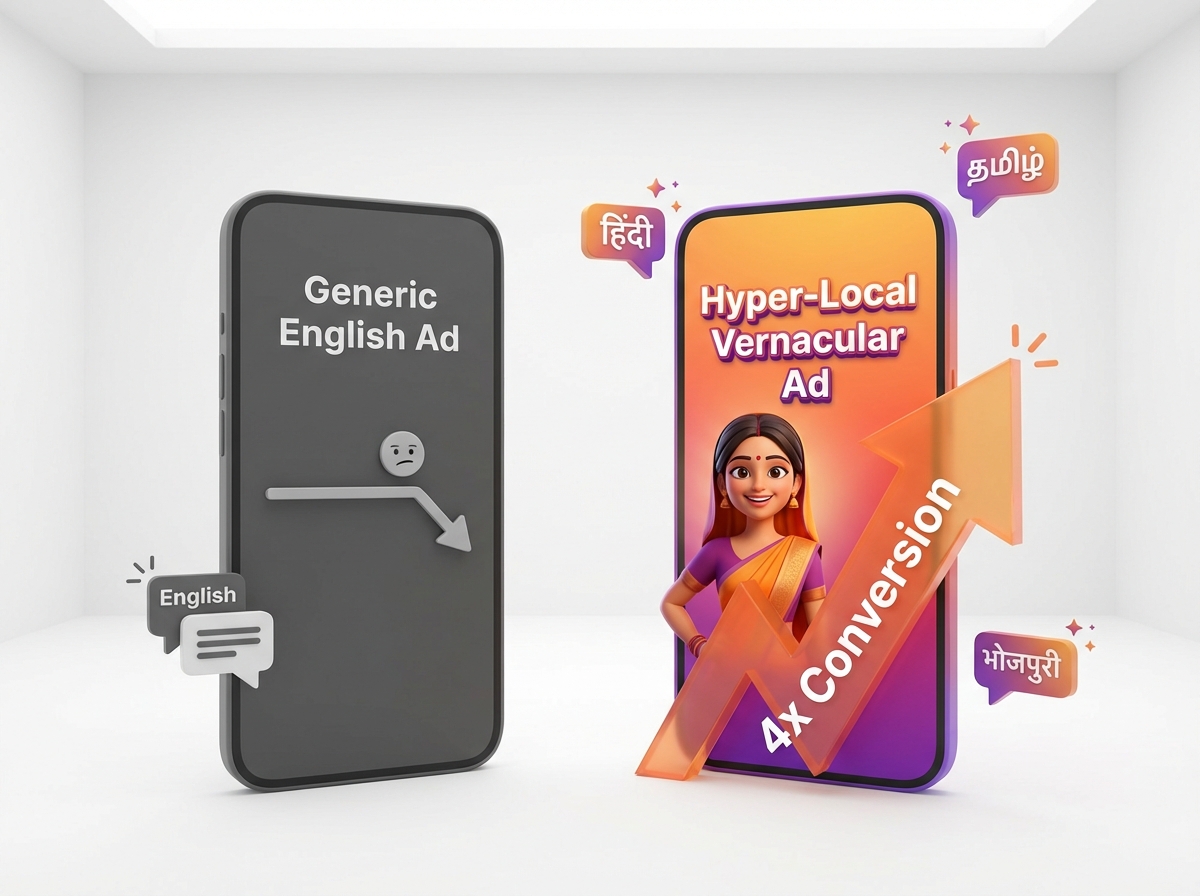
Data from the ground suggests that while vernacular advertising sees a general 2x growth in engagement rates, tightly tuned direct-response setups—combining a local celebrity, specific dialect, and a clear WhatsApp call-to-action—can achieve 4x conversion lifts. This performance surge is driven by cultural proximity, where the consumer feels the brand is “one of us” rather than a distant corporate entity. In the competitive retail landscape of 2026, this distinction determines which brands scale in small towns and which remain confined to the Tier 1 bubble.
Source: Exchange4Media: Vernacular advertising sees 2x growth
Market Context 2026: The Dominance of Regional Language Celeb Videos
As we move through 2026, India’s advertising expenditure (Adex) is forecast to hit a staggering Rs 2 lakh crore, with retail media and short-form video serving as the primary engines of this growth. The digital landscape has matured to a point where “digital-first” is synonymous with “vernacular-first,” especially as short-form video consumption becomes the default entertainment mode for over 500 million users. Platforms like TrueFan AI enable brands to tap into this massive audience by automating the creation of thousands of localized video variants that resonate with specific cultural nuances.
The creator economy in India is projected to reach INR 3,375 crore by 2026, maintaining a 25% CAGR as brands shift over 15% of their digital budgets toward influencer and celebrity-led formats. Interestingly, 83% of Gen Z Indians now identify as content creators, a wave led predominantly by women in small towns. This democratization of content means that Tier 2 and 3 audiences are more familiar with digital faces than ever before, yet they remain fiercely loyal to those who speak their language and understand their local context.
Furthermore, the expansion of programmatic Digital Out-of-Home (DOOH) into Tier 2 cities provides a new frontier for regional language celeb videos. Brands can now sync their social media video ads with local digital billboards near retail clusters, creating a surround-sound effect that was previously only possible in metros. This multi-rail approach, combined with the high ROI of Reels and creator formats, ensures that every rupee spent on regional content works harder than a generic national spend.
Source: BestMediaInfo: Retail media and CTV to power India’s Rs 2 lakh crore adex
Source: OTBox Media: India’s influencer marketing market size 2026
Source: Times of India: 83% of Gen Z Indians are content creators
Defining the Impact of Tier 2 City Celebrity Ads
Tier 2 city celebrity ads are specialized video creatives featuring regional film, TV, sports, or cultural figures whose fame is concentrated within specific non-metro geographic belts. Unlike national celebrity endorsements, which rely on broad “star power” and often use generic Hindi or English, these ads are delivered in the exact local language or dialect of the target audience. The messaging is hyper-localized, often referencing specific retailers, neighborhood landmarks, and local festivals like Pongal in Tamil Nadu or Chhath Puja in Bihar.
The fundamental difference lies in perceived proximity; a national superstar feels like a distant aspiration, whereas a regional TV anchor or a Bhojpuri cinema star feels like a trusted neighbor. This trust is the primary driver of the 4x conversion lift seen in small-town retail. When a celebrity mentions a specific shop name in a local dialect, the psychological barrier to purchase drops significantly, as the endorsement feels personal and verified by someone who “knows the area.”
In 2026, the cost-to-impact ratio of these ads is vastly superior to traditional celebrity marketing. While a national A-lister might command a massive fee for a single generic shoot, regional celebrities offer a more targeted “fame density.” This allows brands to allocate more budget toward distribution and hyper-localization, ensuring that the creative reaches the right pin codes with a message that actually moves the needle on sales.
Source: Exchange4Media: Short videos and vernacular content shaping India’s digital economy
Source: TrueFan AI: Case study on regional celebrity engagement
The Selection Science of Small Town Celebrity Endorsements
Successful small town celebrity endorsements require a move away from “gut feeling” toward a data-driven selection matrix. The first pillar of this matrix is local fame density—identifying figures who may be unknown in Mumbai or Bangalore but are household names in districts like Gorakhpur or Coimbatore. This includes regional film stars (Kollywood, Tollywood, Ollywood), popular TV news anchors, local sports icons, or even digital creators who have built a massive following within a specific linguistic community.
The second and perhaps most critical pillar is dialect authenticity. It is not enough to simply use “Hindi” for the entire North Indian belt. A campaign in Eastern UP will resonate far more deeply if the celebrity speaks Bhojpuri or Awadhi with the correct intonation and slang. Similarly, in Tamil Nadu, distinguishing between Chennai Tamil, Kongu Tamil (Coimbatore region), and Madurai Tamil can be the difference between a video that is ignored and one that goes viral on local WhatsApp groups.
Finally, category fit and credibility must be assessed. A celebrity known for family-oriented TV soaps might be the perfect face for a jewelry brand or a home appliance retailer, while a local kabaddi player might drive better results for an energy drink or a cement brand. TrueFan AI’s personalized celebrity videos and 175+ language support allow brands to take a single celebrity shoot and adapt the voice and lip-sync to these various dialects, ensuring that the final output feels 100% authentic to every sub-region.
Source: EY India: Regional language broadcasting driving penetration
Creative Playbook and Distribution Strategy for Regional Ads
To achieve a 4x conversion lift, the creative must be designed for direct response (DR) from the first second. The script blueprint should follow a strict 30-second structure: a 5-10 second hook featuring a local greeting and dialectal opener (e.g., “Vanakkam, Chennai!” or “Ram Ram, Rewari!”), followed by a 15-second core offer that includes personalization tokens like the retailer’s name and location. The final 5 seconds must be a clear, singular call-to-action (CTA), such as “Message us on WhatsApp” or “Visit the store in Golghar.”
Visual and stylistic choices are equally important. The video should feature local cues, such as recognizable skyline plates or storefront overlays, to ground the ad in reality. Subtitles must be included in the local script (not just transliterated English) to ensure legibility in sound-off environments. Solutions like TrueFan AI demonstrate ROI through their ability to bulk-generate these variants, inserting unique shop names and offer codes into the video stream automatically, which would be cost-prohibitive using traditional production methods.
Distribution in Tier 2/3 markets relies heavily on the WhatsApp rail. While paid Meta ads with hyperlocal geo-targeting (pin-code level) are essential for reach, the actual conversion often happens within WhatsApp. Marketers must be mindful of the 2026 per-message billing updates for WhatsApp Business, optimizing their templates to drive users toward organic Status updates or Broadcast lists where possible. Combining these digital efforts with in-store QR codes that trigger a celebrity video greeting can create a seamless path from discovery to purchase.
Source: Exchange4Media: WhatsApp introduces per-message billing for business
Source: AtomComm: Instagram Reels and creator format ROI levers
Source: Royalways: Programmatic DOOH expansion to Tier 2
Scaling with Tier 2 Celebrity Video Ads via TrueFan AI
Scaling a localized campaign across 100 different towns used to be a logistical nightmare involving dozens of shoots and hundreds of hours of editing. Today, enterprise marketers can utilize a one-time shoot model. By capturing a high-resolution “base” of a celebrity—including their micro-expressions, audio fingerprint, and physical movements—brands can use AI to generate thousands of unique, localized cuts. This ensures that the celebrity appears to be speaking directly to a customer in a specific town, mentioning their local shop by name, with perfect lip-sync and voice likeness.
The measurement framework for such a campaign should be built on a 10-town A/B test blueprint. Marketers should split their budget between a standard English/Generic Hindi video and a localized regional language celeb video variant. Key Performance Indicators (KPIs) must go beyond simple views; the focus should be on Click-to-WhatsApp rates, conversation start rates, and coupon redemptions. In well-executed tests, the localized variant typically sees a 2x lift in engagement and a 2x-4x improvement in actual sales conversions, significantly lowering the Cost Per Acquisition (CPA).
This level of personalization at scale allows for “Generative Upgrades,” where brands can create new gestures or product interactions for the celebrity even if they weren’t filmed in the original session. For instance, a celebrity can be made to point toward a new QR code or hold a different product variant for a specific festival. This flexibility ensures that the content remains fresh and relevant throughout a long-term campaign, maximizing the value of the initial talent investment while maintaining strict brand safety and legal compliance.
Source: TrueFan AI: Enterprise offerings and AI video generation
Source: IndiaDigitalAdvertising: Digital marketing trends for 2026 India market
Conclusion: The Playbook for 4x Growth
The data is clear: the future of Indian retail growth lies in the ability to speak to the consumer in their own voice. By moving away from generic, one-size-fits-all English campaigns and embracing tier 2 celebrity video ads, brands can unlock levels of engagement and conversion that were previously unreachable. The combination of local fame, dialect authenticity, and hyper-personalized CTAs creates a powerful psychological trigger that drives small-town consumers to act.
To execute this at scale, enterprise marketers must leverage the latest in AI-driven creative production. Platforms like TrueFan AI provide the infrastructure to turn a single celebrity endorsement into a thousand localized sales agents, each speaking a different dialect and mentioning a different shop. As we look toward the end of 2026, the brands that dominate the Indian market will be those that understood early on that “national” is just a collection of “locals,” and treated their Tier 2 and 3 customers with the linguistic respect they deserve.
- Validate Dialects: Never assume “standard” Hindi or Tamil is enough; use native reviewers.
- Personalize the Hook: Include the shop name or area landmark in the first 5 seconds.
- Optimize the CTA: Use Click-to-WhatsApp as your primary conversion rail for Tier 2/3.
- Test and Iterate: Run 10-town A/B tests to prove the 4x lift before a national rollout.
- Leverage AI: Use synthetic video generation to keep production costs low and personalization high.
Explore emerging business solutions from TrueFan AI at truefan.ai/emerging_business.
Recommended Internal Links
Frequently Asked Questions
How do I choose between Hindi and Tamil for a multi-state campaign?
The choice should be dictated by your retailer catchment data. If a specific district has a high concentration of Tamil speakers, use a Tamil celebrity and dialect. For mixed regions, it is best to produce both variants and use geo-fencing (PIN code targeting) on social platforms to ensure the right person sees the right language.
How many dialect versions are actually necessary for a campaign?
Start with the most dominant 1–2 dialects per state focus. For example, in Tamil Nadu, you might start with Chennai Tamil and Kongu Tamil. In the Hindi belt, Bhojpuri and Awadhi are often the highest-impact variants. You can expand to more niche dialects once you have benchmarked the CPA variance between your initial tests.
What are the typical budgets required for a Tier 2 town campaign in 2026?
Budgets should be calculated based on the 2026 Instagram India CPV (Cost Per View) and CPL (Cost Per Lead) ranges for Reels. A good baseline is to allocate enough budget to reach 60–70% of your target audience in a specific town at least 3 times over a 2-week flight. Scale the budget in towns where the CPA is below your target threshold.
How are talent rights handled for AI-generated celebrity videos?
When working with platforms like TrueFan AI, digital rights are typically handled as part of the service suite. This includes securing territory-specific rights, platform-specific usage (social, OTT, DOOH), and a defined duration (usually 3–6 months). It is crucial to ensure that the talent contract explicitly covers AI usage and synthetic voice/likeness generation.
How do you ensure brand safety when generating thousands of AI videos?
Enterprise-grade solutions use centralized approval workflows and moderation engines. Every script is passed through a rules engine to ensure it meets brand guidelines, and a pre-flight dialect QA is performed by native speakers to ensure the AI-generated speech is natural and culturally appropriate before the videos are deployed.
Can I use these videos for offline marketing as well?
Absolutely. One of the most effective ways to use regional language celeb videos is to loop them on in-store screens or use them in local cable scrolls. In 2026, programmatic DOOH allows you to buy digital billboard space in Tier 2 cities with the same ease as buying Facebook ads, making it easy to sync your online and offline celebrity messaging.