Summer Camp Enrollment Videos: Dual‑Persona AI That Wins April–May 2026 Sign‑Ups
Estimated reading time: ~16 minutes
Key Takeaways
- Build dual‑persona videos that engage kids with adventure while assuring parents with safety, logistics, and ROI.
- Use personalized urgency (real seat counts, local deadlines) and ethical offers to move families from browsing to booking.
- Deploy interactive virtual tours so parents can explore safety details while children choose interest-led paths.
- Scale trust with localized testimonial automation and compliant data practices under India’s DPDP Act.
- Leverage TrueFan AI Enterprise for API-driven personalization, multilingual avatars, and instant offer updates.
Summer camp enrollment videos help Indian EdTech companies and camp providers convert April–May interest into paid enrollments by addressing both parent concerns and child excitement. As we approach the peak recruitment window for the 2026 season, the traditional “one-size-fits-all” marketing video has become obsolete. In a landscape where families are bombarded with options, the differentiator is no longer just the activity list; it is the ability to deliver a hyper-personalized, dual-persona narrative that speaks simultaneously to the child’s desire for adventure and the parent’s demand for safety and ROI.
The April–May window in India represents a high-stakes decision period. With residential camps in hubs like Bengaluru and Mumbai launching early batches in late April, the pressure to secure deposits is immense. Success in this environment requires a sophisticated blend of emotional engagement and logistical transparency. By leveraging summer camp enrollment videos 2026, providers can bridge the gap between “browsing” and “booking” through automated, data-driven storytelling that respects the unique psychological triggers of both decision-makers in the household.
1. April–May 2026 India Enrollment Realities That Your Videos Must Solve
The enrollment cycle for 2026 follows a rigorous timeline where the “Early Bird” phase transitions into “Final Call” urgency between April 1st and May 15th. During this period, Indian families typically compare 2–4 competing programs, weighing factors such as proximity, counselor-to-camper ratios, and the tangible skills their children will bring home. Data from early 2026 indicates that 68% of Indian parents now prioritize “experiential safety” over brand name alone, making visual proof of protocols essential in every video.
Residential camps running from late April to mid-May in Bengaluru indicate that the most successful enrollment drives are those that utilize deadline-based nudges. These are not generic countdowns but personalized alerts that reflect the actual remaining spots in a specific age cohort or interest track. For instance, a video sent to a parent in mid-April should dynamically display the remaining “Early Bird” slots for the “Robotics Level 1” track, creating a legitimate sense of scarcity that drives immediate action.
Furthermore, the 2026 trend toward “micro-specialization” means that trekking and experiential camps are actively recruiting pilot groups during this window. Parents are citing staff quality and specific learning outcomes as the primary reasons for recommendation. To solve this, your summer camp enrollment videos 2026 must move beyond generic B-roll. They must feature transparent pricing, clear transport options, and refund policies directly on-screen. This reduces the friction of inquiry, allowing the parent to move to the payment gateway without needing a manual follow-up call.
Sources:
- Summercamp India: 2026 national camp schedule
- Indiahikes: Himalayan trekking summer camps and safety practices
2. Parent‑Child Dual Targeting: Scripting for Engagement and Approval
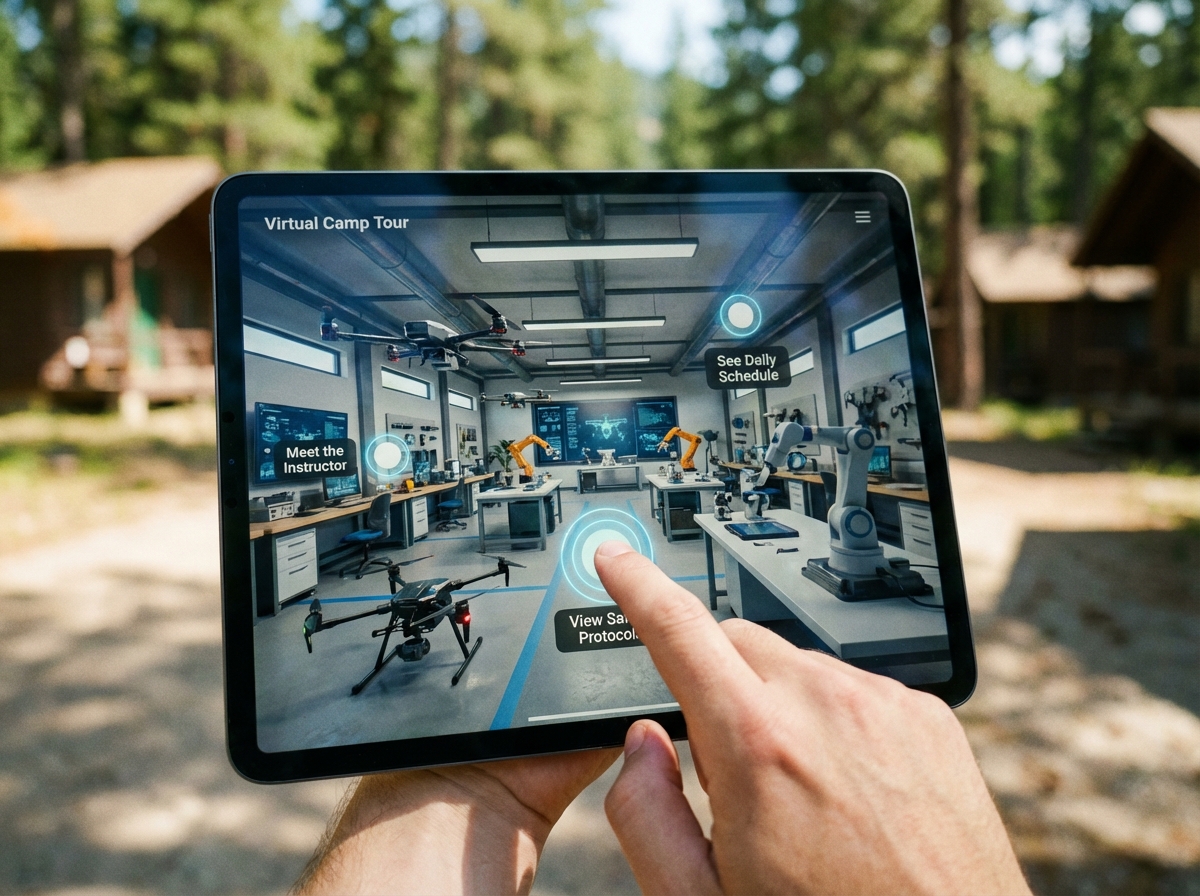
Parent-child dual targeting is a structured creative approach where a single video journey programmatically branches to satisfy two distinct decision-makers. In the Indian context, the child often acts as the “influencer” who initiates interest, while the parent acts as the “gatekeeper” who authorizes the transaction. Achieving child engagement parent approval requires a script that alternates between high-energy visual hooks for the camper and data-heavy trust signals for the guardian.
A high-converting script blueprint for 2026 utilizes a “split-track” architecture. The first 7 seconds must be child-led, featuring a visual hook like a drone shot of a trekking peak or a close-up of a functioning robot. The audio should address the child by name: “Hey Aarav! Ready to build a robot that plays cricket with you this June?” This immediate personalization triggers an emotional “opt-in” from the child. However, immediately following this, a “Parent Assurance Overlay” must appear. This is a Picture-in-Picture (PIP) layout or a text sidebar highlighting ISO-aligned safety standards and trained medical staff, ensuring the parent’s primary concern is addressed while the child remains engaged by the background action.
The middle segment of the video should focus on summer activity personalization. Using API-driven variables, the video can swap modules based on the child’s interest—whether it is coding, football, or art. For the parent, this section must include “Outcomes + Logistics” cards. While the child sees a montage of “buddy moments” and team challenges, the parent sees a daily schedule, meal plans, and pick-up/drop-off timings. Platforms like TrueFan AI enable this level of granular personalization at scale, allowing thousands of unique versions to be rendered and delivered via WhatsApp Business commerce automation in 2026 in under 30 seconds.
3. Virtual Camp Tour Personalization That Converts
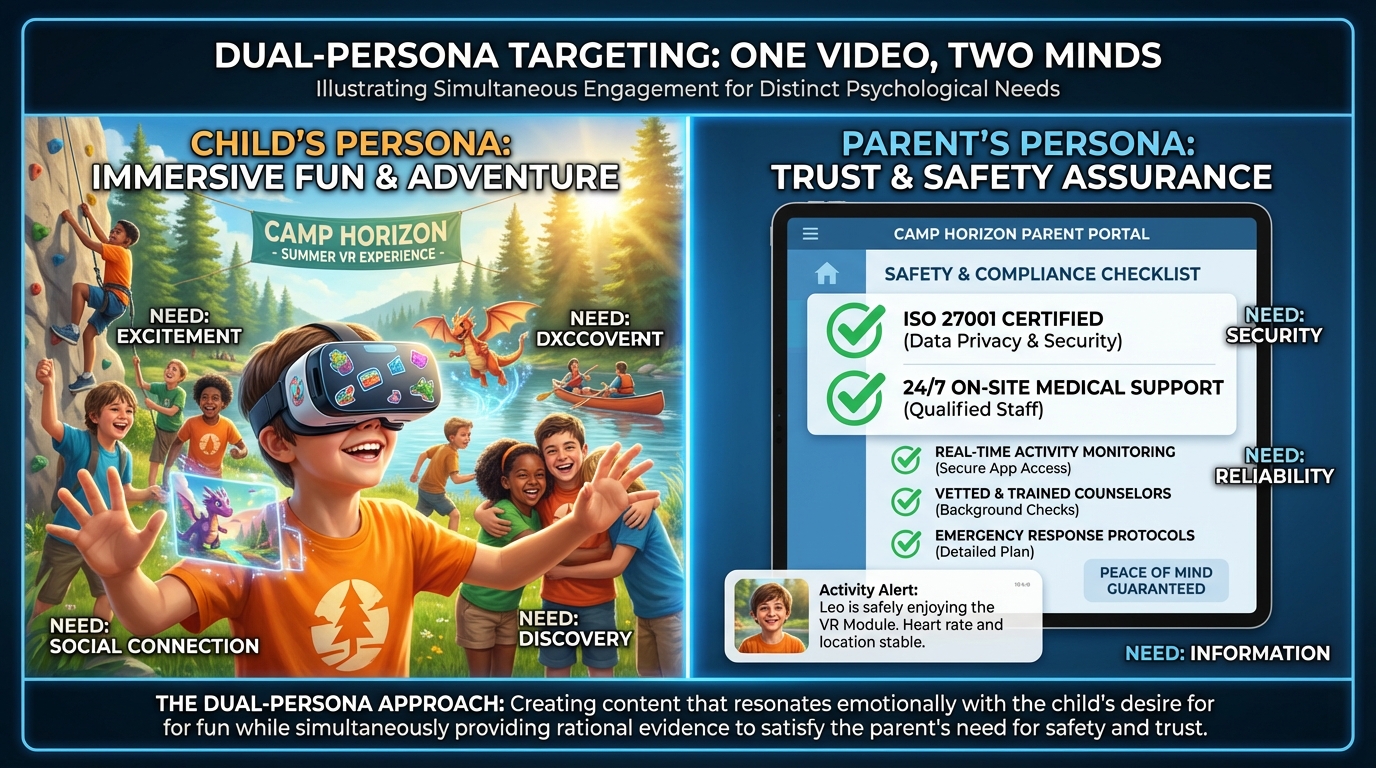
Virtual camp tour personalization is the evolution of the static “About Us” video. In 2026, a generic tour is a missed opportunity. Instead, providers are using decision nodes within the video to allow viewers to “choose their own adventure.” This interactive design ensures that a child interested in the “Astronomy Lab” isn't forced to watch five minutes of “Football Turf” footage, which significantly reduces drop-off rates.
For the parent-leaning branch, the virtual tour should include a “Safety Briefing Snippet” and a tour of the medical station. In India, where heatwaves and hydration are major concerns for May camps, showing the menu board and the cooling facilities in the dorms provides immense psychological relief. These elements should be accessible via in-video buttons like “View Bus Route” or “Meet Your Counselor.” When a parent clicks these, the video dynamically pulls the relevant footage, creating a bespoke experience that feels like a private consultation.
The child-leaning branch, conversely, should focus on the “End-of-Week Showcase.” Teasing the final performance or the “Robotics Championship” creates a goal-oriented excitement. Visual tips for 2026 include keeping transitions under one second and using on-screen icons to distinguish between “Fun Beats” (represented by a lightning bolt) and “Safety Beats” (represented by a shield). This dual-iconography helps both personas navigate the information density of the video without feeling overwhelmed.
Sources:
- SRV Edge: AI automation for student recruitment
- Modifyed: Increasing student admissions with digital marketing
4. From Fun to Future‑Ready: Skill Development Summer Videos
In the 2026 EdTech landscape, summer camps are no longer viewed as mere childcare; they are vacation learning opportunities. Skill development summer videos must bridge the “summer slide” by tying every fun activity to a tangible learning outcome. This is particularly important for Indian parents who are increasingly aligned with National Education Policy (NEP) goals, such as digital literacy, collaboration, and critical thinking.
For a STEM or coding track, the video should explicitly state: “In one week, your child will learn sensors and loops, demo their bot in a team challenge, and receive a Robotics Explorer badge.” This transforms the “fun” of building a robot into a “future-ready” artifact for the child’s portfolio. Similarly, for sports or trekking camps, the messaging should focus on stamina, route planning, and team coordination. Referencing the experiential credibility of leaders like Indiahikes, who emphasize outdoor skills and safety drills, adds a layer of authority that parents value when making high-ticket enrollment decisions.
Marketing these programs requires pairing each video module with a landing page section that addresses parent FAQs. The video acts as the “hook,” while the landing page provides the “depth.” By using summer learning program marketing strategies that highlight micro-badges and certificates, EdTech companies can justify premium pricing. The video should visually showcase these badges, making the achievement feel “real” to the child and “valuable” to the parent before they even set foot in the camp.
5. Offers That Nudge Decisions Ethically: Early Bird + Sibling Logic
The final push for April–May enrollments often hinges on financial incentives. However, in 2026, generic “10% off” banners are less effective than dynamic, personalized offers. Early bird enrollment incentives should be presented as time-bound value adds that are visible in-video with a live countdown synced to the viewer’s local time. For example, “Rs 1,500 off if you book by Friday” feels more urgent when the video itself shows the clock ticking down.
Sibling discount campaigns are another critical lever for the Indian market, where multi-child households are common. A personalized video can include an “Add Sibling” toggle. When clicked, the video dynamically re-calculates the net price and displays the total savings on-screen. This transparency removes the need for the parent to do mental math or search through a complex fee table on a website. It simplifies the decision to a single “Yes.”
It is vital to ground these offers in ethical marketing. India’s 2026 consumer guidelines strictly prohibit “dark patterns” or fake scarcity. Therefore, the urgency in your summer camp enrollment videos must be backed by real-time inventory data. If the video says “Only 3 spots left for the Ooty trek,” it must be an accurate reflection of the CRM data. This builds long-term trust, ensuring that the parent returns for future programs or recommends the camp to their social circle.
Sources:
- Instagram reel examples: Early bird offer messaging
- Instagram post: Sibling discount logic in Indian camps
6. Social Proof at Scale: Parent Testimonial Automation
Social proof is the “closing” element of any enrollment journey. Parent testimonial automation allows camp providers to insert relevant, localized reviews into their videos without manual editing. In 2026, a parent in Delhi is more likely to be swayed by a testimonial from another Delhi-based parent whose child attended the same “Coding Bootcamp” last year.
The workflow for this involves a WhatsApp-first approach. After a successful camp session or inquiry, the system automatically requests a brief testimonial. Once moderated, this quote—along with a photo or short video clip—is tagged by city, age group, and activity. When a new prospect watches an enrollment video in April 2026, the system auto-selects the most relevant testimonial and inserts it at the 56-second mark. This “hyper-local” social proof strategy significantly boosts child engagement parent approval by showing that “people like us” trust this program.
However, compliance is paramount. Under India's Digital Personal Data Protection (DPDP) Act, any data involving minors is classified as high-risk. Providers must obtain verifiable parental consent before using a child’s likeness or even a parent’s quote in an automated marketing stream. The DPDP Act requires purpose limitation, meaning the consent must be specific to the testimonial use and cannot be buried in general terms and conditions.
Sources:
- Exchange4Media: DPDP Act reshapes India’s kids’ digital economy
- SSRana: Ensuring child safety under the DPDP Act
7. Humanizing at Scale with Camp Counselor AI Avatars
One of the most significant breakthroughs for summer camp enrollment videos 2026 is the use of camp counselor AI avatars. These are consented digital replicas of real camp leaders who can greet, explain, and reassure parents in multiple languages. In a country as linguistically diverse as India, the ability to speak to a grandparent in Tamil or a parent in Hindi—while maintaining the counselor’s original voice and warmth—is a massive competitive advantage.
TrueFan AI's 175+ language support and Personalised Celebrity Videos technology can be adapted here to create “Counselor Avatars” that provide a 1:1 feel at a 1:Million scale. These avatars can be used to address specific FAQs that vary by city. For instance, a counselor can explain the specific pickup point in Indiranagar, Bengaluru, in one video, and the pickup point in Powai, Mumbai, in another, all without the need for multiple reshoots.
Implementation requires a “consent-first” approach. The real counselors must have clear contracts regarding their digital likeness, and the videos must include a disclosure that synthetic media is being used. This transparency is not just a legal requirement but a trust-builder. When parents see that a camp is using cutting-edge, compliant technology to communicate clearly, it reflects positively on the camp’s overall professionalism and commitment to safety.
8. Orchestrating EdTech Summer Campaigns: Channels and Timing
A successful EdTech summer campaign in 2026 requires a multi-channel orchestration that respects the different habits of parents and children. For parents, the primary channels remain Email and WhatsApp Business. These videos should be “logistics-heavy,” focusing on the schedule, safety, and offers. For children and teens, the focus shifts to Instagram Reels and YouTube Shorts, featuring high-energy “activity cuts” that lead to a QR code for an interactive virtual tour.
The timing for April–May 2026 should follow a specific sequence:
- Week 1 (Early April): Awareness phase. Launch virtual camp tour personalization and avatar welcomes. Seed the “Early Bird Tier 1” offers.
- Week 2-3: Consideration phase. Deploy skill development summer videos tailored to the child's interest. Inject automated parent testimonials to build trust.
- Week 4 (Early May): Conversion phase. Launch the “Offer Finale” and sibling discount campaigns. Use last-chance WhatsApp nudges with real-time seat scarcity overlays.
By sequencing the content this way, you move the family through the funnel from “curiosity” to “commitment.” The use of personalized video throughout this journey ensures that the messaging remains relevant as the deadline approaches. Solutions like TrueFan AI demonstrate ROI through higher completion rates and lower cost-per-acquisition compared to static ad campaigns.
9. Privacy, Safety, and India Compliance (DPDP Act Focus)
As we navigate the 2026 enrollment season, compliance with the DPDP-compliant personalization strategies is non-negotiable. The Act places a heavy emphasis on the “detrimental processing” of children's data. This means that summer camp enrollment videos must avoid behavioral tracking or targeted advertising aimed directly at minors. Personalization should be restricted to data provided voluntarily by the parent through a secure, age-gated portal.
Practical steps for compliance include:
- Verifiable Parental Consent: Use a double-opt-in process where the parent confirms their identity and provides explicit consent for the child’s data to be used for video personalization. See guidance on interactive video data capture.
- Data Minimization: Only collect the data necessary for the video (e.g., first name, interest). Do not store sensitive health or location data within the video rendering engine.
- No Retargeting of Minors: Ensure that retargeting pixels are only active on parent-facing platforms and do not track the child’s browsing habits across the web.
Adhering to these standards is not just about avoiding fines; it is about protecting the brand’s reputation. In 2026, a single privacy breach can destroy a camp’s enrollment for years. By building “Privacy by Design” into your video automation workflows, you signal to parents that their child’s safety is your absolute priority, both online and offline.
Sources:
10. How TrueFan AI Enterprise Powers This
Executing a dual-persona, hyper-personalized video strategy at scale requires a robust technical infrastructure. The TrueFan AI Enterprise platform is designed to handle the high-volume demands of peak enrollment seasons, ensuring that every inquiry receives a personalized response in near-real-time.
Key capabilities include:
- API-Driven Variable Swaps: Automatically change names, cities, and interest tracks.
- Multilingual Lip-Sync: Localize counselor avatars into 175+ languages with perfect synchronization.
- Virtual Reshoots: Update offer deadlines or pricing in thousands of videos simultaneously without new filming.
- Social Proof Integration: Automatically pull and moderate parent testimonials based on the viewer's profile.
By integrating these tools, EdTech companies can move from generic marketing to “Conversational Video Commerce.” This approach not only increases enrollments but also sets a new standard for how educational programs interact with families in the digital age.
Conclusion
Winning the April–May 2026 enrollment season requires more than just a great camp program; it requires a superior communication strategy. By utilizing summer camp enrollment videos that employ parent-child dual targeting, you can satisfy the emotional and logical needs of the entire household. From virtual camp tour personalization to the use of camp counselor AI avatars, the technology now exists to provide a 1:1 enrollment experience at an enterprise scale.
The window for 2026 sign-ups is narrow. Providers who embrace early bird enrollment incentives and sibling discount campaigns through personalized video will not only fill their spots faster but will do so with higher-quality leads and lower acquisition costs. The future of summer camp marketing is personal, multilingual, and data-driven.
Ready to transform your enrollment numbers? Book a 2-week pilot to ship dual-persona summer camp enrollment videos before May.
Get the template pack: scripts, offer logic, and testimonial automation flows.
Frequently Asked Questions
What should a parent look for in summer camp enrollment videos?
Parents should look for “Trust Signals” including counselor-to-camper ratios, safety certifications (like ISO), clear daily schedules, and transparent refund policies. A high-quality video will also feature real-world testimonials from other parents in their city.
How do sibling discount campaigns work in personalized videos?
In a personalized video, an “Add Sibling” button can be integrated. When clicked, the video's logic engine recalculates the total fee based on the sibling discount and displays the updated net price immediately, making the financial benefit clear and actionable.
Are counselor AI avatars disclosed and compliant under India’s DPDP Act?
Yes, ethical platforms like TrueFan AI ensure that all synthetic media is clearly disclosed to the viewer. Furthermore, the use of such technology must be backed by verifiable parental consent and adhere to the “purpose limitation” rules of the DPDP Act.
Can these videos be delivered via WhatsApp?
Absolutely. In fact, WhatsApp is the preferred delivery channel for the Indian market in 2026. Personalized videos can be rendered in under 30 seconds and sent as a deep link or a native video file to ensure maximum reach and engagement.
How does personalization improve enrollment rates?
Personalization addresses the specific interests of the child and the specific concerns of the parent. By showing a child the exact activity they love and showing a parent the exact safety protocols they require, you remove the “relevance gap” that causes most marketing to fail.



