AI video generation vs traditional ad agencies: India’s 2026 playbook for faster, cheaper, scalable ad creative testing
Estimated reading time: 9 minutes
Key Takeaways
- AI-first pipelines deliver faster time-to-signal and lower cost per variant than traditional shoot-based workflows.
- Hyper-localization at scale across Indian languages and geos is now feasible without multiple shoots.
- Track modern KPIs like TTFL, Break-even Volume, and Cost per Insight to guide budget allocation.
- Legal compliance and governance (ASCI, rights for likeness/voice) are essential for celebrity AI video workflows.
- Adopt a hybrid model: traditional agencies for “hero” films, AI-native tools for high-velocity performance and testing.
For Indian startup and SMB marketing heads, the AI video generation vs traditional ad agencies decision now hinges on time-to-signal, cost per variant, and the ability to A/B test at scale across languages and geos. As we enter 2026, the shift from high-production “hero” films to high-velocity “performance” assets has redefined the modern marketing stack. Platforms like TrueFan AI enable brands to bridge this gap by transforming a single celebrity shoot into hundreds of hyper-localized, platform-ready ad variants—see TrueFan AI’s startup celebrity endorsement ads guide.
AI video tools vs ad agencies India: The 2026 Paradigm Shift
The landscape of AI video tools vs ad agencies India has undergone a fundamental transformation in 2026. Traditional agencies, once the sole gatekeepers of high-quality video content, now face a reality where AI-first creative pipelines produce, personalize, and iterate ad videos programmatically. This shift is driven by the need for hyper-localization and predictive optimization, which legacy shoot-based workflows cannot match in speed or cost-efficiency.
In 2026, India’s advertising playbook is dominated by AI-native production models. Research indicates that 78% of industry leaders have now implemented formal AI governance to manage these automated workflows. While traditional agencies still excel in IP-heavy brand films and complex narrative TVCs that require high “craft polish,” they are increasingly being bypassed for performance-led campaigns that require daily iteration.
The modern Indian consumer expects content that speaks their language and reflects their specific cultural context. AI video tools allow brands to achieve this by generating regional variations—see the TrueFan AI startup celebrity endorsement ads guide—such as a single campaign running in Hindi, Tamil, Telugu, and Marathi—without the logistical nightmare of four separate shoots. This capability has led to a significant shift in budget allocation, with many brands moving up to 40% of their production spend toward AI-native agencies and tools.
For budget-conscious startups, the choice is clear: AI-led approaches maximize ROI efficiency by focusing on content intelligence rather than just content volume. By 2026, the disruption of incumbent agencies is no longer a prediction but a market reality, as AI-first setups deliver the agility required for the rapid-fire nature of digital commerce and retail media.
Source: India's Advertising Playbook 2026: Storyboard18.
Source: AI vs Traditional Marketing: Spinta Digital.
Source: 2026 Global AI Report: NTT DATA.
Startup video production cost comparison: ROI Benchmarks and Financial Modeling
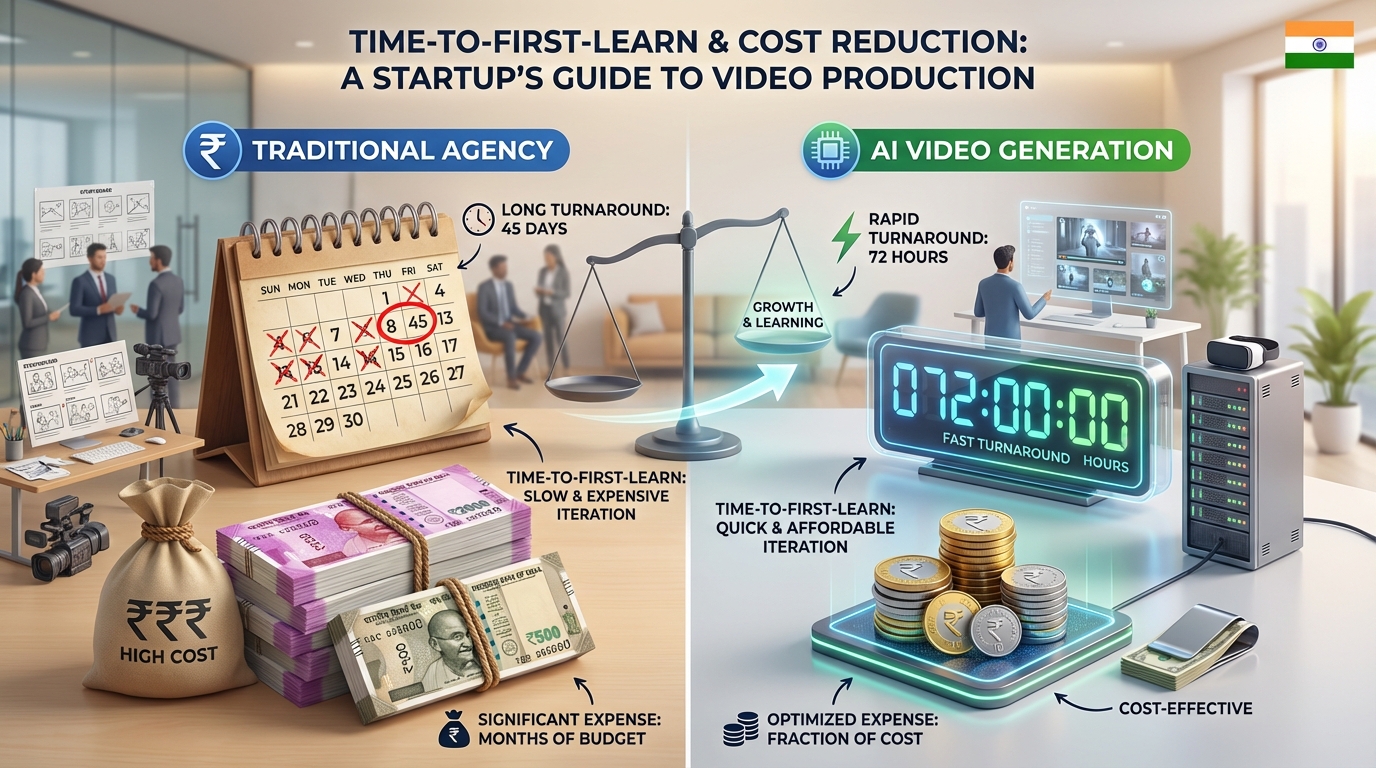
When conducting a startup video production cost comparison, the disparity between traditional and AI-driven models is stark. A traditional shoot in India involves scripting, celebrity talent fees, studio rentals, crew logistics, and extensive post-production, often taking 2 to 8 weeks per concept. In contrast, AI generation reduces this timeline to minutes or hours, eliminating the need for physical reshoots for every minor script tweak or visual adjustment.
Data from 2026 shows that AI video generation reduces production costs by an average of 58%. Solutions like TrueFan AI demonstrate ROI through this massive reduction in overhead, shifting the focus from the cost of creation to the value of content intelligence. For a startup, this means the “Cost per Variant” drops from lakhs of rupees to a fraction of that, allowing for a much higher volume of “shots on goal.”
To evaluate these models, startups should use specific financial metrics. The “Time-to-First-Learn” (TTFL) is a critical KPI, measuring the hours from a brief freeze to the first statistically significant A/B outcome. While a traditional agency might have a TTFL of 45 days, an AI-first workflow can achieve this in under 72 hours. This speed allows for rapid budget reallocation toward winning creatives before the campaign window closes.
Another essential metric is the “Break-even Volume.” This is calculated by dividing the total cost of a traditional production by the cost per variant of an AI-generated ad. In most 2026 benchmarks, if a campaign requires more than five variants (e.g., different hooks, CTAs, or languages), the AI model becomes significantly more cost-effective. This financial reality is forcing even mid-sized SMBs to adopt modern marketing stack AI video solutions to stay competitive.
Source: AI Video Generation ROI: TrueFan AI.
Source: AI Video Ads vs Traditional Ads 2026: APPPL.
Source: AI Marketing vs Traditional Agency: AI Marketing Services.
Modern marketing stack AI video: Architecture for High-Growth Indian Teams
Building a modern marketing stack AI video architecture requires an integrated system that moves from a creative brief to hundreds of channel-ready ads with automated measurement loops. This flow typically starts with a brief intake, followed by the ingestion of brand kits and templates into an AI video generator. The resulting assets are then pushed to a CRM or CDP, triggering personalized ad delivery based on user behavior.
TrueFan AI’s 175+ language support and Personalised Celebrity Videos—see the TrueFan AI startup celebrity endorsement ads guide—fit perfectly into this architecture by solving the “One-Shoot” problem. Instead of booking a celebrity for multiple days to record different scripts, brands conduct a single high-resolution shoot. The AI engine then recreates the celebrity’s speech and expressions, allowing for unlimited variations in languages like Bengali, Kannada, and Malayalam with perfect lip-sync and voice likeness.
The architecture must also include a robust governance and security layer. In 2026, brand safety is paramount, and AI tools must handle legal compliance end-to-end. This includes managing digital rights for celebrity likeness and ensuring that all generated content adheres to the latest ASCI guidelines. Automated formatting for platforms like Instagram (9:16), Facebook (1:1), and YouTube (16:9) ensures that the creative is optimized for the specific UI of each channel.
For Indian teams, the ability to “upgrade” a shoot with synthetic actions is a game-changer. This allows a celebrity to appear as if they are holding a specific product or pointing to a new app feature, even if those actions weren’t filmed during the original session. This level of flexibility transforms the video asset from a static film into a dynamic, modular component of the performance marketing engine.
Source: TrueFan AI Enterprise Documentation.
Source: 2026 Marketing Technology Budget Planning: TrueFan AI.
Scalable AI creative testing India: Engineering High-Velocity Performance Loops
To achieve scalable AI creative testing India, marketing teams must move away from quarterly campaign cycles and toward daily batch generation. This process involves creating a weekly hypothesis backlog where different hooks, offers, and CTAs are tested against one another. AI systems enable the production of 50 to 500 variants per week, which are then deployed across Meta, Google, and regional ad networks for immediate feedback.
The metrics for success in this high-velocity environment go beyond traditional CTR and ROAS. Teams now track the “Cost per Insight” (CPI), which is the total test spend divided by the number of actionable learnings generated. By identifying which celebrity hook or which regional dialect performs best within 48 to 72 hours, brands can scale their winning creatives while they are still relevant to the current market trend.
In the Indian context, scalability also means navigating the vast diversity of the consumer base. AI-first creative operations allow for “Geo-splitting” tests, where different visual styles or languages are tested in specific states or cities. For example, a fintech startup might test a “trust-based” hook in rural markets versus a “convenience-based” hook in urban metros, all using the same celebrity face and voice but with AI-generated script variations.
This level of rapid campaign iteration AI ensures that media spend is never wasted on underperforming assets. By the time a traditional agency would have finished the first round of edits, an AI-driven team has already cycled through three rounds of testing, identified a winning variant, and scaled it to a national level. This shift toward “content intelligence” is what separates the market leaders from the laggards in 2026.
Source: How AI is Transforming Digital Marketing in India 2026: OrangeGlobal.
Source: The 2026 AI Playbook: Amplitude.
A/B testing celebrity ads startups: Navigating Legalities and Localization
When A/B testing celebrity ads startups, teams must be hyper-aware of the legal and regulatory framework in India—review TrueFan AI’s A/B testing tips for celebrity endorsement ads. The Advertising Standards Council of India (ASCI) has updated its guidelines for 2026, specifically focusing on AI-generated content and influencer disclosures. Startups must ensure that any synthetic likeness or voice cloning is backed by explicit legal rights and that the final output does not mislead the consumer regarding the celebrity’s actual involvement.
The execution of these tests involves a sophisticated workflow where a one-time celebrity capture is used to generate infinite localized scripts. This allows for testing not just the message, but the delivery. Does a celebrity speaking in a formal tone perform better than a casual, “behind-the-scenes” style? AI allows you to test these variables without the celebrity ever returning to the studio, maintaining 100% authenticity of likeness and charisma.
Localization is the cornerstone of effective A/B testing in India. A campaign that works in Delhi may fail in Bengaluru if it isn’t culturally and linguistically aligned. AI tools facilitate this by providing perfect lip-sync for over 175 languages, ensuring that the celebrity appears to be a native speaker in every region. This removes the “robotic” feel of older AI tools and builds deeper trust with the local audience.
Furthermore, startups must define clear success thresholds before launching these tests. For instance, a +15% uplift in CTR or a -10% reduction in CAC might be the required signal to declare a script variant as the “winner.” These learnings are then recycled into the next week’s batch of scripts, creating a self-improving loop of creative excellence that traditional agency models simply cannot replicate.
Source: ASCI Influencer Guidelines Update 2025: Lexology.
Source: ASCI Updates Code for Self-Regulation: Khaitan & Co.
Source: Influencer Marketing Sector Demands Attention: Storyboard18.
Rapid campaign iteration AI: Strategic Decision Framework and 90-Day Roadmap
Adopting rapid campaign iteration AI—see TrueFan AI’s rapid iteration tips—requires a strategic shift in how marketing budgets and timelines are managed. A hybrid model is often the most effective approach for established brands: use traditional agencies for high-concept “hero” films that define the brand’s identity, and use AI-native tools for the “always-on” performance, remarketing, and localized bursts that drive daily conversions.
A 90-day roadmap for implementing this model starts with a 30-day pilot. During this phase, the focus is on legal clearance and the one-time celebrity capture. Brands should define 3 to 5 core hypotheses and generate their first 50 to 100 variants. By day 60, the goal is to scale, expanding into at least five regional languages and integrating synthetic gestures to keep the content fresh. By day 90, the AI workflow should be fully embedded into the company’s governance SOPs.
The decision framework for choosing between AI video generation vs traditional ad agencies should be based on four criteria: budget, timeline, volume, and localization. If the budget is under a certain threshold or the timeline is measured in days rather than weeks, AI is the superior choice. Similarly, if the campaign requires more than 50 variants or needs to be localized for multiple Indian states, the traditional agency model becomes a bottleneck.
Ultimately, the goal of rapid iteration is to shorten the Time-to-First-Learn and increase the number of “shots on goal” per rupee spent. In the competitive Indian market of 2026, the ability to ship creative daily rather than quarterly is a significant competitive advantage. This agility allows startups to pivot their messaging in response to real-time data, ensuring that their marketing remains relevant and effective in a fast-changing landscape.
Explore the TrueFan AI Emerging Business program: truefan.ai/emerging_business&utm_source=blog.
Source: Big Brands Ditched Production for Generative AI: Clevertize.
Frequently Asked Questions
SMB video ad automation: Frequently Asked Questions
For small teams, SMB video ad automation is the only way to compete with larger players who have massive creative departments. By using template-driven workflows and pre-approved brand packs, a 2-3 person team can manage a high-volume video ad strategy that would have previously required a full production crew. This automation extends from script generation to multi-platform formatting, allowing small businesses to focus on strategy and growth.
Source: TrueFan AI SMB Documentation.
Source: I Tested 20+ AI Video Generators 2026: Medium.
Source: 26 Best AI Marketing Tools 2026: Marketer Milk.
How does AI video generation compare to traditional agencies for a small startup?
For startups, the primary advantage of AI is the reduction in “Time-to-First-Learn.” While traditional agencies offer high craft, they are often too slow and expensive for the rapid testing cycles required in early-stage growth. AI allows you to test 50 variants for the price of one traditional shoot.
Is the quality of AI-generated celebrity videos good enough for premium brands?
Yes, in 2026, generative AI has reached a point where the likeness, voice, and micro-expressions are indistinguishable from real footage. TrueFan AI’s 175+ language support and Personalised Celebrity Videos ensure that even the most subtle regional nuances are captured, maintaining brand premiumness.
How do we handle the legal rights for celebrity AI videos?
This is a critical area. Most AI-native platforms now offer managed services that handle all digital rights and legal agreements with celebrities. This ensures that your brand is protected and that all content is 100% compliant with ASCI and platform-specific regulations.
Can AI videos be used for platforms other than Instagram and Facebook?
Absolutely. Modern AI video tools provide automated formatting for YouTube (16:9), LinkedIn, and even retail media platforms. The AI can generate different orientations (standing, sitting, walking) to suit the specific UI and user behavior of each platform.
What is the typical ROI improvement when switching to an AI-first creative workflow?
Brands typically see a 58% reduction in production costs and a significant uplift in ROAS due to the ability to scale winning creatives faster. By reducing the cost per variant, you can afford to find the “unicorn” creative that truly drives your business forward.
How do I get started with AI video if I don’t have a technical team?
Many platforms offer a “managed service” model where they handle the technical aspects, from the initial shoot to the final renders. You simply provide the brief and approve the scripts, making it accessible for teams of any size.