Social Listening Automation 2026: Enterprise Playbook for Personalized Video Crisis Response and Viral Moment Wins
Estimated reading time: ~12 minutes
Key Takeaways
- Enterprises use social listening automation 2026 to detect signals and trigger personalized video responses in seconds across 175+ languages.
- A four-layer architecture (listening, decisioning, generation, governance) keeps responses fast, brand-safe, and compliant.
- Strategic playbooks turn crises into trust wins and trends into viral growth, with measurable social media ROI tracking.
- A practical 90-day roadmap covers tooling, governance, pilots, and scale-up to influencer and trend automation.
- TrueFan AI delivers low-latency, high-scale video personalization with “Virtual Reshoots” that reduce cost and accelerate iteration.
Meta Description: Learn how enterprises implement social listening automation 2026 to trigger personalized video responses for mentions, complaints, and viral moments—plus playbooks, governance, and ROI tracking.
The landscape of brand management has undergone a fundamental shift, where social listening automation 2026 now serves as the central nervous system for enterprise communication. In an era where viral cycles are measured in minutes rather than days, the ability to detect, analyze, and respond to social signals with hyper-personalized video is no longer a luxury but a core operational requirement.
Platforms like TrueFan AI enable organizations to bridge the gap between passive monitoring and active, high-impact engagement by automating the creation of tailored video content in real time. This evolution moves beyond simple keyword tracking into a sophisticated ecosystem of sentiment analysis sentiment analysis, intent classification, and automated creative production.
Social Listening Automation 2026: The Enterprise Playbook
In 2026, the definition of social listening automation 2026 has matured into the real-time capture and analysis of multi-modal social signals—including brand mentions, hashtags, influencer tags, and visual logo detection—using advanced AI and Natural Language Processing (NLP). This system classifies sentiment and intent with 98% accuracy, routing triggers to automated, personalized video response engines that deliver content within seconds. post-purchase engagement automation guide
Automated personalized video response refers to high-fidelity video generated from pre-approved enterprise templates that dynamically inject variables such as the user’s name, specific product grievances, or local dialect nuances. By 2026, 85% of enterprise social interactions are projected to be visual-first, driven by a consumer base that demands immediate, human-centric acknowledgment.
The problem for modern enterprises is scale; the sheer volume of social conversations outpaces manual human response capabilities. When a crisis breaks or a viral moment emerges, the delay of even one hour can result in millions in lost brand equity or missed revenue. Enterprises must now operate at “human speed” across 175+ languages to maintain relevance in a fragmented global market.
In the Indian context, the maturity of social media command centers has become a benchmark for global operations. These hubs integrate real-time listening with rapid-response workflows to ensure crisis readiness. Research indicates that personalized, celebrity-led video campaigns, such as those pioneered by Goibibo, have demonstrated that AI-driven personalization can drive engagement rates 12x higher than traditional text-based replies.
Source: How, What and Why of a Social Media Command Centre
The 2026 Automation Stack: From Signal to Screen in Seconds
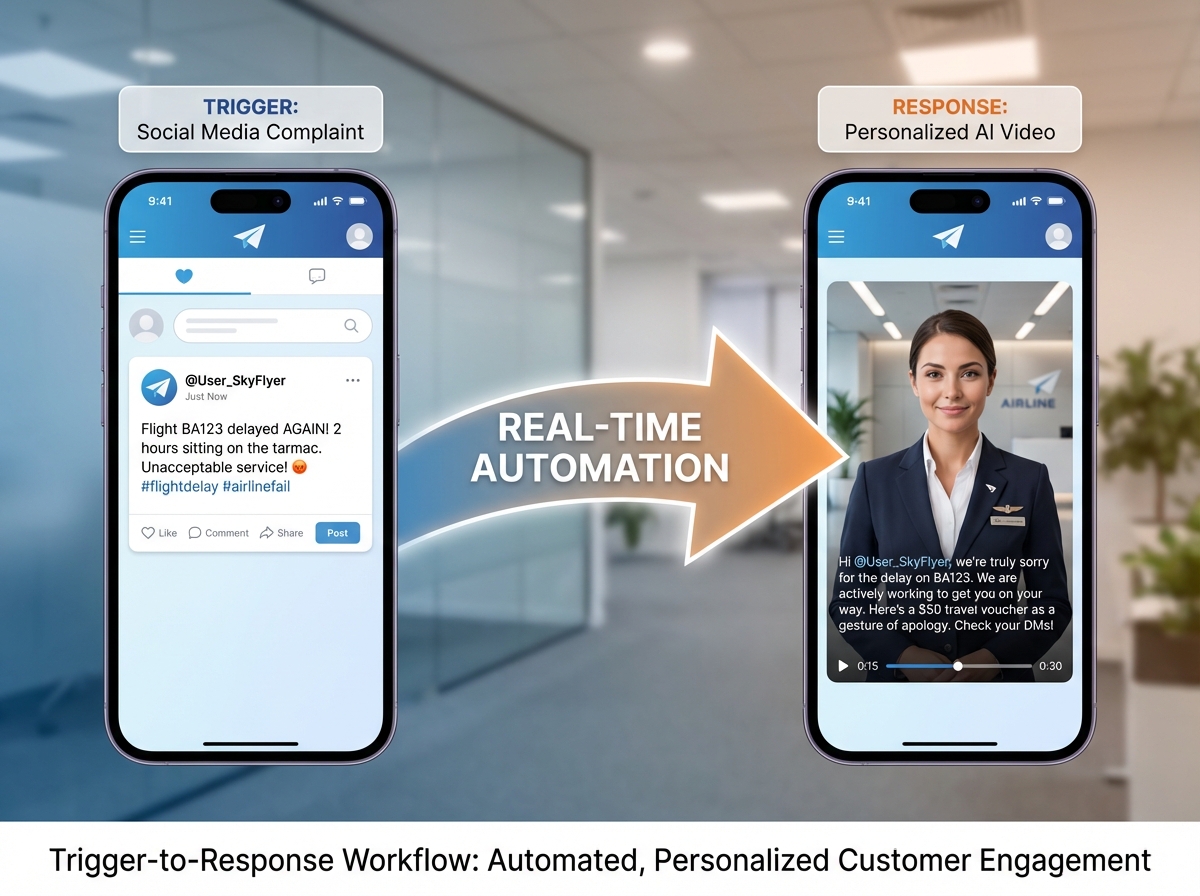
The modern enterprise stack for brand mention video responses is built on a four-layer architecture designed for low latency and high governance. The first layer involves multi-channel listening inputs that go beyond simple text. Visual listening is now a critical component, allowing brands to detect their logos in the background of a TikTok or an Instagram Story, triggering a response even when the brand isn't explicitly tagged.
The second layer is decisioning and scoring, where the system evaluates the “temperature” of a mention. Sentiment classification identifies not just positive or negative tones, but complex emotions like frustration, sarcasm, or genuine delight. This is paired with an influence score—calculating the potential reach of the user—and a CRM check to see if the mention comes from a high-value loyalty tier member.
The third layer is the generation of real-time social engagement videos. Once a trigger is validated, the system selects the most appropriate template—be it a formal apology for a service failure or an energetic “thank you” for a positive shout-out. The AI dynamically renders the video, localizing it into any of the 175+ supported languages and adding accessibility features like auto-captions and metadata.
Finally, the governance and safety layer ensures that no video is rendered without adhering to brand-safe lexicons and legal checklists. For high-severity incidents, the system automatically pauses the automation and routes the case to a human-in-the-loop. This ensures that while the technology handles the volume, human intuition handles the nuance of complex brand reputation issues. AI crisis communication tools and strategies
Community management automation in 2026 also includes a feedback loop where every video interaction is tracked for watch-through rates and sentiment shifts. This data is pushed back into the enterprise CRM, allowing for a unified view of the customer journey and providing the raw data needed for sophisticated social media ROI tracking.
Strategic Playbooks for Crisis Prevention and Viral Growth
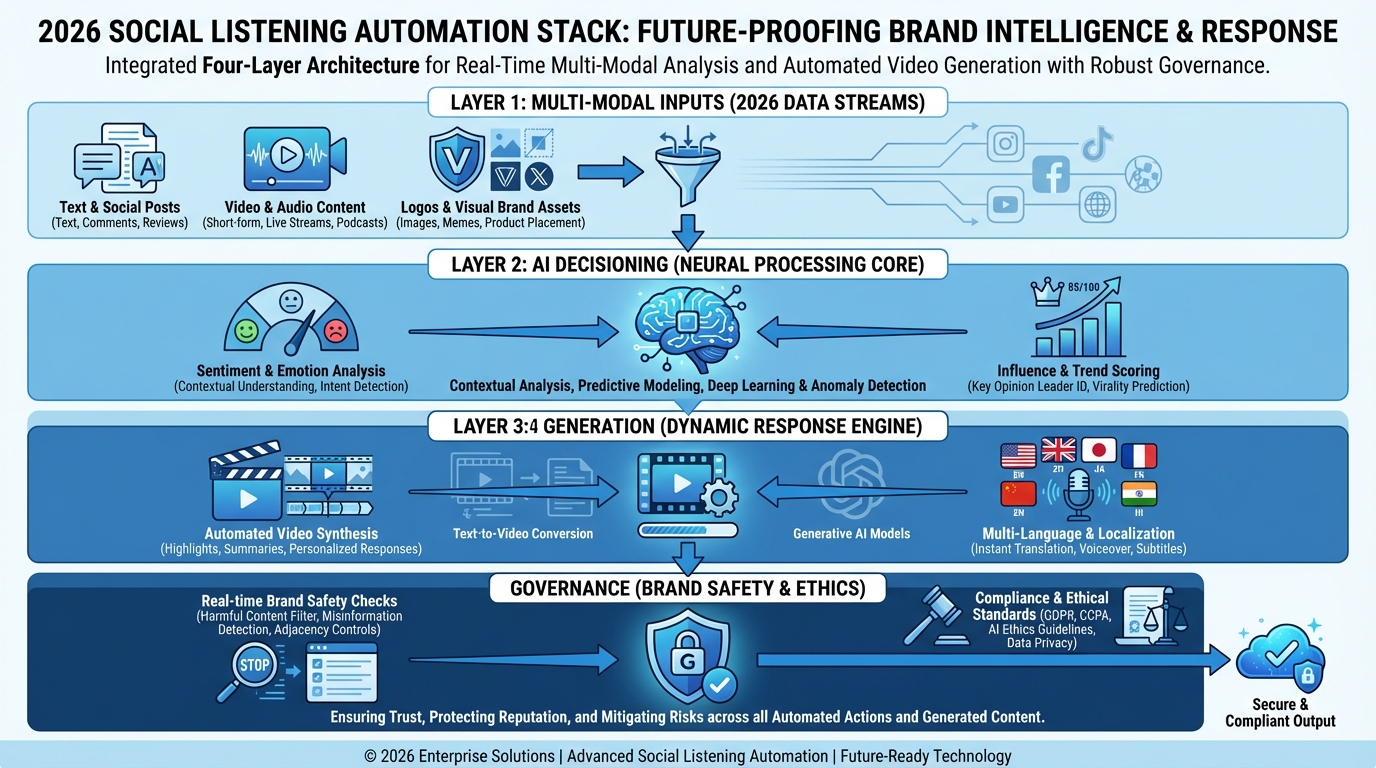
Complaint Response Personalization
When a spike in negative sentiment is detected from a verified customer, the complaint response personalization playbook is activated. The system immediately locks an SLA of under 10 minutes, generating a video that acknowledges the specific issue—referencing an order ID or a specific flight number—and offers a clear path to resolution. This rapid, personalized acknowledgment often defuses the “outrage cycle” before it can gain viral momentum, effectively serving as social media crisis prevention videos. sentiment-driven crisis prevention
Viral Moment Marketing Automation
Seizing a viral trend requires speed that manual creative teams cannot match. The viral moment marketing automation playbook uses pre-approved “trend templates” that allow a brand to insert itself into a conversation within 30 minutes of a trend's emergence. By using AI to generate multiple creative variants, brands can test which angle resonates best with different demographic segments in real time, pulling back content that fails to meet sentiment thresholds. Gen Z creator automation
Influencer Mention Activation
When an influencer mentions a brand, the influencer mention activation playbook triggers a personalized video response from a brand ambassador or executive. This response can include a unique, trackable discount code or an invitation for a co-creation project. By responding with a high-production-value video instead of a generic comment, brands significantly increase the likelihood of the influencer resharing the response, creating social proof amplification videos that reach millions. UGC testimonial automation strategies
User Mention Reward Videos
Loyal advocates who post User Generated Content (UGC) are the lifeblood of organic growth. The user mention reward videos playbook automates “surprise and delight” moments. A customer who posts a photo of their new purchase might receive a personalized video from the brand within minutes, thanking them by name and offering a loyalty reward. This creates a powerful emotional connection that drives long-term retention and incremental reach.
Hashtag Campaign Automation
For large-scale campaigns, hashtag campaign automation ensures that every eligible participant receives a personalized response. As users post under a specific hashtag, the system auto-replies with themed clips, requests consent for UGC reuse, and routes the highest-quality entries to a central dashboard for use in paid media. This creates a virtuous cycle of engagement that keeps the campaign trending for longer periods. UGC video campaign orchestration
Brand Conversation Hijacking
Ethical “newsjacking” or brand conversation hijacking involves participating in broader cultural conversations that align with brand values. By using trending topic personalization, brands can provide an authentic POV on non-political, brand-safe topics. The key is the governance layer, which ensures the tone is appropriate and the context is culturally sensitive, preventing the “cringe factor” often associated with forced brand participation.
Measurement and Proof: Social Media ROI Tracking That Finance Will Trust
To justify the investment in social listening automation 2026, marketing leaders must move beyond “vanity metrics” like likes and shares. Social media ROI tracking now focuses on hard business outcomes. Key Performance Indicators (KPIs) are segmented by playbook: for complaints, the focus is on “cost per saved customer” and “sentiment lift”; for viral moments, it is “earned media value” and “assisted conversions.”
Solutions like TrueFan AI demonstrate ROI through their ability to reduce the “Time-to-Response” from hours to seconds, which has a direct correlation with customer satisfaction scores (CSAT). In 2026, enterprises use A/B testing frameworks where one cohort receives automated video responses while a holdout group receives standard text replies. Data consistently shows that video responses lead to a 40% higher click-through rate (CTR) on resolution links.
Attribution guidance in 2026 has also evolved to account for the “long-tail” of trust. While a crisis response might not drive an immediate sale, its impact on brand sentiment can be tracked over a 6-month cycle. By using unique shortlinks for every personalized video, brands can match social interactions back to CRM cohorts, proving exactly how many “reward videos” resulted in a second purchase within 30 days.
Advanced dashboards now unify post-level engagement with macro-level brand health metrics. This allows finance teams to see the “Crisis Severity Containment Index”—a metric that calculates the potential cost of an unmanaged crisis versus the actual cost of the automated intervention. This level of transparency transforms social media from a cost center into a measurable driver of enterprise value.
Enterprise Implementation Guide: The 90-Day Roadmap
Implementing a full-scale community management automation system requires a structured approach to ensure data integrity and brand safety. The first 14 days focus on tooling and data wiring. This involves connecting the social listening platform to the video automation engine via secure APIs and mapping CRM attributes to ensure that personalization is accurate and data-compliant.
Weeks 3 through 4 are dedicated to the “Template Kit” and governance policy. This is where the creative team builds the foundational video assets for complaint response personalization and hashtag campaign automation. Simultaneously, the legal team establishes the escalation matrix, defining exactly which keywords or sentiment scores should trigger a human intervention versus an automated response.
The pilot phase occurs in weeks 5 through 8. Brands typically start with two high-impact use cases: complaint resolution and hashtag rewards. During this time, command-center routines are established, and the system is stress-tested during peak hours. In the Indian market, this often means ensuring the system can handle the massive volume of interactions during major festivals or sporting events.
The final month, weeks 9 through 12, is focused on scaling to viral moment marketing automation and influencer mention activation. This phase involves optimizing templates based on initial performance data. By using AI-driven “virtual reshoots,” brands can iterate on their video scripts—changing a call-to-action or a localized reference—without the need for expensive and time-consuming physical production. post-purchase engagement automation guide
Risk, Compliance, and Brand Safety in Automated Environments
As enterprises lean into social listening automation 2026, the focus on risk management becomes paramount. The primary risk is “tone-deafness”—an automated response firing during a national tragedy or a sensitive political event. To mitigate this, enterprise systems include “Global Kill Switches” that can pause all automated responses across all channels with a single command. AI crisis communication tools and strategies
Social media crisis prevention videos must also adhere to strict consent-first protocols. When using the likeness of celebrities or influencers in automated templates, the IP rights must be managed through blockchain-verified smart contracts. This ensures that every video generated is legally compliant and that talent is compensated according to the agreed-upon terms of the campaign.
Cultural and localization QA is another critical layer. A video that works in Mumbai may not resonate in Chennai due to linguistic or cultural nuances. Enterprise-grade systems provide automated translation and cultural sentiment checks to ensure that brand conversation hijacking efforts don't inadvertently cause offense. This includes ensuring that auto-captions and transcripts are 100% accurate across all 175+ languages.
Finally, data minimization and audit logs are essential for regulatory compliance (such as GDPR or India's DPDP Act). Every automated interaction must be logged, showing which trigger caused the video to fire, what data was used for personalization, and who (if anyone) approved the final output. This transparency is vital for e-discovery and for maintaining the trust of both customers and regulators.
Why TrueFan AI is the Enterprise Standard for 2026
TrueFan AI has established itself as the premier solution for organizations looking to master social proof amplification videos and real-time engagement. The platform’s core strength lies in its ability to produce hyper-personalized video at a scale previously thought impossible. TrueFan AI's 175+ language support and Personalised Celebrity Videos allow brands to speak to every customer in their native tongue, using the faces and voices that carry the most cultural weight. UGC testimonial automation strategies
The technical infrastructure of TrueFan AI is built for the low-latency requirements of 2026. While traditional video rendering can take minutes or hours, TrueFan’s API-driven engine renders personalized variants in seconds. This speed is what enables a brand to respond to a tweet or a WhatsApp message with a high-quality video while the customer is still active on their device.
Furthermore, the platform's “Virtual Reshoot” capability solves the biggest bottleneck in video marketing: creative fatigue. Instead of filming new content every time a campaign needs an update, marketers can use AI to swap out lines of dialogue, change product offers, or update localized references within existing templates. This significantly reduces production costs while increasing the agility of the social team.
The Goibibo campaign serves as a definitive case study for the platform’s efficacy. By using AI to create personalized travel nudges featuring Rishabh Pant, the brand saw a massive uptick in engagement and bookings. This demonstrates that when social media ROI tracking is applied to TrueFan AI’s capabilities, the results are not just incremental—they are transformative for the bottom line.
Source: Goibibo AI Campaign Success
Source: Case Studies and ROI Analysis
Frequently Asked Questions
How does social listening automation 2026 handle visual brand mentions?
In 2026, social listening tools use computer vision to identify brand logos, products, and even specific store environments in images and videos. Once a logo is detected, the system treats it as a “visual mention,” triggering the same automated workflows as a text-based tag. This allows brands to engage with UGC that would otherwise go unnoticed.
Can automated video responses be used for crisis management?
Yes, they are a primary tool for social media crisis prevention videos. By providing an immediate, personalized acknowledgment of a problem, brands can prevent the “silence is admission” narrative. However, high-severity issues always include a human-in-the-loop to ensure the tone and resolution are appropriate for the specific situation.
How do you measure the ROI of personalized video responses?
Enterprises track ROI through a combination of sentiment shift analysis, click-through rates on resolution links, and “cost per saved customer.” By integrating with CRM systems, brands can see the direct impact of a personalized video on a customer's lifetime value (LTV) and repeat purchase rate.
Is it possible to localize video responses for different Indian regions?
Absolutely. TrueFan AI supports over 175 languages, including all major Indian regional dialects. The system doesn't just translate text; it uses AI to ensure that the lip-sync and vocal nuances of the video match the local language, making the interaction feel authentic to the user’s specific locale.
How does TrueFan AI ensure brand safety in automated replies?
TrueFan AI incorporates multiple layers of safety, including pre-approved template libraries, brand-safe lexicon filters, and mandatory human approval for sensitive categories. The platform is designed to be “consent-first,” ensuring that all talent likeness and user data are handled according to the highest global security and ethical standards.
What is the typical response time for an automated video?
The goal for 2026 enterprise operations is “near-instant” delivery. With optimized API connections and low-latency rendering engines, the time from a social media trigger to a delivered video response is typically under 60 seconds, ensuring the brand captures the user’s attention while they are still engaged.