
URL-to-video AI generator India: Turn Shopify, Amazon, Flipkart links into 15‑second ads automatically
Estimated reading time: ~12 minutes
Key Takeaways
- Paste any PDP link to auto-generate 15-second, marketplace-ready ads in under a minute—no shoots or editors.
- Slash costs by 70–90% versus manual production and scale videos across 100s of SKUs with batch processing.
- Achieve platform compliance for Shopify, Amazon, and Flipkart with safe zones, captions-first, and correct specs.
- Win in Bharat with multilingual voiceovers (Hindi, Hinglish, and regional languages) and localized hooks.
- Drive ROI with dynamic overlays, real-time price updates, and continuous creative refresh to beat ad fatigue.
In the hyper-competitive landscape of 2026, a URL-to-video AI generator is no longer a luxury for Indian D2C brands—it is a survival requirement. For years, Shopify sellers and marketplace giants on Amazon and Flipkart have been held hostage by the "Content Bottleneck." To scale a catalog of 50 to 500 SKUs, founders were forced to pay upwards of ₹5,000 per video to freelancers, only to wait days for a single edit that might not even meet marketplace compliance. As Indian e-commerce GMV hurtles toward the $200 billion mark by 2026, the traditional manual video production model has officially broken.
Today, the promise is simple: paste a product URL and auto-generate a marketplace-ready, 15-second video ad in under a minute. No studio shoots, no expensive models, and zero post-production delays. With e-commerce video automation India 2026 becoming the standard for Product Detail Pages (PDPs) and social commerce see our social commerce and shoppable videos 2026 guide, brands that fail to automate their creative output are essentially invisible to the modern Indian consumer who spends over 150 minutes daily on short-form video.
1. What is a URL-to-video AI generator? (Definition & Mechanism)
A URL-to-video AI generator is a sophisticated automation system designed to bridge the gap between static product data and dynamic video content. Unlike generic video editors, this technology programmatically "reads" a product page to build a narrative. See the full guide Shopify product video AI 2026 guide.
The Technical Engine Under the Hood
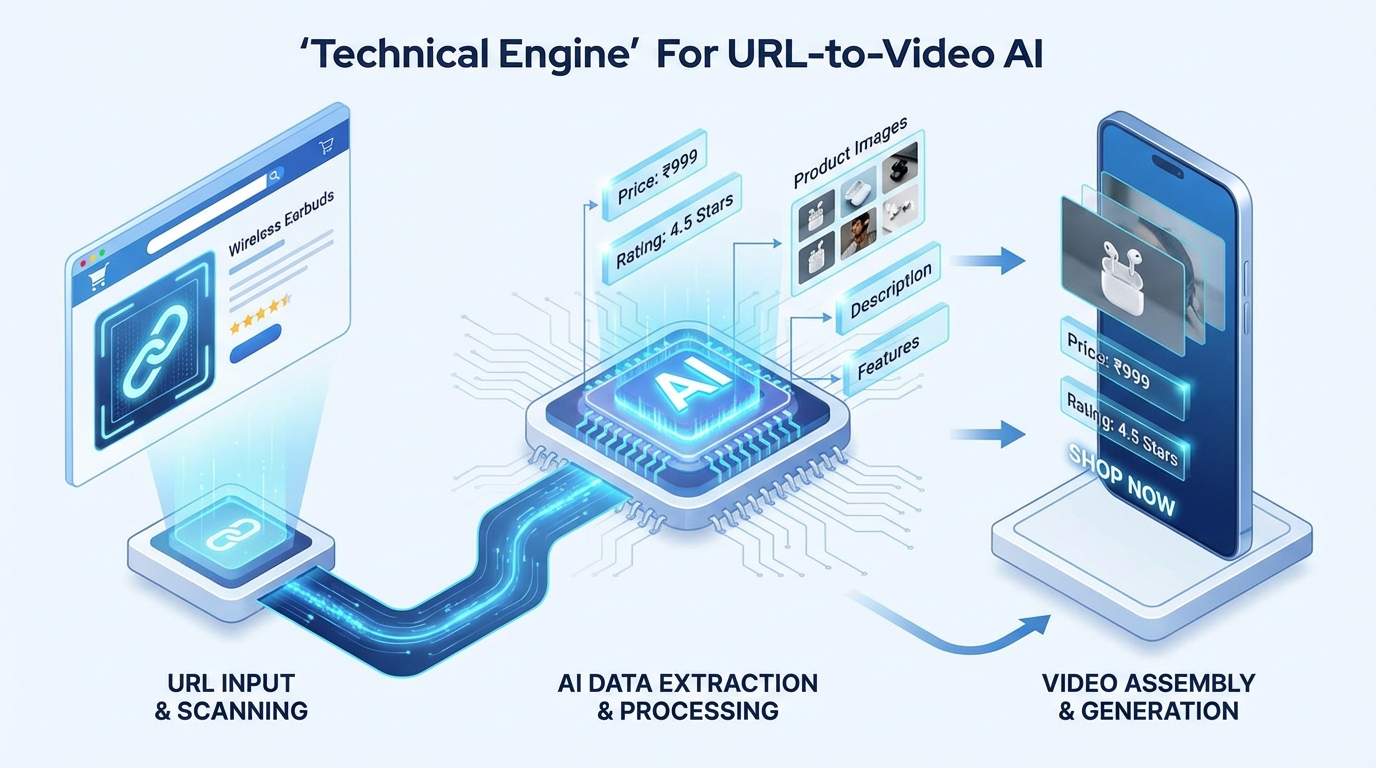
The process begins with DOM Parsing and Structured Data Extraction. When you input a link from Amazon, Flipkart, or Shopify, the AI parses the page’s HTML and JSON-LD (schema.org/Product). It identifies critical metadata: the product title, current sale price vs. MRP, star ratings, key features (bullets), and high-resolution images. It even scrapes customer reviews to identify "social proof" hooks that can be converted into on-screen captions.
Once the data is ingested, a Large Language Model (LLM), specifically tuned for D2C performance marketing, synthesizes a three-beat ad script:
- The Hook: A high-energy opening (e.g., "Tired of frizzy hair?") derived from the product’s primary benefit.
- The Benefits: A rapid-fire sequence of 3-4 key USPs (e.g., "Sulphate-free," "Results in 7 days").
- The CTA: A platform-specific call to action (e.g., "Shop now on Flipkart" or "Link in Bio").
Visual Assembly and Brand Integration
The system then auto-assembles visuals. It doesn't just show a slideshow; it applies motion effects like the Ken Burns technique or parallax scrolling to static images. It overlays dynamic price tags that update in real-time if the URL price changes. Finally, it applies your Brand Kit—ensuring every video uses your specific hex codes, logo watermarks, and typography. Platforms like Studio by TrueFan AI enable this level of granular control, allowing brands to maintain a consistent identity across thousands of automated assets.
Sources:
- Mechanism of URL-to-video automation: TrueFan AI Blog: URL-to-video generator 2026
- Product Data Extraction Standards: Schema.org Product documentation
2. Why now in India 2026? The E-commerce Video Imperative
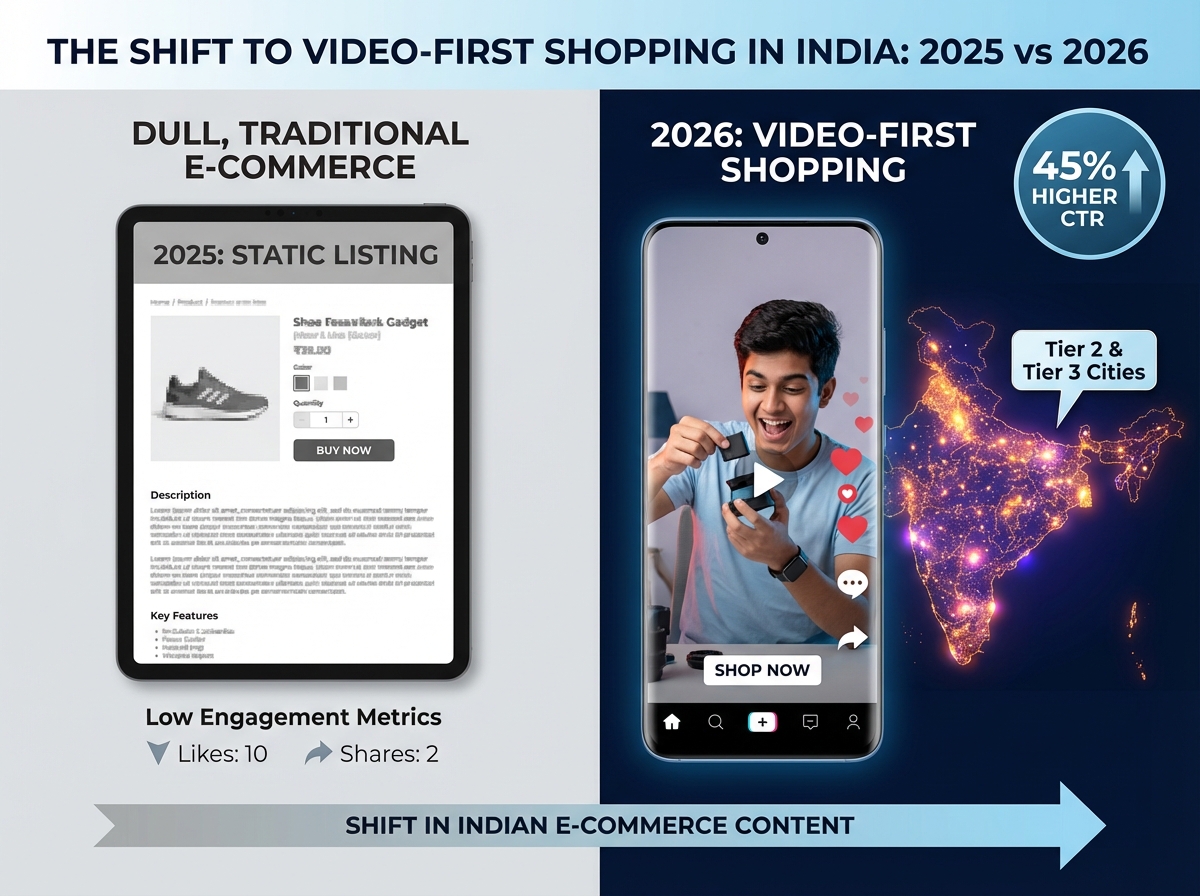
The Indian e-commerce market has undergone a seismic shift. According to IBEF and Morgan Stanley, India’s e-commerce GMV is projected to reach approximately $200 billion by 2026. This growth is driven not just by Tier 1 metros, but by a massive influx of shoppers from Tier 2 and Tier 3 cities who prioritize video-first discovery over reading long product descriptions.
The 2026 Data Reality
- Video Dominance: By 2026, video content is estimated to account for over 80% of all consumer internet traffic in India.
- Social Commerce Surge: The Indian social commerce market is expected to hit $70 billion by 2026, where short-form videos (Reels, Shorts) are the primary conversion drivers. Explore social commerce and shoppable videos 2026
- CTR Superiority: Modern ROI metrics show that video ads on marketplaces like Amazon India see a 45% higher Click-Through Rate (CTR) compared to static image ads in 2026.
- The Vernacular Edge: With 90% of new internet users in India being non-English speakers, the ability to generate videos in Hindi, Hinglish, and regional languages is the ultimate competitive advantage.
The Cost of Inaction
In 2025, a typical D2C brand might have survived with static images. In 2026, "video-less" listings are penalized by marketplace algorithms. Amazon’s A9 algorithm and Flipkart’s search ranking now heavily weight "Listing Quality Scores," which include the presence of high-quality video. Furthermore, the cost of manual production—roughly ₹5,000 to ₹8,000 per video—makes it financially impossible to create unique videos for every SKU in a large catalog. E-commerce video automation India 2026 solves this by reducing the cost per video by up to 90%, allowing for a "Video for Every SKU" strategy.
Sources:
- India E-commerce Market Growth: IBEF research: India e-commerce to $200B by 2026
- Video ROI Statistics: Entrepreneur: Video strategy trends for 2026
3. AI video from product link: How it actually works (Step-by-step & Comparison)
Creating an AI video from product link complete guide to AI video from a product link is a streamlined workflow that replaces weeks of planning with seconds of processing. Here is the definitive 2026 workflow for high-growth sellers.
The 6-Step URL-to-Video Workflow
- URL Ingestion: Paste your Shopify, Amazon, or Flipkart PDP link. The AI fetches the "cleanest" images, removing cluttered backgrounds and identifying the primary product shot.
- Script Synthesis: You select a "Tone of Voice" (e.g., Founder-led, Hype, or Educational). The AI drafts a 45-60 word script optimized for a 15-second duration.
- Template Mapping: Choose a marketplace-compliant template. These templates are pre-designed to ensure no text is cut off by the "Buy Now" buttons or UI overlays on mobile screens.
- Multilingual Voiceover: Select an AI voice. In the Indian context, "Hinglish" (a mix of Hindi and English) often performs best for urban audiences, while pure regional languages (Tamil, Telugu, Bengali) are essential for Bharat-focused brands.
- Dynamic Overlays: The system adds "Price Slashes" (e.g., ₹999 → ₹499) and "Urgency Tickers" (e.g., "Only 5 left in stock") directly from the live URL data.
- Batch Rendering: Export the video in multiple aspect ratios: 9:16 for Instagram Reels, 1:1 for Shopify PDPs, and 16:9 for YouTube.
Text-to-Video AI for Sellers vs. URL-Driven Video
Many sellers confuse generic text-to-video AI for sellers with dedicated URL-to-video generators. The difference is critical for brand safety:
- Accuracy: Text-to-video relies on your prompts, which can lead to "hallucinations" or incorrect product specs. URL-driven video pulls directly from your source of truth (the PDP), ensuring the price and features are 100% accurate.
- Speed: Text-to-video requires you to write a script and find assets. URL-to-video automates asset hunting entirely.
- Compliance: URL-driven tools are built with marketplace specs (like Amazon’s safe zones) in mind, whereas generic AI video makers often produce "cinematic" content that gets rejected by marketplace moderators for having text in the wrong places.
Studio by TrueFan AI's 175+ language support and AI avatars real-time interactive AI avatars in India allow brands to take this a step further by adding a "human" face to the automated video, significantly increasing trust and "thumb-stop" rates on social feeds.
Sources:
- Workflow and Speed Claims: TrueFan AI: AI video from product link overview
- AI Video Trends: LinkedIn: E-commerce content marketing trends 2026
4. Platform Mastery: Shopify, Amazon, & Flipkart Listing Video Creator (Specs & Compliance)
Each platform has distinct requirements. A generic video will often fail to convert—or worse, get your ad rejected. Using a specialized Amazon Flipkart listing video creator ensures your content is optimized for each ecosystem.
Shopify Product Video AI: The Conversion Multiplier
On Shopify Shopify product video AI best practices, video is primarily used to reduce "Return to Origin" (RTO) rates by giving customers a realistic view of the product.
- Best Practice: Use 1:1 square videos for the main image carousel.
- Automation Tip: Sync your Shopify product handles to your AI generator. When you launch a new collection, the system can automatically generate and upload videos to your "Product Media" section via API.
- Mobile Optimization: Ensure on-screen text is large (at least 30pt) because 90% of Shopify traffic in India is mobile-driven.
Amazon India: Sponsored Brands & PDP Rules
Amazon is strict about its video environment. According to Amazon Ads guidelines:
- Muted Autoplay: Videos start without sound. Your URL-to-video AI generator must include "Caption-First" design where the value proposition is readable without audio.
- Safe Zones: Avoid placing text in the bottom right corner (where the mute button sits) or the top left (where the "Sponsored" tag appears).
- Listing Quality: Amazon India suggests at least one video per PDP to achieve "Retail Readiness."
Flipkart: The Regional Powerhouse
Flipkart’s audience is deeply rooted in Tier 2/3 India.
- Language is King: Use the AI video generator from URL to create variants in at least 3 regional languages.
- Visual Style: Flipkart shoppers respond well to "Value-for-Money" messaging. Use dynamic overlays that highlight the "Percentage Off" and "Bank Offers" clearly.
- Compliance: Avoid external URLs or watermarks of other marketplaces (like an Amazon logo appearing in a Flipkart video), which is a common mistake when repurposing content.
Sources:
- Amazon Video Ad Specs: Amazon Advertising: Sponsored Brands video specs
- Shopify Product Media Guide: Shopify Help Center: Product media
- Flipkart Seller Guidelines: Flipkart Seller Learning Center: Ads
5. D2C Video Marketing Automation: Scaling SKUs & Ad Variants (Batch processing)
For a brand with 1,000 SKUs, creating videos one by one is still too slow. This is where D2C video marketing automation enters the "Industrial Scale" phase.
The Architecture of Scale
Enterprise-grade solutions allow for Batch Processing. Instead of pasting one URL, you upload a CSV containing 500 product links. The engine then:
- Parallel Renders: Processes multiple videos simultaneously using cloud-agnostic GPU backends.
- Variant Generation: For every 1 SKU, it creates 10+ variants (different hooks, different languages, different aspect ratios).
- Governance: Applies a "Template Lock." This ensures that even if an intern is running the automation, they cannot change the brand’s primary colors or logo placement, maintaining 100% brand safety.
Automated Product Ads AI
The real ROI of automated product ads AI comes from A/B testing at scale. In 2026, the Meta and Google algorithms (PMax) crave "Creative Refresh." If you run the same ad for 30 days, your CPA (Cost Per Acquisition) will skyrocket due to ad fatigue. Automation allows you to swap the "Hook" of your video every 7 days across 100 SKUs automatically. You can test a "Discount-led" hook against a "Problem-solver" hook and let the AI-driven marketplace algorithms decide the winner.
Solutions like Studio by TrueFan AI demonstrate ROI enterprise video analytics platform through this ability to maintain "Creative Freshness" without increasing the headcount of your design team. By integrating directly with WhatsApp APIs, these automated videos can also be sent as personalized "Abandoned Cart" reminders, which have shown to recover 20% more revenue than text-only messages in 2026.
Sources:
- Automation and Scaling Principles: TrueFan AI Product Studio
- Social Media Trends 2026: Hootsuite: Social trends research
6. Costs, Governance, and ROI: Stop Paying ₹5,000 Per Video
The financial argument for a URL-to-video AI generator India is undeniable. Let's look at the "Video ROI Calculator" AI video ROI calculator for India for a mid-sized Indian D2C brand in 2026.
The Manual vs. AI Cost Comparison
| Metric | Manual Production (Freelancer) | AI Automation (e.g., Studio by TrueFan AI) |
|---|---|---|
| Cost per Video | ₹5,000 - ₹8,000 | ~₹150 - ₹500 (Platform dependent) |
| Turnaround Time | 48 - 72 Hours | < 60 Seconds |
| Scalability | Limited by human hours | Infinite (Batch processing) |
| Language Variants | Extra cost/time per language | One-click conversion |
| Brand Consistency | High risk of "Creative Drift" | 100% Template-locked |
Governance and Security
For enterprise brands, security is as important as speed. Modern AI video platforms now offer:
- Content Moderation: Real-time filters that block the generation of any content containing profanity, political endorsements, or prohibited health claims (critical for the Nutraceutical and Beauty sectors in India).
- Watermark Traceability: Every video generated is digitally fingerprinted, ensuring that if a video is misused, the source can be traced.
- Consent-First Models: Using licensed AI avatars ensures that your brand is never at risk of "Deepfake" legalities or unauthorized use of likeness.
The Bottom Line ROI
By shifting to e-commerce video automation India 2026, brands typically see a 70-90% reduction in content production costs. More importantly, they see a "Time-to-Market" advantage. When a competitor launches a sale, an automated brand can have 500 "Sale Announcement" videos live across all platforms in the time it takes the competitor to write a creative brief for their editor. Estimate payback here AI video payback period calculator.
Sources:
- Cost-Benefit Analysis: TrueFan AI Blog: AI video from product link
- Digital Trends 2026: Adobe: Digital Trends report
Final Checklist for 2026 Success:
- Paste your first URL: Stop overthinking and start automating.
- Go Multilingual: Don't ignore the 70% of India that doesn't shop in English.
- Check Compliance: Ensure your text is in the "Safe Zones" for mobile UIs.
- Iterate: Use the cost savings to test 5 different hooks for your best-selling SKU.
Ready to scale? Book a demo of the URL-to-video AI generator at Studio by TrueFan AI and launch your first 50 marketplace-ready videos this week.
Frequently Asked Questions
Is URL-to-video allowed on Amazon and Flipkart PDPs?
Yes. Both Amazon India and Flipkart encourage video content as long as it meets their technical specs (MP4, H.264, no external watermarks). In fact, Amazon’s "Sponsored Brands Video" is one of the highest-converting ad formats in 2026. Using a dedicated Amazon Flipkart listing video creator ensures your videos are compliant from the first render.
How do I handle price changes in my videos?
A major advantage of a URL-to-video AI generator is that it is "Data-Aware." If your Shopify price changes from ₹999 to ₹799 during a Flash Sale, you can simply re-run the automation. The AI will pull the new price from the URL and update the on-screen graphics instantly, ensuring your ads never mislead customers.
Can I use these videos for Instagram Reels and YouTube Shorts?
Absolutely. The system allows you to export in 9:16 aspect ratio specifically for vertical viewing. Since the AI also generates the script, it ensures the "Hook" happens in the first 3 seconds, which is the gold standard for high engagement on social media in 2026. For shoppable formats and tagging, see our social commerce and shoppable videos guide.
Does Studio by TrueFan AI support regional Indian languages?
Yes, Studio by TrueFan AI's 175+ language support and AI avatars real-time interactive AI avatars in India allow you to create videos in Hindi, Marathi, Gujarati, Tamil, and many more. This is essential for reaching the "Next Billion Users" in India who prefer consuming content in their mother tongue.
What is the difference between this and "Text-to-Video" tools?
Generic text-to-video AI for sellers often uses stock footage that might not look like your actual product. A URL-to-video generator uses your product images and your specific PDP data, ensuring the video is a factual representation of what the customer will receive.
How many videos can I generate in a day?
With batch processing and API integrations, you can generate anywhere from 100 to 1,000+ videos per day. This allows you to have a unique video for every single SKU, variant (color/size), and target language in your catalog.



