The 2026 Playbook for Retail Media Networks India 2026: AI-Powered Personalized Video for Enterprise ROAS on Amazon, Flipkart, Blinkit & Zepto
Estimated reading time: ~13 minutes
Key Takeaways
- 2026 marks a tipping point where retail media networks in India become the primary performance engine.
- AI-powered personalized video plus DCO closes the creative gap and lifts CTR and ROAS.
- Leverage first-party data cohorts to align creative messaging with high-intent audiences safely.
- Adopt platform-specific playbooks for Amazon, Flipkart, Blinkit, Zepto, and Myntra to maximize incrementality.
- Operationalize with a central creative brain, real-time triggers, multilingual rendering, and robust governance.
The landscape of digital advertising has undergone a seismic shift, positioning retail media networks India 2026 as the primary engine for enterprise growth. As third-party cookies vanish and signal loss complicates the open web, India’s fast-growing advertising ecosystem has matured into a sophisticated powerhouse where marketplaces and quick commerce platforms monetize first-party shopper data. This evolution allows brands to access high-intent audiences across search results, product pages, and home feeds with unprecedented precision.
The 2026 inflection point is staggering; e-retail media is currently driving a 56% YoY surge in digital spends, cementing its status as a core growth engine for FMCG and D2C brands. Despite this technological leap in targeting, a significant problem persists: most enterprises still rely on static images for their Product Detail Pages (PDPs). Creative speed and relevance are lagging behind the sophistication of audience mapping, leaving a massive gap in potential performance.
This playbook establishes that AI video ads for e-commerce listings, combined with Dynamic Creative Optimization (DCO) and first-party data signal mapping, will be the definitive differentiator for ROAS and incrementality in 2026. By turning a single source video into thousands of platform-compliant, high-intent variants, enterprises can finally match their creative output to the speed of the modern shopper.
Sources:
1. Why 2026 is the Tipping Point for Enterprise Retail Media Strategy 2026
The structural shifts in the Indian digital economy have made an enterprise retail media strategy 2026 a non-negotiable priority for market leaders. The deprecation of traditional tracking mechanisms has forced a migration of budgets toward Retail Media Networks (RMNs) that boast logged-in users and closed-loop attribution. In this environment, every rupee spent is traceable to a specific SKU-level conversion path, enabling near-real-time optimization that was previously impossible on social or search alone.
India’s specific momentum is particularly aggressive, with e-retail media spends reaching approximately ₹17,601 crore by the start of the year. Brands are no longer just "testing" these channels; they are consolidating their entire performance budgets onto platforms that offer robust ROI reporting and high-intent inventory. The rise of short video and shoppable formats has become mainstream on commerce surfaces, with creator-style content now embedded directly into marketplace feeds to drive engagement.
Furthermore, the expansion of quick commerce giants like Blinkit and Zepto has added a new layer of mission-based inventory. These platforms capture shoppers who require delivery within 10–20 minutes, creating a high-pressure, high-intent environment where the creative must be instantaneous and hyper-local. To win in these auctions, creative assets must evolve from static banners to video-first, dynamic variants that are mapped directly to shopper intent and platform constraints.
Sources:
- exchange4media: E-retail media tightens grip on digital ads
- PitchOnnet: Budget reallocation trends for RMNs
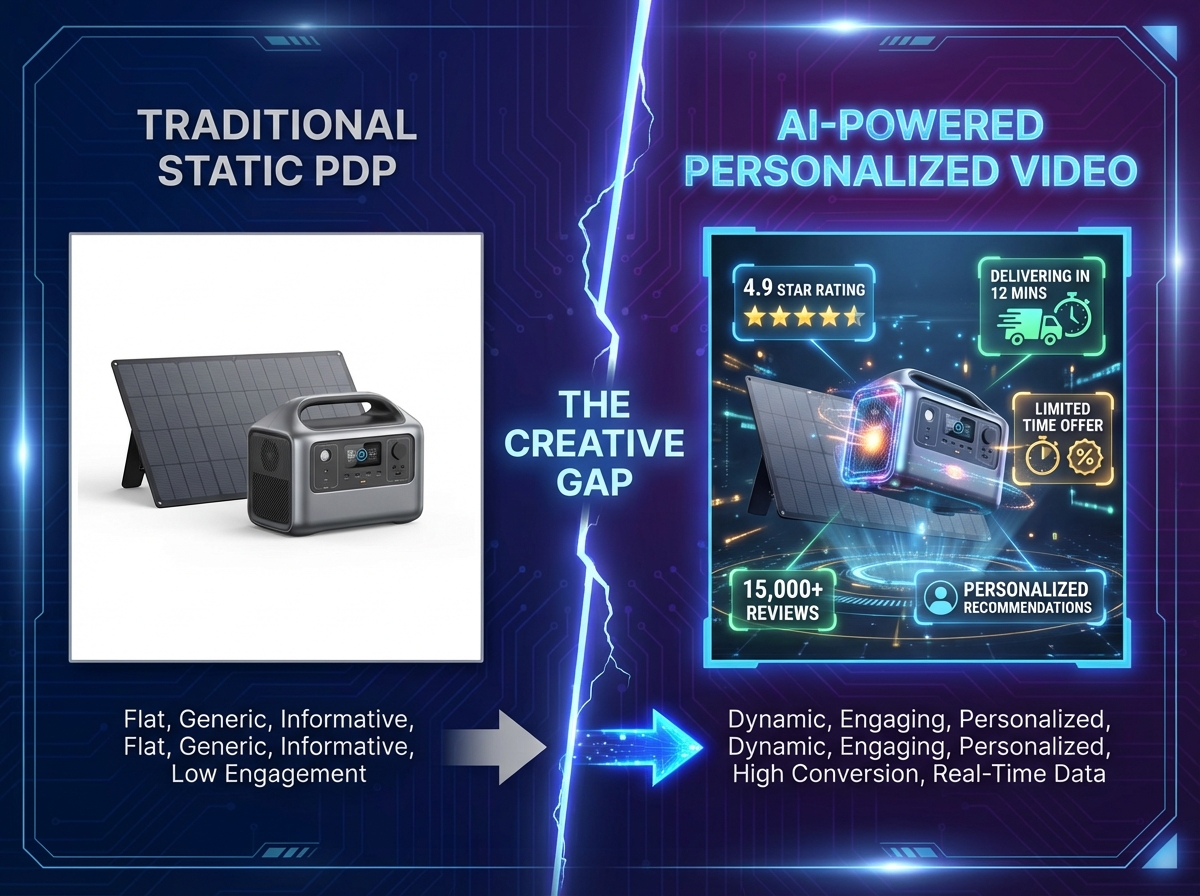
2. The Creative Gap: From Static PDPs to Personalized Product Video Ads Retail
The transition to personalized product video ads retail represents the next frontier in e-commerce conversion. These are AI-generated video units derived directly from PDP or product feeds, where scenes, overlays, voice-overs, and CTAs change dynamically based on audience intent. For instance, a shopper who recently searched for "organic face wash" will see a different video variant than one who searched for "budget skincare," even if they land on the same product listing.
Currently, the reliance on one-size-fits-all PDP imagery is a major bottleneck for enterprise growth. Static assets miss the nuances of shopper intent and fail to utilize the rich first-party signals provided by RMNs. Moreover, the manual production of video variants is too slow to keep up with daily price fluctuations, stock changes, or weather-triggered demand. Platforms like TrueFan AI enable enterprises to bridge this gap by automating the creation of thousands of high-quality video variants that are platform-ready and brand-compliant.
By implementing retail media AI-driven creative automation India, brands can output sponsored video ads marketplace India assets that are specifically tailored to the shopper's context. This includes automated generation of platform-spec video from catalog feeds, ensuring that every ad rendered in search results or brand stores is optimized for the highest possible CTR. Creative governance remains a priority, with AI systems ensuring that all variants adhere to brand-legal guardrails and platform policies without manual oversight.
Sources:
3. Platform Playbooks: How to Win on Each Indian Retail Media Surface
Amazon Retail Media Personalized Video
Amazon’s Sponsored Brand Video (SBV) remains the gold standard for sponsored video ads marketplace India. These click-to-PDP ads autoplay in search results, making them ideal for showcasing unique selling propositions (USPs) and pricing overlays. To succeed, enterprises must utilize Amazon retail media personalized video strategies that swap scenes based on specific search terms. A shopper looking for "noise-canceling headphones" should see a video highlighting ANC technology, while a "long battery life" query triggers a variant focused on endurance.
Flipkart Ads AI Video Creative
Flipkart’s responsive auction system requires a high volume of Flipkart ads AI video creative to maintain performance across its diverse user base. By using Product Contextual Ads (PCA) insights, brands can define variant clusters that include multilingual captions for Tier 2 and Tier 3 cities. This retail media creative automation scalable approach allows for the rapid deployment of offer-driven end-cards during major events like the Big Billion Days, where "Only X left" urgency triggers can be dynamically inserted into the video.
Blinkit & Zepto: Quick Commerce Video Advertising India
In the world of quick commerce, Blinkit Zepto ad platform video ads must be hyper-local and time-sensitive. Shoppers here are mission-oriented, often looking for immediate solutions. Successful quick commerce video advertising India involves geo-overlays that mention specific dark-store delivery promises, such as "Delivered to Indiranagar in 12 minutes." For FMCG retail media video campaigns, basket-build prompts like "Buy 2 get 10% off" with dynamic pricing tiles are essential for increasing average order value (AOV).
Myntra: Shoppable Video Retail Media India
For fashion and beauty, shoppable video retail media India on Myntra thrives on short-form, creator-native visuals. The focus here is on high-intent shopper video personalization, where size/fit overlays and texture close-ups are prioritized. AI can generate variants that feature different styling tips or "complete the look" end-cards, encouraging users to add multiple items to their basket directly from the video feed.
Sources:
- Amazon Ads India: Ad specs and guidelines
- Paxcom: Flipkart Ads primer
- Paxcom: Quick commerce landscape
4. Dynamic Creative Optimization RMN India: Triggering Performance
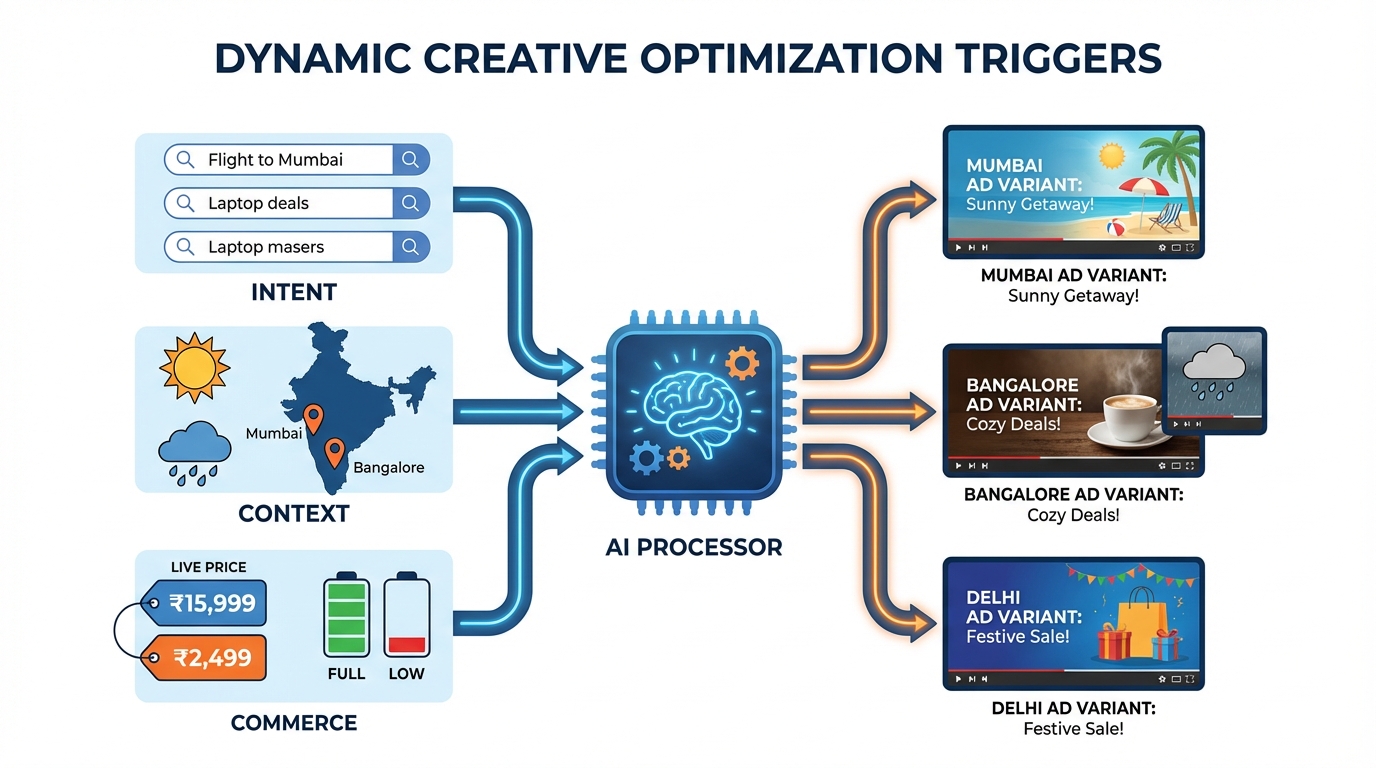
The core of a modern RMN strategy is dynamic creative optimization RMN India. This automation system selects the best-performing creative variant in real-time based on contextual triggers, all while keeping the targeting within the platform's ecosystem. By mapping assets to a trigger framework, enterprises can ensure that every impression is as relevant as possible to the individual shopper's current state.
The trigger framework for 2026 includes:
- Intent Signals: Search terms, last-viewed categories, and current cart state.
- Contextual Triggers: Geo-location, delivery SLAs, local store inventory, and even weather patterns (e.g., promoting umbrellas during rain).
- Commerce Signals: Real-time price drops, stock levels, and star rating thresholds.
This retail media creative automation scalable model uses an asset-swapping matrix to replace scenes, voice-over lines, and end-cards instantly. For example, if a product's rating crosses a 4.5-star threshold, the AI can automatically update the video overlay to reflect this social proof. This level of high-intent shopper video personalization ensures that the creative is never static and always aligned with the most persuasive data point available at that moment.
5. Targeting Meets Creative: First-Party Data Retail Media Video Targeting
Implementing first-party data retail media video targeting is the key to maintaining a competitive edge without risking PII leakage. In 2026, enterprises use brand-owned cohorts—such as high LTV tiers or lapsing customers—to select platform-approved audience packages. The creative is then tailored to these cohorts; for instance, a "new-to-brand" shopper might see a video focused on brand heritage and trust, while a "repeat buyer" sees a variant highlighting a loyalty discount.
This approach ensures that personalized product video ads retail are delivered with surgical precision. The implementation blueprint involves mapping cohorts to specific benefit emphases, such as highlighting EMI options for high-value electronics to price-sensitive segments. Because the cohorts are passed into the RMNs securely, the creative references permissible context rather than individual identity, maintaining strict compliance with evolving data privacy laws in India.
Measurement of these efforts is conducted through platform experiments that compare cohort-tailored variants against a baseline. By tracking metrics like New-to-Brand (NTB) rates and repeat purchase frequency, brands can quantify the impact of their high-intent shopper video personalization strategies. This closed-loop system allows for continuous refinement of both the audience segments and the creative assets used to reach them.
6. Execution Blueprint: AI Video Ads for E-Commerce Listings at Scale
To execute AI video ads for e-commerce listings at an enterprise scale, a robust automation-first workflow is required. The process begins with the ingestion of catalog and PDP feeds, including images, feature bullets, and real-time pricing. This data is then fed into approved brand templates, where retail media AI-driven creative automation India systems generate thousands of scripts and render multilingual variants in seconds.
The output profiles are customized for each network's specific requirements, such as Amazon SBV's 16:9 aspect ratio or Myntra's vertical creator-style formats. Solutions like TrueFan AI demonstrate ROI through this rapid production cycle, allowing brands to launch and iterate on campaigns in a fraction of the time required by traditional agencies. The team model shifts from manual editing to a "central creative brain" that manages templates and brand guardrails, supported by category pods that provide specific insights and offers.
Key components of the execution blueprint include:
- Multilingual Rendering: Localizing content into regional languages to reach India's diverse demographic.
- QC & Compliance: Automated checks to ensure every variant meets platform specs and legal requirements.
- Low-Latency Delivery: Ensuring that videos are rendered and ready for deployment within minutes of a price or inventory change.
7. Measurement and Optimization: Retail Media Network ROI Measurement
In 2026, retail media network ROI measurement has moved beyond simple ROAS. Enterprises now focus on a holistic framework that includes incrementality, contribution margin, and SKU velocity. By using on-platform A/B testing and geo-holdouts, brands can determine the true incremental lift provided by their FMCG retail media video campaigns. This data is essential for justifying the reallocation of budgets from traditional channels to RMNs.
KPI sets are now vertical-specific to reflect different consumer behaviors. For electronics, the focus might be on PDP view-to-cart rates and assisted conversions, whereas for FMCG, the priority is repeat purchase rates within a 30-day window. Creative taxonomies allow for variant-level reporting, showing which specific elements—such as a name-first greeting or a specific discount overlay—are driving the most engagement.
TrueFan AI's 175+ language support and Personalised Celebrity Videos provide a unique layer of data for this measurement. Brands can analyze how different regional languages or celebrity endorsements impact conversion rates across different parts of India. This level of granular insight allows for a highly optimized media mix where every creative lever is pulled to maximize total business impact.
Sources:
8. TrueFan AI for Enterprises: The Future of Retail Media Automation
TrueFan AI stands as the premier creative infrastructure for enterprises looking to dominate the RMN landscape in 2026. By transforming a single source performance into thousands of compliant, high-intent variants, the platform enables hyper-personalization at a scale previously thought impossible. Whether it is Amazon retail media personalized video, Flipkart ads AI video creative, or Blinkit Zepto ad platform video ads, TrueFan AI provides the technical pipeline to ensure every impression is optimized.
The platform's capabilities include:
- Virtual Reshoots: Update pricing, offers, or features across all video variants without the need for additional shoots.
- Multilingual Localization: Native voice retention and perfect lip-sync across 175+ languages, addressing India's T1, T2, and T3 audiences.
- Enterprise Governance: ISO 27001 and SOC 2 certification, ensuring all assets are consent-led and brand-safe.
- Real-Time API Triggers: Sub-30 second render pipeline that responds to inventory changes or CRM events.
For fashion and beauty brands, shoppable video retail media India becomes a powerful tool when combined with TrueFan AI's ability to integrate creator-native visuals with dynamic product data. The result is a seamless, highly engaging shopping experience that drives both brand love and immediate sales. By partnering with TrueFan AI, enterprises can move from static, generic advertising to a dynamic, personalized approach that defines the future of retail media.
Recommended Internal Links
- Quick Commerce Video Personalization India: drive ROI now
- Rapid Fulfillment Personalization for Quick Commerce
- Instant Shopping Video Triggers: Quick Commerce Wins
- Hindi AI Video Marketing: Vernacular Growth Strategies
- Enterprise AI Video Platform: Secure, Scalable Solutions
- Enterprise AI Video Platform: Real-Time API for Scale
- C2PA watermarking AI video marketing: enterprise guide
- AI Impact Summit 2026 TrueFan: Enterprise AI Video ROI
Frequently Asked Questions
What are the technical specs for sponsored video ads marketplace India?
For platforms like Amazon and Flipkart, video durations typically range from 6 to 45 seconds. Amazon SBV usually requires a 16:9 or 1:1 aspect ratio with no sound as the default (muted autoplay). It is crucial to place key product visuals and USPs in the first 2–3 seconds to capture attention. Detailed specs can be found on the Amazon Ads India Hub.
How does TrueFan AI ensure brand safety in automated video generation?
TrueFan AI utilizes advanced moderation filters and brand-legal guardrails to ensure every generated variant is compliant. The platform is ISO 27001 and SOC 2 certified, and all celebrity or ambassador assets are used under a formal consent-led model. This ensures that even when generating thousands of videos, the brand's integrity is never compromised.
Can first-party data retail media video targeting be done without PII?
Yes. In 2026, the standard practice is to use cohort-based targeting where PII is never exposed to the creative asset itself. Brands pass anonymized audience segments into the RMN, and the AI selects the appropriate creative variant based on the segment's characteristics (e.g., "Frequent Buyer" or "Category Enthusiast") within the platform's secure environment.
What is the typical ROI lift from retail media AI-driven creative automation India?
Enterprises implementing AI-driven creative automation typically see a 15–30% lift in CTR and a significant improvement in ROAS compared to static PDP images. By delivering more relevant, intent-aligned video content, brands also see higher New-to-Brand (NTB) acquisition rates and improved SKU velocity across marketplaces.
How long does it take to set up an enterprise retail media strategy 2026 with AI video?
A pilot program can be executed in 4–6 weeks. This includes selecting a category, integrating product feeds, and generating 12–24 creative variants across three major RMNs like Amazon, Flipkart, and Blinkit. Success is measured through on-platform experiments and geo-holdouts to ensure clear incrementality.