Quick Commerce Video Personalization: The Growth Leader's Playbook for India’s 10-Minute Economy
Estimated reading time: ~20 minutes
Key Takeaways
- Win the 10-minute economy with hyperlocal, inventory-aware videos that reflect real-time stock, pin-codes, and ETAs.
- Latency matters: pre-render high-traffic variants and use CDN edge caching to keep TTI under two seconds.
- Platform-specific playbooks for Blinkit, Zepto, and ONDC ensure creative, bidding, and metadata alignment.
- Combine WhatsApp commerce with neighborhood flash sales to drive recovery and clear localized inventory.
- Measure what matters: geo-holdouts, CPA per pin-code, and sell-through to prove incremental GMV.
In the hyper-competitive landscape of 2026, quick commerce video personalization has emerged as the decisive factor for brands looking to dominate India’s 10-minute delivery ecosystem. As platforms like Blinkit, Zepto, and Swiggy Instamart transition from simple delivery services into sophisticated advertising powerhouses, the ability to deliver hyper-relevant, inventory-aware content is no longer a luxury—it is a survival mandate. For growth leaders, the challenge lies in moving beyond generic digital ads to a model where every video is a real-time reflection of local demand and dark store availability.
Quick commerce video personalization India represents the convergence of AI-driven creative production and hyperlocal logistics data. By 2026, the Indian quick commerce market is projected to surpass $10 billion in gross merchandise value (GMV), driven by a consumer base that demands instant gratification and extreme relevance. To capture this demand, brands must deploy instant shopping conversion videos that do more than showcase a product; they must communicate a promise of immediate availability within a specific pin-code.
Platforms like TrueFan AI enable brands to bridge the gap between static catalogs and dynamic, high-converting video experiences. By integrating real-time data signals—such as weather patterns in Bengaluru or inventory levels in a South Delhi dark store—marketing leaders can automate the delivery of personalized content that resonates at a neighborhood level. This strategic shift from broad-based awareness to hyperlocal precision is what defines the winners in the 10-minute economy.
Defining the New Standard of Hyperlocal Engagement
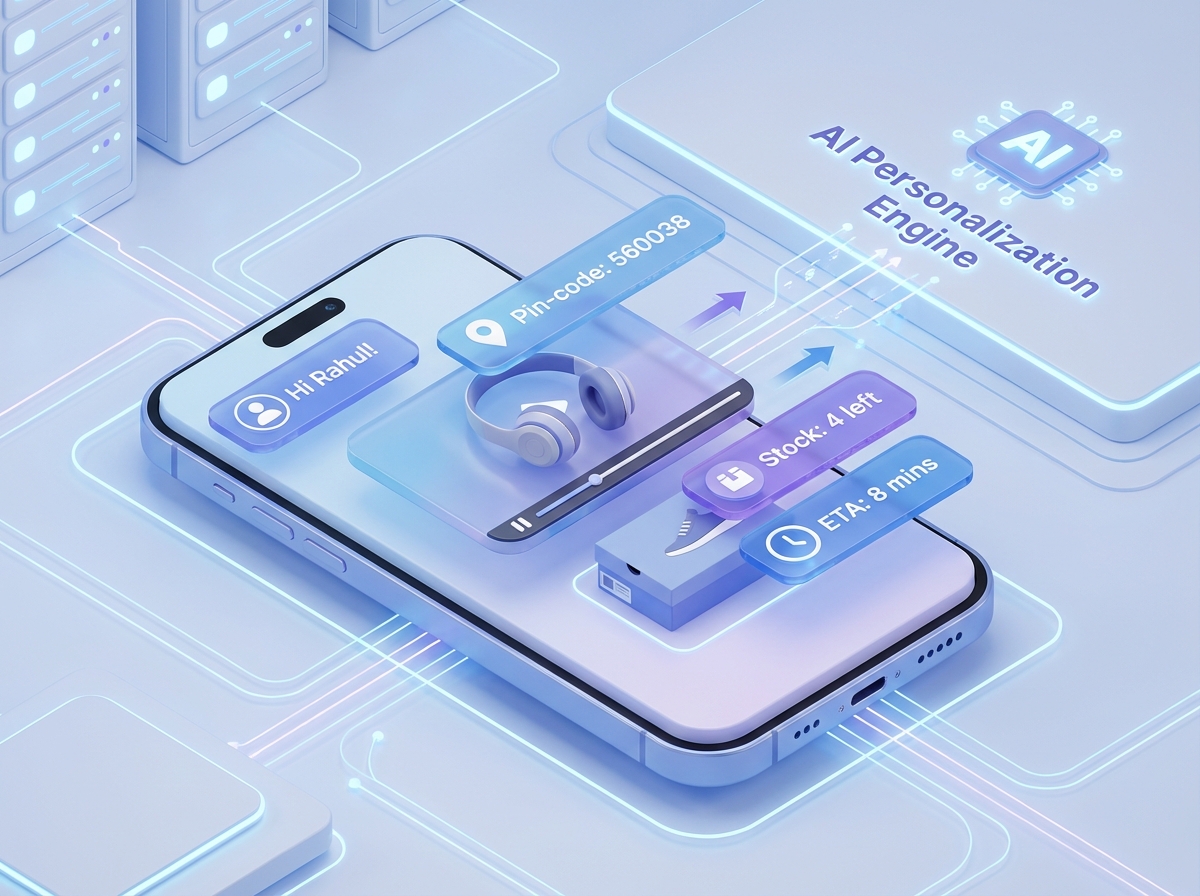
To master this domain, one must first understand the technical pillars of quick commerce video personalization. This involves the use of AI-generated, short, shoppable videos that dynamically personalize creative elements—including the customer’s name, their specific pin-code, live stock levels at the nearest dark store, and the current delivery ETA. In a market where a 10-minute delivery window is the standard, the marketing content must be just as fast and contextually accurate.
Furthermore, 10-minute commerce optimization refers to the technical and operational practices that ensure these personalized videos load in under two seconds. In the world of quick commerce, latency is the enemy of conversion. High-performance brands utilize pre-rendered variants and Content Delivery Network (CDN) edge caching to ensure that a personalized video does not slow down the product detail page (PDP) or the checkout flow.
Finally, hyperlocal delivery marketing automation serves as the “always-on” decisioning engine. This system reads local signals such as rain alerts, temperature spikes, or local festivals to automatically switch offers and creative assets. For instance, if a sudden downpour hits Mumbai, the automation engine can instantly pivot from promoting cold beverages to hot snacks, updating the video creative across all buyer apps without manual intervention.
Sources:
- Inc42: Quick commerce 2026 trends and competitive outlook
- VWO: E-commerce personalization trends
- EIN News: Quick commerce market 2026 overview
Operationalizing 10-Minute Commerce Optimization and Shoppable Video Trends
As we navigate through 2026, the shift toward vertical-first, short-form video content has become absolute. Consumers are no longer scrolling through static grids; they are engaging with micro-moment hooks that provide immediate utility. To operationalize 10-minute commerce optimization, brands must adopt a “video-first” architecture that prioritizes silent autoplay with shoppable overlays. These overlays provide critical information, such as “Only 5 units left in Indiranagar” or “Delivered to 560038 in 9 minutes,” creating a sense of urgency that static images cannot replicate.
The rise of agentic AI and creator-led retail has further transformed how brands approach authenticity. In 2026, the most successful instant shopping conversion videos are those that feel personal and unpolished yet are backed by sophisticated data. Brands are now using consented AI avatars and brand ambassadors to deliver personalized messages at scale. TrueFan AI’s 175+ language support and Personalised Celebrity Videos allow brands to speak to a diverse Indian audience in their native tongue while maintaining a premium brand feel. This level of localization is essential in a country where linguistic preferences change every few hundred kilometers.
Privacy-Safe Hyper-Personalization
In the current regulatory environment, privacy-safe personalization is paramount. Growth leaders are moving away from third-party cookies toward zero-party and first-party data signals. By leveraging the data provided directly by the quick commerce platforms—such as past purchase behavior within a specific hub—brands can create highly targeted video campaigns without infringing on user privacy. This “privacy-by-design” approach ensures long-term sustainability and builds trust with the consumer. Explore our interactive video data capture guide for practical steps.
Moreover, the consistency of the omnichannel experience is a critical trend for 2026. A user might see a personalized video nudge on WhatsApp, click through to a Blinkit PDP, and see the same visual language and offer. This seamless transition is powered by unified creative templates that adapt to different aspect ratios and platform requirements while maintaining a single source of truth for inventory and pricing data.
Sources:
- BenchmarkEmail: Short-form video tactics (2026)
- Grazitti: Digital commerce trends
- VWO: Personalization trends
Building the Hyperlocal Engine with Dark Store Inventory Videos
The heart of a successful quick commerce strategy lies in its data architecture. To drive real results, brands must move beyond basic demographic targeting and embrace location-based urgency triggers. These triggers are automated creative cues that leverage geographic data (pin-codes), real-time weather, time-of-day, and rider availability. For example, a “Breakfast Essentials” video might only trigger between 7:00 AM and 10:00 AM for users in high-density residential areas, featuring items currently in stock at the local dark store.
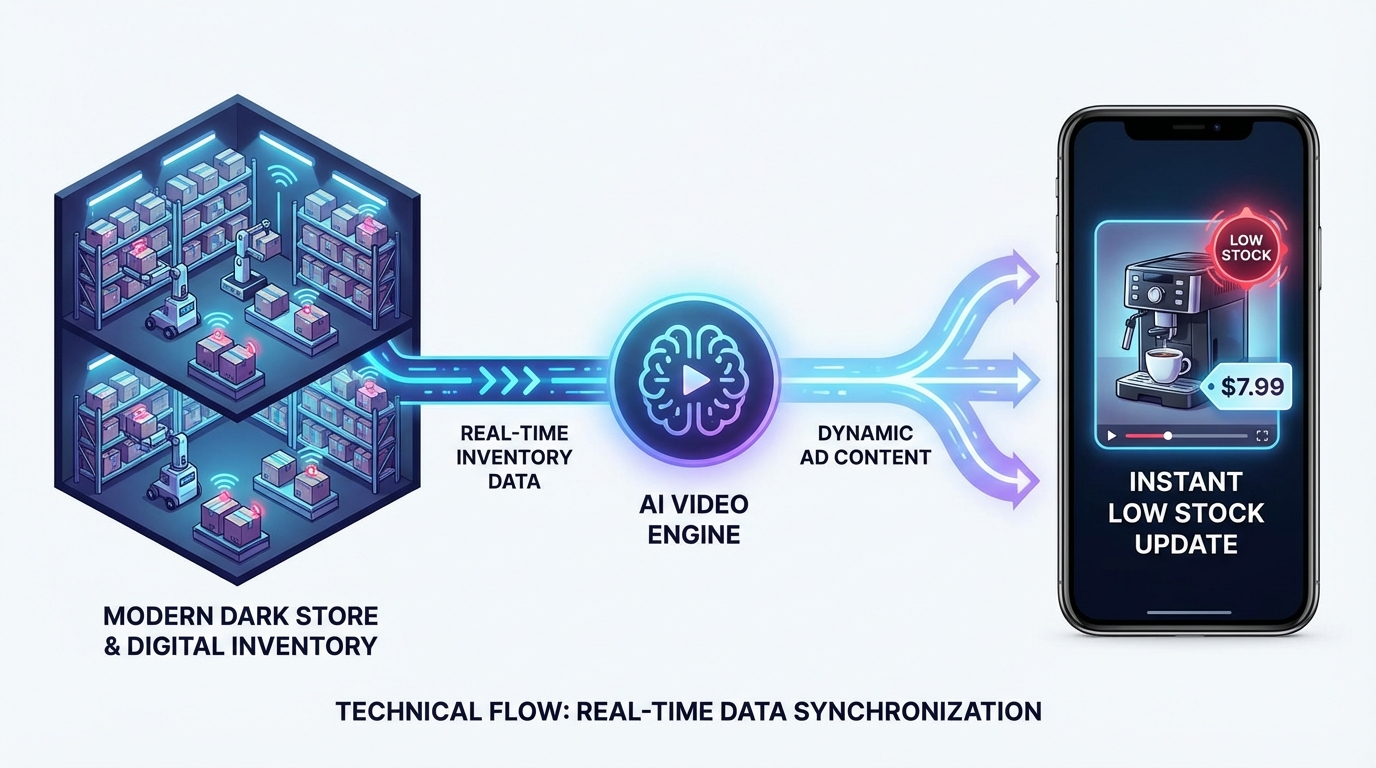
Dark store inventory videos represent the next evolution of product advertising. By sourcing live SKU counts directly from dark store feeds, brands can overlay dynamic tickers onto their video assets. If a particular dark store in Powai has only ten units of a high-demand organic milk brand, the video creative automatically updates to show a “Low Stock” badge. This transparency not only drives immediate action but also manages consumer expectations, reducing the friction of out-of-stock cancellations.
Automating Neighborhood Flash Sales
Another critical component of the hyperlocal engine is neighborhood flash sales automation. This involves setting up rules-based triggers that launch short, time-boxed sales at the borough level. These sales are often used to clear expiring inventory or overstock in specific hubs. A growth leader might authorize a “30-minute flash sale” on avocados in South Bengaluru to prevent wastage, with the automation engine generating and distributing personalized video alerts to users who have previously purchased fresh produce in that area.
To support this, a robust creative system is required. This system typically includes a library of video templates with variables for pin-codes, hub names, SKU prices, and countdown timers. For the top 50 highest-performing pin-codes, variants are often pre-rendered to ensure zero latency. For all other areas, real-time rendering APIs are used to generate the video on the fly as the user interacts with the app.
Sources:
Executing ONDC Marketplace Video Integration and Platform-Specific Playbooks
The democratization of e-commerce through the Open Network for Digital Commerce (ONDC) has opened new avenues for ONDC marketplace video integration. Unlike closed ecosystems, ONDC allows brands to reach consumers across a variety of buyer apps. Integrating short, silent-first videos into ONDC PDPs requires a technical approach that maps SKU IDs between the brand's master feed and the ONDC catalog. By attaching VideoObject metadata to these listings, brands can ensure their content is indexed correctly and plays seamlessly across different buyer app interfaces.
When it comes to platform-specific playbooks, Blinkit and Zepto require distinct strategies. On Blinkit, growth leaders focus on hub-level segmentation, grouping campaigns by dark store to manage bids and budgets at the pin-code level. The use of captioned videos on “Festival Shelves” has proven particularly effective, where city-specific bundles are promoted through high-energy visual content.
Zepto and the Art of Time-Sensitive Promos
Zepto’s ecosystem thrives on speed and the “10-minute” promise. Strategies here often revolve around time-sensitive promos for impulse categories like beverages and snacks. Ensuring that the video messaging is aligned with the Service Level Agreement (SLA)—for instance, “Delivered in 10 mins in Koramangala”—is vital for maintaining brand credibility. Solutions like TrueFan AI demonstrate ROI through significant uplifts in add-to-cart rates and reduced customer acquisition costs in these hyper-competitive zones by ensuring the creative is always in sync with the platform's delivery capabilities.
For both platforms, the “latency budget” is a non-negotiable KPI. If a video block takes more than two seconds to become interactive (TTI), the conversion rate typically drops by over 15%. Therefore, the implementation of CDN edge caching and fallback static images is a standard part of the 2026 playbook. This ensures that even in areas with poor network connectivity, the user experience remains fluid.
Sources:
- ONDC: Official site
- Paxcom: Blinkit advertising updates
- Inc42: 2026 competitive context for quick commerce
Scaling Neighborhood Flash Sales Automation and WhatsApp Commerce Integration
In the Indian context, WhatsApp is more than a messaging app; it is a primary commerce channel. WhatsApp commerce integration allows brands to send consent-based, personalized video messages that act as powerful nudges for cart recovery or festival reminders. Imagine a user who added a premium coffee brand to their Zepto cart but didn’t check out. A personalized video message featuring a brand ambassador mentioning the user's name and noting that there are only “3 units left at the Bandra West hub” can achieve recovery rates that far exceed traditional SMS or email.
The operational guardrails for WhatsApp are strict. Brands must capture explicit opt-ins and ensure that video assets are lightweight (typically under 2 MB) to ensure quick downloading on mobile networks. When combined with neighborhood flash sales automation, WhatsApp becomes a surgical tool for driving GMV. A brand can trigger a “Happy Hour” video offer specifically for a 2-kilometer radius around a dark store that is currently experiencing a lull in order volume, effectively balancing the load across their delivery fleet.
Leveraging Platform-Exclusive Festival Deals
India’s cultural calendar provides a continuous stream of opportunities for platform-exclusive festival deals. Whether it’s Ramadan, Diwali, or the IPL season, localization is the key to resonance. During the 2026 Ramadan season, top brands used quick commerce to offer “Iftar Kits” that were exclusive to specific platforms and cities. By using personalized videos that reflected local Iftar timings and regional delicacies, these brands saw a 30% increase in bundle sales.
These festival playbooks are often pre-scheduled but remain inventory-aware. If a Diwali sweet box sells out in a specific hub in Gurugram, the video creative for that hub automatically switches to an alternative “Gift Hamper” variant. This level of agility ensures that the brand's marketing spend is never wasted on out-of-stock items, a common pitfall in traditional digital advertising.
Sources:
- WhatsApp Business Platform policy
- TrueFan AI: Ramadan quick commerce playbook (2026)
- VWO: Privacy-safe personalization insights
Roadmap to Success: Platform-Exclusive Festival Deals and Measurement
Implementing a comprehensive quick commerce video personalization strategy requires a structured 30/60/90 day roadmap. In the first 30 days, the focus is on “wiring” the data feeds. This involves connecting the brand's inventory management system to the video orchestration platform and mapping the pin-code-to-hub relationships. The initial pilot should focus on the top 20 pin-codes by GMV potential, using instant shopping conversion videos with simple dynamic overlays like price and delivery time.
By the 60-day mark, brands should expand their efforts to include neighborhood flash sales automation and WhatsApp commerce integration. This phase is about testing the “nudge” logic—determining which triggers (e.g., cart abandonment vs. time-of-day) yield the highest ROI. It is also the time to launch the first festival-specific playbook, localized by city and language.
The 90-Day Scale-Up and Governance
In the final phase of the initial rollout, the focus shifts to ONDC marketplace video integration and multilingual scaling. By day 90, a brand should be capable of delivering video content in at least 6-8 Indian languages, ensuring that the “Bharat” consumer is addressed with the same level of sophistication as the urban “India” consumer. This is also when formal governance SOPs are established to ensure claims integrity—ensuring that no video makes a stock or delivery promise that the logistics backend cannot fulfill.
Measurement is the final piece of the puzzle. Growth leaders track core KPIs such as conversion rate uplift vs. control groups, CPA per pin-code, and inventory sell-through speed. By using geo-holdout tests, brands can isolate the incremental impact of personalized video on their total quick commerce GMV. This data-driven approach allows for continuous optimization, ensuring that the creative strategy evolves as quickly as the market itself. See our full quick commerce video personalization guide for measurement frameworks.
Sources:
- ONDC GitHub: Network and protocol specifications
- Paxcom: Blinkit ads setup
- TrueFan AI: Enterprise case references
Conclusion
The era of generic, one-size-fits-all marketing in the quick commerce space is over. As we move through 2026, the brands that thrive will be those that treat every pin-code as a unique market and every 10-minute delivery window as a personalized brand promise. By mastering quick commerce video personalization, growth leaders can turn the logistical complexity of India’s dark store networks into a powerful competitive advantage.
From the integration of dark store inventory videos to the strategic use of WhatsApp commerce integration, the tools for dominance are now available. The roadmap is clear: wire your data, automate your creative, and speak to your customers in their language, at their location, in real-time. The 10-minute economy waits for no one—it’s time to hit play on your personalized video strategy.
Frequently Asked Questions
What is the primary benefit of quick commerce video personalization over static images?
The primary benefit is the significant increase in conversion rates and consumer trust. In the 10-minute economy, static images are often seen as generic. Personalized videos that include real-time data like “Delivered to your pin-code in 10 mins” or “Only 4 units left” create immediate urgency and provide the specific information a quick-commerce shopper needs to make a split-second decision.
How does 10-minute commerce optimization affect app performance?
When implemented correctly, it should not negatively affect performance. By using pre-rendered video variants for high-traffic pin-codes and leveraging CDN edge caching, brands can ensure that personalized videos load as fast as static images. Most advanced systems also include a fallback mechanism where a static image is shown if the user's network latency exceeds a certain threshold.
Can I use quick commerce video personalization for regional languages in India?
Absolutely. In fact, it is highly recommended. India is a multilingual market, and localized content consistently outperforms English-only campaigns. Advanced AI tools can now handle lip-sync and voice retention in over 175 languages, allowing you to scale Hindi, Tamil, Telugu, and Marathi variants of your video creative effortlessly. Explore the vernacular video automation in India guide to get started.
How does TrueFan AI handle the latency requirements of quick commerce?
TrueFan AI utilizes a high-performance, real-time rendering API designed specifically for low-latency environments. By pre-rendering common elements and dynamically overlaying data-driven variables (like stock levels and pin-codes) at the edge, the platform ensures that the video content is ready to play the moment a user lands on a page, meeting the strict sub-2-second TTI requirements of quick commerce platforms.
Is ONDC marketplace video integration different from Blinkit or Zepto?
Yes, the technical execution differs. While Blinkit and Zepto are closed ecosystems with their own ad managers, ONDC is an open network. Integration on ONDC requires mapping your video assets to the ONDC-compliant product feeds and ensuring the metadata (like VideoObject) is correctly formatted so that various buyer apps can ingest and display the video content properly on their respective PDPs.
What data is required to start neighborhood flash sales automation?
To run automated flash sales, you need three main data streams: real-time inventory levels per dark store (SKU-level), a mapping of pin-codes to their respective supply hubs, and a trigger feed (which could be based on time, weather, or inventory age). Once these are connected to your video automation platform, you can set rules to launch and pause sales without manual intervention.