
AI video generation API India 2026: The Enterprise Developer Guide to REST, Webhooks, and Bulk Video at Scale
Estimated reading time: ~10 minutes
Key Takeaways
- API-first video pipelines in India (2026) rely on asynchronous REST, webhooks, and batch workflows for scale.
- Studio by TrueFan AI enables cost-effective bulk personalization (~₹85/10s in 4K) with deep vernacular support.
- Webhook security via HMAC verification and DLQs is essential for enterprise-grade reliability.
- Indian enterprises prioritize DPDP Act compliance, data residency, audit logs, and watermarking.
- HeyGen vs TrueFan: India-first features (WhatsApp optimization, INR billing, local compliance) often tip the scale toward TrueFan.
The landscape of digital communication has shifted from static text to dynamic, programmatic media. In the current market, implementing an AI video generation API India 2026 is no longer a luxury for forward-thinking startups—it is a core infrastructure requirement for any enterprise scaling personalized engagement. As Indian SaaS ecosystems mature, developers are moving beyond simple dashboard-based creation to robust, event-driven architectures that leverage REST APIs and webhooks to generate thousands of hyper-localized videos in real-time.
1. The State of Programmatic Video in India (2026)
The Indian AI video market has undergone a radical transformation. By early 2026, the sector is projected to reach a valuation of $1.2 billion, driven largely by the demand for vernacular content in Tier 2 and Tier 3 cities. According to recent industry reports, 78% of Indian enterprises have now integrated AI for marketing automation, with a specific focus on video-first strategies.
For developers, the shift is technical. We are seeing a transition from “human-in-the-loop” editing to “API-first” video pipelines. The ROI metrics are staggering: businesses using AI-driven video marketing have reported an 82% increase in ROI compared to traditional production methods. In the Indian context, where WhatsApp remains the primary communication channel, AI-generated videos delivered via the WhatsApp Business API are seeing open rates 3x higher than traditional email campaigns.
Platforms like Studio by TrueFan AI enable developers to bridge the gap between complex generative models and production-ready applications. The benchmark for performance in 2026 has been set at a cost-per-10s for 4K AI video of approximately ₹85 (~$1), making bulk personalization economically viable for the first time.
Fastest AI video generator benchmark
Key 2026 Market Data Points:
- Market Size: India's AI video generation sector is valued at $1.2B.
- Adoption Rate: 78% of Indian businesses utilize AI for media creation.
- Cost Efficiency: Average cost for 4K AI video generation is ₹85 per 10 seconds.
- Engagement: WhatsApp video delivery yields 3x higher engagement than email.
- Growth: API-centric video generation is seeing a 45% year-over-year growth in Indian SaaS.
Sources:
2. Architecture & Quick Start: Implementing the REST API
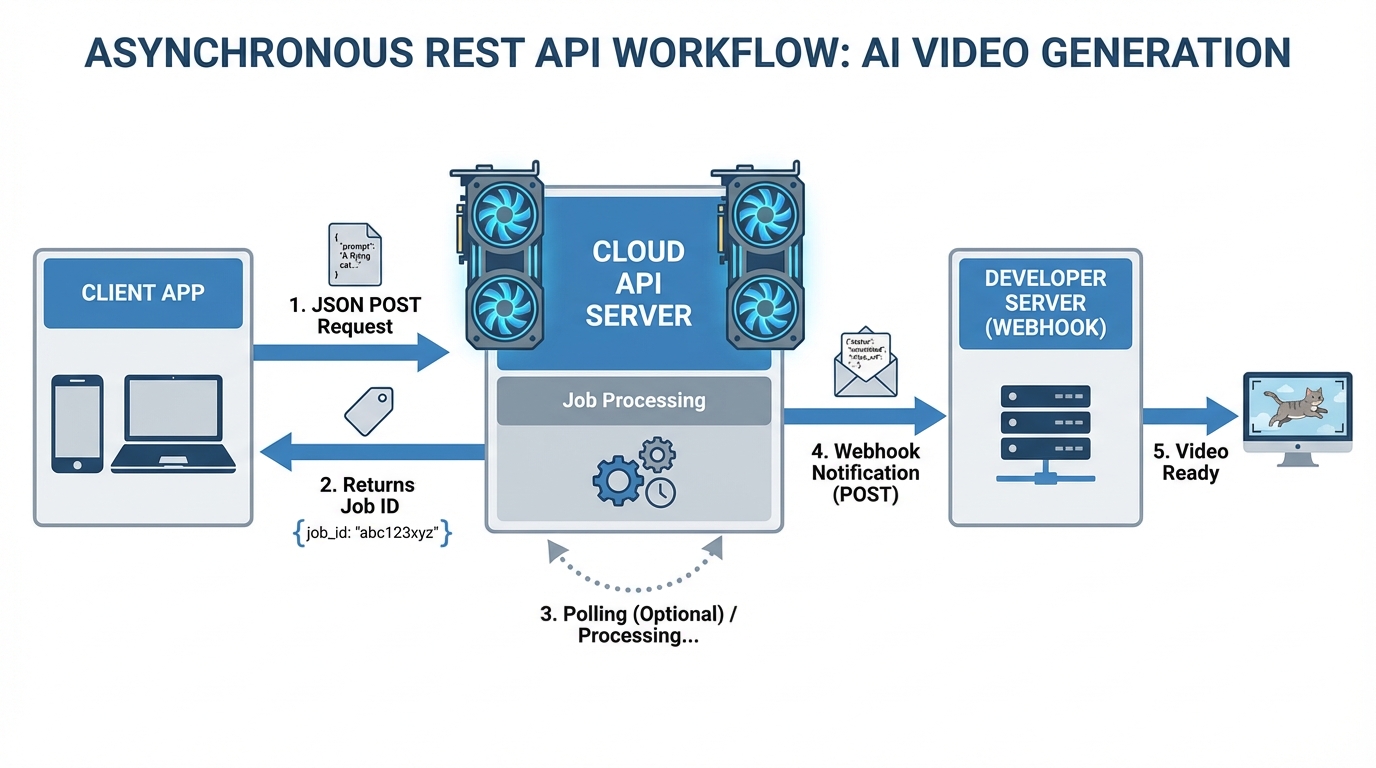
Building a scalable video pipeline requires a deep understanding of the RESTful patterns that govern AI generation. Unlike standard image APIs, video generation is asynchronous by nature due to the heavy GPU compute required for lip-syncing and rendering.
Authentication and Base Configuration
Most modern AI video APIs, including the TrueFan AI API documentation guide, follow standard Bearer Token authentication. Developers must secure their API keys and use environment variables to manage access across staging and production environments.
# Example: Initializing a video generation request
curl -X POST https://api.truefan.ai/v1/videos \
  -H "Authorization: Bearer YOUR_API_KEY" \
  -H "Content-Type: application/json" \
  -d '{
    "template_id": "tpl_88234",
    "variables": {
      "first_name": "Rahul",
      "product_name": "Premium Credit Card",
      "language": "Hindi"
    },
    "avatar_id": "avatar_gunika_01",
    "voice_id": "voice_hi_female_02",
    "resolution": "1080p",
    "webhook_url": "https://your-app.com/webhooks/video-ready"
  }'
The Request-Response Pattern
When you hit the /v1/videos endpoint, the server does not return the video file immediately. Instead, it returns a job_id. This is a critical distinction for text-to-video API India developers. Your application must be designed to handle the “Queued” or “Processing” states.
Text-to-cinematic API guide for India 2026
- POST Request: Initiates the job with script, avatar, and variables.
- Immediate Response: Returns a
job_idand an estimated processing time. - Polling (Optional): A
GET /v1/jobs/{job_id}request can be used to check status, though webhooks are preferred for scale. - Completion: The final payload includes a signed CDN URL for the MP4 or WebM file.
Studio by TrueFan AI's 175+ language support and AI avatars ensure that the script provided in the payload is perfectly lip-synced, regardless of whether the input is in English, Hindi, Tamil, or Marathi. This level of localization is handled entirely at the API layer, removing the need for developers to manage separate translation or dubbing microservices.
Sources:
3. Scaling with Webhooks and Bulk Processing
For enterprise-grade applications—such as an e-commerce platform generating 10,000 personalized product videos for a “Big Billion Day” sale—polling is inefficient. Developers must implement a robust webhook architecture.
Webhook Security and Verification
When the video generation is complete, the API provider will send a POST request to your webhook_url. To prevent spoofing, you must verify the HMAC-SHA256 signature provided in the headers.
# Python/Flask example for Webhook Verification
import hmac
import hashlib

@app.route('/webhooks/video-ready', methods=['POST'])
def handle_webhook():
    signature = request.headers.get('X-TrueFan-Signature')
    payload = request.data
    secret = b'YOUR_WEBHOOK_SECRET'

    expected_signature = hmac.new(secret, payload, hashlib.sha256).hexdigest()

    if hmac.compare_digest(signature, expected_signature):
        # Process the completed video
        data = request.json
        video_url = data['result_url']
        return "OK", 200
    return "Unauthorized", 401
Bulk Video Generation API India
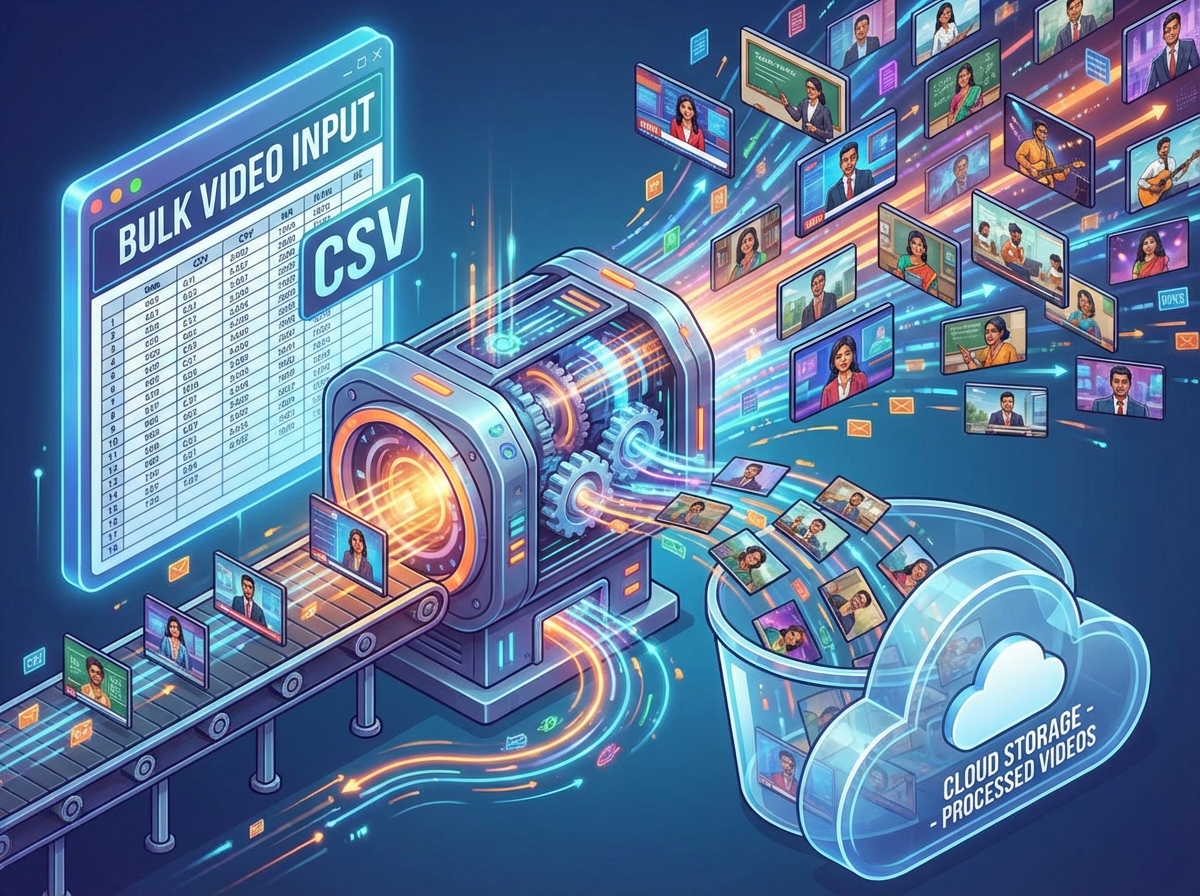
The bulk video generation API India pattern allows for massive horizontal scaling. Instead of individual calls, developers can submit a CSV or JSONL file containing thousands of rows of data. Each row represents a unique video variant.
Batch video creation automation guide
Implementation Pattern for Bulk:
- Ingestion: Upload a data file to a secure bucket.
- Trigger: Call the
/v1/bulk/jobsendpoint with the file URL and atemplate_id. - Concurrency Control: Manage rate limits (e.g., 50 concurrent renders) to ensure downstream systems (like your CRM or WhatsApp gateway) are not overwhelmed.
- Observability: Use a dashboard to track the “Success vs. Failure” rate of the batch.
AI video webhook automation developers should also implement a Dead Letter Queue (DLQ) for failed jobs. If a video fails to render due to a script violation or a transient GPU error, the DLQ ensures the job is retried or flagged for manual review without breaking the entire pipeline.
Sources:
4. Enterprise Use Cases: EdTech, E-commerce, and Personalization
The true power of an AI video API for developers India lies in its application across specific high-growth sectors. By 2026, the following blueprints have become industry standards.
AI Video API for EdTech Apps India
EdTech platforms are using APIs to turn static lesson notes into interactive video modules.
- The Workflow: A teacher uploads a lesson summary → The API triggers a generation using a “Professor” avatar → The video is rendered with bilingual subtitles (e.g., English + Telugu) → The video is pushed to the student's LMS dashboard.
- The Benefit: This reduces content production costs by 90% while allowing for “just-in-time” curriculum updates.
Automated Video API for E-commerce India
E-commerce giants are moving away from static images to “Video PDPs” (Product Detail Pages).
- The Workflow: A price change or new product launch occurs in the database → A trigger hits the programmatic video creation API India → A 15-second video highlighting the new price and features is generated → The video is automatically updated on the website and sent via WhatsApp to high-intent customers.
- The Benefit: Real-time synchronization between inventory and marketing assets.
Video Personalization API SaaS Integration
SaaS companies are integrating video directly into their customer lifecycle. Solutions like Studio by TrueFan AI demonstrate ROI through personalized onboarding. When a new user signs up, they receive a video from a digital twin of the CEO or Account Manager, greeting them by name and explaining the specific features relevant to their industry.
Sources:
5. HeyGen API vs TrueFan API: The 2026 Comparison for India
When choosing a partner for video infrastructure, developers often compare global players like HeyGen with India-centric solutions. While HeyGen offers a powerful Streaming API for real-time interaction, the requirements for the Indian market often favor a different set of features.
| Feature | HeyGen API | TrueFan AI (Studio) |
|---|---|---|
| Primary Focus | Real-time streaming & Global Avatars | Bulk Automation & India-First Avatars |
| Language Depth | Global (100+ languages) | Hyper-local (175+ languages, including Indian dialects) |
| WhatsApp Integration | Requires third-party middleware | Native/Optimized for WhatsApp Business API |
| Compliance | SOC 2, GDPR | ISO 27001, SOC 2, DPDP Act 2023 (India) |
| Pricing Model | Credit-based (USD) | Usage-based (INR) with GST Invoicing |
| Avatar Licensing | Mixed (CGI & Real) | 100% Licensed Real Influencers/Actors |
The HeyGen API vs TrueFan API comparison highlights a critical gap: data residency and local compliance. For Indian enterprises, especially in FinTech and HealthTech, having a partner that understands the Digital Personal Data Protection (DPDP) Act of 2023 is non-negotiable. Furthermore, the ability to generate videos at a cost-effective ₹85/10s rate allows for the high-volume “spray and pray” marketing common in the Indian retail sector, which global pricing models often prohibit.
Sources:
6. Security, Compliance (DPDP), and Governance
In 2026, the legal framework surrounding AI-generated media in India is strictly enforced. Developers must ensure their implementation adheres to the Digital Personal Data Protection Act, 2023.
DPDP Act Compliance for AI Video
The DPDP Act governs how personal data (like names and purchase history used in personalized videos) is processed.
- Consent Management: Your API implementation must include a “Consent Flag.” You cannot generate a personalized video using a user's name without explicit, verifiable consent.
- Purpose Limitation: Data sent to the AI video API must only be used for the generation of that specific video and must be purged according to retention policies.
- Data Fiduciary Duties: As a developer, you are responsible for ensuring the API provider (the Data Processor) has adequate security measures, such as ISO 27001 and SOC 2 certifications.
Ethical Guardrails and Watermarking
To prevent the creation of deepfakes or misinformation, enterprise APIs now include mandatory watermarking and content moderation. The AI avatar API integration guide India emphasizes that all avatars must be ethically sourced. Studio by TrueFan AI, for instance, uses digital twins of real influencers who have signed explicit licensing agreements for their likeness.
Security Checklist for Developers:
- Encryption: Ensure all media assets are encrypted at rest and in transit (TLS 1.3).
- PII Redaction: Mask sensitive information in logs and metadata.
- Audit Logs: Maintain a clear trail of who generated what video and when.
- Data Residency: For government or banking projects, ensure the GPU clusters are located within Indian borders.
Sources:
7. FAQs & Implementation Roadmap
Below you'll find an implementation roadmap. Frequently asked questions are consolidated in the FAQ section at the end of this article.
Next Steps for Developers
- Review the Documentation: Access the TrueFan AI API documentation guide to understand the specific endpoint structures and rate limits.
- Prototype with Postman: Use the provided OpenAPI collection to test single video generations with different avatars and languages.
- Set Up Your Webhook Listener: Build a simple Node.js or Python receiver to handle job completion events.
- Request an India Rate Card: For enterprise-scale projects, contact the sales team for custom INR pricing and GST-compliant billing.
By leveraging a robust AI video generation API India 2026, your development team can transform static applications into dynamic, video-first experiences that resonate with the diverse Indian audience.
Frequently Asked Questions
What is an AI video generation API India 2026 and how does it differ from a video editor SDK?
An AI video generation API is a cloud service that uses generative AI to create video content from scratch (script-to-video) or modify existing footage using AI avatars. Unlike a video editor SDK (which provides tools for trimming or filtering), an AI API handles synthesis of human speech, lip-syncing, and facial animation. In 2026, these APIs are optimized for bulk processing, with costs as low as ₹85 per 10 seconds of 4K content.
How do I trigger a bulk video generation API India job from a CSV?
Use a POST /v1/bulk/jobs endpoint and provide a URL to a CSV or JSONL file where each row contains variables (for example, customer_name, discount_code). The API queues rows as individual tasks and tracks them under a batch ID. Solutions like Studio by TrueFan AI allow monitoring progress of thousands of jobs with summaries once all renders complete.
How do I verify webhooks for AI video webhook automation developers?
Verification uses a shared secret. The provider signs the payload with HMAC-SHA256 and includes the signature in a header (for example, X-Signature). Your server recomputes the signature over the raw body using the secret and compares it with a timing-safe check. Matching values confirm authenticity and prevent replay attacks.
What factors impact AI avatar API pricing India developers?
Pricing typically depends on: 1) Resolution (4K > 1080p > 720p costs), 2) Volume (bulk discounts at scale), 3) Avatar Type (library avatars vs. custom digital twins), and 4) Distribution (hosting/CDN and egress). In India, remember to account for 18% GST.
How does the DPDP Act affect video personalization?
Under the DPDP Act, personal data used for personalization (such as names or images) requires explicit, verifiable consent. Users must have rights to access, correct, or erase their data. Your integration should support deletion of generated videos and metadata once the stated purpose (for example, a campaign) is fulfilled.



