Connected TV Advertising India 2026: The Enterprise IPL Playbook for AI-Personalized Video
Estimated reading time: ~9 minutes
Key Takeaways
- CTV becomes premium at scale in India by 2026, with IPL inventory commanding higher rates and addressable reach across millions of households.
- Second-screen orchestration turns TV attention into action using QR-to-WhatsApp flows and cross-screen journeys that personalize in real time.
- Programmatic, moment-based triggers map match events (sixes, wickets) to dynamic creatives for relevance and reduced fatigue.
- AI-powered creative scale localizes celebrity-led videos across 175+ languages, enabling rapid testing and optimization.
- Full-funnel measurement triangulates VTR, QR scans, and business outcomes with cross-screen attribution to prove ROI.
The landscape of connected TV advertising India 2026 has shifted from a nascent digital experiment to the undisputed centerpiece of the premium media mix. As we approach the IPL 2026 season, enterprises are no longer asking whether to invest in CTV, but how to orchestrate high-fidelity, addressable campaigns that bridge the gap between the living room screen and the smartphone in the viewer's hand. With the Indian CTV ad spend projected to cross ₹2,500–3,000 crore by 2026, the convergence of programmatic precision and AI-driven creative scale is redefining the "big screen" experience for over 129 million users across 50 million households.
In this high-stakes environment, the traditional "spray and pray" broadcast model is being replaced by a sophisticated, data-driven architecture. For the modern CMO, winning the IPL 2026 cycle requires more than just a premium spot; it demands real-time creative optimization triggered by match events—wickets, sixes, and milestones—delivered with surgical accuracy to specific household cohorts. This playbook outlines the strategic framework for deploying IPL 2026 connected TV campaigns that leverage programmatic CTV video personalization to drive measurable business outcomes.
The 2026 CTV Tipping Point: Market Dynamics and Publisher Landscape
By 2026, the Indian television market has reached a definitive fork in the road. While linear TV maintains its reach, the "premium" audience has decisively migrated to Connected TV. Industry forecasts from WPP’s This Year, Next Year report and Ormax OTT Audience insights indicate that CTV penetration has grown by over 85% since 2024, creating a massive, addressable inventory pool. This shift is particularly visible during the IPL, where JioCinema CTV advertising and Disney Hotstar connected TV ads have become the primary battlegrounds for brand attention.
The economics of the 2026 season reflect this premiumization. Rate cards for IPL 2026 show a clear "CTV Premium," with 10-second spots on CTV priced at approximately ₹21 lakh, compared to ₹18 lakh for linear SD/HD feeds. Base CPMs for CTV have stabilized around ₹600, reflecting the high-intent, co-viewing nature of the medium. Unlike mobile-first digital ads, CTV offers a brand-safe, non-skippable environment that commands 70–85% completion rates, making it the ideal vehicle for high-impact storytelling.
Publishers have also introduced innovative formats to capture this value. Disney Hotstar’s "Pause Ads" have emerged as a high-attention placement, turning viewer-initiated breaks into interactive brand moments. Meanwhile, JioStar’s bundled deals allow enterprises to scale across both mobile and CTV, though the most sophisticated players are now treating CTV as a distinct, addressable tier. This evolution toward addressable TV advertising enterprise capabilities allows brands to move beyond broad demographics and target based on household income, device type, and even real-time viewing behavior.
Sources:
- Campaign India: 2026 is set to be the year of Connected TV
- Exchange4media: IPL 2026 CTV's Premium Reset
- The Media Ant: CTV Ad Formats India 2026
Decoding the Second-Screen Imperative: Capturing the Dual-Screen Fan
One of the most critical insights for connected TV advertising India 2026 is the near-ubiquity of the "second screen." Nearly 90% of Indian sports fans use a smartphone or tablet while watching live matches. This behavior is not a distraction; it is an opportunity for second-screen marketing IPL 2026. The goal for enterprises is to create a seamless handoff between the high-impact visual on the TV and the conversion-ready interface on the mobile device.
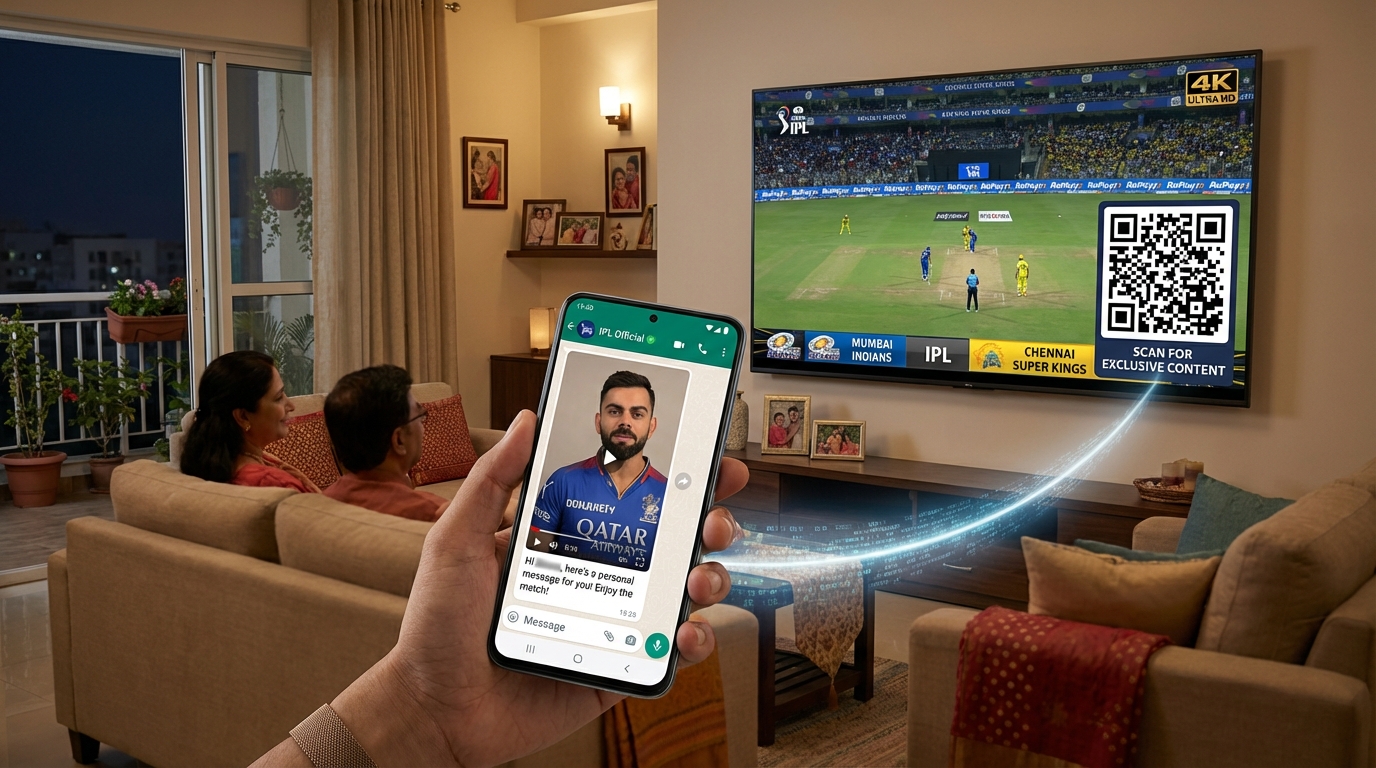
To execute this, brands are deploying QR code overlays that occupy 8–10% of the frame, designed for high contrast and 2–3 second scanability. When a viewer scans a CTV ad, they shouldn't just land on a generic homepage. Instead, the scan should trigger a cross-screen video personalization flow—perhaps a WhatsApp Business API journey that delivers a personalized discount code or a deep link to a pre-filled shopping cart.
Platforms like TrueFan AI enable enterprises to bridge this gap by generating personalized celebrity video messages that can be delivered via WhatsApp seconds after a CTV exposure. Imagine a scenario where a viewer sees a 15-second CTV spot featuring a cricket icon; they scan the QR code and instantly receive a video on their phone where that same icon addresses them by name, congratulating their team on a recent wicket and offering a limited-time match-day deal. This level of orchestration transforms passive viewing into active, high-intent engagement.
Sources:
- IndianTelevision: 90% of sports fans use a second screen
- Inc42: IPL 2026 and the AI-led second-screen economy
Programmatic Architecture: Building the Engine for Addressable TV
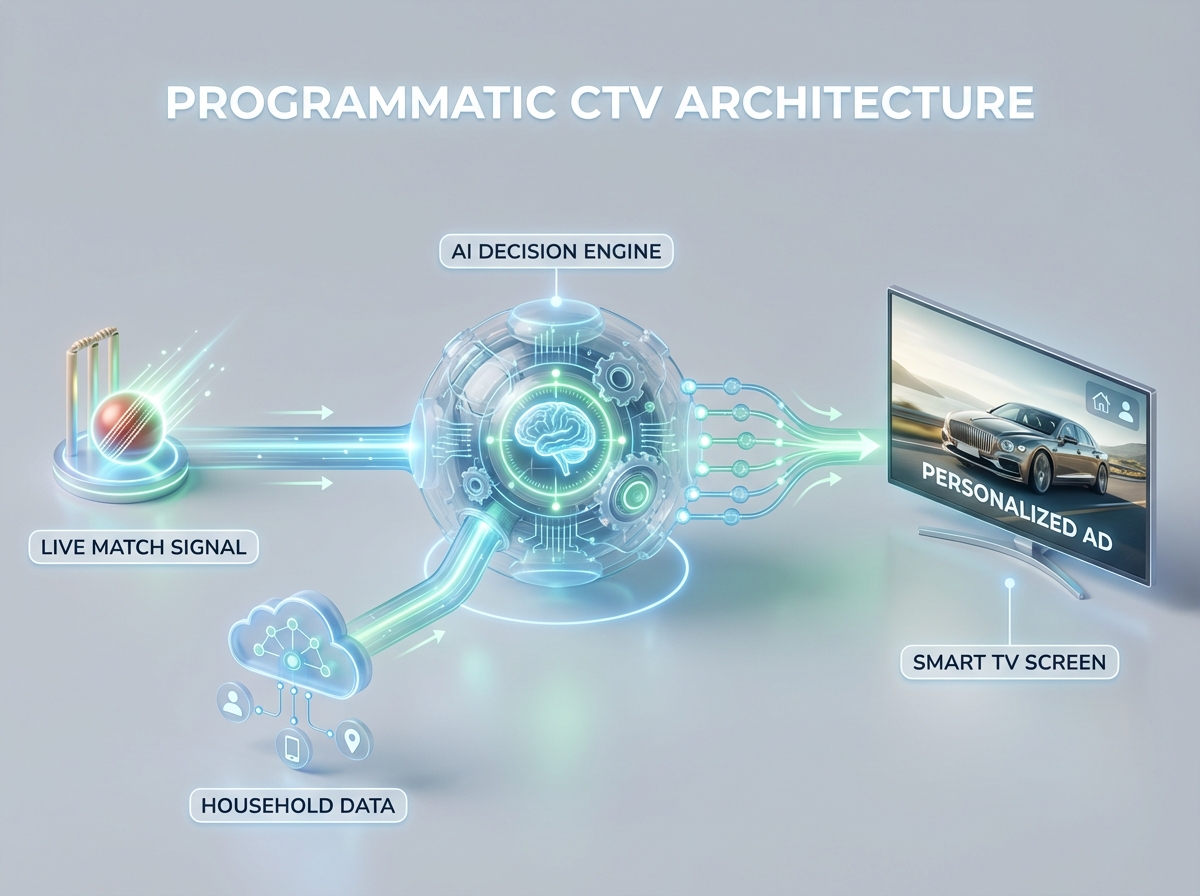
The technical backbone of a successful 2026 campaign is smart TV marketing automation India. Enterprises are moving away from static ad scheduling toward a programmatic architecture that uses real-time match signals to drive ad decisioning. This involves integrating live match data feeds (wickets, boundaries, milestones) with a Demand-Side Platform (DSP) that can swap creative assets in milliseconds.
The architecture for programmatic CTV video personalization follows a sophisticated logic:
- Signal Ingestion: A real-time feed monitors the match. When a specific event occurs (e.g., Virat Kohli hits a six), a trigger is sent to the ad server.
- Creative Mapping: The system selects a pre-approved creative variant that matches the event. For a "six," the ad might feature a celebratory message; for a "wicket," a "bounce-back" offer.
- Audience Resolution: Using household-level IDs, the system ensures the ad is delivered to the right segment—for instance, serving Mumbai Indians-themed creative only to households in Maharashtra or known MI fan clusters.
- Dynamic Delivery: The ad is served via the CTV programmatic pipe, ensuring the creative is contextually relevant to the exact moment of the match.
This addressable TV advertising enterprise approach solves the problem of creative fatigue and irrelevance. By automating the decisioning process, brands can maintain a "war-room" level of responsiveness without the manual overhead, ensuring that every rupee of the IPL budget is spent on a high-relevance impression.
Sources:
Creative at Scale: The Role of AI in CTV Video Personalization
The bottleneck for personalized advertising has always been creative production. In the past, creating 100 different versions of an ad for different cities, languages, and match moments was cost-prohibitive. However, CTV ad creative automation AI has fundamentally changed the math. Enterprises can now produce a single master shoot and use AI to generate thousands of hyper-localized variants.
TrueFan AI's 175+ language support and Personalised Celebrity Videos allow brands to achieve this scale with unprecedented fidelity. By using advanced voice cloning and lip-sync technology, the platform can take a 15-minute celebrity shoot and turn it into a library of assets where the spokesperson speaks in Marathi, Tamil, Bengali, or any of the 175+ supported languages—all while retaining their original voice and personality. This is not just dubbing; it is a virtual reshoot that ensures the "living room marketing video personalization" feels authentic to every household in India.
Furthermore, AI-powered CTV creative optimization allows for multivariate testing at scale. Brands can test different opening hooks, CTAs, and celebrity lines in real-time, automatically shifting budget toward the variants that drive the highest VTR and QR scan rates. TrueFan’s enterprise partners have reported saving up to 3,888 hours of creative production time, allowing marketing teams to focus on strategy rather than the manual labor of versioning. This efficiency is what makes CTV personalized video ads IPL viable at a national scale.
Sources:
- TrueFan Enterprise Documentation: Generative AI Video Solutions
- AWS News: TrueFan AI Named Gen AI Market Disruptor
The IPL 2026 Moment-Based Playbook: From Pre-Match to Victory
To win the IPL 2026 season, enterprises must deploy a three-phase strategy that capitalizes on the emotional arc of the tournament. This moment-based playbook ensures that IPL 2026 connected TV campaigns remain relevant from the first ball to the final trophy lift.
Phase 1: Pre-Match Intent Building
During the build-up to a match, the focus is on "City Pride" and anticipation. Use OTT advertising personalized video India to serve teasers that reference the viewer's local team. For example, a pre-match spot in Bangalore might feature a celebrity discussing the "Red and Gold" spirit, with a QR code to pre-order a match-day meal kit. This builds a data pool of high-intent users who can be retargeted during the live broadcast.
Phase 2: In-Match Emotional Capital
This is where programmatic CTV video personalization shines.
- The Boundary Boost: Within seconds of a six, serve a 10-second celebratory spot. The creative should feel like an extension of the match excitement.
- The Wicket Winback: If a rival team takes a key wicket, serve a "reassurance" offer to the home fans—perhaps a "stress-buster" discount.
- Timeout Takeovers: Use Disney Hotstar’s Pause Ads during strategic timeouts to deliver longer-form brand stories when the viewer is most likely to be looking at the screen but not distracted by live action.
Phase 3: Post-Match Conversion and Retention
The 24 hours following a match are critical for converting attention into sales. Use cross-screen video personalization to retarget households that saw the CTV ad with a mobile-optimized follow-up. If their team won, the message is celebratory; if they lost, it’s a "better luck next time" consolation offer. This sequential storytelling ensures the brand remains top-of-mind long after the TV is turned off.
Sources:
- Hotstar Discover: Innovative CTV Ad Formats - Pause Ads
- Medianews4u: Disney Hotstar Pause Ads for CTV
Measuring Success: A Framework for CTV Video Ads ROI Measurement India
The final piece of the puzzle is CTV video ads ROI measurement India. Enterprises can no longer rely on vanity metrics like "impressions." In 2026, the standard for success is a triangulated framework that combines brand health, media efficiency, and hard performance data.
Solutions like TrueFan AI demonstrate ROI through granular analytics that track the entire journey from the big screen to the final transaction. A robust measurement framework should include:
- Core Media Metrics: VTR (Video Through Rate), Quartile Completion, and CPV (Cost Per View). On CTV, you should aim for a VTR of 80%+, significantly higher than mobile benchmarks.
- Engagement Metrics: QR code scan rates and WhatsApp opt-ins. These are the primary indicators of "living room" intent.
- Business Outcomes: Incremental sales lift, app installs, and coupon redemptions. By using geo-holdout tests (comparing cities where the campaign ran vs. where it didn't), enterprises can isolate the true impact of their CTV spend.
- Cross-Screen Attribution: Using household IDs to track if a user who saw a CTV ad eventually converted on their mobile device or laptop.
By 2026, the integration of India-ready verification partners has reduced fraud and improved transparency, allowing CMOs to defend their CTV budgets with confidence. The goal is to move from "media spend" to "business investment," where every personalized impression is linked to a measurable lift in the bottom line.
Sources:
- AgencyReporter: CTV is the centerpiece of India's TV revolution in 2026
- BestMediaInfo: Behind Disney Hotstar's Pause Ads ROI
Implementation and Strategy: Navigating the Enterprise CTV Journey
Executing a campaign of this scale requires a 12-week lead time and a specialized "war-room" setup. Enterprise CTV campaign management is not a part-time job; it requires coordination between media agencies, creative tech partners, and data teams.
The 8-Week Implementation Checklist:
- Week 8: Lock objectives and publisher deals (JioCinema/Hotstar). Define the "Event Trigger" matrix (which match moments trigger which ads).
- Week 6: Master creative production. Shoot high-quality source footage with brand ambassadors, ensuring enough "hooks" for AI versioning.
- Week 4: Ingest footage into the AI pipeline. Generate localized variants in priority languages (Hindi, Tamil, Telugu, Kannada, etc.).
- Week 2: Technical integration. Connect the match-data feed to the DSP and QA the QR code-to-WhatsApp flows.
- Launch Week: Activate the war-room. Monitor pacing, frequency caps, and creative performance daily, making real-time adjustments based on match results.
The "Build vs. Buy" debate is also settled in 2026. Building an in-house AI video pipeline is a multi-year, multi-million dollar endeavor. For most enterprises, partnering with a proven platform that offers ISO 27001 security, SOC 2 compliance, and a consent-first celebrity roster is the only way to achieve the speed and scale required for the IPL.
Conclusion
As we look toward connected TV advertising India 2026, the opportunity for enterprises is clear: the living room has become an addressable, interactive, and hyper-personalized storefront. By combining the emotional power of the IPL with the technical precision of programmatic AI, brands can finally deliver the right message, in the right language, at the exact moment it matters most. The future of television is no longer about reaching everyone; it's about connecting with someone—one household at a time.
Frequently Asked Questions
How do I personalize CTV ads during the IPL 2026 season?
Personalization is achieved through programmatic ad servers that use real-time match data (like a wicket or a six) to trigger specific creative variants. By using TrueFan AI, you can automate the creation of these variants, ensuring that the celebrity in your ad speaks the viewer's language and references the current match context.
What are the expected CPMs for IPL 2026 on Connected TV?
Base CPMs for CTV during IPL 2026 are expected to be around ₹600 for a 10-second spot. However, highly targeted segments (for example, premium households in Tier 1 cities) can command higher rates. This is a premium over mobile but offers significantly higher VTR and brand impact.
Do Pause Ads actually work on CTV in India?
Yes, Pause Ads on platforms like Disney Hotstar have shown high engagement because they appear when the viewer is in a "lean-forward" state but not distracted by the live match. They are particularly effective for QR-code-driven conversions.
How can I measure the ROI of my CTV campaign?
ROI is measured by triangulating media metrics (VTR/CPV) with performance data (QR scans/WhatsApp conversions) and business outcomes (incremental sales lift). Using household-level attribution allows you to see the path from a CTV impression to a mobile conversion.
Is AI-generated celebrity content legal and safe for brands?
It is safe only if you use a platform that operates on a consent-first model. Reputable providers ensure that all celebrity likenesses are used under formal contracts and that the AI-generated content is moderated to prevent any brand safety risks.