SaaS user adoption automation 2026: The first 30 days playbook for time-to-value and early churn prevention
Estimated reading time: ~10 minutes
Key Takeaways
- Personalized onboarding videos drive faster time-to-value and reduce early churn risk.
- Behavioral triggers should orchestrate messages across onboarding, engagement, feature depth, and risk.
- Role-based journey mapping ensures each persona reaches clear Minimum Critical Actions within 30 days.
- Enterprise-ready architecture connects data, orchestration, personalization, and delivery layers end to end.
- Governance and measurement (caps, suppression, KPIs) keep automation effective and brand-safe.
How to deploy product onboarding personalization videos and feature discovery video campaigns that compress time-to-value and protect Q1 renewals
In the hyper-competitive landscape of 2026, SaaS user adoption automation 2026 has evolved from a luxury to a survival mandate for enterprise Customer Success Managers (CSMs) and Product Teams. As we enter the Q1 renewal season, the pressure to demonstrate tangible ROI within the first 30 days of a contract has never been more acute. Platforms like TrueFan AI enable organizations to bridge the gap between initial signup and long-term retention by deploying hyper-personalized, video-led interventions that speak directly to the user’s specific pain points and role-based objectives.
The traditional “one-size-fits-all” onboarding sequence is obsolete. In 2026, time-to-value optimization is driven by agentic workflows and real-time behavioral triggers (see micro-moments marketing automation 2026). This playbook provides a comprehensive blueprint for implementing SaaS engagement automation that targets early churn prevention strategies through the strategic use of product onboarding personalization videos. By the end of this guide, you will have the architecture to transform your first 30 days from a period of uncertainty into a high-velocity engine for customer success.
What SaaS user adoption automation 2026 means in Q1 renewal season
In the current fiscal climate, SaaS user adoption automation 2026 is defined as the AI-native, trigger-led orchestration of onboarding and feature education. It is a system that delivers the right message—predominantly via personalized video—at the exact moment a user encounters friction or reaches a milestone. This precision is critical because Q1 renewals are often won or lost in the first four weeks of the preceding year. If a user does not achieve their “Aha!” moment within 30 days, the probability of churn increases by over 60% in the enterprise segment.
India’s digital economy, projected to reach $1T by 2026, is built on a foundation of cloud-native stacks and AI-powered personalization. Global Capability Centers (GCCs) in India are now the primary drivers of these autonomous onboarding systems, leveraging massive datasets to trigger contextual content in real time. For SaaS leaders, this means moving beyond static email drips and toward SaaS engagement automation that adapts to user behavior. Early churn signals—such as incomplete account setup, low Weekly Active Usage (WAU), or zero exploration of “sticky” features—must be met with immediate, automated interventions.
The shift toward time-to-value optimization is no longer just about speed; it is about relevance. As Indian SaaS maturity reaches new heights, the expectation for localized, role-specific guidance has become the standard. By integrating early churn prevention strategies into the very fabric of the product experience, companies can ensure that their Q1 renewal conversations are focused on expansion rather than justification.
Sources:
- NASSCOM: Future of Cloud and its Economic Impact in India
- NASSCOM: AI-Powered Personalization at Scale
- IBEF: The Rise of SaaS in India - Trends and Future Outlook
- The Smarketers: SaaS Marketing Trends 2026
SaaS customer journey mapping for the first 30 days
Effective SaaS customer journey mapping in 2026 requires a granular, role-based approach. You cannot treat an Administrative user the same way you treat an Individual Contributor (IC) or an Executive Sponsor. Each persona has a unique definition of “value,” and your automation must reflect these distinctions. The first 30 days should be viewed as a series of micro-conversions, where each step is designed to reduce friction and accelerate the path to the next milestone.
A robust 30-day map identifies the “Minimum Critical Actions” (MCAs) that correlate most strongly with long-term retention. For a project management tool, this might be “creating the first task” or “inviting the first collaborator.” For a FinTech platform, it might be “connecting the first bank account.” Once these MCAs are identified, SaaS engagement automation can be used to nudge users toward them. This involves a multi-channel approach, utilizing in-app tooltips, Intercom/CS touches, and, most importantly, product tour personalization through video.
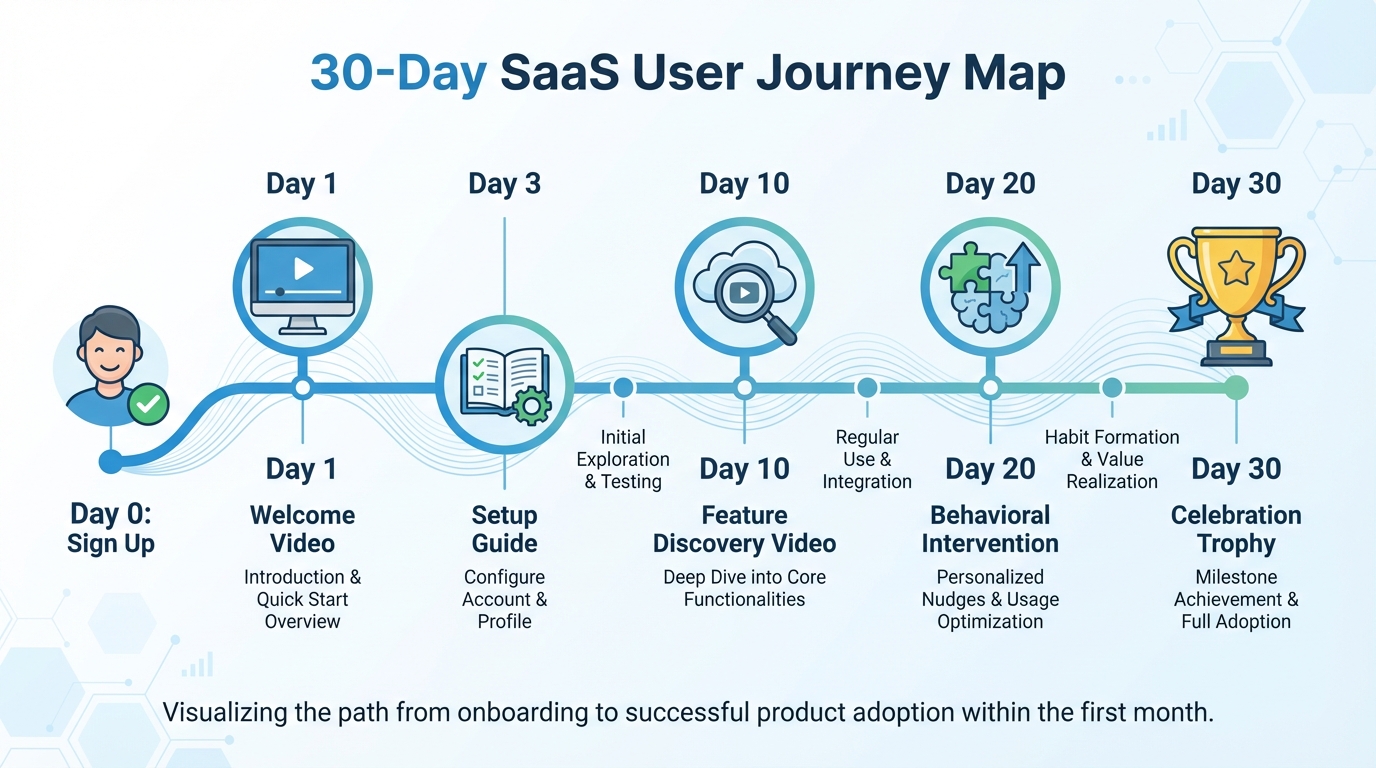
By mapping the journey across Day 0 to Day 30, CSMs can visualize the “friction points” where users typically drop off. For instance, Day 3 is often a high-risk period where initial excitement wanes if the setup isn't complete. By deploying first 30 days customer success tactics—such as a personalized video from the account manager—you can humanize the digital experience and provide the necessary momentum to push through the “trough of disillusionment.”
Product onboarding personalization videos and activation sequences
The core of your 2026 adoption strategy must be the deployment of product onboarding personalization videos (related onboarding playbooks: ONDC personalized video onboarding and ONDC seller onboarding videos). Text-heavy guides are ignored; generic videos are skipped. Personalization is the only way to capture attention in a saturated market.
Day 0–1: Welcome + product tour personalization
The first 24 hours are critical for setting the tone. The objective is to confirm account creation and deliver a product tour personalization experience that feels bespoke. Instead of a generic “Welcome” email, users should receive a 45–60 second video that mentions their name, company, and specific plan tier. TrueFan AI's 175+ language support and Personalised Celebrity Videos allow for this level of scale, ensuring that a user in Mumbai receives a video that feels as personal as one sent to a user in San Francisco. The script should be direct: “Hi [Name], welcome to [Product]. As a [Role] at [Company], your quickest path to value is [Feature 1]. Click the in-app checklist to get started.”
Day 2–7: Setup completion via user activation video sequences
Between Day 2 and Day 7, the focus shifts to user activation video sequences. These are triggered by specific events, such as an incomplete integration or a failed data import. If a user has not completed their profile by Day 3, an automated nudge—ideally via WhatsApp or in-app modal—should deliver a 30-second “Setup Unblocker” video. This video shouldn't just say “finish your setup”; it should show them exactly how to resolve the specific hurdle they are facing. This is the essence of time-to-value optimization (trigger design examples: instant shopping video triggers).
Day 8–14: Feature discovery video campaigns for deeper activation
Once the basics are covered, the goal is to expand usage to “sticky” features. Feature discovery video campaigns should be segmented based on user behavior. If a user has mastered Feature A but hasn't touched Feature B (which is a high predictor of retention), they should receive a targeted video highlighting the “Why” and “How” of Feature B. These micro-demos should be no longer than 45 seconds and must include a clear Call to Action (CTA) that links directly to the feature within the app.
Day 15–21: Behavior-led interventions and habit formation
By the third week, you are looking for signs of habit formation. If a user’s login frequency drops by 50% week-over-week, this is a “red flag” trigger. User behavior video interventions can be used to “win back” these users by showing them new value or reminding them of the progress they’ve already made. This is where SaaS engagement automation becomes predictive, using historical data to intervene before the user even realizes they are disengaging (see real-time moment design: micro-moments marketing automation 2026).
Day 22–30: User milestone celebration videos and renewal priming
The final week of the first month is about reinforcement. User milestone celebration videos should be triggered when a user achieves a major goal, such as “10 projects created” or “Team fully onboarded.” These videos serve two purposes: they provide positive reinforcement and they prime the user for future expansion. A simple “Congratulations on your first 100 reports!” video can significantly boost sentiment as you approach the first quarterly business review (renewal season playbooks: predictive churn prevention videos).
Sources:
Designing the product adoption triggers and intervention playbook
A successful automation strategy relies on a sophisticated product adoption triggers taxonomy. You cannot automate what you do not measure. In 2026, triggers are categorized into four main buckets: Onboarding State, Engagement, Feature Depth, and Sentiment/Risk (see trigger-to-offer orchestration examples: instant shopping video triggers and micro-moments marketing automation 2026).
- Onboarding State Triggers: These include
account_created,checklist_started, andintegration_failed. These are binary events that require immediate, tactical responses. For example, anintegration_failedevent should immediately trigger a customer success playbook video that walks the user through common troubleshooting steps for that specific integration. - Engagement Triggers: Metrics like
DAU/WAU ratioandinactivity_72hare vital for monitoring health. If a user hasn't logged in for three days during their first week, the system should automatically trigger a “re-engagement” sequence. - Feature Depth Triggers: These track the transition from a novice to a power user. Triggers like
feature_B_unusedorautomation_createdallow you to send highly relevant feature discovery video campaigns. - Sentiment and Risk Triggers: Low NPS scores (0–6) or a spike in support tickets are clear indicators of early churn risk. These should trigger a high-priority intervention, perhaps even escalating to a live CS touch combined with a personalized “We’re here to help” video.
For every trigger, your playbook must define the goal, the audience, the message angle, and the success metric. For example, the goal of a “Setup Unblocker” video is to increase the setup_completion_rate. By defining these parameters upfront, you ensure that your SaaS engagement automation is always aligned with business outcomes. Solutions like TrueFan AI demonstrate ROI through the measurable lift in these specific activation metrics, providing a clear link between personalized content and bottom-line retention.
Customer success playbook videos and automation architecture
To scale these interventions, you need a library of customer success playbook videos that can be dynamically assembled and delivered. These templates should be role- and stage-specific, allowing for variables like name, company, and feature status to be injected in real time.
The Template Library
- The Welcome Script: “Hi [Name], I'm [CSM Name]. We're thrilled to have [Company] on board. Your first goal is to [MCA]. Here is how to do it in 30 seconds.”
- The Feature Aha! Script: “Did you know [Feature] can save you [X hours] a week? Most [Role]s use it to [Outcome]. Check it out here.”
- The Risk Win-Back Script: “We missed you, [Name]! Since you last logged in, we've added [New Update] that helps with [Pain Point]. Ready to jump back in?”
Automation Architecture for Enterprise Scale
Building an “India-ready” architecture requires a seamless flow of data between your product, your CRM, and your personalization engine.
- Data Layer: Use tools like Segment or Mixpanel to capture behavioral events.
- Orchestration Layer: Platforms like Braze or MoEngage act as the “brain,” deciding which message to send and when.
- Personalization Layer: This is where TrueFan AI sits, receiving a trigger from the orchestration layer and rendering a personalized video in under 30 seconds via API (see renewal automation analogs: AMC renewal automation 2026).
- Delivery Layer: The final video is delivered via the user's preferred channel—be it an in-app modal, a personalized email, or a WhatsApp message (with explicit consent).
Security and compliance are non-negotiable in the enterprise space. Your architecture must be ISO 27001 and SOC 2 compliant, ensuring that PII is minimized and data is encrypted at every stage. In the Indian context, where the Digital Personal Data Protection (DPDP) Act is central, having a “consent-first” model for all automated communications is essential for long-term viability.
Sources:
Measurement, governance, and adoption rate improvement campaigns
The final component of the playbook is a rigorous framework for measurement and iteration. Adoption rate improvement campaigns are not “set and forget” projects; they require constant tuning based on real-world performance data.
The KPI Ladder
- Time-to-Value (TTV): The primary metric. You must measure the median time it takes for a user to reach their first “Aha!” moment. Your goal should be a 20–30% reduction in TTV through automation.
- Activation Rate: The percentage of users who complete the onboarding checklist within 7 days.
- Feature Discovery %: The percentage of users who engage with at least three “sticky” features within their first 30 days.
- Content Metrics: Beyond product usage, you must track video watch-through rates and CTA click-through rates to ensure your creative is resonating.
Governance and Risk Mitigation
With great automation comes the risk of “over-messaging.” To prevent “notification fatigue,” you must implement strict frequency caps—typically no more than 2–3 video touches per week during the onboarding phase. Furthermore, your governance model must include “suppression lists” to ensure that once a user has converted or reached a milestone, the related nudges stop immediately.
Brand safety is another critical pillar. All dynamic video templates must undergo a rigorous approval process, and variable whitelisting should be used to prevent any unintended output. By maintaining high standards for both data security and creative quality, you protect the integrity of the customer relationship while reaping the benefits of scale. See also Q1 retention sequencing for enterprise marketing teams: cultural celebration marketing automation Q1.
The 2-Week Pilot Plan
If you are starting from scratch, don't try to automate the entire 30-day journey at once. Start with a 2-week pilot:
- Week 1: Instrument four universal triggers (
account_created,checklist_completed,inactivity_72h,feature_B_unused). Build the corresponding videos using TrueFan AI. - Week 2: Launch A/B tests comparing your video-led interventions against your existing text-only sequences. Monitor the lift in setup completion and TTV.
- Refine: Use the data from the pilot to refine your scripts and expand to more complex, role-based personas.
Final Thought: The future of SaaS is not just about the software you build, but the experience you orchestrate around it. By mastering SaaS user adoption automation 2026, you aren't just preventing churn; you are building a foundation of trust and value that will sustain your customer relationships for years to come.
Primary CTA: Book an enterprise demo to launch your first 30 days “adoption automation” pilot with personalized videos.
Secondary CTA: Download the 30-day trigger and script template pack (CSV + Script Docs).
Frequently Asked Questions
How do we justify the budget for personalized video automation?
The cost of SaaS user adoption automation 2026 should be framed against the cost of churn. If a personalized video sequence improves Day-30 retention by even 5%, the ROI often exceeds 10x in the enterprise segment. Automated video is significantly more scalable and cost-effective than hiring additional CSMs to perform manual outreach.
Is the data used for personalization secure?
Yes. Enterprise-grade solutions like TrueFan AI are built with ISO 27001 and SOC 2 compliance. We utilize PII minimization techniques, ensuring that only the necessary data points (like first name or company) are used to generate the video, and all data is encrypted in transit and at rest.
Can we localize these videos for our global users?
Absolutely. TrueFan AI supports over 175 languages, allowing you to deliver a consistent, high-quality onboarding experience regardless of the user's location. This includes lip-syncing and voice retention to ensure the brand avatar remains authentic across different languages.
How do these videos integrate with our existing tech stack?
Most SaaS engagement automation platforms integrate via API or webhooks. You can connect your product analytics (Segment/Mixpanel) to your orchestration tool (Braze/MoEngage), which then triggers the video generation in TrueFan AI. The final video URL is then pushed back into your delivery channel (Email/WhatsApp/In-app) (see real-time playbooks: micro-moments marketing automation 2026).
What is the ideal length for a customer success playbook video?
For onboarding and activation, brevity is key. Aim for 30–60 seconds. The first 5 seconds must establish personal context to prevent the user from skipping, and the final 10 seconds should be a clear, single CTA.