Retail media networks India 2026: How AI‑generated personalized product videos win on Amazon, Flipkart, Blinkit, and Zepto
Estimated reading time: ~11 minutes
Key Takeaways
- Retail Media Networks (RMNs) in India are now a primary growth engine, powered by first‑party data and closed‑loop attribution.
- AI‑generated personalized product videos outperform static creatives across Amazon, Flipkart, Blinkit, and Zepto.
- Creative automation enables data‑to‑video at SKU scale with localization in 175+ languages and dynamic overlays.
- Platform‑specific strategies—hooks on Amazon, regional value messaging on Flipkart, and snackable urgency on quick‑commerce—drive uplift.
- Proving ROI with incrementality testing and ASIN/SKU‑level performance lets CMOs reallocate spend to winning video variants.
Retail media networks India 2026 have officially transitioned from a secondary performance channel to the primary engine of digital advertising growth. As e-commerce penetration deepens across Tier 2 and Tier 3 cities, brands are no longer just fighting for “shelf space”—they are fighting for “attention equity” at the exact millisecond of purchase intent. In this hyper-competitive landscape, static imagery and generic banners have lost their edge. The new gold standard is the personalized product video ad, a dynamic, AI-driven creative format that speaks directly to the shopper’s context, language, and immediate needs. Platforms like TrueFan AI enable enterprises to bridge the gap between massive SKU catalogs and individual consumer preferences, turning every product detail page (PDP) into a high-converting cinematic experience.
1. The 2026 Landscape: Why RMNs are India’s Next Ad Pillar
By the start of 2026, the Indian advertising ecosystem underwent a tectonic shift. Retail Media Networks (RMNs)—retailer-owned advertising platforms that leverage first-party purchase data—now command a staggering share of the digital pie. According to the dentsu–e4m Digital Advertising Report 2026, e-retail media accounted for 24.58% of India’s total digital ad spend by the end of 2025, with total spends on e-retail platforms reaching ₹17,601 crore. As we move through 2026, industry projections from WPP’s This Year Next Year (TYNY) suggest that retail media will cross the ₹30,000 crore mark, capturing approximately 15% of India’s total ad revenue.
This explosive growth is driven by the “closed-loop” advantage. Unlike traditional social media or search ads, RMNs like Amazon Ads, Flipkart Ads, and quick-commerce giants like Blinkit and Zepto allow CMOs to track a direct line from ad exposure to a confirmed SKU-level sale. In an era where privacy regulations like the Digital Personal Data Protection (DPDP) Act DPDP-compliant personalization strategies have limited third-party cookie tracking, the deterministic first-party data held by retailers has become the most valuable currency in marketing.
However, this growth has brought about a “fragmentation tax.” CMOs are now managing budgets across a dozen different platforms, each with its own creative specs and audience nuances. The challenge in 2026 isn't just spending the budget; it's ensuring that the creative assets—specifically video—can scale across these networks without exploding production costs. This is where AI-driven creative automation becomes the critical differentiator for enterprise retail media strategy 2026.
Sources:
- exchange4media: Drivers of retail media’s 56% YoY surge
- BestMediaInfo: Dentsu outlook on India AdEx 2026
- Storyboard18: WPP TYNY on content-driven ad spend
2. The Shift to Video: From Static Listings to Shoppable Experiences
The evolution of the Indian shopper in 2026 is defined by “video-first” discovery. Whether it's a 10-minute grocery delivery on Zepto or a high-consideration electronics purchase on Amazon, shoppers are increasingly ignoring static carousels in favor of immersive, shoppable video. This shift is being led by the platforms themselves, which have integrated AI-powered video tools directly into their advertising consoles.
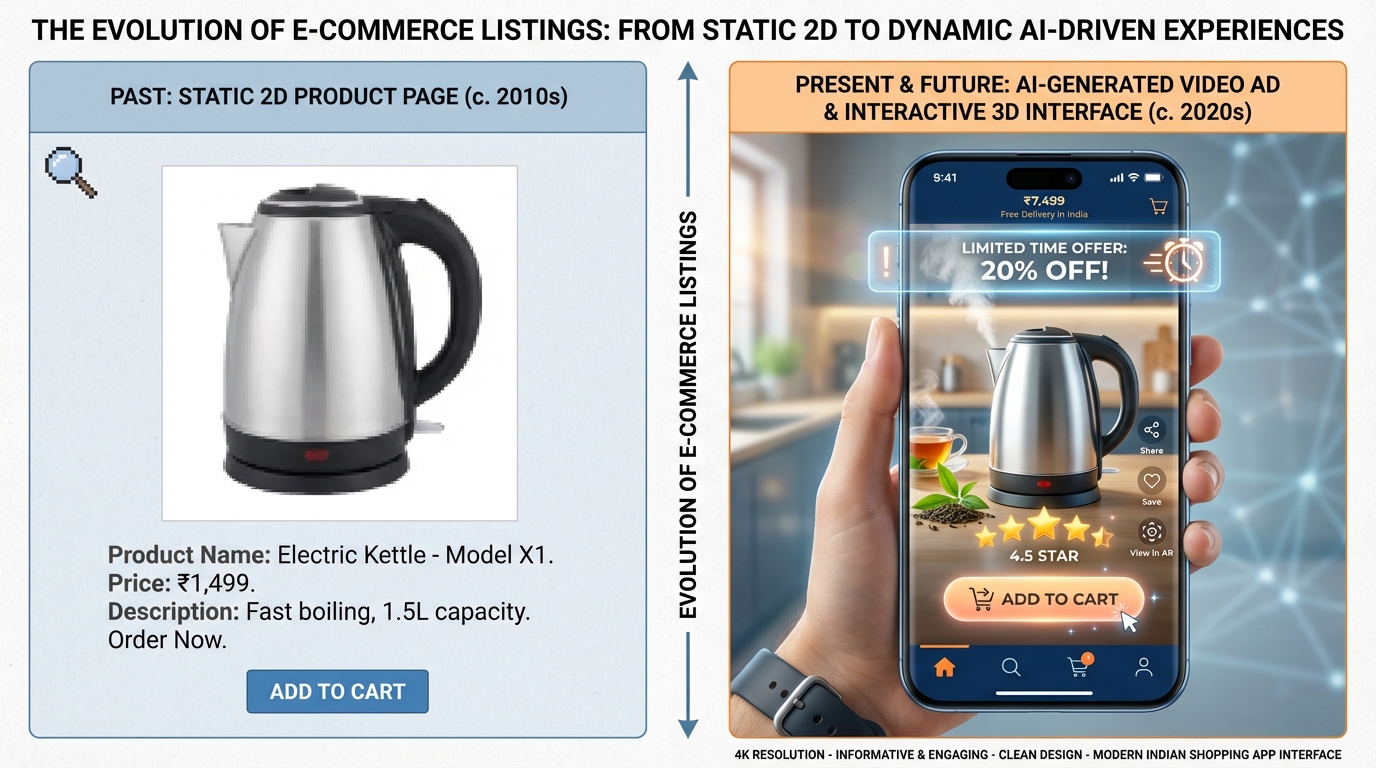
Amazon Ads India, celebrating over a decade in the country, recently expanded its AI-powered Video Generator. This tool allows even small-to-medium businesses (SMBs) to transform a single product image into a multi-scene video with smooth transitions and background music. For enterprises, the bar is even higher. They are moving beyond basic “image-to-video” templates toward high-fidelity, personalized product video ads that feature dynamic overlays of real-time pricing, ratings, and localized offers.
In the quick-commerce sector, the transformation is even more rapid. Blinkit and Zepto campaign examples have introduced “snackable” video formats—6 to 10-second clips that highlight product benefits and the “delivered in 10 minutes” promise. These videos are designed to capture impulse buys, where the time from discovery to cart is less than a minute. Shoppable video retail media in India has effectively collapsed the marketing funnel, turning the creative asset itself into the storefront. For CMOs, this means the creative must be as agile as the supply chain, updating in real-time to reflect stock levels, lightning deals, and regional festivities calendars.
Sources:
- exchange4media: Amazon Ads brings AI Video Generator to India
- ET Enterprise AI: Amazon AI-powered Video Generator launch
- Blinkit for Brands: Creative formats and specs
3. Hyper-Personalization: Winning the High-Intent Shopper
The true power of retail media networks India 2026 lies in the marriage of first-party data and creative personalization. Generic video ads are being replaced by high-intent shopper video personalization strategies that leverage a retailer’s deterministic data. This includes category affinity, purchase recency, and even basket co-purchase signals (e.g., if a user buys organic flour, show them a video for organic cold-pressed oil).
Personalization in 2026 is not just about inserting a name; it’s about context. A personalized product video ad on Flipkart might change its messaging based on the shopper's location—highlighting “Next Day Delivery” for a Mumbai resident while focusing on a “Festive Discount” for a shopper in a Tier 2 city. Furthermore, with India's diverse linguistic landscape, localization has become a non-negotiable. AI now allows brands to auto-localize video content into 175+ languages, ensuring that a shopper in Tamil Nadu sees a video with perfect lip-sync and voice retention in Tamil, while a shopper in Punjab sees the same product featured in Punjabi.
This level of first-party data retail media video targeting ensures that the creative is always relevant to the shopper's current stage in the buying journey. For “Value Seekers,” the video might emphasize the MRP vs. Offer Price. For “Premium/ARPU” segments, the focus might shift to product heritage, quality, or exclusive features. By tailoring the creative variant to the audience segment, brands are seeing significantly higher add-to-cart rates and a lower cost-per-acquisition (CPA).
4. The Creative Automation Playbook: Scaling Video with AI
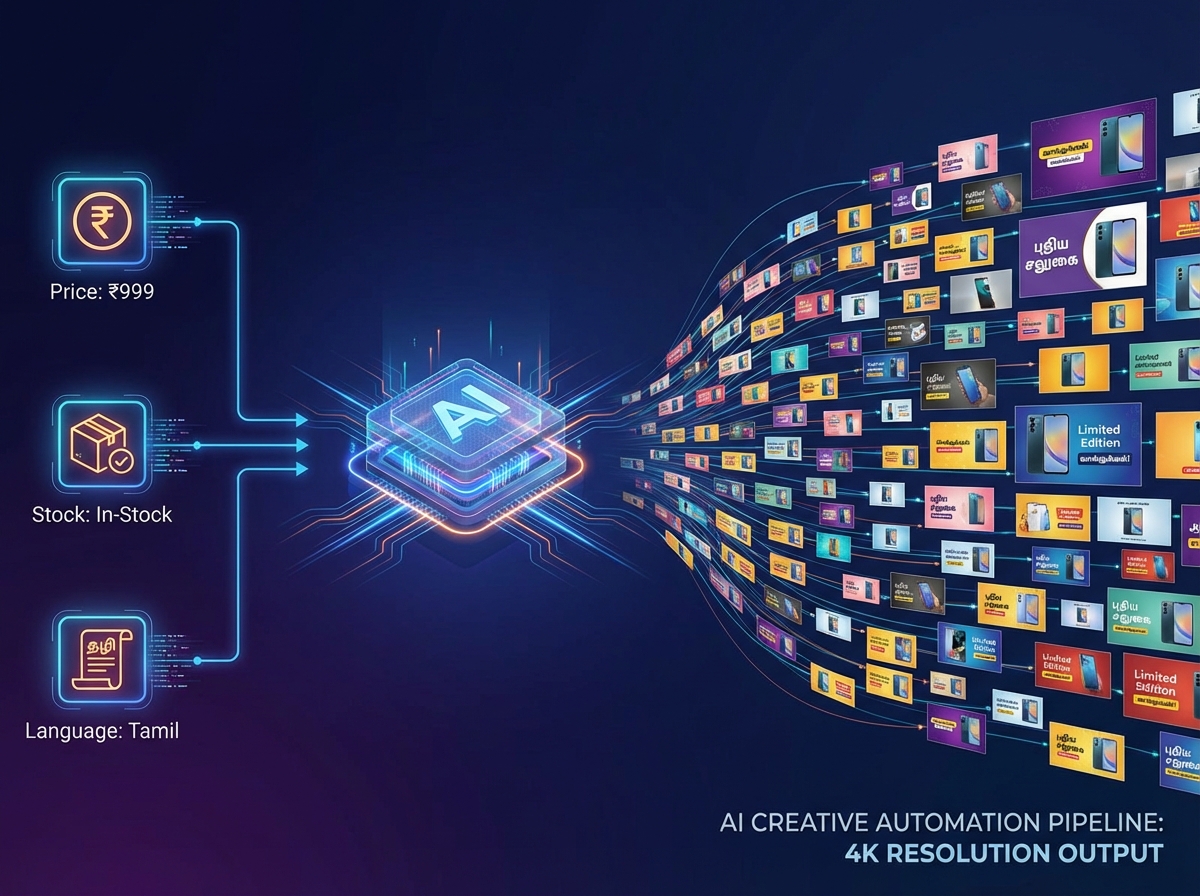
Executing a personalized video strategy across thousands of SKUs and multiple RMNs is humanly impossible without a robust creative automation framework. In 2026, enterprises are adopting a “data-to-video” system that automates the entire production pipeline. This retail media AI-driven ad creation India workflow involves several key stages:
- Data Ingestion: The system pulls real-time metadata from Product Detail Pages (PDPs), including SKU names, current prices, promotional offers, stock availability, and user ratings.
- Template Design: Modular video templates are built with dynamic fields. These templates include a “hook” (the first 3 seconds), product benefits, social proof (ratings/reviews), and a clear Call-to-Action (CTA) like “Add to Cart” or “Buy Now.”
- Variant Rules: Brands define rules for different segments. For example, if a user is a “Frequent Buyer” of a specific FMCG brand, the AI generates a video focusing on a “Bulk Pack” offer. If they are a “New-to-Category” user, the video focuses on product education and trials.
- Mass Rendering: Using high-performance GPU farms, the system renders thousands of unique video variants in under 30 seconds per output. TrueFan AI's 175+ language support and Personalised Celebrity Videos can be integrated here, allowing a brand ambassador to “speak” directly to the shopper in their local dialect, mentioning the specific product they are viewing.
- Automated Deployment: These assets are then bulk-uploaded to Amazon Ads, Flipkart Ads, and Quick-commerce platforms via API, ensuring that the right creative reaches the right audience without manual intervention.
This retail media creative automation approach doesn't just save time; it ensures brand consistency across the fragmented RMN landscape. By using AI video ads for e-commerce listings, brands can refresh their creative weekly—or even daily during major sales events like “The Big Billion Days”—to prevent creative fatigue and maintain high engagement rates.
5. Platform-Specific Strategies: Amazon, Flipkart, Blinkit, and Zepto
Each retail media network in India has its own unique ecosystem, requiring a tailored creative approach.
Amazon Ads: The Gold Standard for Consideration
Amazon retail media personalized video strategies focus on the “Sponsored Brands” and “Sponsored Products” video placements. In 2026, the most successful ads on Amazon are those that lean into the first 3 seconds of the video. With the Amazon Video Generator, brands are creating “benefit-led” hooks that immediately address a pain point.
- Creative Tip: Use ratings badges and social proof overlays. If a product has a 4.5-star rating, that should be a dynamic element in the video.
- Measurement: Focus on ASIN-level sales lift and “New-to-Brand” (NTB) metrics to justify the video spend.
Flipkart Ads: Dominating the Value and Regional Segments
Flipkart ads AI video creative often prioritizes regional localization and “value” messaging. Given Flipkart's strong hold in the fashion and electronics categories, videos that showcase product demos (e.g., how a smartphone camera performs or the texture of a fabric) perform exceptionally well.
- Creative Tip: Use Hindi and top regional languages (Tamil, Telugu, Bengali) for all voice-overs and subtitles.
- Measurement: Track “Share of Voice” (SOV) within specific category fests to ensure your video ads are outshining competitors.
Quick-Commerce (Blinkit & Zepto): The Impulse Engine
Blinkit Zepto ad platform video ads are all about speed and urgency—see instant shopping video triggers and rapid fulfillment personalization strategies. These are “snackable” 6-10 second videos that highlight the “10-minute delivery” promise.
- Creative Tip: Ensure the pack-shot is clear and occupies at least 40% of the screen. Use high-contrast text for price drops and “Buy 1 Get 1” offers.
- Measurement: The primary KPI here is “View-to-Cart” rate. Because the mission is often immediate (e.g., “I need milk now”), the video must facilitate a frictionless transition to the cart.
6. Measurement & ROI: Closing the Loop on Retail Media
The ultimate goal of any enterprise retail media strategy 2026 is to prove a tangible return on investment. Unlike traditional digital channels that rely on “estimated” lift, RMNs provide closed-loop video attribution retail. This means connecting the specific video ad a user watched directly to the SKU they purchased within the same ecosystem.
Solutions like TrueFan AI demonstrate ROI through increased engagement metrics—such as a 17% higher read rate on personalized notifications or a 3.2x higher participation rate in brand activations—which directly correlate to lower down-funnel conversion costs. In 2026, the measurement architecture for retail media includes:
- Top-of-Funnel: Thumb-stop rate (percentage of users who watch past 3 seconds) and VTR (View-Through Rate).
- Mid-Funnel: PDP dwell time and “Add-to-Cart” (ATC) rate.
- Bottom-Funnel: ROAS (Return on Ad Spend), Unit Sales Lift, and Incrementality.
Incrementality testing has become the “North Star” for CMOs in 2026. By using audience holdout tests, brands can determine exactly how many sales were driven by the personalized video ad versus how many would have happened anyway. This level of retail media network ROI measurement allows for precise budget reallocation, moving funds from underperforming static ads to high-performing AI video variants.
Sources:
7. Enterprise Strategy: Building the 2026 Operating Model
To succeed in the era of retail media networks India 2026, enterprises must evolve their internal operating models. It is no longer enough to have a “performance team” and a “creative team” working in silos. The most successful brands have created “Creative Ops” pods that sit at the intersection of data and design.
FMCG Retail Media Video Campaigns
For FMCG brands, the focus is on “Mission-Based” creative. If a shopper is searching for “breakfast” on Blinkit, the AI should automatically generate a video for oats or coffee that mentions “Start your morning right” and “Delivered in 10 mins.” This high-intent shopper video personalization is what drives the impulse basket.
Consumer Electronics & D2C
For high-value electronics, the strategy shifts to “Education and Trust.” AI video ads for e-commerce listings in this category should focus on spec-led demos, EMI offers, and unboxing experiences. Using AI to create 15-30 second “virtual demos” allows brands to answer consumer questions before they are even asked, reducing the bounce rate on high-ticket items.
The Implementation Timeline
- Weeks 1-2: Audit existing PDPs and define audience segments based on retailer first-party data.
- Weeks 3-4: Set up the creative automation pipeline and generate the first 500 variants for a pilot category.
- Weeks 5-8: Deploy on Amazon and Flipkart; begin A/B testing hooks and CTA copy.
- Weeks 9-12: Scale to 10,000+ variants across all RMNs and automate weekly creative refreshes based on performance data.
Conclusion
The landscape of retail media networks India 2026 is one of immense opportunity and significant complexity. As ad spends cross the ₹30,000 crore mark, the brands that win will be those that move beyond “one-size-fits-all” advertising. By embracing AI-driven creative automation and hyper-personalized video, CMOs can finally deliver on the promise of the right message, to the right person, at the exact moment of purchase. The future of retail media isn't just about being present on the shelf; it's about being the most relevant, engaging, and personalized story on the screen.
Frequently Asked Questions
How does AI video personalization comply with India’s DPDP Act?
AI video personalization in 2026 relies on privacy-by-design approaches and data minimization practices. Platforms use a retailer’s first-party data within clean-room environments so no PII leaves the retailer’s walls. TrueFan AI is ISO 27001 and SOC 2 certified, ensuring alignment with the DPDP Act and current Indian regulations.
Can AI-generated videos match traditional production quality?
Yes. Modern generative AI leverages advanced diffusion models, face reanimation, and high-fidelity voice cloning to achieve production-grade outputs. Critically, AI scales this quality across thousands of variants in the time traditional teams spend editing a single cut.
What ROAS uplift can I expect when switching to personalized video?
Results vary by category, but enterprises report a 25%–40% ROAS improvement versus static image ads. Gains stem from higher thumb-stop rates, stronger PDP engagement, and better conversion at the point of sale.
Which RMN should I prioritize for a new product launch in India?
For mass consideration and reach, prioritize Amazon and Flipkart. For rapid trials and impulse baskets—especially FMCG and D2C—quick-commerce platforms like Blinkit and Zepto are increasingly the preferred launchpads.
How do I manage creative fatigue across multiple retail networks?
Use creative automation to refresh hooks, music, overlays, and offers on a 7–10 day cadence. Automating template updates at the SKU level helps maintain relevance for frequent shoppers and prevents performance decay.